
Growth rate is the primary metric investors use to assess a company’s potential for future returns and valuation premium. The role of growth rate in investor appeal goes beyond a single number. It signals momentum, capital efficiency, and market relevance. Growth investors typically target companies with annual revenue growth of 20% or more, treating acceleration as a bullish indicator that justifies higher valuation multiples. Frameworks like the Rule of 40 and compound annual growth rate (CAGR) give investors a structured way to compare growth quality across stages and sectors. Understanding how these metrics work, and what context surrounds them, separates disciplined investment decisions from speculative ones.
How is growth rate measured and why does it matter to investors?
Growth rate, in investment analysis, refers to the percentage increase in a key business metric over a defined period. Revenue growth is the most common measure, but investors also track user growth, gross profit growth, and gross merchandise value depending on the business model.
CAGR vs. year-over-year growth

CAGR smooths out volatility by showing the average annual growth rate over multiple years. Year-over-year (YoY) growth captures the most recent momentum. Both matter. CAGR tells you where a company has been. YoY tells you where it is heading right now. Investors weight YoY growth heavily at early stages because it reflects current execution, not historical averages.
Accelerating vs. static growth
Accelerating growth, where the growth rate itself increases quarter over quarter, is the clearest bullish signal in early-stage investing. A company growing at 30% this year after growing at 20% last year tells a fundamentally different story than one holding flat at 30%. Acceleration signals that the business model is working and that the market opportunity is expanding.
The Rule of 40 in SaaS
The Rule of 40 is the standard capital efficiency benchmark for software companies. It requires that revenue growth rate plus free cash flow margin exceed 40%. Companies scoring above 60% on the Rule of 40 command 2–3x higher valuation multiples than peers scoring below 40%. That gap in valuation is significant. It means capital efficiency is not just a nice-to-have at Series B and beyond. It is a direct input to price.
Benchmarks by stage
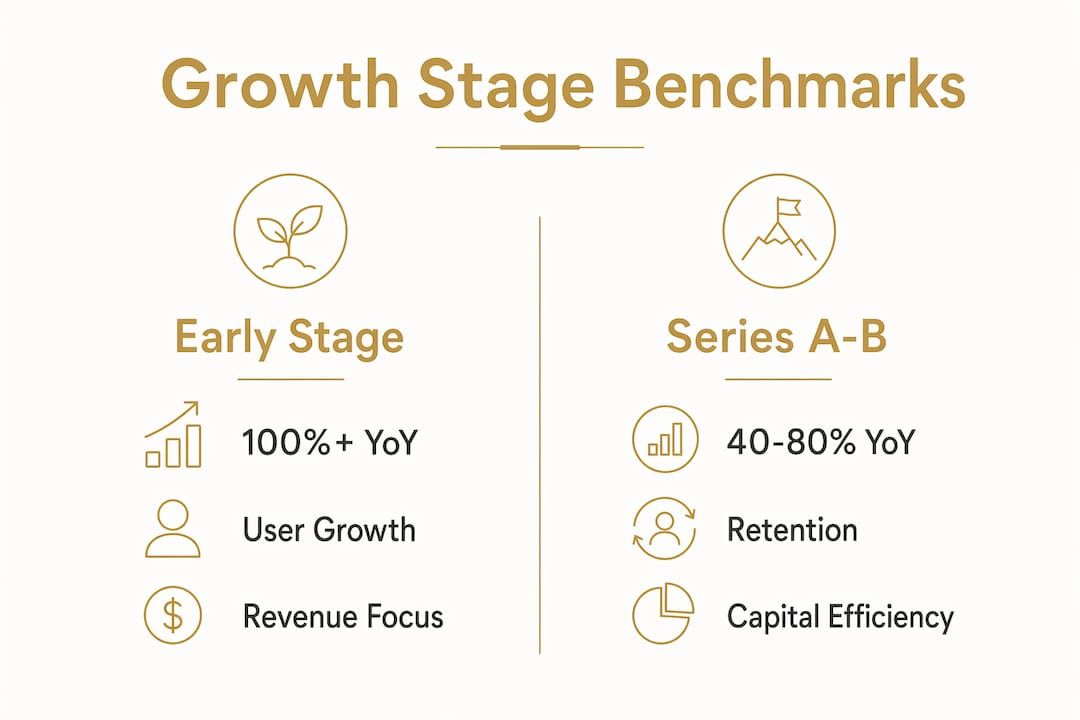
| Stage | Expected Revenue Growth | Key Metric Focus |
|---|---|---|
| Pre-Seed / Seed | 100%+ YoY | User or revenue traction |
| Series A | 80–150% YoY | Revenue growth, retention |
| Series B | 60–100% YoY | Rule of 40, unit economics |
| Growth Stage | 40–80% YoY | Margin, burn multiple, CAGR |
Pro Tip: Track both YoY growth and trailing-twelve-month (TTM) growth side by side. Divergence between the two often signals a recent inflection, either positive or negative, that a single metric would hide.
At Series A and B, growth rate dominates valuation models. Trading growth for margin at these stages misreads what investors are actually buying. They are buying the future, not the present.
What market and economic factors influence investor appeal based on growth rate?
External conditions shape how investors interpret and price growth. The same 50% revenue growth rate commands very different multiples depending on the macro environment.
Interest rates and valuation compression
Interest rates act as a direct multiplier on growth stock appeal. When rates rise, the discount rate applied to future cash flows increases. That compression hits high-growth companies hardest because their value is concentrated in distant future earnings. During tightening cycles, growth stocks have declined 60–80% from their peaks. That is not a minor correction. It is a structural repricing of risk.
Thematic concentration in 2026
Sector relevance now shapes growth rate appeal as much as the number itself. More than 70% of global startup capital in Q2 2026 flowed into AI-focused companies, up from under 50% in 2025. That concentration means an AI company growing at 40% attracts more investor interest than a non-AI company growing at the same rate. Thematic alignment amplifies perceived growth quality.
Capital availability and market liquidity
Global venture funding reached $510 billion in the first half of 2026, setting a record. High liquidity environments lower the bar for funding access, but they also raise the bar for differentiation. When capital is abundant, investors become more selective about growth quality, not less.
Key factors affecting investor appeal in any macro environment:
- Interest rate direction and its effect on discount rates
- Sector thematic relevance (AI, climate tech, health tech in 2026)
- Market liquidity and exit activity (IPO and M&A pipeline)
- Investor skepticism toward extreme multiples despite high growth
“Markets often overpay for growth. Disciplined valuation models frequently question extreme growth multiples, even when the underlying business is genuinely strong.”: Janus Henderson
That skepticism is healthy. It separates investors who understand growth from those who chase it.
What qualitative aspects enhance growth rate’s appeal to investors?
Raw growth speed gets attention. Growth quality earns conviction. Investors who write large checks want both.
-
Repeatability of the growth model. A company that grew 80% last year by running a one-time promotion has a very different risk profile than one that grew 80% through a repeatable acquisition channel. Investors probe for the mechanism behind the number. If you cannot explain the engine, the number loses credibility.
-
Unit economics and retention. High-quality growth includes stable unit economics, retention, and channel diversification. Net revenue retention above 100% tells investors that existing customers are expanding their spend. That metric alone can justify a premium multiple because it means growth compounds without proportional customer acquisition cost.
-
Channel diversification. Single-channel growth is fragile. A brand growing entirely through paid social faces platform risk, algorithm changes, and rising CPMs. Investors discount growth that depends on one channel. Diversification across organic, paid, retail, and wholesale signals durability.
-
Management transparency. Experienced investors prefer growth models that incorporate ranges, scenarios, and decision triggers over single-point forecasts. A founder who presents a base case, a downside case, and a clear explanation of what drives each scenario builds more trust than one who projects a straight line upward.
-
Avoiding false precision. Aggressive, unsupported forecasts reduce investor trust. A projection showing 200% growth with no clear explanation of the inputs signals either wishful thinking or a lack of financial rigor. Both are red flags.
Pro Tip: Build your growth model around three scenarios: base, upside, and stress. Show investors what triggers each scenario. That transparency signals operational maturity and builds the kind of trust that closes rounds.
The trade-off between growth and margin shifts by stage. Early-stage companies should protect growth at almost any reasonable cost. Later-stage companies need to show a credible path to profitability alongside growth. Knowing which trade-off applies to your stage is as important as the growth number itself. A profitability path alongside growth is increasingly expected in 2026.
How do investors apply growth rate analysis in valuation and funding decisions?
Growth rate does not just influence investor interest. It directly sets the price investors are willing to pay.
Price-to-Sales multiples and growth correlation
The relationship between growth rate and valuation multiples is direct and well-documented. Companies growing at 40% may trade at 15x sales, while companies growing at 10% trade near 3x sales. That 5x difference in multiple is entirely attributable to growth rate expectations. Valuation discipline matters here. Paying 15x sales for a company whose growth is decelerating is a fundamentally different bet than paying the same multiple for one that is accelerating.
Burn multiple and capital efficiency
Burn multiple measures how much cash a company burns to generate each dollar of new revenue. A burn multiple below 1.0x signals efficient growth. Above 2.0x signals that growth is expensive and potentially unsustainable. Investors use burn multiple alongside the Rule of 40 to assess whether growth is worth the capital cost.
Stage-dependent funding thresholds
| Stage | Growth Rate Threshold | Capital Efficiency Signal |
|---|---|---|
| Series A | 80%+ YoY | Burn multiple below 2.0x |
| Series B | 60%+ YoY | Rule of 40 score above 40 |
| Growth / Late Stage | 40%+ YoY | Rule of 40 score above 60 |
Exit and acquisition readiness
Growth rate is the first metric acquirers examine. A company growing at 50% with strong retention commands a strategic premium because the acquirer is buying future revenue, not just current revenue. Investors preparing portfolio companies for exit prioritize growth rate sustainability over short-term margin improvement for exactly this reason.
Key ways investors apply growth metrics in decisions:
- Setting valuation multiples using Price-to-Sales and growth rate correlation
- Screening deals using Rule of 40 and burn multiple thresholds
- Assessing exit readiness by projecting forward growth trajectories
- Comparing growth quality across cohorts using retention and unit economics data
A founder financial dashboard that surfaces these metrics clearly gives investors the confidence to move faster through due diligence.
Key Takeaways
Growth rate is the single most decisive metric in investor appeal because it directly sets valuation multiples, signals capital efficiency, and determines funding access at every stage.
| Point | Details |
|---|---|
| Growth rate sets valuation price | Companies growing at 40% may trade at 15x sales; 10% growers trade near 3x sales. |
| Rule of 40 is the efficiency benchmark | Scores above 60% command 2–3x higher multiples; use it at Series B and beyond. |
| Macro context shapes growth value | Rising interest rates compress growth multiples; thematic sectors like AI attract premium capital in 2026. |
| Quality beats speed alone | Retention, unit economics, and channel diversification determine whether growth is durable. |
| Transparency builds investor trust | Scenario-based forecasts with clear decision triggers close rounds faster than single-point projections. |
Growth rate is indispensable, but context is everything
The 2026 AI funding surge is a perfect example of thematic growth appeal distorting judgment. Founders are rebranding as AI companies to capture the 70% capital concentration flowing into the sector. Some of those companies are genuinely AI-driven. Many are not. Experienced investors know the difference, and they are increasingly skeptical of growth narratives that lack clear fundamentals beneath the theme.
What actually builds investor confidence is clarity in your growth model. Investors trust founders who can explain exactly what is driving growth, what would accelerate it, and what would slow it down. That kind of transparency is rarer than you think. When you bring it to a meeting, it stands out.
How Commerce Catalyst helps founders build investor-ready growth clarity
Knowing your growth rate is one thing. Presenting it with the financial depth investors expect is another.

Commerce Catalyst works with consumer brand founders to translate growth metrics into clear, investor-ready financial narratives. The DTC Financial Health Assessment identifies where your growth story is strong and where it has gaps that will slow a funding conversation. The Fractional CFO service builds the dashboards, scenario models, and reporting structures that give investors the confidence to move quickly. If you want to know what your brand is worth today and what growth rate you need to hit your target valuation, the brand valuation calculator gives you a concrete starting point. Commerce Catalyst turns financial complexity into the kind of clarity that attracts capital.
FAQ
What growth rate do investors typically look for?
Growth investors generally target companies with annual revenue growth of 20% or more, with higher rates expected at earlier stages. Series A companies are typically expected to show 80–150% YoY growth.
What is the Rule of 40 and why do investors use it?
The Rule of 40 requires that a company’s revenue growth rate plus free cash flow margin exceed 40%. Companies scoring above 60% command 2–3x higher valuation multiples, making it a standard benchmark at Series B and beyond.
How do interest rates affect growth rate investor appeal?
Rising interest rates increase discount rates applied to future earnings, compressing growth stock valuations. During tightening cycles, growth stocks have declined 60–80% from their peaks, making rate direction a critical factor in growth investing decisions.
What makes growth rate high quality in investor eyes?
High-quality growth combines strong retention, stable unit economics, and channel diversification. Investors also prioritize repeatability and transparent scenario-based forecasting over aggressive single-point projections.
How does growth rate affect acquisition and exit valuation?
Acquirers use growth rate as the primary input for exit multiples. A company with strong, sustained growth commands a strategic premium because the acquirer is pricing future revenue, not just current performance.
Recommended
- Why a Profitability Path Attracts Investors in 2026 | Commerce Catalyst
- 7 Signs Your Business Is Investment-Ready in 2026 | Commerce Catalyst
- Top 3 therevgrowthadvisors.com Alternatives 2026 | Commerce Catalyst
- Supplements & Wellness Brand Benchmarks 2026: CAC, Margins, LTV, Profitability | Commerce Catalyst