Exit strategy planning is the process of preparing a business for sale, succession, or transfer in a way that protects its value and ensures a smooth ownership transition. The role of exit strategy planning goes far beyond picking a buyer. It shapes how you run your company today so it commands the best price tomorrow. About 75% of business owners plan to exit within 10 years, yet only 20–30% succeed in selling. That gap exists because most owners treat exit planning as a final step rather than an ongoing discipline built into how they operate.
What are the key components of an effective exit strategy?
A written exit plan is the foundation of any successful ownership transition. Documenting your plan transforms vague intentions into accountable timelines and dollar-quantified value drivers with clear owners. Without that document, you are making decisions in the dark.
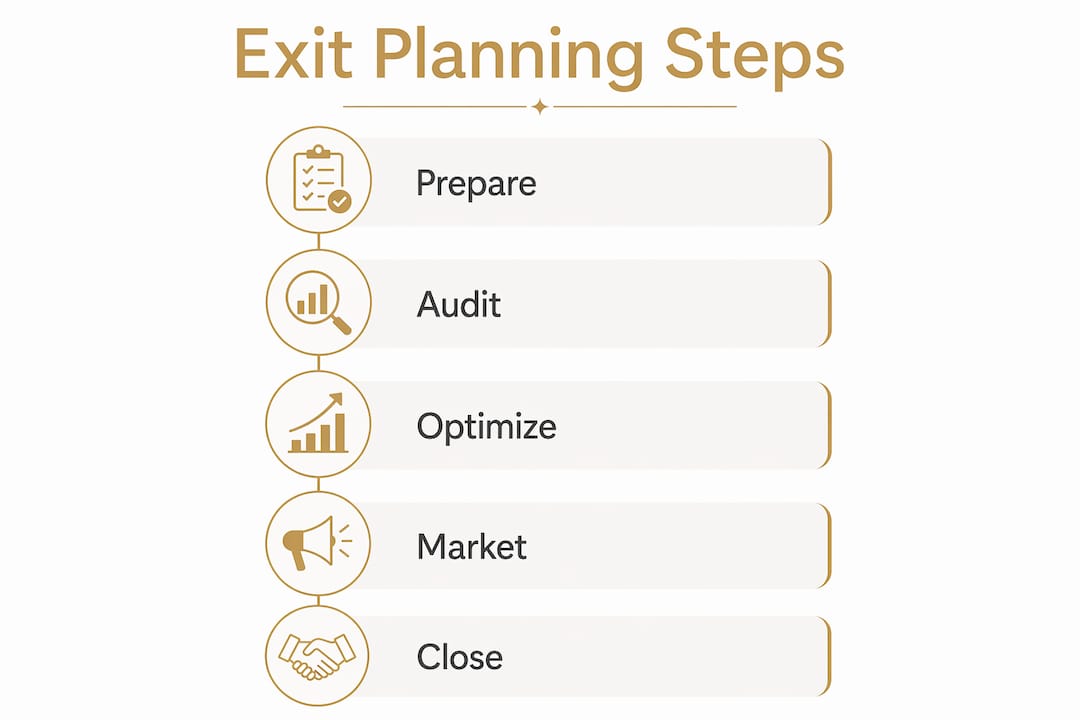
Industry standards recommend a 12–36 month preparation timeline before going to market. That window breaks into distinct phases, each with specific deliverables.
- Pre-process preparation (months 1–12). Clean up your financials, resolve any entity structuring issues, and commission a Quality of Earnings (QofE) audit. A QofE audit is an independent review of your revenue and profit figures that buyers and their lenders rely on. Skipping this step is the single fastest way to kill a deal in due diligence.
- Transaction readiness (months 6–12 before launch). Prepare your data room, finalize legal documents, and complete financial verification. Transaction readiness prevents deal failure caused by financial discovery issues that surface at the wrong moment.
- Market launch and negotiation. Engage your M&A advisor, run a structured process, and negotiate terms with qualified buyers.
- Post-close transition. Define your role after the sale, whether that is a short consulting period or a full handover, and document it in the purchase agreement.
Your advisory team matters as much as your timeline. You need an M&A advisor to run the sale process, a tax advisor to structure the deal efficiently, a transaction attorney to protect your interests, and a wealth manager to plan what happens to the proceeds.
Pro Tip: Start your QofE audit at least 18 months before your target sale date. Buyers discount valuations when they find financial surprises. Removing those surprises before the process starts puts you in control of the narrative.

| Phase | Key Activity | Typical Timing |
|---|---|---|
| Pre-process preparation | Financial cleanup, QofE audit, entity structuring | 12–24 months before sale |
| Transaction readiness | Data room, legal docs, financial verification | 6–12 months before launch |
| Market launch | Buyer outreach, negotiations, LOI | 3–6 months |
| Post-close transition | Handover, consulting period, earnout | 0–24 months after close |
How does exit planning increase company value and attract buyers?
A formal exit strategy creates a self-sustaining operation that is less dependent on the founder. That shift directly improves your valuation multiple and broadens the pool of buyers willing to pay a premium. A business that falls apart when the owner steps back is worth far less than one that runs without them.
The practical work of building that independence includes:
- Delegating leadership. Promote or hire managers who own key functions. Buyers pay more when a capable team is already in place.
- Documenting processes. Write down how your business actually operates. Standard operating procedures reduce perceived risk for any acquirer.
- Diversifying revenue. A business with one large customer or one product line carries concentration risk. Buyers price that risk into their offers.
- Removing founder dependency. Your name, relationships, and institutional knowledge should live in the company, not just in your head.
Successful founders treat the business as an asset, delegate leadership early, and remove what advisors call “key-man risk.” Key-man risk is the danger that the business loses significant value if one person, usually the founder, leaves. Eliminating it attracts strategic buyers who are willing to pay higher multiples. You can use the DTC Brand Valuation Calculator to get a baseline sense of where your business stands today.
Pro Tip: Run your business for 90 days as if you were already gone. Track every decision that required your personal involvement. Each one is a value leak you need to fix before going to market.
Early planning also strengthens resilience and attractiveness even when the exit is years away. A company built to be sold is also a company built to scale, attract talent, and weather downturns.
What practical steps should you take to develop your exit strategy?
Exit strategy steps work best when they follow a clear sequence. Skipping ahead creates gaps that surface at the worst possible time.
- Clarify your exit vision. Decide what a successful exit looks like for you. Define your target timeline, minimum acceptable price, and preferred buyer type, whether that is a strategic acquirer, private equity, or a management buyout.
- Assess your current state. Use a tool like the exit readiness scorecard to identify gaps in your financials, operations, and leadership team. You cannot fix what you have not measured.
- Set value enhancement projects. List the specific initiatives that will increase your valuation. Assign an owner, a deadline, and a dollar estimate for each one. This turns your exit plan into a project plan.
- Engage your advisory team early. Bring in your M&A advisor, tax counsel, and transaction attorney before you need them. Their input shapes decisions you are making right now.
- Build your contingency plan. Developing two parallel exit plans, one for a planned voluntary exit and one for an involuntary event like death or disability, protects the business and your family. Most owners skip this step entirely.
- Review and adjust quarterly. Market conditions change. Your personal goals change. A plan that sits in a drawer is not a plan. Schedule a quarterly review with your advisory team to keep it current.
Decisions made today directly impact your available exit options and tax implications later. Treating exit planning as a live document rather than a one-time exercise is what separates owners who close great deals from those who leave money on the table.
What challenges do business owners face during exit planning?
Exit planning surfaces personal and operational challenges that most owners do not anticipate. Recognizing them early gives you time to address them before they affect your outcome.
- Identity tied to the business. Founders struggle with the shift from hands-on operator to strategic investor. This is not a soft issue. It affects whether you can delegate effectively, which directly affects your valuation.
- Balancing current operations with preparation. Exit planning requires time and attention that competes with running the business. Owners who treat it as a side project consistently under-prepare.
- Overlooking contingency scenarios. Most plans address a clean, planned sale. Few address what happens if the owner becomes incapacitated or dies. A contingency exit plan protects business continuity for sudden involuntary events and prevents forced liquidation at a fraction of fair value.
- Waiting too long to start. Exit timing can matter more than operational performance in determining valuation and sale success. Entering a down market without preparation is a costly mistake.
“Exit planning is not about leaving your business. It is about building a business worth leaving. The owners who plan early do not just get better offers. They build better companies along the way.”
The solution to most of these challenges is the same: start earlier than feels necessary and treat the plan as a living part of your business strategy, not a separate project you will get to someday.
Key Takeaways
Effective exit strategy planning requires a documented plan, a structured timeline, and a business that operates independently of its founder.
| Point | Details |
|---|---|
| Start early | Begin exit preparation 12–36 months before your target sale date to avoid rushed decisions. |
| Document everything | A written plan converts intentions into accountable timelines, owners, and measurable value drivers. |
| Remove founder dependency | Delegate leadership and document processes so the business runs without you. |
| Build a contingency plan | Plan for involuntary exits like death or disability to prevent forced liquidation. |
| Assemble your advisory team | Engage M&A, tax, legal, and wealth advisors before you need them, not during the process. |
How Commerce Catalyst supports your exit preparation
Knowing what to do and having the financial clarity to do it are two different things. Commerce Catalyst works directly with consumer brand founders to close that gap before they go to market.

A financial health assessment identifies the specific profitability gaps and financial risks that reduce your valuation. From there, Commerce Catalyst’s fractional CFO services give you the financial leadership to fix those gaps without the cost of a full-time hire. For founders who are closer to a transaction, the exit advisory service provides hands-on guidance through every stage of preparation and sale. These are not generic consulting engagements. They are built around the specific pressures consumer brand founders face when preparing for a successful exit.
FAQ
What is the role of exit strategy planning for business owners?
Exit strategy planning prepares a business for sale, succession, or transfer by aligning current operations with future ownership transition goals. It protects company value, reduces founder dependency, and gives owners control over timing and terms.
When should a business owner start planning their exit?
Industry standards recommend starting 12–36 months before your target exit date, with financial cleanup and QofE audits beginning at least 18 months out. Starting earlier gives you time to fix value gaps before buyers find them.
What are the most common exit strategy examples for small businesses?
The most common options are a sale to a strategic acquirer, a private equity buyout, a management buyout, and a family succession transfer. Each has different tax implications and preparation requirements.
How does exit planning increase business value?
Exit planning increases value by creating a self-sustaining operation that does not depend on the founder. Documented processes, a capable leadership team, and clean financials all reduce buyer risk and support higher valuation multiples.
What happens if a business owner does not have an exit plan?
Without a plan, owners face rushed decisions, reduced valuations, and limited buyer options. In involuntary exit scenarios like death or disability, the absence of a contingency plan can force a liquidation at a fraction of the business’s fair market value.