A capital allocation strategy is the set of rules you use to decide where each dollar goes: inventory, marketing, hires, debt paydown, cash reserves or your own pocket. For a consumer brand doing $3M to $50M, the strategy that works is simple to state and hard to hold: fund liquidity first, then only the investments that clear a return hurdle, and review the whole list on a fixed schedule. Most founders skip the hurdle, because spending more on a growing brand feels like the obvious answer. At Commerce Catalyst we work with founders on exactly this problem, and our DTC Operator Diagnostic is a $197 one-off way to see where your constraints sit before you commit the next dollar.
TL;DR
- Capital allocation is the distribution and reinvestment of your financial resources to maximize returns, and HBS Online notes that poor decisions can stall growth.
- Order of operations: secure liquidity, set a hurdle rate, rank projects against it, then fund them.
- Treat reinvestment as an investment decision, not a default. Ask what each extra dollar of spend returns.
- Review quarterly and move money out of anything that misses its projected return.
- Founders at $3M to $50M can get a faster read from a diagnostic than from building the model alone.
Table of Contents
- What a capital allocation strategy actually decides
- Why reinvestment is the decision founders get wrong
- A capital allocation framework in six steps
- Comparing the options side by side
- Allocation versus reallocation
- Examples: what good and poor allocation look like
- When high spending is good and when it is not
- Allocating when investors are in the picture
- Where we help
- Our perspective
- FAQ
- Sources
What a capital allocation strategy actually decides
The academic definition is broad: the distribution, redistribution and investment of financial resources to maximize returns, a decision that sits with the CEO and CFO and shapes long-term success, according to HBS Online. Done well, it improves efficiency and compounds value. Done badly, it lowers returns and stalls growth.
In a public company the menu is capital expenditures, acquisitions, dividends and buybacks. In a founder-led consumer brand the menu is different and more constrained. Your real choices usually look like this:
- Working capital: inventory purchases, deposits to manufacturers, payment terms.
- Customer acquisition: paid media, creative, retention programs.
- Capacity: headcount, a 3PL (third-party logistics provider that stores and ships your product), systems.
- New products, channels or retail doors.
- Debt repayment or avoiding new debt.
- Cash reserves.
- Owner distributions or a secondary sale.
Every one of these competes for the same limited cash. The strategy is the rulebook for who wins.
Why reinvestment is the decision founders get wrong
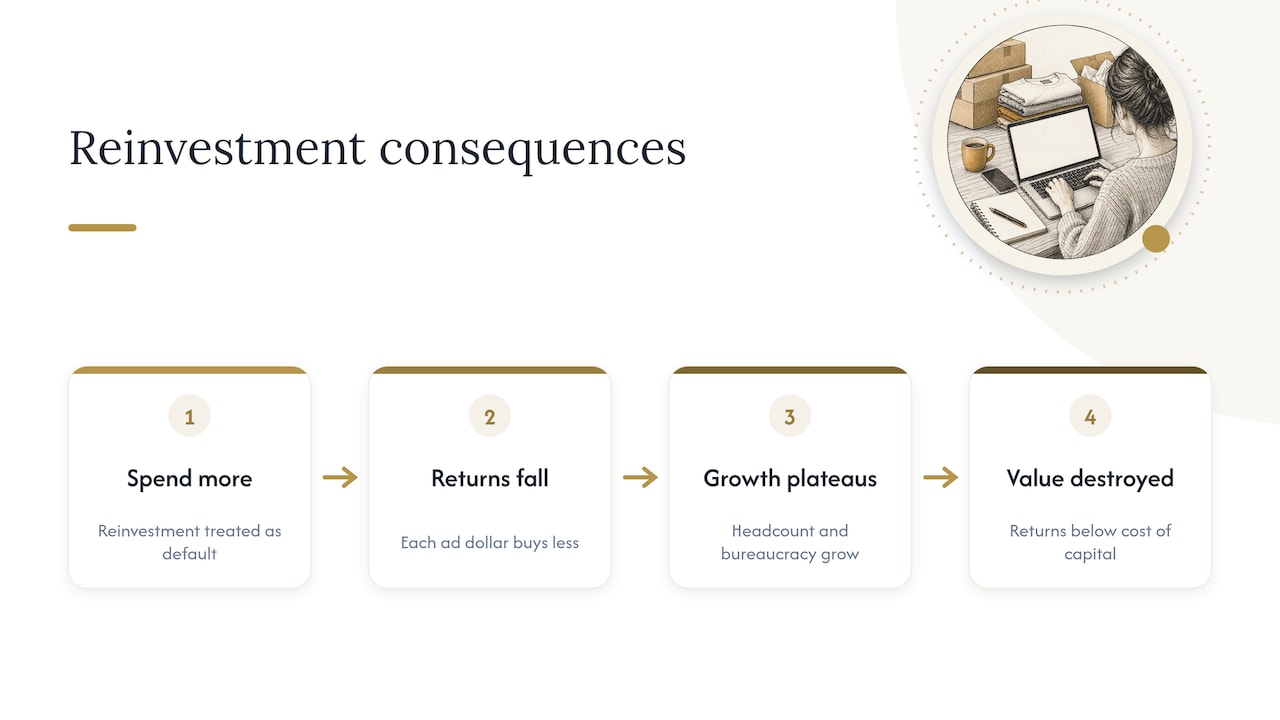
Consumer brands show this pattern early. Ad spend scales, the blended return on it drops, and the next dollar buys less than the last one. Revenue still rises, so the dashboard looks healthy. Cash tells a different story.
Investor Bill Miller makes the underlying point in a Forbes interview: value is created when a company earns above its cost of capital and reinvests at returns above that cost. Reinvesting below it destroys value however fast the top line moves.
The question is not whether to spend. It is what the marginal dollar returns, compared with the next best use of it.
A capital allocation framework in six steps
Published frameworks agree on the sequence: assess available capital, identify opportunities and their fit with strategy, evaluate returns and risk, prioritize, then execute and monitor, as Intuit’s guide lays out. Here is how that sequence translates for a consumer brand.
1. Start with strategy and two or three scenarios
Allocation follows a goal. Are you building toward profitability, an investor round, or an exit? A practical CFO guide recommends building two to four planning scenarios, including a base case and a downside. For a brand, the downside is usually a weaker repeat rate, a late holiday, or a retailer pushing payment out. Decide what you would cut first in that case before you need to.
2. Quantify the capital you actually have
The same guide splits available capital into three sources: surplus cash, maintainable free cash flow, and new debt or equity. The word that matters is maintainable. A strong quarter driven by a one-time pre-order or a stretched payables cycle is not free cash flow you can plan around.
3. Secure liquidity first
Before growth, fund the floor: payroll, inventory commitments, tax obligations and debt service for the downside scenario. Cash trouble is where brands lose the ability to choose. Our cash flow guide for consumer brands covers the mistakes we see founders make here.
4. Set a hurdle rate
A hurdle rate is the minimum return a project must offer to get funded. The CFA Institute explains the two standard tests: net present value (NPV) estimates the increase in firm value from a project, and internal rate of return (IRR) estimates its rate of return to compare against that hurdle.
For a founder, a workable version is a payback window and a contribution margin floor. For example, “a new channel must return its spend in contribution margin within six months, or it does not get a second budget.” The exact numbers are yours to set. What counts is that they are written down before the request arrives.
5. Model cash flows honestly
The CFA Institute notes that projects should be modeled on after-tax cash flows, avoid double counting, and include effects on the rest of the business: cost savings on one side, lost sales from existing products on the other. A new SKU that cannibalizes your bestseller has a smaller return than its own sales suggest.
6. Rank, fund, and make every project compete
One framework advocate, Stratex, argues for zero-based budgeting: nothing carries forward by default, and each initiative competes on its own merits, scored on urgency, strategic alignment, expected benefit and implementation risk. Last year’s budget is not evidence. We go deeper on this in our piece on zero-based budgeting for founders.
Comparing the options side by side
| Use of cash | What to ask | Typical trap |
|---|---|---|
| Inventory | Turns, cash tied up, sell-through of the last buy | Buying to hit a supplier minimum, not demand |
| Paid acquisition | Marginal return on the next dollar, payback | Judging on blended averages |
| Hires and systems | Does it remove a constraint or add overhead? | Hiring ahead of a plateau |
| Debt paydown | Interest cost versus return elsewhere | Paying down while starving a high-return use |
| Reserves | Months of downside-case runway | Holding far more than the floor requires |
| Owner distributions | Does the business still clear its floor after? | Taking cash before liquidity is secured |
HBS Online points out that excess cash can be used to pay off debt, improving the debt-to-equity ratio and business health. That is a legitimate use. It simply has to beat the alternatives on your own ranked list.
Allocation versus reallocation
Allocation is the initial distribution of funds based on expected returns and fit. Reallocation redirects funds away from underperformers toward better opportunities. Intuit recommends quarterly reviews that compare projected and actual returns.
This is where most small brand frameworks fail. The plan exists, but nobody checks it. A quarterly meeting with one page works: each funded project, its projected return, its actual return, and a decision to keep, cut or move. Stopping spend that is not working is often the highest-return move available, particularly when growth spend stops paying back and the next dollar earns less than the last.
Examples: what good and poor allocation look like
The best-known cases are large public companies, but the logic transfers.
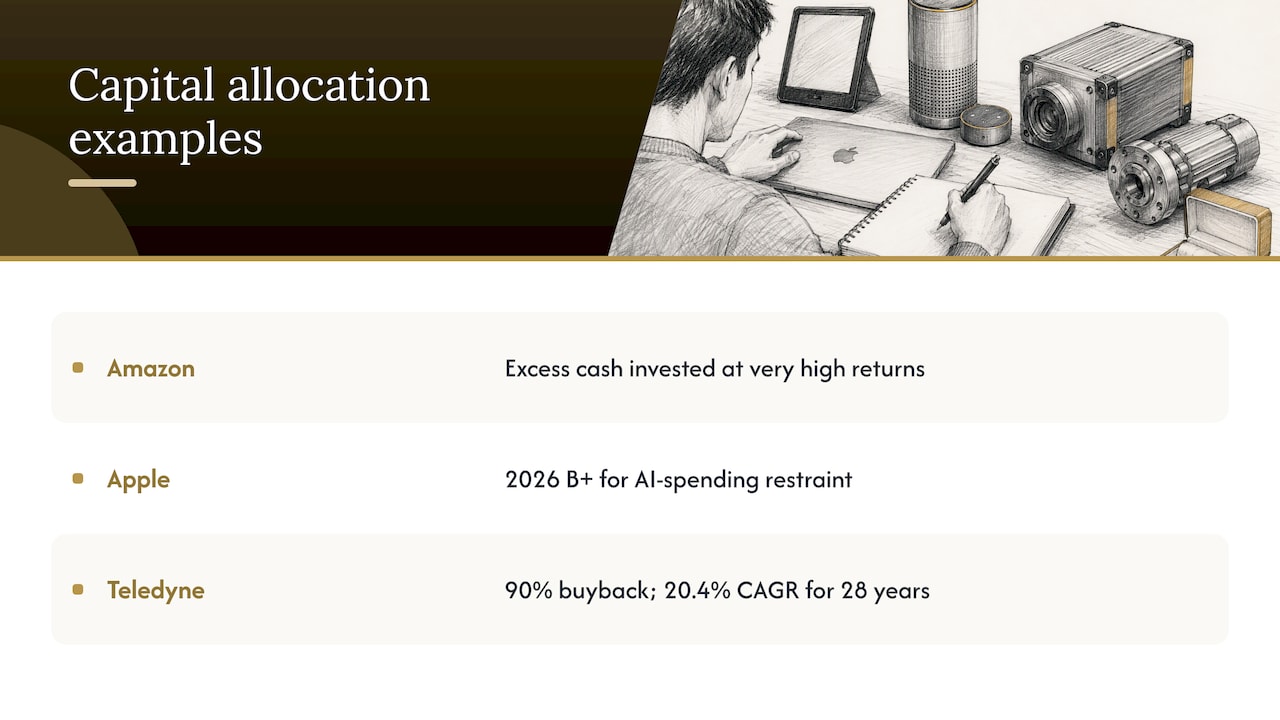
Amazon. Miller describes Jeff Bezos taking excess cash and investing it at very high returns on capital, and notes that Amazon’s stock tracked growth in gross profit dollars far more closely than GAAP earnings. Accounting profit understated the value being created because R&D is expensed.
Apple. In the same interview, Miller says Apple’s allocation improved once it stopped hoarding cash, when nearly half its market value was sitting in cash. In 2026, NYU’s Aswath Damodaran graded Apple a B+ for restraint in AI spending, leaving it debt-free and cash-rich.
Teledyne. Per Commoncog, Sam Singleton bought back 90% of Teledyne’s stock when other uses of cash were weak, producing a 20.4% compound annual return for shareholders over 28 years. The lesson is that returning capital is a valid choice when reinvestment cannot clear the hurdle.
The common thread across three very different companies is a willingness to say no to spending that does not earn its keep. An academic comparison of Apple, Amazon and Walmart for fiscal 2017 found very different margins and ROIC across the three, which shows that profit margin alone does not tell you whether capital is being used well.
When high spending is good and when it is not
Founders often ask whether heavy investment is good or bad. A study of 24,030 firm-year observations from 2006 to 2015 found that higher capital expenditure was associated with better next-year earnings for profitable firms and worse earnings for loss-making ones. The size of the spend matters less than the position you spend from. A brand with healthy contribution margin can usually put investment to work. A brand already losing money on each order needs to fix unit economics first.
Allocating when investors are in the picture
Investors read your allocation history as a signal of judgment. They want to see a stated hurdle, evidence you cut what failed, and a use-of-funds plan tied to returns. If a raise is on your horizon, our guides on positioning your brand for strategic investment and the signs a business is investment-ready show what that conversation looks like. Different investor types also weigh priorities differently, as we outline in our guide to brand investor types.
Where we help
The hard part of allocation is not the formula. It is seeing your own numbers clearly enough to apply it. The DTC Operator Diagnostic is a $197 one-off that identifies your operating constraints, so you know which dollars are working. If you want to pressure-test a specific decision, the Founder Hour is $500 per hour. For deeper work, our Financial Health Assessment and 90-Day Profit Sprint are built for consumer brands.
Start at commercecatalyst.ai.
Our perspective
We see the same shape in founder conversations: revenue climbs, spend climbs with it, and nobody has defined what return would justify the next increase. The fix is not a more elaborate model. It is a short list of constraints, a hurdle you will honor, and the discipline to review it.
That is why our work starts with diagnosis. Once you know the one or two constraints that actually limit cash and profit, allocation gets simpler, and the decisions that matter stand out from the ones that only feel urgent. Our approach is hands-on and founder-to-founder, and our Profitable Growth work is built to turn that clarity into prioritized decisions and implementation support.
FAQ
What is the difference between a capital allocation strategy and a budget?
A budget lists planned spending by category. A capital allocation strategy sets the rules for ranking competing uses of cash, including a hurdle rate and a review cadence. The strategy decides what earns a budget line in the first place.
How often should a consumer brand review capital allocation decisions?
Quarterly is a sound default, comparing projected returns with actual returns for each funded project, as Intuit’s guide recommends. Brands with heavy seasonality may add a pre-peak review before inventory commitments.
What metrics should a founder use to compare projects?
NPV and IRR compare projects against a hurdle rate, while return on invested capital shows how well the whole business turns capital into profit, according to the CFA Institute. In practice, add payback period and contribution margin, which are easier to track monthly.
Should I pay down debt or reinvest?
Compare both against your hurdle rate after liquidity is secured. If debt service is draining your downside-case cash, paying it down can be the stronger move. If a project clears the hurdle comfortably, it can take priority.
Sources
- The Importance of Proper Capital Allocation | HBS Online
- Building a Valuable Business? It’s How You Spend It | Commoncog
- Investing Legend Bill Miller On Apple, Amazon, And Tesla | Forbes
- Capital allocation framework and best practices | Intuit
- Your Practical Guide to Capital Allocation
- Capital Investments and Capital Allocation | CFA Institute
- A Guide to Effective Capital Allocation for Capital Projects | Stratex
- 9 trillion-dollar stocks | BNN Bloomberg
- A Value Perspective: The Case of Warren Buffett and His Investments
- Do Capital Expenditures Influence Earnings Performance? | ResearchGate
- BabyLoveGrowth
Recommended