Profit is defined as the accounting measure of revenue minus expenses. Cash flow is the actual money moving in and out of your bank account. These two numbers almost never match, and that gap is exactly why profit doesn’t equal cash. The core reason is accrual accounting, a standard method that records revenue when it’s earned and expenses when they’re incurred, regardless of when cash actually changes hands. Accounts receivable, inventory purchases, and debt repayments all drive this divide. For business owners, confusing the two is one of the most common and costly financial blind spots.
Why profit doesn’t equal cash: the accrual accounting explanation
Accrual accounting records revenue when earned and expenses when incurred, not when cash moves. That single principle is the root cause of the profit vs cash flow gap. Your income statement can show a healthy profit while your bank account sits empty.
Here is how the mechanics play out in practice:
- Revenue recognition before cash collection. You ship $50,000 worth of product to a retailer. Your income statement records $50,000 in revenue immediately. But if that retailer pays on net-60 terms, you won’t see that cash for two months.
- Expenses recorded before payment. You accrue a $10,000 marketing bill in december. It hits your profit calculation now, but you pay it in january. Your cash balance doesn’t move until the check clears.
- Accounts receivable timing. Every dollar sitting in accounts receivable is profit you’ve recognized but cash you haven’t collected. A growing receivables balance is a warning sign, not a success story.
- Inventory and capital expenditures. Inventory purchases tie up cash but don’t immediately reduce profit. The matching principle delays the expense until the inventory sells. Meanwhile, your cash is gone.
Pro Tip: Review your accounts receivable aging report every two weeks. If invoices older than 45 days are growing as a percentage of total receivables, your cash position is deteriorating even if your profit looks fine.
The gap between accounting profit vs cash is not a flaw in your business. It’s a structural feature of how financial statements work. The problem arises when founders treat profit as a proxy for cash availability.
Common scenarios where profit and cash tell different stories
Real businesses run into this mismatch constantly. Understanding the specific situations helps you spot the risk before it becomes a crisis.

1. Delayed customer payments. A business can show profit on paper but struggle with liquidity due to timing differences in collections and payments. A consumer brand selling through wholesale channels often waits 60 to 90 days for payment. During that window, the brand has already paid for production, shipping, and marketing. Profit is recorded. Cash is not there.
2. Large inventory builds. Seasonal brands face this acutely. Buying $200,000 in inventory for a holiday season drains cash immediately. The profit from those sales won’t appear until the goods move. If sales are slower than projected, cash stays locked in unsold stock for months.
3. Tax liabilities and prepaid expenses. Tax payments and prepaid expenses create timing differences between reported profit and available cash. You may owe quarterly estimated taxes based on a profitable quarter, but paying that bill pulls cash out of the business right when you need it for operations.
4. Owner draws and debt repayments. Owner distributions are cash outflows unrelated to profit calculation but they reduce liquidity directly. The same applies to loan principal payments. Paying down a $5,000 monthly loan principal doesn’t touch your income statement, but it absolutely empties your bank account.
5. Capital expenditures. Buying equipment or investing in technology reduces cash immediately. Depreciation spreads that cost across years on the income statement. Your profit looks better than your cash position actually is.
These scenarios compound each other. A founder who builds inventory, extends payment terms to win a big wholesale account, takes an owner draw, and makes a loan payment in the same month can face a serious cash shortfall despite reporting a profitable quarter. This is a common founder financial blind spot that Commerce Catalyst works to address directly.
How do cash flow and profit metrics differ in practice?
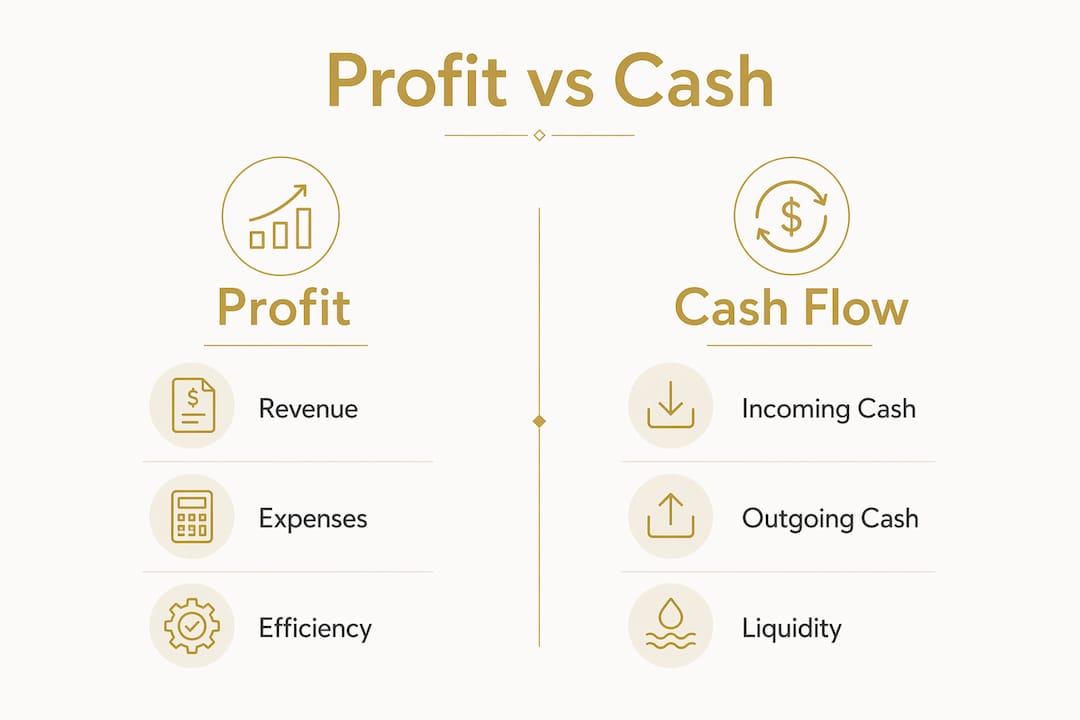
Profit and cash flow measure fundamentally different things. Profit measures efficiency. Cash flow measures survival.
| Metric | What it measures | Why it matters |
|---|---|---|
| Gross profit | Revenue minus cost of goods sold | Shows product margin health |
| Net profit | Revenue minus all expenses | Measures overall accounting performance |
| Operating cash flow | Cash generated from core business operations | Shows if the business funds itself |
| Free cash flow | Operating cash flow minus capital expenditures | Measures true financial flexibility |
| Financing cash flow | Cash from loans, equity, and owner draws | Reveals funding and distribution activity |
Cash flow categorizes into operating, investing, and financing activities, each affecting cash differently than profit. Free cash flow after expenses and capital expenditures is the most critical number for assessing real business health. A company with strong net profit but negative free cash flow is burning through reserves or relying on debt to stay operational.
Positive profit with negative operating cash flow is a specific red flag. It means the business is growing its receivables or inventory faster than it’s collecting cash. This pattern is common in scaling consumer brands that win new accounts before their working capital can support the growth.
Pro Tip: Pull your cash flow statement alongside your income statement every month. If net profit is rising but operating cash flow is flat or declining, your working capital is under pressure. Address it before it becomes a liquidity crisis.
Viewing profit and cash flow as two sides of the same coin helps business owners make informed, balanced decisions that protect liquidity and drive growth. Neither metric alone tells the full story.
Practical strategies to close the gap between profit and cash
Managing the difference between profitability and liquidity requires deliberate systems, not just better bookkeeping.
- Build a 13-week cash flow forecast. A rolling 13-week forecast shows you exactly when cash will be tight before it happens. Map every expected inflow and outflow by week. Update it every Monday. This single habit prevents most cash crises.
- Tighten your accounts receivable process. Efficient collections improve liquidity even when profit margins stay constant. Send invoices the day goods ship. Follow up on day 15, day 30, and day 45. Offer a 1% to 2% early payment discount for large accounts. The discount costs less than a line of credit.
- Negotiate accounts payable terms. Extend payment terms with suppliers wherever possible. Paying in 45 days instead of 30 keeps cash in your account longer. This doesn’t change your profit, but it directly improves your cash position.
- Manage inventory with discipline. Set reorder points based on actual sales velocity, not optimistic projections. Excess inventory is cash sitting on a shelf. A profitability roadmap for your brand should include inventory turnover targets alongside margin goals.
- Separate owner draws from business cash flow. Pay yourself a fixed salary and treat it as a business expense. Avoid taking draws based on profit figures. Your draw should reflect what the business cash flow can actually support, not what the income statement shows.
- Review both reports monthly, together. Your income statement and cash flow statement answer different questions. Profit tells you if the business model works. Cash flow tells you if the business survives. Looking at one without the other is like driving with one eye closed.
Understanding how to choose between growth and profitability becomes much clearer once you track both metrics consistently. Growth that destroys cash is not sustainable growth.
Key Takeaways
Profit and cash flow are distinct metrics, and managing both together is the only way to build a business that is both profitable and financially stable.
| Point | Details |
|---|---|
| Accrual accounting drives the gap | Revenue and expenses are recorded when earned or incurred, not when cash moves. |
| Receivables and inventory are cash traps | Unpaid invoices and inventory builds reduce cash without reducing reported profit. |
| Free cash flow reveals true health | Operating cash flow minus capital expenditures shows actual financial flexibility. |
| Owner draws and debt payments matter | These reduce cash but never appear as expenses on the income statement. |
| Forecast cash, not just profit | A 13-week rolling cash forecast prevents liquidity crises before they start. |
The metric that actually keeps the lights on
The practical shift is simple but not easy. Stop checking your bank balance and calling it financial management. Pull your cash flow statement every month. Build a forecast. Know your receivables aging. Know your inventory days on hand. These numbers tell you what’s actually happening in the business, not what the accounting says happened.
When profit and cash don’t add up, Commerce Catalyst can help
Running a consumer brand means making financial decisions with incomplete information. If your income statement looks healthy but your bank account tells a different story, that gap needs a diagnosis, not a guess.

Commerce Catalyst offers a DTC Financial Health Assessment that identifies exactly where cash is leaking relative to your profit. The assessment maps your working capital cycle, flags receivables and inventory risks, and gives you a clear picture of where profitability and liquidity diverge. For founders who need ongoing support, the Fractional CFO service provides expert financial oversight without the cost of a full-time hire. Both services are built for consumer brand founders who need real answers, not generic financial advice.
FAQ
Why does a profitable business run out of cash?
A profitable business runs out of cash when revenue is recognized before it’s collected, or when cash is tied up in inventory and capital purchases. Profit is an accounting measure; cash is what’s actually in the bank.
What is the difference between profit and cash flow?
Profit measures revenue minus expenses on an accrual basis. Cash flow measures the actual money received and paid during a period. The two differ because of timing gaps created by accounts receivable, accounts payable, and inventory.
How does accrual accounting affect cash flow?
Accrual accounting records transactions when they occur, not when cash moves. This means a sale is counted as revenue before the customer pays, creating a gap between reported profit and actual cash available.
What is free cash flow and why does it matter?
Free cash flow is operating cash flow minus capital expenditures. It measures how much cash a business actually generates after maintaining and investing in its operations, making it the clearest indicator of financial health.
How can I improve cash flow without changing my profit margin?
Tightening accounts receivable collections, extending supplier payment terms, and reducing excess inventory all improve cash flow without affecting profit margins. Efficient working capital management is the most direct path to better liquidity.