
Profitability improvement is defined as a continuous, data-driven process of improving net profit by balancing pricing, cost control, and resource allocation across every part of a business. Unlike chasing a single revenue spike, it targets sustainable margin improvement through structured financial and operational analysis. Tools like TrueProfit and practices led by FP&A teams or outsourced CFOs make this process measurable and repeatable. Manufacturing firms typically achieve 2–5% net margin improvements through structured oversight alone. That number understates the opportunity for consumer brands, where margin leakage is often hiding in plain sight.
What is profitability improvement and what metrics drive it?
Profitability improvement is the practice of identifying where a business earns and loses money at a granular level, then making deliberate decisions to improve the net result. The industry term most financial leaders use is profit improvement, and it sits at the intersection of financial analysis and operational execution. Three ratios form the foundation of any serious effort.
Gross profit margin measures revenue minus the direct cost of goods sold. Operating profit margin adds in overhead and operating expenses. Net profit margin captures everything, including taxes, interest, and one-time costs. Tracking all three reveals where margin erodes between the top line and the bottom line.

Profitability analysis goes deeper than these ratios. It breaks performance down by product, customer segment, and sales channel. A brand selling through both direct-to-consumer and wholesale, for example, may find that one channel generates 60% of revenue but only 20% of net profit. Aggregated P&L statements hide these critical insights, which is why granular tracking matters.
Direct costs like materials and fulfillment are easy to assign. Indirect costs, including customer service labor, software subscriptions, and warehouse overhead, are harder to allocate but equally important. FP&A teams and outsourced CFOs enforce this cost discipline by building allocation models that assign every dollar of expense to the revenue it supports.
Pro Tip: Start your profitability analysis at the SKU or product category level before moving to customer segments. Fixing one underperforming product line often reveals a pattern across the entire catalog.
How does profitability improvement differ from profit maximization?
Profit maximization focuses on short-term revenue or margin spikes, often through aggressive pricing, deep discounting, or rapid cost-cutting. Profitability improvement takes a longer view. It balances revenue growth, pricing discipline, and cost management to produce margins that hold up over time.
Aggressive cost-cutting often harms long-term growth and service quality. A brand that slashes its customer support team to save $200,000 may lose $800,000 in lifetime value from churned customers within 18 months. That is profit maximization logic producing a net loss outcome.
The distinction also shows up in how each approach treats customer and product mix. Profit maximization chases volume. Profitability improvement prioritizes high-margin customers and products based on net contribution, even if that means serving fewer customers or carrying a tighter product range.
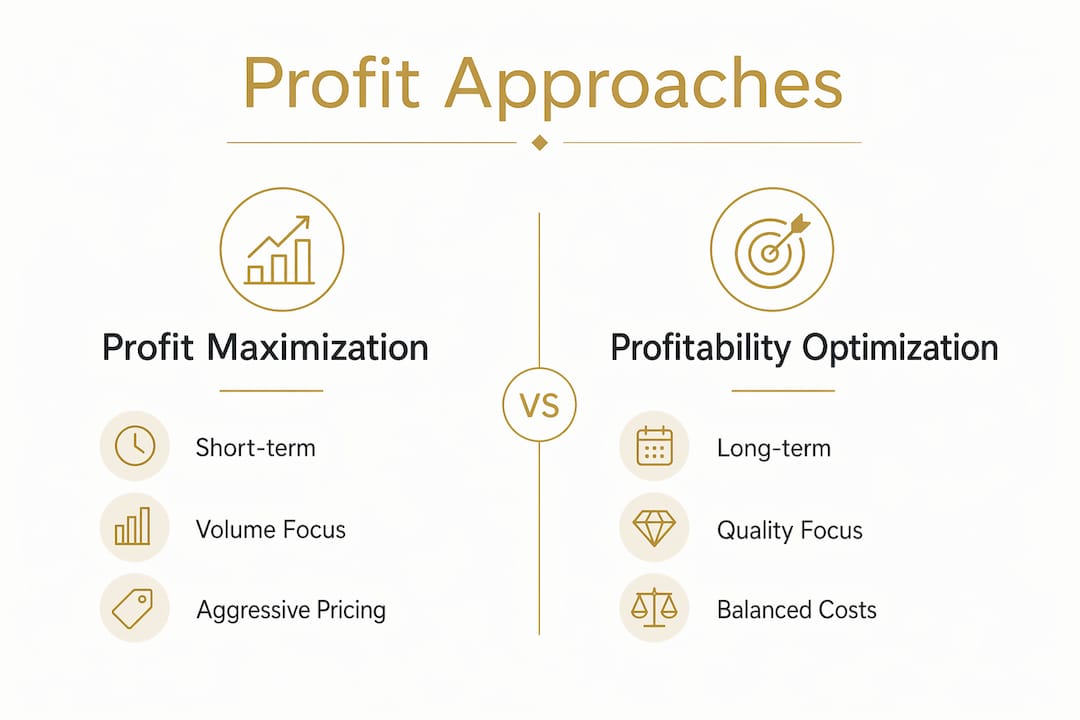
| Characteristic | Profit maximization | Profitability improvement |
|---|---|---|
| Time horizon | Short-term | Long-term |
| Primary lever | Revenue or cost spikes | Balanced pricing, cost, and mix |
| Risk profile | High: quality and growth suffer | Lower: sustainable margin improvement |
| Decision basis | Volume and top-line growth | Net contribution per product or customer |
| Outcome | Margin spikes followed by erosion | Steady, compounding margin improvement |
The table above shows why founders who choose between growth and profitability often frame it as a binary. It is not. improvement is the framework that lets you pursue both without sacrificing one for the other.
What strategies actually improve profit margins?
Business profit improvement does not require a larger budget. Profit gains most often come from improving operational efficiency rather than adding capital expenditure. The following framework gives founders a structured starting point.
- Audit your true unit economics. Calculate the fully loaded cost per unit sold, including ad spend, shipping, returns, and payment processing. Most founders undercount by 15–25% because they exclude variable indirect costs.
- Rank products and customers by net contribution. Sort every SKU and customer segment from highest to lowest net margin. The bottom 20% often consumes a disproportionate share of operational resources.
- Adjust pricing on underperforming segments. Price increases of 5–10% on low-margin products frequently have minimal impact on volume but a significant impact on gross profit.
- Reduce margin leakage in fulfillment and returns. Packaging improvement, carrier rate negotiation, and return rate reduction are three areas where founders consistently find recoverable margin.
- Automate repetitive financial processes. Automation and refined onboarding reduce churn and improve margins by freeing up team capacity for higher-value work.
- Reallocate ad spend toward profitable channels. If one acquisition channel delivers customers with a 40% higher lifetime value, shifting budget there improves both revenue quality and net margin.
The DTC turnaround playbook shows how one brand cut $3M in costs without gutting growth by following a structured version of this process. The key was identifying which costs were supporting profitable revenue and which were subsidizing unprofitable volume.
Pro Tip: Never cut costs before you know which costs are tied to your most profitable customers. Blind cuts often eliminate the infrastructure that retains your best buyers.
Maximizing profit potential also means protecting revenue quality. Over-discounting trains customers to wait for sales, compresses margins permanently, and attracts price-sensitive buyers who churn at the first competitive offer. Pricing discipline is a profit strategy, not just a revenue strategy.
How do tools and financial leadership sustain margin improvement?
Technology and experienced financial leadership are what separate a one-time profit improvement from a sustained one. TrueProfit, for example, automates real-time net profit tracking by product, channel, and period. It pulls in ad spend, shipping costs, and returns to give founders a live view of true profitability rather than a lagging monthly P&L.
Outsourced CFOs and dedicated FP&A teams add the human layer. Operational improvements can yield EBITDA increases of 4–10% in manufacturing firms when financial leadership enforces cost discipline and margin management consistently. For ecommerce brands, the same principle applies: a fractional CFO who reviews margin by channel every week catches problems that a quarterly review misses entirely.
The most effective financial performance setups combine both. Dashboards and KPI tracking give real-time signals. Financial leaders interpret those signals and translate them into decisions. Neither works as well alone.
Key capabilities to build or buy for sustained profit margin enhancement:
- Real-time P&L by product and channel: Know which SKUs are profitable today, not last quarter.
- Cost allocation models: Assign indirect costs accurately so no product appears more profitable than it is.
- Trend analysis and benchmarking: Compare margins against industry benchmarks to identify where you are underperforming relative to peers.
- Scenario modeling: Test the margin impact of a price change, a new supplier, or a channel shift before committing resources.
Integrating operational data with financial data enables accurate profit tracking at the SKU, channel, or region level. Without that integration, founders make pricing and investment decisions based on incomplete information and wonder why margins do not improve despite growing revenue.
A clear profitability roadmap ties these tools and leadership inputs together into a plan with milestones, owners, and measurable targets. That structure is what converts financial insight into actual margin improvement.
Key Takeaways
Profitability improvement is a structured, ongoing process that improves net margins by combining granular financial analysis, pricing discipline, and operational efficiency across every part of the business.
| Point | Details |
|---|---|
| Definition is precise | Profitability improvement targets net profit improvement through pricing, cost control, and resource allocation. |
| Metrics must be granular | Track gross, operating, and net margins by product, customer, and channel, not just at the company level. |
| improvement beats maximization | Long-term margin discipline outperforms short-term revenue or cost spikes every time. |
| Tools accelerate results | Platforms like TrueProfit and outsourced CFO support turn financial data into repeatable margin decisions. |
| Efficiency before spending | Most profit gains come from fixing existing processes, not adding headcount or capital. |
What founders get wrong about profit management
The third mistake is organizational. Founders often keep financial data siloed in accounting while operators make decisions based on gut feel. When your marketing team does not know the true margin on the products they are promoting, they will improve for revenue and inadvertently destroy profit. Alignment across teams, grounded in shared financial data, is what makes improvement stick.
The financial blind spots that hurt founders most are not exotic. They are the basics done inconsistently: incomplete cost allocation, no channel-level P&L, and pricing decisions made without margin data. Fix those three things and most brands see meaningful improvement within a quarter.
How Commerce Catalyst helps brands build lasting profit margins
Profitability challenges rarely have a single cause. They are usually the result of several compounding issues: incomplete cost data, misaligned pricing, and no clear view of which products or customers are actually driving net profit.

Commerce Catalyst works directly with consumer brand founders to cut through that complexity. The DTC Financial Health Assessment identifies exactly where margin is leaking and what to fix first. For brands that need ongoing financial leadership, the fractional CFO service provides the expertise to execute a full profit improvement plan without the cost of a full-time hire. If you want to start with a self-assessment, the unit economics calculator gives you an immediate read on your CAC, LTV, and payback period.
FAQ
What is profitability improvement in simple terms?
Profitability improvement is the process of improving a business’s net profit by analyzing costs, pricing, and resource allocation at a detailed level. It focuses on sustainable margin improvement rather than short-term revenue spikes.
How is profitability improvement different from profit maximization?
Profit maximization chases short-term revenue or margin gains, often at the expense of quality or long-term growth. Profitability improvement takes a balanced, long-term approach that protects margins while sustaining business health.
What metrics should I track for profitability analysis?
Track gross profit margin, operating profit margin, and net profit margin, broken down by product, customer segment, and sales channel. Aggregated totals hide the margin differences that drive real decisions.
Can a business improve profitability without increasing revenue?
Yes. Profitability improvements most often come from operational efficiency gains, better cost allocation, and pricing adjustments rather than revenue growth alone.
How do tools like TrueProfit support profit margin enhancement?
TrueProfit automates real-time net profit tracking by product and channel, incorporating ad spend, shipping, and returns. That live data lets founders scale profitable products and cut loss-making ones before problems compound.