
Unit economics measures whether you make or lose money on a single customer, order, or transaction, before overhead. Get this wrong and every growth decision on top of it is built on sand. The terms that matter most: LTV (lifetime value), CAC (customer acquisition cost), LTV:CAC ratio, CAC payback period, gross margin, and churn. The benchmark most operators use is a 3:1 LTV:CAC ratio, with payback under 12 to 18 months. Founders running lean should push for payback under 6 to 12 months.
- LTV: what a customer is worth in margin dollars over their lifetime
- CAC: fully loaded cost to acquire one customer
- LTV:CAC: the ratio that tells you if growth is profitable
- Payback period: how fast you recover acquisition spend in cash
- Gross margin: the input that makes LTV honest
- Churn: the leak that quietly erodes everything above it
The math is not complicated. The discipline to calculate it correctly, and act on what it tells you, is where most founders fall short.
Key Takeaways
Unit economics works when founders use gross-margin-adjusted LTV, fully loaded channel-level CAC, and monthly cohort tracking instead of blended annual snapshots.
| Point | Details |
|---|---|
| Use margin, not revenue | Gross-margin-adjusted LTV is the only version that reflects true customer value. |
| Calculate CAC by channel | Blended CAC hides which acquisition source is actually profitable. |
| Watch payback, not just ratio | A strong LTV:CAC with 18-month payback can still drain cash reserves. |
| Track cohorts monthly | Cohort curves reveal retention decay that blended metrics bury. |
| Get a structured diagnostic | Commerce Catalyst’s Financial Health Assessment and Unit Economics Calculator help founders fix inputs before scaling spend. |
Table of Contents
- The Core Unit Economics Terms Founders Need to Define
- How to Calculate Unit Economics: Formulas and a Worked Example
- Common Mistakes That Distort Unit Economics
- Which Lever to Prioritize by Revenue Stage
- Building a Monthly Unit Economics Dashboard
- A One-Hour Unit Economics Checklist
- Why Standardized Terms Change How Founders Make Decisions
- Getting Hands-On Help With Your Unit Economics
- Frequently Asked Questions
- Sources
The Core Unit Economics Terms Founders Need to Define
Every one of these terms exists to answer a single question: does this customer relationship make you money, and how fast? Here’s what each one actually means, and the decision it should drive.
Lifetime value (LTV) is the gross-margin-adjusted profit you expect from a customer over the life of the relationship. Note the word “margin,” not “revenue.” A $500 customer on 20% gross margin is worth $100, not $500. Confusing the two is the single most common distortion in early-stage financial models, and it makes every downstream number look better than reality.
Customer acquisition cost (CAC) is what you spend, fully loaded, to acquire one paying customer. That means ad spend, yes, but also agency fees, sales salaries, commissions, tools, and creative production. Calculate CAC by channel whenever you can. A blended CAC across paid social, email, and organic hides which channel is actually profitable and which one is quietly bleeding you.

LTV:CAC ratio divides the two. A 3:1 ratio is the widely cited threshold for sustainable growth, meaning every dollar spent on acquisition returns three dollars in margin over time. Below 3:1, you are likely underpricing growth risk. Above 5:1 or 6:1, you may be under investing in acquisition and leaving growth on the table. The ratio is a signal, not a scorecard. It should inform whether you push harder on a channel or pull back.
CAC payback period tells you how many months it takes to recoup acquisition cost from gross margin dollars. This is often the more urgent number for bootstrapped founders, because it measures cash timing, not eventual profitability. A business can have excellent LTV:CAC and still run out of cash if payback stretches past 18 months.
A few supporting terms round out the picture:
- ARPA/ARPU: average revenue per account or user, the base input for LTV
- Contribution margin: revenue minus variable costs per unit, the number that actually funds fixed costs and growth
- Cohort vs. blended metrics: cohort tracks one acquisition group over time; blended averages everyone together and hides deterioration
- Gross revenue retention (GRR): the percentage of revenue kept without expansion, caps at 100%
- Net revenue retention (NRR): GRR plus upsells and expansion, which is why NRR can exceed 100% and become a growth engine on its own
Pro Tip: If you only fix one input this quarter, fix CAC allocation. Founders routinely undercount it by excluding salaries and tools, which inflates LTV:CAC and creates false confidence right before a fundraising round.
How to Calculate Unit Economics: Formulas and a Worked Example
The formulas are not the hard part. Getting consistent inputs is.
- ARPA = Total revenue ÷ number of active accounts
- Gross-margin-adjusted LTV = ARPA × gross margin % × average customer lifespan (in months or years)
- CAC = Total fully loaded acquisition spend ÷ new customers acquired in that period
- LTV:CAC = LTV ÷ CAC
- CAC payback period = CAC ÷ (monthly contribution margin per customer)
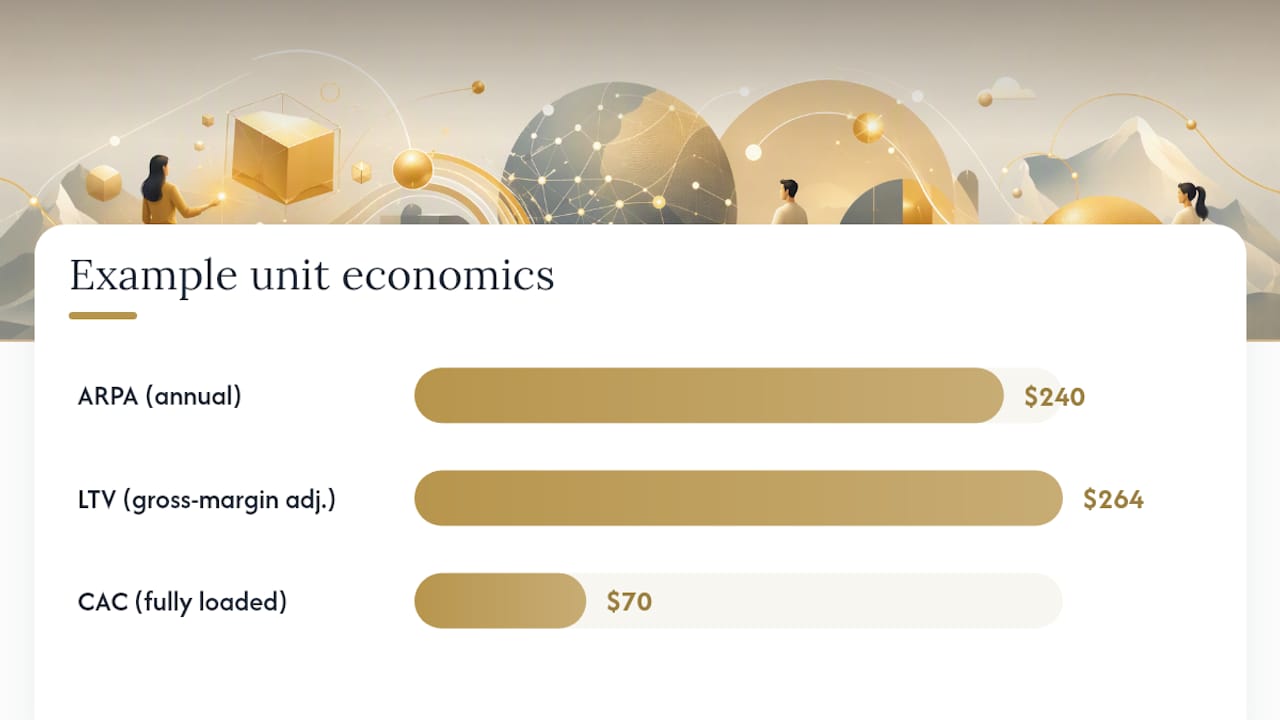
Here’s a worked example for a direct-to-consumer brand:
| Input | Value |
|---|---|
| ARPA (annual) | $240 |
| Gross margin | 54% |
| Average customer lifespan | 2 years |
| CAC (fully loaded) | $70 |
| Monthly contribution margin | $11 |
LTV = $240 × 0.55 × 2 = $264. LTV:CAC = $264 ÷ $70 = 3.77, comfortably above the 3:1 threshold. Payback = $70 ÷ $11 = roughly 6.4 months, well inside the 12 to 18 month guidance and strong even by bootstrapped standards.
The two most common ways founders break this: using revenue instead of margin in step 2, and forgetting agency fees or salaries in step 3. Both errors inflate the ratio and mask a weaker business than the spreadsheet shows.
Common Mistakes That Distort Unit Economics
Most bad unit-economics decisions trace back to one of these five errors:
- Blended CAC instead of channel or cohort CAC: averages hide which channel is actually working
- Revenue-only LTV: skipping the gross margin adjustment overstates customer value
- Ignoring cohort deterioration: a shrinking retention curve in later cohorts signals a real problem, and blended metrics bury it
- Treating LTV:CAC as a fundraising slide only: it should be a monthly operating input, not a once-a-year exercise
- Chasing LTV:CAC while ignoring payback: a great ratio with an 18-month payback can still starve you of cash before the value materializes
Fix the inputs before you fix the strategy. A strategy built on bad numbers just fails more efficiently.
Which Lever to Prioritize by Revenue Stage
The right fix depends on where you are, not what looks impressive on a slide.
- Pre-revenue to early revenue: Define your unit clearly and calculate contribution margin per unit before anything else. If you don’t know what one unit costs to serve, nothing downstream is trustworthy.
- $1M to $10M ARR: Prioritize reducing churn and lifting gross revenue retention. Losing customers faster than you acquire them makes every other lever irrelevant.
- $10M to $50M ARR: Shift focus to margin expansion and scalable acquisition channels. This is where fully loaded CAC discipline pays off most.
- At scale: Small margin gains and NRR improvements compound across a large customer base, often outperforming new acquisition spend for the same effort.
Pro Tip: Don’t skip stages. A founder chasing NRR gains at $2M ARR while ignoring basic churn is improving the wrong variable for where they actually stand.
Building a Monthly Unit Economics Dashboard
Unit economics rot fast if nobody checks them. Track these monthly: MRR or ARR, ARPA, gross margin, cohort retention by acquisition month, CAC by channel, and payback period by channel. Quarterly, step back and look at trend direction across cohorts rather than single-month noise.
For investor decks or internal reviews, cohort retention curves paired with channel-level CAC payback tables tend to be the most diagnostic and most persuasive artifacts you can present. A single blended LTV:CAC number rarely survives scrutiny; a cohort curve tells the real story.
The founders who scale sustainably are the ones who treat unit economics like a monthly habit, not a fundraising exercise they dust off twice a year.
Commerce Catalyst built its DTC Unit Economics Calculator specifically because most spreadsheets fall apart the moment inputs get inconsistent between team members.
A One-Hour Unit Economics Checklist
- Define your unit: customer, order, or subscription, and stay consistent
- Recalculate LTV using gross margin, not revenue
- Compute CAC by channel, including salaries and tools
- Calculate payback period per channel
- Identify one lever to test this quarter: margin, retention, or CAC
- Assign an owner and a monthly review cadence
- Pause scaling spend on any channel missing the 3:1 or payback thresholds
Why Standardized Terms Change How Founders Make Decisions
Most founders don’t have a math problem. They have a vocabulary problem. When “LTV” means margin-adjusted value to one team member and gross revenue to another, every meeting about acquisition spend becomes an argument about definitions instead of a decision about dollars.
In diagnostics, the fastest unlock is often just forcing everyone onto the same definitions before touching strategy. Once a founder can see cohort curves and channel payback side by side, the next move usually becomes obvious. Run the checklist above for one cohort this quarter. Pick the weakest lever, test a fix for 30 to 90 days, and measure it against the same definitions you started with.
Getting Hands-On Help With Your Unit Economics
Running the checklist above tells you where the problem lives. Fixing it, especially fully loaded CAC allocation or cohort segmentation, often takes an outside eye who has done this across dozens of consumer brands. Commerce Catalyst built its services around exactly that gap: the DTC Financial Health Assessment audits your margin, CAC, and payback inputs and hands you a prioritized fix list instead of a generic report.

For founders who need more than a one-time audit, the DTC Operator Diagnostic digs into the operational constraints behind weak unit economics, and the Fractional COO engagement provides ongoing support implementing the fixes. If your numbers are directionally fine and you just need pricing input on the margin side, Kinetic Pricing’s blog is a useful complement. If your CAC payback is stretching past 18 months or your cohorts are deteriorating and you cannot pinpoint why, that’s the signal to bring in help rather than keep iterating solo. Start with the Financial Health Assessment to get a clear read on where your constraint actually lives.
Frequently Asked Questions
What is the most important unit economics term for a new founder to learn first? Gross-margin-adjusted LTV. It forces you to separate real customer value from top-line revenue, which prevents every other calculation downstream from being misleading.
Is a 3:1 LTV:CAC ratio always the right target? It’s a widely used benchmark, but payback period often matters more for cash-constrained founders. A 3:1 ratio with 20-month payback can still create a cash crunch a strong ratio alone won’t warn you about.
How often should founders recalculate CAC payback period? Monthly, broken out by channel. Quarterly reviews are useful for spotting trends, but monthly tracking catches a deteriorating channel before it compounds into a bigger cash problem.
Does NRR matter for non-subscription consumer brands? Less directly, but the underlying principle, expansion revenue reducing reliance on new acquisition, still applies through repeat purchase rate and average order value growth over time.
Sources
- Unit Economics Calculator and Interpretation Guide | Ultimate Guide For Startups | 2026 EDITION
- Unit Economics Explained: LTV, CAC & the 3:1 Ratio (2026 Guide)