
For US-based DTC founders evaluating rmwcommerce.com alternatives, the clearest recommendation is a finance-first advisor with founder-side experience, and Commerce Catalyst is the strongest pick in that category. If your primary need is a platform migration, ERP integration, or technical storefront build, a platform-specialist agency or systems integrator will serve you better. But if margin pressure, cash flow, or scaling decisions are what’s keeping you up at night, the DTC Operator Diagnostic from Chris Wichert is the logical first move. Request a scoping call, bring your top three P&L concerns, and you’ll have a prioritized view of your constraints within weeks.
Table of Contents
- What are the best rmwcommerce.com alternatives by advisory type?
- How do you choose the right alternative for your ecommerce business?
- What does a typical engagement look like in terms of deliverables and cost?
- How does Commerce Catalyst compare, and who is it built for?
- What proof and trust signals should you look for in any advisory firm?
- Key Takeaways
- Why a finance-first advisor changes the decisions you make
- What happens when you reach out to Commerce Catalyst
- Useful sources and further reading
What are the best rmwcommerce.com alternatives by advisory type?
The table below maps the five most viable alternative categories across the dimensions that matter most to a $5M–$75M consumer brand founder.
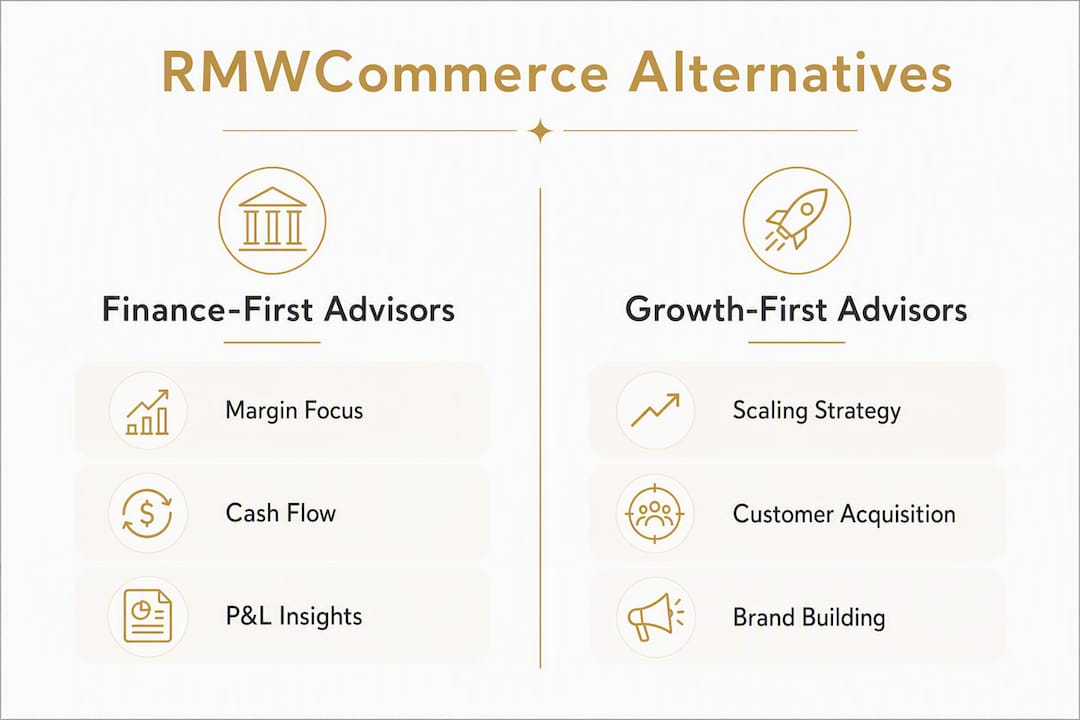
| Advisory type | Best for / ideal client | Core services | Engagement model | Typical revenue band | Pricing signals | Timeline & primary KPIs |
|---|---|---|---|---|---|---|
| Finance-first advisor | Founders with margin, cash flow, or unit economics problems | Financial diagnostics, profitability audits, founder advisory | One-time diagnostic, hourly, retainer | $5M–$75M | Hourly advisory or scoped project | 2–8 weeks; gross margin, CAC payback, LTV:CAC |
| Platform-specialist agency | Brands needing Shopify, Magento, or NetSuite migrations | Platform builds, migrations, integrations | Project-based | $5M–$75M | Mid-to-high project fees | weeks; storefront uptime, conversion rate |
| Systems integrator | Brands with complex ERP, CRM, or 3PL connections | Salesforce, NetSuite, ERP/CRM integration | Project or retainer | $5M–$75M | High project fees | weeks; order accuracy, fulfillment speed |
| Boutique strategy firm | Founders seeking go-to-market or channel strategy | Market positioning, channel mix, pricing strategy | Retainer or scoped project | $5M–$75M | Mid-range retainer | weeks; revenue growth, channel contribution |
| Fractional COO/retainer | Operators needing embedded leadership without a full-time hire | Operational oversight, team management, vendor negotiation | Monthly retainer or fractional | $5M–$75M | Monthly retainer | Ongoing; EBITDA, fulfillment cost, team throughput |
A few trade-offs worth naming directly:
- Speed vs. depth. Agencies that bundle development with digital marketing can shorten time-to-impact for traffic-driven gains, but they rarely surface the margin and cash-flow opportunities a finance-first diagnostic uncovers.
- Technical vs. strategic. Platform specialists and systems integrators solve infrastructure problems. They are not built to tell you whether your unit economics can support the infrastructure you’re about to buy.
- Cost shape. Hourly advisory rates in the ecommerce consultancy space can range from $25 to $150 per hour depending on scope and seniority, per agency directory data. Scoped projects and retainers carry a different cost structure entirely.
- Founder fit. A finance-first advisor with operator experience produces faster, more pragmatic recommendations than a generalist strategy firm staffed primarily with junior analysts.
How do you choose the right alternative for your ecommerce business?
Prioritize fit by revenue band, outcome focus, and the seniority of the team that will actually work your account. Those three filters eliminate most poor fits before you ever get on a discovery call.
Selection criteria to apply first:
- Revenue band alignment: does the firm regularly work with businesses at your scale?
- Domain experience: have they solved your specific problem (margin compression, platform migration, operational bottleneck) before?
- Demonstrable outcomes: can they show before-and-after KPIs, not just project descriptions?
- Team seniority: mid-market clients consistently get better results from firms that assign experienced operators, not junior project managers
- Reporting cadence: do they commit to a defined cadence with specific KPIs, or is reporting ad hoc?
- Integration experience: if you have a complex tech stack, does the firm have hands-on experience with your platforms?
Questions to ask during discovery calls:
- Who will lead my account day-to-day, and what is their operating background?
- Show me three outcomes you’ve driven for clients in my revenue band, with specific before-and-after metrics.
- What does your diagnostic process look like, and what does the deliverable actually contain?
- How do you prioritize recommendations when a client has five competing problems?
- What KPIs do you track, and how often do you report on them?
- Have you worked with brands in my category (apparel, CPG, home goods, etc.)?
- What does a typical engagement cost, and what triggers scope changes?
- Can I speak with a current or recent client at a similar revenue stage?
- What happens if the strategy isn’t working at the 60-day mark?
- Do you have experience with my specific platforms (Shopify, NetSuite, 3PL network)?
Red flags to walk away from:
- Vague deliverables with no sample to review
- Junior-only teams with no operator-level leadership on your account
- No financial modeling capability or P&L fluency
- References only from clients significantly smaller or larger than your business
- Promises tied to traffic or revenue without a clear mechanism
Pro Tip: Before signing any engagement, ask to see a sample deliverable from a comparable client. Then cross-reference the assigned team lead’s LinkedIn against the firm’s case studies. If the person leading your account wasn’t involved in the outcomes they’re selling you on, that’s a structural problem, not a minor detail.
What does a typical engagement look like in terms of deliverables and cost?

Most advisory engagements follow a clear progression: diagnostic, then strategy, then implementation support, then measurement. The firms that skip the diagnostic phase and jump straight to recommendations are usually the ones whose advice doesn’t stick.
Typical timeline milestones:
- Weeks 1–4: Diagnostic phase. P&L review, unit economics analysis, operational audit, constraint identification.
- Weeks 4–8: Strategy phase. Prioritized growth roadmap, financial model, implementation plan.
- Months 2–6: Implementation sprints. Focused execution on the strongest items from the roadmap.
- Ongoing: Measurement and iteration. Monthly KPI reviews, course corrections, reporting against targets.
Sample deliverables you should expect:
- Diagnostic report with prioritized constraints
- Financial model covering gross margin, contribution margin, and CAC payback
- Growth roadmap with sequenced priorities
- KPI dashboard tracking monthly revenue, gross margin, CAC payback, and LTV:CAC
- Implementation plan with owners, timelines, and success metrics
Pricing shapes vary significantly by provider type. Hourly advisory engagements tend to run at the lower end of the cost spectrum and suit founders who need targeted input on a specific decision. Scoped diagnostic projects carry a fixed fee and deliver a defined output. Monthly retainers or fractional CFO engagements provide ongoing leadership and typically run for three to twelve months. Fractional COO arrangements sit at the higher end of the monthly cost range and are appropriate when a brand needs embedded operational leadership, not just advice.
Reporting cadence matters as much as the deliverables themselves. Monthly revenue, gross margin, CAC payback, and LTV:CAC are the four KPIs that tell you whether an advisory engagement is actually moving the business.
How does Commerce Catalyst compare, and who is it built for?
Commerce Catalyst is a finance-first, founder-side advisory built specifically for consumer brand founders running $5M–$75M businesses. The positioning is deliberate: Chris Wichert built this practice around the problems that actually constrain growth at that revenue stage, which are almost always financial and operational before they are technical.
Core services:
- DTC Operator Diagnostic: a structured review of your P&L, unit economics, and operating constraints
- Ecommerce Profitability Audit: a financial health assessment identifying margin leaks and cash flow gaps
- 90-Day Ecommerce Growth Sprint: a short, results-focused engagement targeting the strongest items
- Fractional CFO/COO: embedded financial and operational leadership on a monthly retainer
- Founder Advisory Sessions: hourly or scoped calls for specific strategic decisions
Ideal client profile: A founder or senior leader at a consumer brand with $5M–$75M in revenue, facing margin pressure, cash flow unpredictability, or scaling decisions that require financial clarity before committing capital. Brands dealing with complex 3PL relationships, rising ad spend with unclear payback, or investor conversations that require clean unit economics are a particularly strong fit.
Engagement models:
- One-time diagnostic for founders who need a clear picture before committing to a longer engagement
- Scoped project for a defined strategic output (financial model, growth roadmap)
- Monthly retainer or fractional for ongoing leadership and accountability
- Hourly advisory for targeted input on a specific decision
Pro Tip: If you’re unsure which engagement model fits, start with the DTC Operator Diagnostic. It surfaces your top three constraints in a format you can act on immediately, and it tells you whether a longer engagement is worth the investment.
What proof and trust signals should you look for in any advisory firm?
Trust in this space comes down to three things: named methodologies, founder-level experience on the team, and measurable outcomes tied to real clients. Star ratings on agency directories are a starting point, not a conclusion.
Commerce Catalyst’s DTC Operator Diagnostic and Ecommerce Profitability Audit are named, structured methodologies with defined deliverables. That matters because it means the process is repeatable and the output is comparable across engagements.
How to verify any firm’s claims before signing:
- Request before-and-after KPIs from a comparable client engagement, not just a testimonial
- Ask for a sample diagnostic deliverable so you can assess the depth of analysis
- Check the assigned team lead’s LinkedIn to confirm operator-level experience
- Use company profile listings to verify service focus and tenure before your first call
- Ask for a contactable reference at a business in your revenue band
Key Takeaways
The clearest path to a confident decision is matching your primary constraint to the advisory type built to solve it. Finance-first advisors like Commerce Catalyst are the right fit when margin, cash flow, or unit economics are the core problem. Platform specialists and systems integrators are the right fit when the constraint is technical.
| Point | Details |
|---|---|
| Match advisory type to your constraint | Finance-first advisors solve margin and cash flow problems; platform specialists solve technical ones. |
| Verify team seniority before signing | Experienced operators deliver faster, more pragmatic recommendations than junior analysts. |
| Start with a diagnostic | A structured diagnostic surfaces your top constraints and tells you whether a longer engagement is warranted. |
| Ask for outcome-linked references | Request before-and-after KPIs from a comparable client, not just a star rating or a testimonial. |
| Commerce Catalyst for $5M–$75M brands | Commerce Catalyst’s DTC Operator Diagnostic is the recommended first step for consumer brand founders with financial or operational constraints. |
Why a finance-first advisor changes the decisions you make
The firms that produce durable outcomes at the $5M–$75M stage are the ones that start with the P&L, not the growth plan. When you understand your unit economics before you commit to a channel expansion or a platform migration, you make fundamentally different decisions. You stop improving for revenue and start improving for margin. That shift alone changes what you prioritize, what you spend, and what you say no to.
Pro Tip: Set a 90-day measurable target at the start of any advisory engagement. Require a weekly financial pulse, even a brief one. Advisory relationships that lack a defined measurement cadence drift toward activity and away from outcomes.
The distinction between strategy that looks good and strategy that moves cash and margin is almost always traceable to the depth of the financial work underneath it. A beautiful roadmap built on assumptions is a liability. A prioritized constraint list built on your actual P&L is a decision-making tool.
What happens when you reach out to Commerce Catalyst
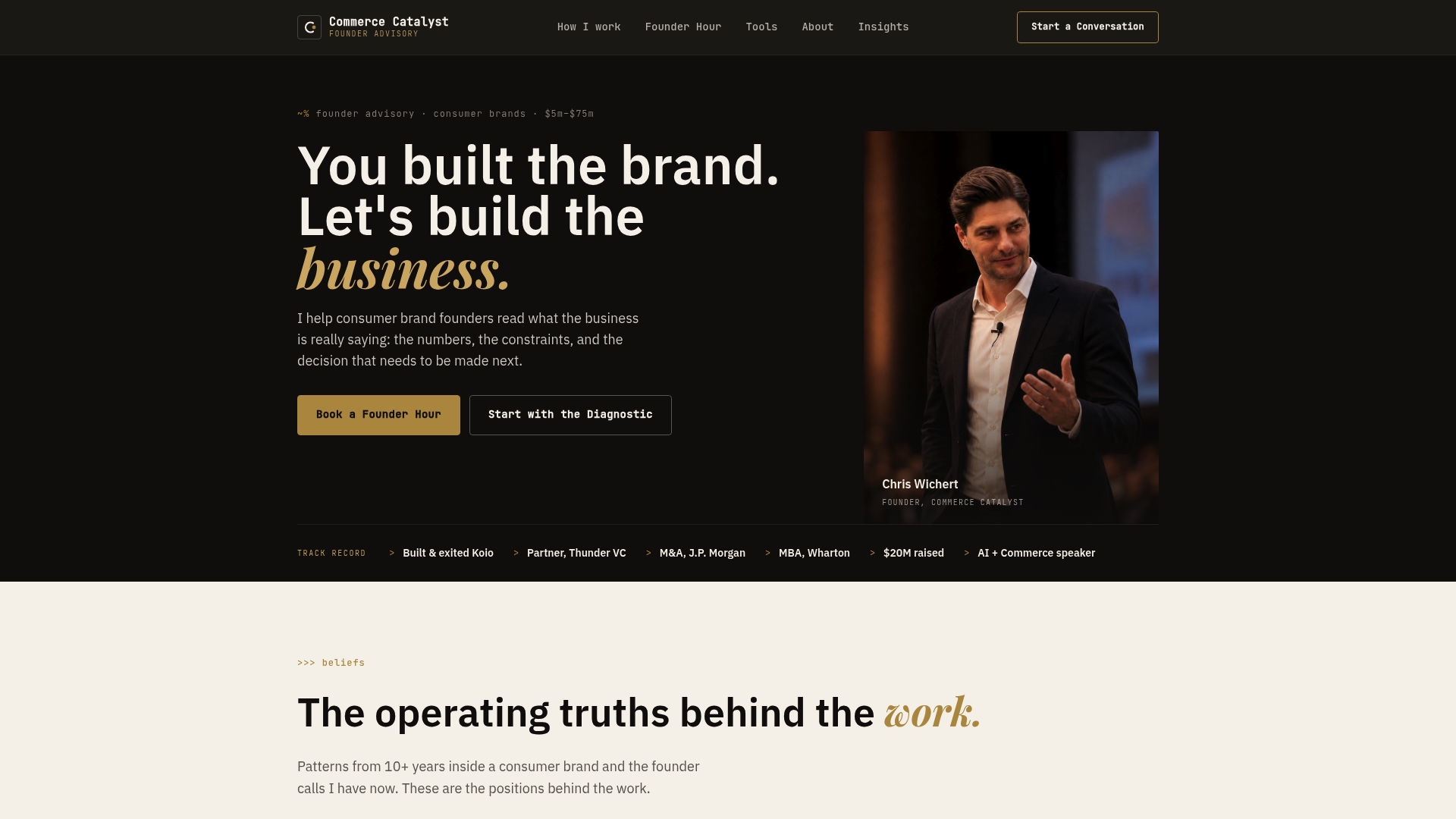
The simplest first step is the DTC Financial Health Assessment. It’s a structured entry point designed to give you a prioritized view of your financial constraints without committing to a long engagement.
After you reach out, here’s what to expect:
- A 30-minute scoping call to confirm fit and clarify your top three constraints
- Pre-call homework: bring your last three months of high-level revenue and COGS data, plus your top P&L concerns
- A proposed engagement structure with a defined deliverable, timeline, and next steps within a few days of the call
If you’re comparing advisory options for your DTC brand and want a finance-first perspective before committing to a longer engagement, the Financial Health Assessment is the lowest-friction way to get one. Book the scoping call at commercecatalyst.ai.
Useful sources and further reading
- DTC Financial Health Assessment | Commerce Catalyst: Entry-point diagnostic service for consumer brand founders seeking a prioritized financial view of their business.
- Commerce Catalyst | Main site: Overview of all advisory services, target client profile, and contact options.
- Fractional CFO for Ecommerce & DTC Brands | Commerce Catalyst: Details on ongoing fractional financial leadership for brands that need embedded expertise.
- 90-Day Ecommerce Growth Sprint | Commerce Catalyst: Short, results-focused engagement model for founders who need fast traction on a defined problem.
- 9 Best E-commerce Development Companies (G2 Learn): Third-party roundup grouping agencies by platform specialization and service strength.
- RMW Commerce Reviews | DesignRush: Agency directory profile listing RMW Commerce’s service scope and client reviews.
- RMW Commerce Reviews | Clutch: Client reviews highlighting the value of operator-level experience in mid-market ecommerce consulting.
- RMW Commerce | SelectedFirms: Pricing signals and service scope for context on hourly and project-based cost ranges.
- How to Streamline Operations for Your Consumer Brand | Commerce Catalyst: Practical operational guidance for founders working through post-advisory implementation.