Your total landed cost equals: Product cost + International freight + Insurance + Customs duties & tariffs + Customs brokerage & user fees + Domestic transport. That single formula, documented across U.S. import guides, is the number every importer needs before quoting a price or setting a margin target. To get your landed cost per unit, divide the total shipment cost by the number of units in that shipment. Open a spreadsheet now, create one column per component, and plug in your actual invoice and freight numbers. Everything below shows you exactly how.
- Product cost: supplier invoice value (FOB, EXW, or as quoted)
- International freight: ocean FCL/LCL or air, plus origin charges
- Insurance: typically 0.3–1.5% of cargo value
- Customs duties & tariffs: MFN base rate plus any Section 301/232/122 additions
- Brokerage & user fees: MPF, HMF, ISF, broker invoice
- Domestic transport: drayage, LTL/FTL from port to warehouse
Key Takeaways
Accurate landed cost calculation, not the factory invoice, is the only defensible basis for pricing imported goods and protecting gross margin.
| Point | Details |
|---|---|
| Use the full formula | Product cost + freight + insurance + duties + brokerage/fees + domestic transport = total landed cost per shipment. |
| Tariff stacking changes everything | MFN base rate plus Section 301 additions can push effective duty rates to 31% or higher on China-origin goods. |
| Reconcile after every shipment | Match actual freight, duty, and broker invoices to your estimate; investigate variances above 5%. |
| Model per SKU, not per shipment | Allocate every cost component per unit so pricing decisions reflect true per-unit economics. |
| Commerce Catalyst maps landed cost to margins | The DTC Financial Health Assessment connects your landed-cost model to pricing, COGS, and profitability decisions. |
Table of Contents
- What does “landed cost” mean for U.S. importers?
- Breaking down every landed cost component
- How to calculate landed cost step by step
- Two worked examples: ocean FCL and air/small parcel
- U.S.-specific duties, fees, and where to check official rates
- Which tools help you estimate landed cost accurately?
- How to model and audit landed cost across SKUs
- Common landed-cost mistakes and how to lower your total
- The cost of not knowing your numbers
- What Commerce Catalyst does for import-heavy brands
- Sources
What does “landed cost” mean for U.S. importers?
Landed cost is the all-in cost of getting a product from your supplier’s door to your warehouse door in the United States. It is not the factory price. It is not the FOB price on the commercial invoice. It is every dollar you spend to own that unit, ready to sell or fulfill.
The distinction matters because many importers underprice products by using the factory invoice instead of landed cost, and in the current tariff environment, duties and freight can add a significant percentage of the original product cost for certain categories. Pricing off the wrong number is not a rounding error; it is a structural margin problem.
Incoterms determine which costs you must include. The four terms you will encounter most often:
- EXW (Ex Works): you pay everything from the supplier’s factory gate forward, including origin trucking, export clearance, ocean/air freight, insurance, and all U.S. import costs. Your landed-cost model must include every line item.
- FOB (Free On Board): the supplier covers origin trucking and export clearance; you take responsibility from the moment goods are loaded on the vessel. Your model starts at ocean freight.
- CIF (Cost, Insurance & Freight): the supplier pays freight and insurance to the destination port; you cover U.S. import duties, brokerage, and domestic transport. Verify the supplier’s insurance coverage before relying on it.
- DDP (Delivered Duty Paid): the supplier handles everything, including duties. Your “landed cost” is essentially the DDP invoice price, but you lose visibility into the component breakdown.
The actual landed cost lands closer to $14.10 per unit, not $10. That gap is where margin disappears.
Landed cost also differs from COGS. Landed cost is a per-unit all-in number; COGS is the accounting-period figure built from the landed cost of units sold. Use landed cost for pricing decisions and COGS for financial reporting.
Breaking down every landed cost component
Understanding each component individually is what separates a defensible model from a rough guess. Here is how each one works in practice, with the ranges you should use when building your initial estimate.
Product cost
This is your supplier invoice value, typically stated in the currency of the purchase order. For customs purposes, U.S. Customs and Border Protection (CBP) uses transaction value as the basis for calculating duties, which is generally the price actually paid or payable for the goods. Currency conversion to USD happens at the CBP-published exchange rate for the week of importation, not your bank rate.
International freight
Ocean freight on Asia–U.S. lanes for a 40-foot FCL container runs roughly $2,500–$6,000 in 2026, though rates are volatile. Air freight for standard cargo commonly runs within a range of typical rates per kilogram. Origin charges (origin trucking, export documentation, terminal handling) add $200–$600 per container and are often buried in the freight forwarder’s invoice. Pull them out and model them separately.

Insurance
Skipping insurance to save a few hundred dollars on a $50,000 shipment is a risk most founders regret exactly once.
Customs duties and tariff stacking
This is where U.S. importers face the most complexity right now. Duties can stack across multiple programs:
- MFN (Most Favored Nation) base rate: the standard rate for the HTS code, found via the USITC HTS search
- Section 301 (China): additional rates on goods from China, currently ranging from 7.5% to 145% depending on the list
- Section 232 (metals): 25% on steel and aluminum products, applied on top of MFN
- Section 122 surcharge: a temporary mechanism; note that Section 232 and Section 122 are generally mutually exclusive on the same entry, so check current CBP notices before stacking them
- AD/CVD (Antidumping/Countervailing Duties): product-specific, can be substantial, and are assessed separately from standard tariffs
Tariff stacking is the single biggest source of landed-cost surprise for U.S. importers in 2025–2026. A product with a 6% MFN rate and a 25% Section 301 addition carries a 31% effective duty rate before freight or fees enter the calculation.
Customs brokerage and user fees
Standard U.S. user fees include:
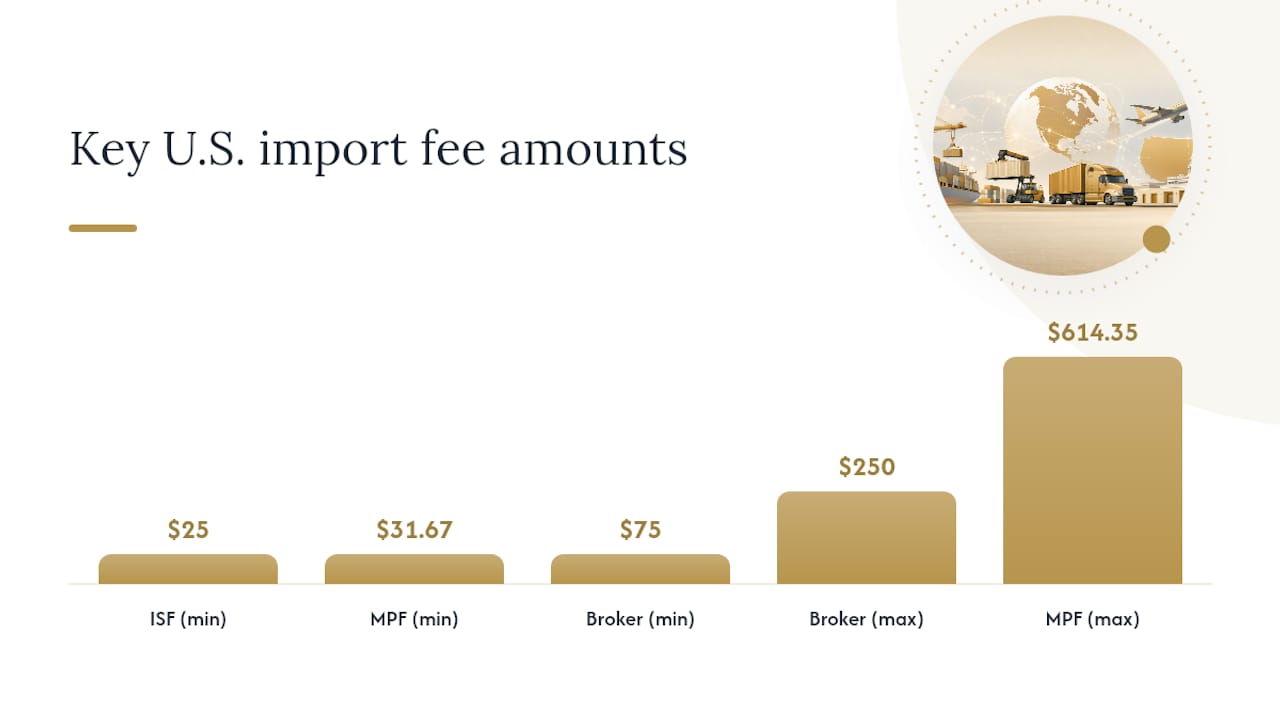
- MPF (Merchandise Processing Fee): 0.3464% of entered value, with a statutory minimum of $31.67 and a maximum of $614.35 per entry
- HMF (Harbor Maintenance Fee): 0.125% of cargo value, applied to ocean shipments only
- ISF (Importer Security Filing): typically $25–$50 per filing
- Customs broker fee: commonly $75–$250 per entry for standard clearance; complex entries or those requiring additional documentation run higher
Domestic transport
Drayage from the port to your warehouse or 3PL typically incurs a fee that varies with distance and complexity. If you are splitting a container across multiple destinations, LTL rates apply and per-unit costs rise accordingly.
Incidentals
Demurrage (container detention at the port) and storage fees accumulate fast when clearance is delayed.
How to calculate landed cost step by step
A reproducible method matters more than a one-time estimate. Maintaining a per-SKU landed-cost spreadsheet with every component column is the operational standard recommended across the industry. Here is the sequence:
- Collect your commercial invoice and HTS code. The invoice gives you product cost and quantity. The HTS code, looked up via the USITC HTS database, determines your duty rate. Do not proceed without both.
- Get a freight quote. Obtain an all-in quote from your freight forwarder that separates ocean/air freight from origin charges. Record the total freight cost for the shipment.
- Calculate insurance. Multiply your CIF value (product cost + freight) by your insurance rate (0.3–0.5% for standard goods).
- Determine applicable tariff rates. Apply MFN base rate plus any Section 301, 232, or other applicable additions to the transaction value. Calculate the total duty amount.
- Add brokerage and user fees. Calculate MPF (0.3464% of entered value, within the statutory min/max), HMF if ocean, ISF, and your broker’s invoice.
- Add domestic transport. Get a drayage or LTL quote from port to your warehouse.
- Sum all components. Total landed cost = product cost + freight + insurance + duties + brokerage/fees + domestic transport.
- Allocate per unit. Divide each cost component by total units in the shipment to get per-unit figures.
Spreadsheet columns to build:
- Supplier SKU / product description
- Unit price (in supplier currency and USD)
- Quantity
- Total product cost (USD)
- HTS code and applicable duty rate(s)
- Total freight cost / freight per unit
- Insurance total / insurance per unit
- Duty amount per unit
- MPF per unit / HMF per unit
- Brokerage per unit
- Domestic transport per unit
- Total landed cost per unit
Sanity check: sum your per-unit components and multiply by quantity. That figure should reconcile within a small tolerance to your actual freight forwarder bill and CBP entry summary. If it does not, find the gap before you set your price.
Two worked examples: ocean FCL and air/small parcel
Example 1: Ocean FCL, 1,000 units of consumer goods from China
The supplier’s FOB price can significantly increase when adding the landed cost components driven primarily by the stacked tariff rate. Pricing off the invoice would have left $10.03 per unit of margin on the table, or worse, produced a loss after fulfillment costs.
Sensitivity check: if Section 301 rates shift by 10 percentage points, duty per unit changes by $1.50. Model both scenarios before locking in a price.
Example 2: Air/small parcel, 50 units of specialty accessories
- Product cost: $80/unit ($4,000 total)
- Air freight: $6/kg × 75 kg total = $450 ($9.00/unit)
- Insurance: $0.50/unit (0.5% of CIF)
- Customs duty (MFN 4.5%): $3.60/unit
- MPF: statutory minimum $31.67 applies (shipment value below threshold), allocated $0.63/unit
- Broker fee: $175 entry, $3.50/unit
- Domestic delivery (LTL): $250, $5.00/unit
- Total landed cost per unit: $102.23
For small-parcel international sellers, carrier disbursement fees and VAT/GST collection services often create the largest gap between estimated and actual landed cost. On air shipments, the MPF minimum and broker fee hit harder per unit because the shipment volume is smaller, so allocating those entry-level fees accurately is critical.
U.S.-specific duties, fees, and where to check official rates
The two authoritative sources for every U.S. importer are U.S. Customs and Border Protection and the USITC HTS search tool. CBP publishes binding rulings, current tariff notices, and the official exchange rates used for entry. The USITC HTS database gives you the 10-digit classification code and the applicable duty rates for any product.
Key fee parameters to hardcode into your model:
- MPF: 0.3464% of entered value; minimum $31.67, maximum $614.35 per entry
- HMF: 0.125% of cargo value (ocean only)
- ISF: $25–$50 per filing
- Broker fee: $75–$250 per standard entry
On tariff stacking: the Section 301 lists covering Chinese-origin goods are the most consequential variable in landed-cost models right now. Rates vary by HTS code and have been subject to ongoing modification. Tariff programs in 2025–2026 have materially increased landed-cost volatility, and CBP notices can change effective rates with limited lead time.
Misclassifying your HTS code is the most expensive mistake in landed-cost modelling. A one-digit error can shift your duty rate by 10–25 percentage points and expose you to CBP penalties. When classification is ambiguous, request a binding ruling from CBP or engage a licensed customs broker.
When to use a broker versus self-clearing: self-clearance (filing your own entry) is legally permitted for informal entries under $2,500 but carries real classification risk above that threshold. For any shipment with stacked tariffs, AD/CVD exposure, or complex origin rules, a licensed customs broker is worth the $150–$250 fee.
Which tools help you estimate landed cost accurately?
The right tool depends on how much data you have and how precise you need to be.
Official lookups (always start here):
- USITC HTS Search (hts.usitc.gov): look up your 10-digit HTS code and read the applicable MFN rate and any chapter notes. Free, authoritative, updated with each tariff action.
- CBP.gov: access binding rulings, current Federal Register notices on Section 301/232 rates, and the weekly currency exchange rates used for entry valuation.
Commercial calculators:
Freightos offers a landed-cost and freight-quoting platform that estimates duties, taxes, and fees alongside freight rates. It is useful for getting a directional landed-cost number quickly, particularly for ocean and air shipments. The accuracy ceiling is your HTS code: a wrong classification produces a wrong duty estimate, regardless of how good the tool is.
DHL’s MyGTS (Global Trade Services) provides duty and tax estimates for cross-border shipments and is particularly strong for small-parcel and express lanes. It also flags restricted goods and documentation requirements.
Easyship integrates landed-cost calculation into the shipping workflow, making it practical for e-commerce brands shipping individual orders internationally. It handles carrier disbursement fees and VAT/GST collection, which are the components most likely to create post-sale chargebacks for small-parcel sellers.
The operational rule: use commercial calculators for estimates and scenario planning. Use your customs broker’s actual entry summary for reconciliation. Save every calculator output alongside the corresponding entry paperwork so you can close the gap between estimate and actual after each shipment.
Pro Tip: Enter your HTS code, invoice value, and freight terms before opening any calculator. A calculator fed incomplete or incorrect inputs produces a number that feels precise but is not. Garbage in, garbage out applies here as much as anywhere in finance.
How to model and audit landed cost across SKUs
A single landed-cost calculation is a snapshot. What protects your margins over time is a repeatable modelling and reconciliation process.
Modelling cadence: run a full landed-cost model for every new SKU before placing a purchase order. For existing SKUs, DHL recommends periodic reconciliation of estimated vs. actual landed cost to protect margins, with monthly reviews for high-tariff or high-frequency importers and quarterly at minimum for everyone else. When tariff rates change, recalculate immediately, not at the next scheduled review. The Commerce Catalyst blog post on how tariff changes affect landed cost walks through the recalculation logic in detail.
Post-delivery reconciliation checklist:
- Match freight forwarder invoice line by line to your estimate (ocean freight, origin charges, fuel surcharges)
- Confirm HTS code on the CBP entry summary matches what you modelled
- Reconcile actual duty paid against estimated duty; investigate variances above 5%
- Check currency exchange rate used by CBP against your model assumption
- Account for any demurrage or storage fees incurred during clearance
- Post adjustments to inventory value and COGS in your accounting system
KPIs worth tracking:
- Landed-cost variance % (actual vs. estimated, by shipment)
- Average effective duty rate by supplier and origin country
- Freight cost per unit by lane
- Time-to-clearance (days from vessel arrival to delivery)
Accounting note: under GAAP, freight, insurance, and customs duties are capitalizable costs that flow into inventory value and eventually into COGS when units are sold. Brokerage fees and domestic transport are also typically capitalized. Expensing these as period costs instead of capitalizing them understates inventory and overstates period expenses, which distorts your gross margin reporting. Tag every landed-cost adjustment with the relevant purchase order so period-end corrections are traceable.
Pro Tip: If your import volume justifies it, a continuous customs bond (rather than a single-entry bond) reduces per-entry cost and simplifies reconciliation. Integrating your freight forwarder’s data feed into your ERP or TMS eliminates manual entry and catches fee variances before they hit your P&L.
Scenario modelling is the other half of the audit discipline. If your margin holds in all three, the pricing is defensible. If it collapses in the duty scenario, you have a structural problem to solve before the next purchase order, not after.
Common landed-cost mistakes and how to lower your total
The most expensive mistakes are not calculation errors. They are structural assumptions that go unchallenged for months.
Mistakes that erode margin:
- Pricing off the factory invoice or FOB price without adding all downstream costs
- Misclassifying the HTS code, either through guesswork or using a competitor’s classification without verification
- Assuming the Incoterm on the purchase order covers costs it does not (e.g., treating CIF as if it includes U.S. import duties)
- Ignoring entry-level fees (MPF minimum, ISF, broker fee) on small or low-value shipments where they represent a disproportionate per-unit cost
- Failing to allocate freight and brokerage per unit, leading to SKU-level margin blind spots
- Not budgeting for demurrage when clearance timelines are uncertain
Levers to reduce total landed cost:
- Renegotiate Incoterms. Moving from EXW to FOB shifts origin logistics risk and cost to the supplier, often at a lower total cost because the supplier has better local carrier relationships.
- Consolidate shipments. Combining multiple SKUs into a single FCL entry reduces per-unit freight and spreads entry-level fees across more units.
- Audit your HTS classification. Correct classification sometimes reveals a lower applicable duty rate. This is not about gaming the system; it is about paying the rate that actually applies to your product.
- Use bonded warehouses or Foreign Trade Zones (FTZs). Deferring duty payment until goods leave the bonded facility improves cash flow on high-value or high-duty shipments.
- Right-size insurance. Standard cargo on established lanes often qualifies for the lower end of the 0.3–0.5% range. Review your policy annually.
- improve routing. For time-sensitive goods, compare the total landed cost of air versus ocean plus expedited domestic transport. Air freight’s higher per-kg cost sometimes beats ocean when you factor in carrying costs and stockout risk.
When diagnosing unprofitable revenue streams, landed-cost errors are among the first places to look.
Currency exposure is the variable most importers undermodel. Build your landed-cost model in USD using the CBP exchange rate, and consider forward contracts or natural hedges for large purchase orders denominated in foreign currency.
Documentation and record-keeping: retain your commercial invoice, packing list, bill of lading, CBP entry summary (CF-7501), and broker invoice for a minimum of five years. CBP has the authority to audit entries within that window, and your landed-cost model is only as defensible as the paperwork behind it.
The cost of not knowing your numbers
The brands that get into margin trouble on imported goods almost never made a single catastrophic decision. They made a series of small, compounding assumptions: the FOB price is close enough, the duty rate probably hasn’t changed, the broker will catch anything we miss. Each assumption is individually plausible.
The current tariff environment makes this more urgent, not less. Section 301 rates have shifted multiple times in the past two years, and the gap between an importer who monitors CBP notices and one who does not can be 15–25 percentage points of duty rate on the same product. That is not a rounding error. That is a business model question.
What Commerce Catalyst does for import-heavy brands
Landed-cost modelling is only as useful as the decisions it feeds. Commerce Catalyst’s DTC Financial Health Assessment maps your landed cost directly into your unit economics, pricing architecture, and gross margin model, so you can see exactly where the numbers break down and what to fix first. For brands that need ongoing support, the fractional CFO advisory covers landed-cost reconciliation, tariff scenario planning, and financial reporting on a retainer basis.

If you are not sure where to start, the Next Move Finder is a no-cost diagnostic that identifies which operational or financial constraint deserves your attention first, including landed-cost gaps. Most founders who complete it walk away with a clearer picture of their margin structure than they had going in.
Sources
- How to Calculate Landed Cost: The Complete Guide for US Importers (2026): FreightFigures
- What Is a Landed Cost? Formula, Components & How to Calculate It | Easyship
- How to Calculate Landed Cost: Formulas and Examples | ExFreight