
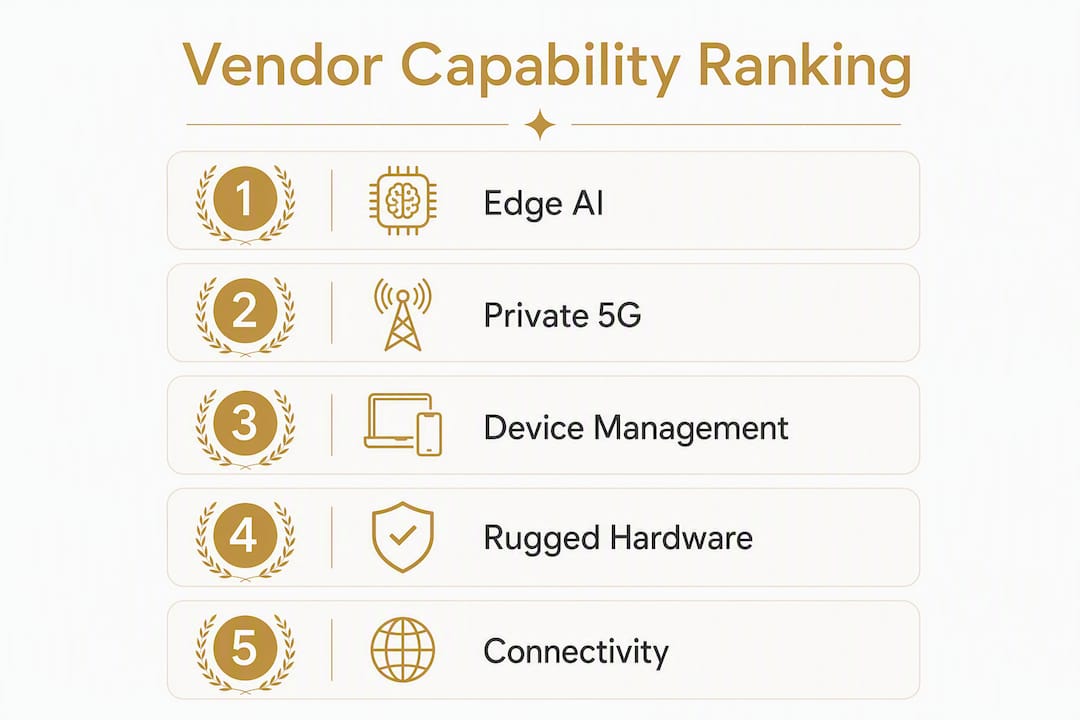
If you’re shortlisting IIoT vendors to replace or benchmark against InHand Networks, the top alternatives identified by CB Insights fall into four distinct capability tiers: edge AI platforms, private 5G/connectivity providers, device-management stacks, and rugged hardware specialists. The vendors worth your time are Quarkifi (edge AI deployments), Expeto (private enterprise mobile networking), Blueforce Development (edge software and safety-critical IoT), AiKaan (secure remote device management), Cradlepoint (LTE/5G cellular routing), Sierra Wireless/Semtech (global cellular IoT modules and gateways), and Digi International (rugged industrial routers and remote management). Each solves a different dominant problem.
- Quarkifi: best for deploying AI inference models at the industrial edge
- Expeto: best for enterprises building private LTE/5G connectivity layers
- Blueforce Development: best for safety-critical edge software where hardware is already in place
- AiKaan: best for centralized, secure remote access and OTA management of distributed edge devices
- Cradlepoint: best for branch and mobile LTE/5G routing with cloud-managed policy
- Sierra Wireless (Semtech/Sierra): best for cellular IoT module integration at scale
- Digi International: best for rugged, field-hardened routers with a mature device-management platform
Table of Contents
- How do these InHand.co alternatives compare on core capabilities?
- What each vendor sells and when to pick them
- How to evaluate and choose the right alternative for your project
- How this shortlist was built
- Which vendors have US sales and support?
- What to expect from post-purchase service and warranty terms
- Key Takeaways
- The procurement trap most buyers fall into
- Useful sources for vendor validation
- Vendor selection is a financial decision, not just a technical one
How do these InHand.co alternatives compare on core capabilities?
The vendors above split across four categories: edge-AI platforms (Quarkifi, Blueforce), private-connectivity providers (Expeto), device-management stacks (AiKaan, Digi), and cellular hardware/module specialists (Cradlepoint, Sierra Wireless). The table below maps capability dimensions procurement teams use most often. Vendor names are referenced alongside the table rather than inside cells, so you can match rows to the profiles in the next section.
| Capability dimension | Edge-AI platforms | Private-5G/connectivity | Rugged hardware specialists | Device-management stacks |
|---|---|---|---|---|
| Product types offered | Edge servers, AI inference appliances | Managed connectivity platforms | Industrial routers, gateways, switches | Cloud platforms, remote-access agents |
| Edge compute / AI | Core differentiator | Limited | Moderate (varies by SKU) | Minimal |
| Connectivity options | LTE, Wi-Fi, Ethernet | Private LTE/5G, managed WAN | LTE, 5G, Wi-Fi, Ethernet | Agnostic (manages existing hardware) |
| Device management / cloud | Moderate | Strong (managed service) | Varies; some include platforms | Core differentiator |
| Security & certifications | Industrial protocol hardening | Network-layer encryption, operator certs | FIPS, carrier certifications | Zero-trust access, role-based controls |
| Ruggedization / environmental rating | Moderate (depends on hardware partner) | Software-only (no hardware) | High (MIL-SPEC variants) | N/A (software layer) |
| US support presence | Varies by vendor | Yes | Yes | Varies by vendor |
| Pricing model | License + hardware | Managed service subscription | Hardware + optional platform license | SaaS subscription |
| Integration ecosystem | AWS, Azure, industrial protocols | Operator partnerships | AWS, Azure, carrier-certified | API-first, broad OT/IT integrations |
What each vendor sells and when to pick them
Quarkifi focuses on edge computing with AI and IoT platform capabilities across industrial sectors. Its core value is deploying trained AI models directly at the edge, reducing latency and cloud dependency for inference-heavy workloads. If your project involves real-time anomaly detection on a factory floor or predictive maintenance at a remote site, Quarkifi belongs on your shortlist. Ask their rep: “Which industrial protocols does your edge runtime support natively, and what is the model update pipeline for distributed sites?”

Expeto takes a different approach entirely. Rather than selling hardware, it delivers a managed enterprise mobile networking platform that combines private connectivity and management layers for LTE and 5G scenarios. It suits enterprises that need to operate a private network without building carrier-grade infrastructure in-house. Ask: “Which US mobile operators are you certified with, and what does the SLA look like for private network uptime?”
Blueforce Development sells edge software for IoT deployments where safety, security, and operational efficiency are non-negotiable. The hardware-agnostic model means you can layer Blueforce on existing field devices rather than ripping and replacing. It fits public safety, defense-adjacent, and critical infrastructure projects. Ask: “What is your certification status for safety-critical deployments, and do you have published case studies in our vertical?”
AiKaan is a device-management and secure remote access platform for distributed edge devices. Think of it as the control plane for a fleet of edge nodes: remote monitoring, OTA upgrades, and secure tunneling without requiring a VPN. It fits operations teams managing hundreds or thousands of geographically dispersed devices. Ask: “What authentication standards does your remote access layer use, and how does rollback work after a failed OTA update?”
Cradlepoint is the most established name in LTE/5G cellular routing for branch, vehicle, and mobile deployments. Its NetCloud platform provides cloud-managed policy, zero-touch provisioning, and carrier-grade failover. US support is well-documented, and carrier certifications are extensive. Ask: “What is the NetCloud SLA for policy push latency, and which private 5G operators have you certified with?”

Sierra Wireless (now operating under Semtech) specializes in cellular IoT modules, embedded gateways, and managed connectivity services. It is the right choice when you need cellular connectivity baked into a custom device design or when you are managing a large fleet of cellular-connected endpoints across carriers. Ask: “What is your module lifecycle commitment, and how do you handle carrier certification updates across SKUs?”
Digi International offers rugged industrial routers, gateways, and the Digi Remote Manager platform. Its hardware carries strong environmental ratings and the platform supports remote configuration, firmware management, and alerting. It is a natural fit for utilities, transportation, and manufacturing where field hardware must survive harsh conditions. Ask: “What is the IP rating and operating temperature range for the specific SKU we are evaluating, and what does the Remote Manager SLA cover?”
Pro Tip: When reviewing vendor datasheets, verify that carrier certifications and private 5G operator partnerships are current, not legacy. Certifications lapse, and a datasheet dated two years ago may not reflect today’s carrier ecosystem.
How to evaluate and choose the right alternative for your project
The biggest procurement mistake in IIoT is selecting a vendor based on brand recognition rather than matching the vendor’s dominant capability to your project’s dominant technical need.
- Map your project requirements first. Identify whether your primary need is edge compute/AI, private connectivity, device management, or rugged hardware. This single step eliminates at least half the shortlist before any vendor call.
- Define your proof-of-concept scope in writing. Specify the number of sites, device types, connectivity environment (LTE, 5G, private, Wi-Fi), and the operational KPIs the pilot must move. Vendors who cannot respond to a written scope are a red flag.
- Test connectivity in your actual environment. LTE and 5G performance varies sharply by geography and carrier. Run signal surveys at representative sites before committing to a hardware SKU.
- Benchmark edge compute under realistic load. If AI inference is in scope, test the vendor’s edge runtime with your actual model and data volume, not a vendor-supplied demo dataset.
- Verify security certifications independently. Ask for FIPS 140-2 certificates, carrier certifications, and any relevant industrial compliance documentation. Do not accept “we are compliant” without the certificate number.
- Confirm API and protocol compatibility with your OT/SCADA stack. Modbus, DNP3, OPC-UA, and MQTT support varies. Get this in writing before the pilot.
- Require a written SLA. Mean time to respond, escalation paths, and firmware rollback commitments should be in the contract, not a verbal assurance.
- Calculate total cost of ownership across three years. Hardware, platform licenses, support contracts, and integration labor all belong in the model.
Red flags to watch for: missing or outdated technical datasheets; SLAs described only in marketing language with no numeric commitments; no US-based support contact for production issues; authentication that relies on shared credentials rather than certificate-based or zero-trust models; absence of published security certifications.
How this shortlist was built
The vendors featured here were selected using CB Insights’ InHand Networks alternatives list as the primary aggregator source, cross-referenced with market-footprint data from SitePrice’s competitor analysis and public product datasheets. Selection signals included: documented product types (routers, gateways, edge servers, software platforms), stated edge compute or private 5G capabilities, device-management platform availability, US support presence, and published technical specifications. Vendors without public technical specs or any verifiable US support pathway were deprioritized.
Readers should treat this shortlist as a starting point. Validate each vendor against your own RFP criteria, review current datasheets directly from vendor sites, and request anonymized case studies from your specific industry vertical.
Which vendors have US sales and support?
Cradlepoint and Digi International both maintain established US sales organizations and documented US-based support infrastructure, which matters when a production outage at 2 AM needs a human response, not a ticket queue routed overseas. Sierra Wireless (Semtech/Sierra) has US operations through its legacy Sierra Wireless business and carrier relationships. Expeto operates as a managed service with enterprise-facing support, though buyers should confirm US-based escalation contacts explicitly during procurement. Quarkifi, Blueforce Development, and AiKaan are smaller vendors where US support depth varies. For all three, require a named US support contact and a documented escalation path as a contract condition, not an afterthought.
What to expect from post-purchase service and warranty terms
Hardware warranties across this vendor set typically run one to three years, with extended warranty and advance hardware replacement available as paid add-ons. Platform and software support is almost always subscription-based, meaning your device-management or cloud features lapse if the subscription lapses. Before signing, confirm three things: whether the hardware warranty covers field-replacement labor or only the unit itself; whether firmware updates are included in the base support tier or require a premium contract; and what the decommissioning and data-migration process looks like at end of contract. The last point is consistently underspecified in vendor contracts and consistently painful when it matters.
Key Takeaways
The right InHand.co alternative depends on your project’s dominant technical need, not the vendor’s market profile.
| Point | Details |
|---|---|
| Match vendor to primary need | Edge AI, private 5G, device management, and rugged hardware are four distinct categories requiring different vendors. |
| Require written SLAs | Verbal support commitments do not hold at 2 AM; numeric SLA terms belong in the contract before pilot sign-off. |
| Validate US support explicitly | Cradlepoint and Digi have documented US presence; smaller vendors require a named escalation contact as a contract condition. |
| Run a scoped pilot | Define sites, device count, connectivity environment, and operational KPIs in writing before any vendor call. |
| Commerce Catalyst advisory | Commerce Catalyst’s DTC Operator Diagnostic translates vendor feature comparisons into operational impact and TCO clarity for decision-makers. |
The procurement trap most buyers fall into
The vendors on this list are genuinely different from one another. Cradlepoint and Digi are hardware-first companies with mature cloud platforms bolted on. Quarkifi and Blueforce are software-first, with hardware either abstracted or handled by a partner. Expeto is a managed service that does not sell hardware at all. AiKaan is a control plane. Sierra Wireless is a module and connectivity business.
The procurement trap is treating all of them as interchangeable “IoT vendors” and running a feature-by-feature comparison that flattens these differences into a scoring matrix. That matrix will produce a winner that fits the matrix, not your project.
What actually works: define the one capability your project cannot succeed without, find the two or three vendors that lead in that capability, and run a narrow pilot against real operational KPIs. Stage pilots by risk tier. Insist on device-level rollback for firmware updates. Require an exit plan for device decommissioning and data migration before you sign anything.
On commercial terms: multi-year support bundling, pilot discounts, and volume-based licensing are all negotiable levers, but only if you ask before the contract is drafted. Once you are in a pilot, your negotiating position weakens considerably.
Useful sources for vendor validation
When validating any vendor on this shortlist, start with these sources:
- CB Insights: InHand Networks Alternatives and Competitors: the primary aggregator list used to build this shortlist
- SitePrice: inhand.com competitors and market footprint: traffic and market-overlap data for broader context
- InHand Networks product pages: useful as a baseline specification reference when comparing hardware SKUs
- Vendor datasheets, published SLAs, and customer case studies requested directly from each vendor’s sales team
- AWS Partner Network and Azure Certified IoT Device catalogs for verifying cloud integration certifications
Vendor selection is a financial decision, not just a technical one
The vendors covered here represent real procurement options, each with a distinct capability profile. But selecting the right one requires translating technical features into operational and financial outcomes. That is where most procurement teams stall.

Commerce Catalyst works with consumer brand founders and operators who need to pressure-test vendor decisions before committing capital to a pilot. The DTC Financial Health Assessment is built to surface the operational constraints and TCO realities that vendor sales decks do not show you. If you are evaluating an IIoT deployment and need a clear-eyed view of what it will actually cost and deliver, that is the conversation to have before you sign a contract, not after. Reach out to schedule an advisory session with Chris Wichert and get the financial clarity your procurement decision requires.