
Most brand founders treat bookkeeping as something to catch up on before tax season. That’s a costly mistake. Solid brand founder bookkeeping best practices, what accountants formally call financial recordkeeping and management accounting, do far more than satisfy the IRS. They tell you whether your brand is actually profitable, whether your cash will survive the next 90 days, and whether the decisions you’re making today are grounded in reality or gut feeling. This article gives you the specific habits and systems that turn your books from a compliance chore into one of the sharpest tools in your business.
Table of Contents
- Key takeaways
- 1. Understand what bookkeeping actually is (and isn’t)
- 2. Choose your accounting method with intention
- 3. Open dedicated business accounts before anything else
- 4. Set up your chart of accounts to match how your brand actually operates
- 5. Record transactions on a weekly cadence
- 6. Reconcile every bank and credit card account monthly
- 7. Review your financial statements as management tools
- 8. Build an audit-ready documentation system
- 9. Stay on top of invoicing and accounts receivable
- 10. Choose accounting software that fits your brand’s complexity
- My take: bookkeeping discipline is the unsung hero of brand success
- How Commerce Catalyst helps you build financial clarity
- FAQ
Key takeaways
| Point | Details |
|---|---|
| Bookkeeping is a management tool | Consistent records give you the financial clarity to make confident decisions, not just file taxes. |
| Choose your accounting method deliberately | Accrual accounting gives consumer brands with inventory a steadier view of real profitability. |
| Reconcile monthly without exception | Monthly bank reconciliation catches errors early and prevents compounding mistakes that distort your numbers. |
| Document everything digitally | Attaching receipts to transactions on the day of purchase eliminates year-end scrambles and IRS exposure. |
| Build repeatable weekly routines | Recording transactions weekly and reviewing statements monthly keeps your books current in about 30 minutes per session. |
1. Understand what bookkeeping actually is (and isn’t)
Most founders think bookkeeping is a backward-looking task. Record what happened, hand it to an accountant, move on. But bookkeeping is a management system for running and scaling your business, not just a tax compliance requirement. The moment you start treating it that way, everything changes.
Your books are the only place where every financial decision your brand has made lives in one place. Pricing changes, ad spend spikes, supplier cost increases, refund rates. All of it shows up in your records before it shows up in your bank account. Founders who read that data regularly make better calls. Founders who don’t are flying blind.
Reframe bookkeeping as your financial operating system. It runs in the background, but when something goes wrong, it’s the first place you look.
2. Choose your accounting method with intention
The two primary methods are cash basis and accrual accounting. Cash basis records revenue when money hits your account and expenses when you pay them. Accrual records revenue when it’s earned and expenses when they’re incurred, regardless of when cash moves.
For consumer brands, especially those carrying inventory, running subscriptions, or issuing invoices, accrual accounting gives a steadier view of actual performance. Cash basis can make a profitable month look terrible if a large supplier payment clears at the same time, or make a weak month look strong if a big customer batch pays late.
Here’s where it gets nuanced. You can run two sets of books without losing your mind. Many founders use accrual internally for management decisions and cash basis for tax filings, since the IRS allows cash basis for most small businesses. The key is keeping them clearly labeled so you never confuse your management P&L with your tax return.
Pro Tip: If your brand carries inventory or runs a subscription model, default to accrual for your internal reporting from day one. Switching methods later is painful and creates gaps in your historical data.
3. Open dedicated business accounts before anything else
This is non-negotiable. Separate business and personal finances rigorously from the start. Commingled accounts create audit exposure, make reconciliation a nightmare, and blur the line between what the business actually earns and what you personally spend.
Open a dedicated business checking account, a business credit card, and a savings account for tax reserves. Run every brand transaction through these accounts only. This single habit eliminates more bookkeeping errors than any software upgrade ever will.

4. Set up your chart of accounts to match how your brand actually operates
A chart of accounts is the backbone of your bookkeeping system. Most default software templates are built for generic small businesses, not consumer brands. You need to customize yours to reflect how your brand actually makes and spends money.
For a consumer brand, your chart of accounts should include:
- Revenue streams broken out separately. DTC website sales, wholesale, Amazon, and retail should each be their own line. Blending them hides which channel is actually profitable.
- Cost of goods sold by category. Product cost, packaging, inbound freight, and fulfillment should be separated so you can calculate true gross margin by product line.
- Marketing spend by channel. Paid social, search, influencer, and email should each have their own expense account. Lumping all marketing together makes it impossible to evaluate channel ROI.
- Owner compensation and distributions. Keep these distinct from operating expenses so your P&L reflects true business profitability, not a number inflated by how much you’re paying yourself.
Pro Tip: Spend two hours with your accountant customizing your chart of accounts before you record a single transaction. Fixing it retroactively after 12 months of data is a significant project.
5. Record transactions on a weekly cadence
Waiting until the end of the month to enter transactions is where most founders fall behind. Weekly recording combined with monthly reconciliation keeps your books current and turns month-end close into a 30-minute task instead of a two-day ordeal.
Pick one day per week, Friday morning works well for many founders, and spend 20 to 30 minutes categorizing transactions, uploading receipts, and flagging anything unclear. The consistency matters more than the specific day. When your books are current, you can pull a P&L at any point and trust what it says.
6. Reconcile every bank and credit card account monthly
Reconciliation is the process of matching your recorded transactions against your actual bank and credit card statements. It catches duplicate entries, missed transactions, and bank errors before they compound into bigger problems. Monthly reconciliation prevents compounding mistakes that distort your numbers and erode trust in your own data.
Build a month-end close checklist and stick to it. A solid founder-friendly version looks like this:
- Download statements for all business bank and credit card accounts
- Match every transaction in your accounting software to the corresponding statement line
- Investigate and resolve any discrepancies before moving on
- Review your accounts receivable aging report for overdue invoices
- Review your accounts payable for upcoming bills
- Run your P&L, balance sheet, and cash flow statement
- Compare this month’s numbers to the prior month and to your budget
| Task | Frequency | Time Required |
|---|---|---|
| Transaction recording | Weekly | 20-30 minutes |
| Bank reconciliation | Monthly | 30-60 minutes |
| Financial statement review | Monthly | 30 minutes |
| Accounts receivable aging review | Monthly | 15 minutes |
| Full bookkeeping audit | Quarterly | 2-3 hours |
Standardized month-end checklists reduce errors and support timely reporting. The bottleneck in most founders’ month-end close is process, not time. A clear checklist removes the friction.
7. Review your financial statements as management tools
Your profit and loss statement, balance sheet, and cash flow statement are not documents you hand to your accountant once a year. They are the three instruments on your cockpit dashboard. A strong P&L review habit is one of the first steps toward real financial clarity.
Your P&L shows whether the brand is profitable. Your cash flow statement shows whether you can pay your bills. Your balance sheet shows what you own versus what you owe. Read all three monthly, not just the P&L. Many founders are surprised to discover their brand is “profitable” on paper while simultaneously running out of cash, a situation the cash flow statement would have flagged months earlier.
Pro Tip: Schedule a recurring 45-minute “money date” on your calendar at the same time each month. Treat it like a board meeting. Review your three statements, compare to last month, and write down two or three financial decisions the numbers are telling you to make.
8. Build an audit-ready documentation system
The IRS expects you to support every amount on your tax filings with receipts, invoices, contracts, or other records. Both digital and paper records are accepted, but digital is far more durable and searchable.
Your documentation system should cover:
- Receipts attached to transactions. Scan or photograph receipts on the day of purchase and attach them directly to the transaction in your accounting software. This takes 60 seconds and eliminates year-end receipt hunts.
- Business purpose notes. For any expense where the receipt doesn’t make the purpose obvious, add a short note. “Team lunch, Q2 planning meeting, 4 attendees” is all you need.
- Mileage logs. If you drive for business, log it in real time. Apps like MileIQ make this nearly automatic.
- Contracts and agreements. Store vendor contracts, supplier agreements, and any revenue-sharing deals in a dedicated folder, either in cloud storage or directly in your accounting software.
- Backup everything. Your records should live in at least two places. Cloud accounting software plus a separate cloud backup is the minimum.
9. Stay on top of invoicing and accounts receivable
Late invoicing is one of the most common and most avoidable cash flow problems in consumer brands. Prompt invoicing and regular follow-up on overdue payments are non-negotiable parts of a healthy bookkeeping workflow.
Here’s a practical system:
- Send invoices the same day goods ship or services are delivered. Never batch invoices at the end of the month.
- Set payment terms clearly on every invoice. Net 30 is standard, but Net 15 is better for your cash flow.
- Run an accounts receivable aging report every month. Anything past 30 days gets a follow-up email. Anything past 60 days gets a phone call.
- Automate payment reminders inside your invoicing software. Most platforms send these automatically at 7, 14, and 30 days past due.
- Track your average days to collect and watch that number over time. If it’s creeping up, your collections process needs attention before it becomes a cash crisis.
10. Choose accounting software that fits your brand’s complexity
Generic spreadsheets work for a brand doing $5,000 a month in revenue. They break down fast once you have multiple sales channels, inventory, and a team. The right accounting software automates bank feeds, categorizes recurring transactions, and generates your financial statements without manual assembly.
For most consumer brand founders, QuickBooks Online or Xero handle the core bookkeeping needs well. If you’re running a product-based brand with significant inventory, look for software that integrates directly with your e-commerce platform and inventory management system. That integration eliminates a major source of manual data entry errors. You can find industry-specific benchmarks to understand what financial metrics your software should be tracking for your category.
How Commerce Catalyst helps you build financial clarity
Getting your bookkeeping right is the foundation. But knowing what your numbers are telling you, and what to do about it, is where most founders need a thinking partner.
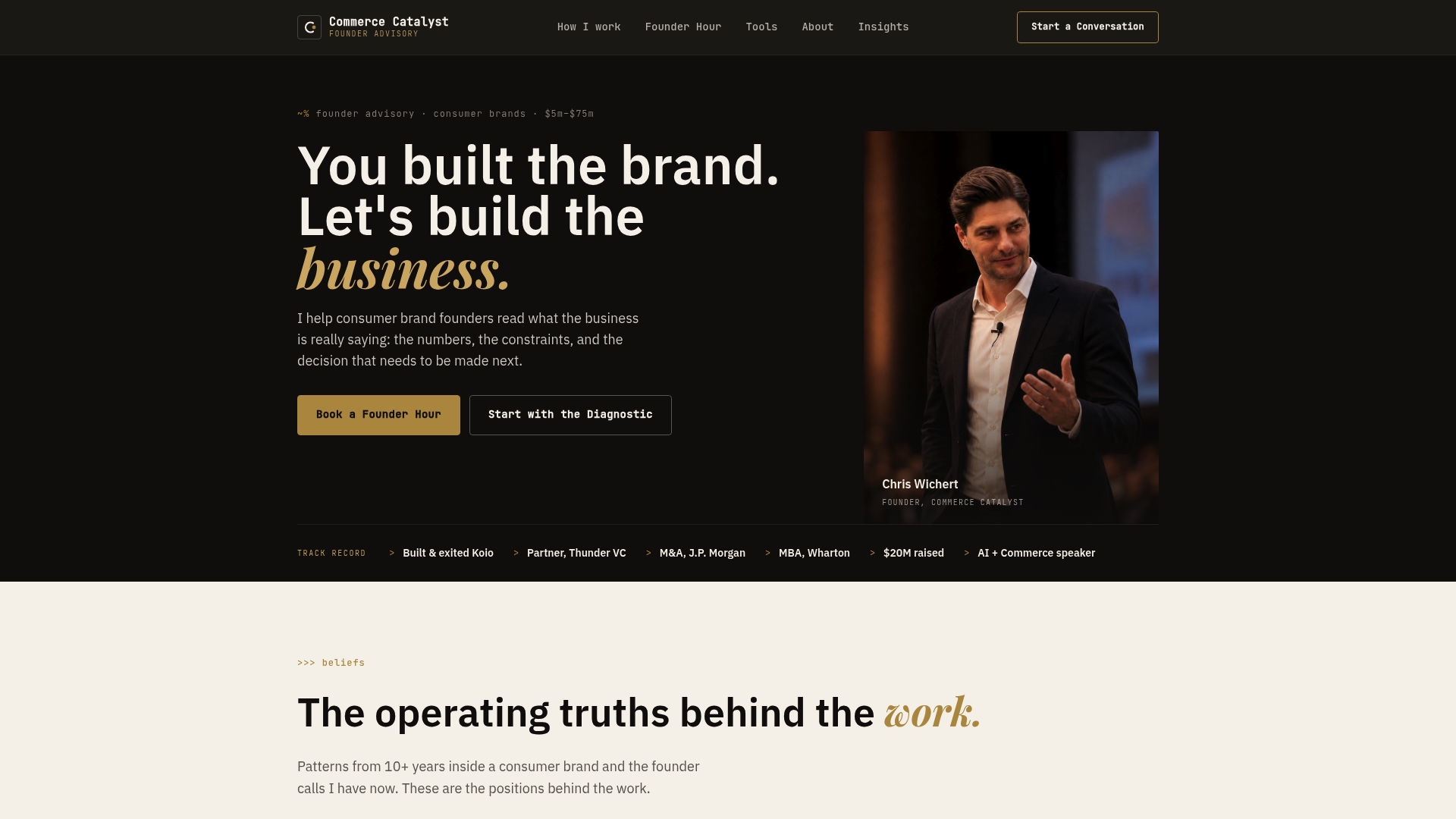
At Commerce Catalyst, we work directly with consumer brand founders to translate financial data into decisions that actually move the business forward. Whether you need a financial health assessment to identify where your numbers are hiding problems, or ongoing fractional CFO support to build the financial management layer your brand needs to scale, we bring the founder-side experience to make it practical. If you want to pressure-test your current financial setup and figure out the strongest next step, book a Founder Hour to get started.
FAQ
What is the best accounting method for consumer brand founders?
Accrual accounting gives consumer brands with inventory or subscriptions a more accurate view of profitability. Many founders use accrual for internal management and cash basis for tax filings, which is a legitimate and practical approach.
How often should a brand founder reconcile their books?
Monthly reconciliation is the standard. Reconciling every bank and credit card account at month-end catches errors early and keeps your financial statements reliable for decision-making.
What records does the IRS require small business owners to keep?
The IRS expects receipts, invoices, and contracts that support every amount on your tax filings. Digital records are accepted and preferred for durability. Attaching scanned receipts directly to transactions in your accounting software is the most efficient approach.
How do I stop bookkeeping from piling up?
Record transactions on a weekly cadence rather than monthly. Consistent weekly entry, combined with monthly reconciliation, keeps your books current and reduces month-end close to roughly 30 minutes of focused work.
When should a brand founder hire bookkeeping help?
When your monthly revenue exceeds what you can track in 30 to 60 minutes per week, or when you have multiple sales channels and inventory, it’s time to bring in a bookkeeper or fractional CFO to maintain accuracy and free your attention for growth decisions.