
Working capital is the difference between a startup’s current assets and current liabilities, and it is the single most direct measure of whether your business can fund its own operations tomorrow. Profitability on paper means nothing if you cannot make payroll on Friday. Working capital is the lifeblood of any organization because a profitable income statement does not guarantee the liquidity needed to meet daily obligations. The role of working capital in startups goes beyond accounting. It determines your negotiating power with suppliers, your attractiveness to lenders, and your ability to grow without constantly raising outside money. Tools like TallyPrime and platforms like Jumpstart Partners have made working capital tracking accessible even for early-stage teams, and working capital improvement is the top finance objective for many firms heading into 2026.
What is the role of working capital in startups?
Working capital, formally defined as net working capital (NWC) in financial analysis, is calculated by subtracting current liabilities from current assets. The result tells you how much short-term financial cushion your business holds at any given moment. For startups, this number is not just a balance sheet line. It is a real-time signal of operational health.
A startup with $200,000 in current assets and $150,000 in current liabilities holds $50,000 in working capital. That $50,000 is what stands between you and a cash crisis when a major customer pays 45 days late or a supplier demands early payment. The gap is often smaller than founders expect, especially in the first two years of operation.

81% of CFOs use working capital solutions, and 68% of high-growth firms use working capital funding for expansion rather than relying on traditional debt or equity. That statistic reveals a fundamental shift in how sophisticated operators think about growth. They treat working capital as a financing tool, not just a safety buffer.
Understanding the role of cash flow within this framework matters equally. Cash flow measures movement over time. Working capital measures position at a point in time. Both are necessary, but confusing them leads to poor decisions. A startup can have strong monthly cash flow and still carry dangerously low working capital if short-term liabilities are stacking up faster than assets.
What components make up working capital in a startup?
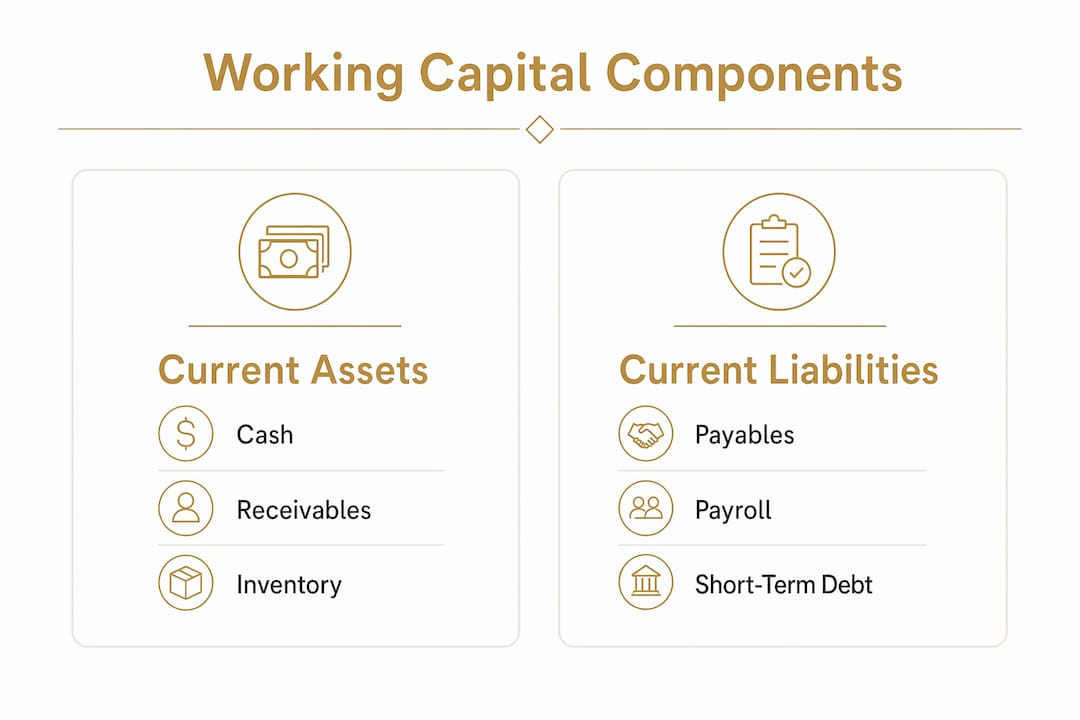
Working capital is built from two categories: current assets and current liabilities. Current assets are resources your business expects to convert to cash within 12 months. Current liabilities are obligations due within the same window. The interaction between these two categories determines your financial flexibility.
| Component | Type | Startup Example |
|---|---|---|
| Cash and cash equivalents | Current asset | Operating account, money market funds |
| Accounts receivable | Current asset | Invoices sent to B2B customers, net 30 terms |
| Inventory | Current asset | Physical product held before sale |
| Prepaid expenses | Current asset | Prepaid software subscriptions, insurance |
| Accounts payable | Current liability | Unpaid supplier invoices |
| Payroll liabilities | Current liability | Wages owed but not yet paid |
| Short-term debt | Current liability | Credit line draws, loans due within 12 months |
| Deferred revenue | Current liability | Annual SaaS subscriptions paid upfront |
The composition of these items matters as much as the total. A startup with $300,000 in current assets made up entirely of slow-moving inventory is in a worse position than one with $200,000 in cash and receivables due within 30 days. Similarly, a startup whose current liabilities are mostly deferred revenue (a SaaS company with annual prepayments) faces far less liquidity risk than one whose liabilities are overdue supplier invoices.
Founders often overlook payroll liabilities as a working capital component. Wages accrue daily but are paid weekly or biweekly. That gap creates a recurring short-term liability that must be covered by current assets. Ignoring this in your working capital calculation produces a falsely optimistic picture of your financial position.
How do you interpret working capital ratios for your startup?
The current ratio is the standard metric for evaluating working capital health. It divides current assets by current liabilities. A ratio above 1.0 means you have more short-term assets than obligations. Below 1.0 means you technically cannot cover your near-term debts with available resources.
A current ratio between 1.2 and 2.0 is generally healthy, with 1.0 considered the minimum acceptable threshold when liabilities consist of deferred revenue rather than overdue debt. This distinction is critical. A SaaS startup with a current ratio of 0.9 driven by annual subscription prepayments is in a fundamentally different position than a product startup with a 0.9 ratio driven by overdue supplier invoices.
Signs your working capital position is healthy:
- Current ratio sits between 1.2 and 2.0
- Accounts receivable aging shows most invoices under 45 days
- Inventory turnover aligns with your sales cycle
- Accounts payable terms are being honored without strain
- No reliance on credit lines to cover routine payroll
Signs your working capital position is deteriorating:
- Current ratio falling below 1.2 for two or more consecutive months
- Customers consistently paying beyond agreed terms
- Suppliers tightening payment requirements or removing credit
- Cash balance dropping despite growing revenue
- Increasing reliance on short-term borrowing for operating expenses
Negative working capital is not automatically fatal. Amazon and many large retailers operate with negative working capital because they collect cash from customers before paying suppliers. For most early-stage startups, however, negative working capital signals a structural mismatch that compounds quickly under growth pressure.
What practical strategies improve working capital management?
Working capital management for startups centers on one core concept: the cash conversion cycle (CCC). The CCC measures how long it takes to convert your investments in inventory and receivables back into cash. Shortening it improves your working capital position without requiring outside funding.
Three levers control the cash conversion cycle:
-
Reduce Days Sales Outstanding (DSO). DSO measures how long customers take to pay after invoicing. Automate invoice delivery through tools like QuickBooks or FreshBooks so invoices go out the same day work is delivered. Offer early payment discounts structured as 2/10 net 30, meaning customers get a 2% discount if they pay within 10 days instead of 30. For many B2B customers, that discount is worth taking, and you get cash three weeks earlier.
-
Control Days Inventory Outstanding (DIO). Excess inventory ties up cash without generating returns. Review your reorder points quarterly and align purchase orders with actual demand data rather than optimistic sales forecasts. A product startup carrying 90 days of inventory when 45 days is sufficient is effectively lending money to its own warehouse.
-
Extend Days Payable Outstanding (DPO). Negotiate Net 45 or Net 60 payment terms with your key suppliers. Supply chain and payment term negotiation are primary levers for improving working capital without sacrificing supplier relationships. The goal is not to delay payment irresponsibly but to align your outflows with your inflows.
For SaaS and subscription businesses, billing structure is a direct working capital lever. Switching customers from monthly to annual contracts provides immediate cash inflow that improves working capital without changing recognized revenue. A startup with 100 customers paying $500 per month collects $50,000 monthly. Converting half to annual contracts at $5,500 per year generates $275,000 upfront. That single change can fund three to four months of operations.
Pro Tip: Treat billing terms as a financing decision, not just a sales convenience. Founders who approach billing as a cash management tool consistently outperform those who let customers dictate payment schedules.
Milestone billing for project-based work achieves the same effect. Invoice at project kickoff, at mid-point delivery, and at completion rather than billing entirely at the end. This aligns cash inflows with the work being performed and reduces your exposure to slow-paying clients.
How does working capital impact startup funding and growth?
Lenders and investors read working capital ratios as a proxy for how well a founder manages operations. Poor working capital management leads to higher interest rates or credit restrictions even when a startup’s growth fundamentals are strong. A business growing 40% year over year but carrying a current ratio of 0.8 will face harder terms on any credit facility it pursues.
The relationship between working capital and demonstrating a path to profitability to investors is direct. Investors use working capital trends to assess whether a founder understands the mechanics of their own business. A startup that can show improving DSO, stable DPO, and a rising current ratio over six months signals operational discipline that revenue growth alone cannot communicate.
Growth itself creates working capital pressure that founders consistently underestimate. Growth can produce cash crunches when customers have long payment terms but suppliers require faster payment, creating a working capital gap despite profitability. A startup doubling revenue may simultaneously be doubling its receivables balance while suppliers demand payment in 30 days. The faster you grow without managing this gap, the faster you can run out of cash while technically profitable.
Key risks of poor working capital management include:
- Inability to fund inventory purchases ahead of peak sales seasons
- Missed payroll creating legal exposure and team attrition
- Forced reliance on high-cost short-term credit to bridge gaps
- Reduced negotiating use with suppliers who sense financial stress
- Investor concern that undermines valuation in funding rounds
Understanding the role of gross profit in growth alongside working capital gives founders a complete picture. Gross profit funds the working capital cycle. If margins are thin, every dollar of revenue growth requires more working capital to support it.
Common pitfalls founders make with working capital
The most expensive mistake founders make is confusing runway with working capital. Runway and working capital are distinct financial health measures with different implications. Runway tells you how many months of cash you have before the bank account hits zero. Working capital tells you whether you can meet obligations that come due in the next 30 to 90 days. A startup can have extensive runway but zero working capital if short-term liabilities are large, risking creditor action before runway ends.
Other common errors that cost founders real money:
- Ignoring liability composition. A high current ratio built on deferred revenue looks healthy but requires delivering services. A high ratio built on cash is genuinely healthy. The numbers look identical on the surface.
- Growing sales without modeling working capital needs. Every new customer with net 30 terms increases your receivables balance before it increases your cash balance. Model this before signing large contracts.
- Over-reserving cash. Too much working capital signals idle cash or excess inventory, reducing return on investment and burdening profitability. Cash sitting in an operating account earning nothing is a cost.
- Accepting default payment terms. Most suppliers offer standard terms. Most will negotiate. Founders who never ask leave weeks of float on the table.
Pro Tip: Align your working capital targets with your growth plan. If you are planning to double revenue in 12 months, model what that does to your receivables, inventory, and payables before you commit to the growth target.
Bookkeeping accuracy underpins all of this. Founders who follow brand founder bookkeeping best practices consistently catch working capital problems weeks earlier than those relying on monthly reports from their accountant.
Key takeaways
Working capital management is the operational discipline that separates startups that scale from those that stall despite strong revenue growth.
| Point | Details |
|---|---|
| Working capital definition | Current assets minus current liabilities; the direct measure of short-term financial health. |
| Healthy current ratio | A ratio between 1.2 and 2.0 signals adequate liquidity; composition matters as much as the number. |
| Cash conversion cycle | Shortening DSO, controlling DIO, and extending DPO improves working capital without outside funding. |
| Billing as a cash tool | Annual contracts and milestone billing inject cash earlier and reduce working capital pressure. |
| Runway vs. working capital | These are different measures; strong runway does not protect against short-term creditor action. |
Working capital is where strategy meets survival
The mindset shift that matters most is moving from reactive accounting to proactive cash management. Reactive founders look at their bank balance and react. Proactive founders model their working capital position 60 to 90 days forward and make decisions today that shape what that number looks like next quarter. That shift does not require a CFO. It requires a framework and the discipline to use it consistently.
The founders who build durable businesses treat working capital metrics the same way they treat customer acquisition cost or gross margin. They track it weekly, they understand what moves it, and they use it as a negotiating tool with suppliers, lenders, and investors. That is not advanced finance. That is operational literacy.
How Commerce Catalyst helps you get working capital right
If you recognize your business in any of the scenarios above, the next step is a structured look at where your working capital is leaking and what it would take to fix it.

Commerce Catalyst’s financial health assessment is built specifically for consumer brand founders who need clarity on cash flow, working capital, and the financial constraints holding back growth. Chris Wichert brings direct founder experience to every engagement, which means the analysis connects to decisions you actually face rather than generic benchmarks. For founders who need ongoing support, the fractional CFO service provides the strategic finance function without the full-time cost. Both services are designed to turn working capital from a source of stress into a source of competitive advantage.
FAQ
What is working capital in a startup?
Working capital is current assets minus current liabilities. It measures whether a startup can cover its short-term financial obligations using resources it already holds.
What is a healthy working capital ratio for a startup?
A current ratio between 1.2 and 2.0 is generally healthy for most startups. A ratio of 1.0 is the minimum acceptable threshold when liabilities are primarily deferred revenue rather than overdue debt.
How does working capital affect startup funding?
Lenders and investors use working capital ratios as a proxy for operational discipline. Poor working capital management leads to higher borrowing costs or credit restrictions even when revenue growth is strong.
What is the difference between runway and working capital?
Runway measures how many months of cash remain before the account reaches zero. Working capital measures the ability to meet obligations due within 30 to 90 days. A startup can have strong runway and still face a working capital crisis.
How can a startup improve working capital quickly?
The fastest levers are shortening invoice payment cycles through automation and early payment discounts, negotiating Net 45 or Net 60 terms with suppliers, and converting monthly subscription customers to annual contracts for immediate cash inflow.