
Running out of cash is the most visible sign of startup failure, but it is rarely the actual cause. CB Insights research analyzing 431 failed VC-backed startups found that cash depletion appears in 70% of failures. That number sounds like a cash problem. It is not. It is a symptom of deeper failures in product-market fit, unit economics, and financial discipline. Understanding why startups run out of cash requires looking past the bank balance and into the operational decisions that drained it. Burn rate, runway, and cash flow are the metrics that tell that story.
Why do startups run out of cash?
Cash depletion is the final outcome of compounding operational and market failures. The root causes fall into three categories: the wrong product for the market, the wrong timing for growth, and the wrong financial habits throughout.
Poor product-market fit explains 43% of startup failures. When founders build something the market does not urgently need, revenue stays thin and unpredictable. Without consistent revenue, every dollar of burn brings the company closer to zero with no recovery mechanism in place.

Bad timing accounts for 29% of failures, and unsustainable unit economics account for 19%. Timing failures often look like cash problems because the startup is spending ahead of market readiness. Unit economics failures are more insidious. A startup can grow its customer base while losing money on every transaction, which means more customers accelerates the cash drain rather than solving it. Customer acquisition costs that exceed lifetime customer value are a direct path to insolvency.
Premature scaling compounds all of these issues. Startup Genome data shows that premature scaling afflicts 70% of high-growth startups, and 93% of those that scale too early face financial collapse. Scaling before product-market fit is confirmed means spending aggressively on a foundation that has not been proven. Payroll, infrastructure, and marketing costs multiply while the revenue model remains unvalidated.
The common thread across all these causes is that founders spend money based on optimism rather than evidence. Financial mismanagement in startups often begins not with reckless spending but with misplaced confidence in projections that have not been stress-tested against reality.
How do cash flow timing issues drain even profitable startups?
A profitable startup can still run out of cash. This is one of the most misunderstood dynamics in early-stage finance, and it catches founders off guard at exactly the wrong moment.
Profitability and cash availability are not the same thing. A startup can show positive margins on paper while its bank account runs dry because of the timing gap between when expenses go out and when revenue comes in. A founder who invoices a client in january but does not collect until march has a 60-day window where the business must fund its own operations from reserves.
This timing gap is called the cash gap, and growth makes it worse. Rapid growth increases costs before revenue catches up. Hiring new staff, buying inventory, and building infrastructure all require cash upfront. The revenue those investments generate arrives weeks or months later. Founders who believe more sales will fix their cash situation often discover the opposite: more sales at this stage require more cash, not less.
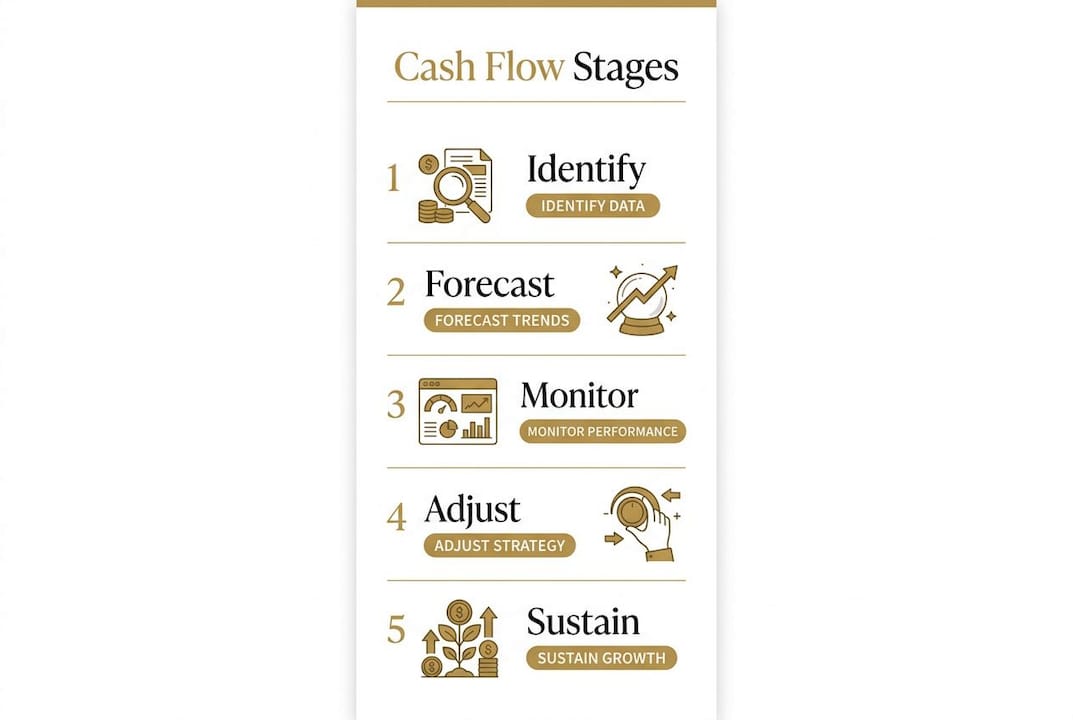
Pro Tip: Build a 13-week rolling cash flow forecast. Update it every week. This single habit gives you visibility into cash gaps before they become emergencies, not after.
The practical implication is that startups without 12 months of runway face serious risk of layoffs and forced budget cuts. Twelve months sounds like a long time. In practice, between fundraising cycles, hiring delays, and unexpected expenses, it disappears faster than most founders expect. Founders who treat runway as a cushion rather than a countdown clock tend to run out of time before they run out of ideas.
| Scenario | Profitable? | Cash positive? |
|---|---|---|
| Revenue exceeds costs on paper | Yes | Not necessarily |
| Delayed client payments (net-60 terms) | Yes | No |
| Rapid hiring ahead of revenue | Depends | No |
| Slow growth with tight expense control | Depends | Often yes |
What cash management mistakes do founders make most often?
Cash flow management failures account for 38% of startup failures, according to Techstars research. That figure covers a wide range of founder behaviors, from ignoring invoices to building financial models on best-case assumptions.
The most damaging mistakes fall into a predictable pattern:
- Starting fundraising too late. Founders consistently underestimate how long capital raises take. A six-month runway buffer feels safe but leaves almost no margin for a deal that takes longer than expected, an investor who pulls out, or a market shift that changes the terms. Experienced operators start raising when they have 12 months of runway remaining, not six.
- Ignoring burn rate until it is critical. Many founders track revenue obsessively but check their burn rate only when something feels wrong. By then, the options are limited and expensive.
- Forecasting from optimism. Projections built on best-case sales assumptions create a false sense of security. When reality comes in below forecast, the cash gap appears suddenly and without warning.
- Neglecting invoice follow-up. Late-paying customers are one of the most common startup cash flow problems. A founder who does not actively manage accounts receivable is effectively offering interest-free loans to clients.
- Overlooking founder financial blind spots. Cognitive biases lead founders to overweight recent wins, underweight risks, and avoid looking at numbers that tell an uncomfortable story.
Pro Tip: Set a hard rule: no financial meeting ends without reviewing burn rate, runway, and accounts receivable aging. These three numbers tell you where you actually stand, not where you hope to stand.
The deeper issue is that most founders are product builders or salespeople first. Financial discipline is a learned skill, and many founders do not invest in it until the consequences are already visible. By that point, the options narrow fast.
How can founders prevent running out of cash?
Prevention requires systems, not just awareness. Founders who survive cash crunches are not necessarily smarter. They are more disciplined about the habits and structures that keep them informed.
-
Build a “Default Alive” cash model. This framework, drawn from Startup Genome thinking, asks a simple question: if revenue growth stays flat and expenses stay constant, does the company survive? If the answer is no, the company is “Default Dead.” Knowing which category you are in changes every decision you make about hiring, spending, and fundraising.
-
Maintain 12–24 months of runway. Twelve months is the minimum. Twenty-four months gives you room to pivot, experiment, and raise capital from a position of strength rather than desperation. Managing working capital for startups is the practical discipline that makes this possible.
-
Start fundraising at 12 months of runway, not six. Capital raises routinely take longer than founders expect. Starting early means you negotiate from strength. Starting late means you accept whatever terms are available.
-
Track cash flow monthly, at minimum. Monthly cash flow statements are not optional. They are the earliest warning system available to a founder. Pair them with a rolling 13-week forecast for operational precision.
-
Control overhead before scaling. Fixed costs are the enemy of runway. Every dollar of overhead that does not directly generate revenue shortens the timeline. Founders who follow profitability best practices before scaling avoid the trap of building expensive infrastructure on an unproven model.
-
Bring in outside financial expertise early. A fractional CFO or financial advisor provides the financial clarity that most early-stage teams lack internally. The cost of that expertise is almost always lower than the cost of a cash crisis.
| Financial habit | Why it matters |
|---|---|
| 13-week rolling cash forecast | Spots cash gaps 90 days before they hit |
| Monthly burn rate review | Prevents late-stage panic decisions |
| Fundraising at 12 months runway | Preserves negotiating use |
| Conservative revenue forecasting | Avoids false security from optimistic models |
| Active accounts receivable follow-up | Closes the gap between invoiced and collected revenue |
Key Takeaways
Startups run out of cash because poor product-market fit, premature scaling, and financial mismanagement drain resources faster than revenue can replace them.
| Point | Details |
|---|---|
| Cash depletion is a symptom | The root causes are market fit, unit economics, and financial discipline, not the bank balance itself. |
| Profit does not equal cash | Delayed payments and upfront growth costs can make a profitable startup cash-poor within weeks. |
| Fundraising timing is critical | Start raising at 12 months of runway, not six, because capital cycles take longer than founders expect. |
| Burn rate must be tracked weekly | Founders who monitor burn rate proactively avoid the panic decisions that come from late discovery. |
| Scaling too early is the fastest path to failure | 93% of startups that scale prematurely face financial collapse, per Startup Genome data. |
The cash problem is almost never about cash
Hiring one more person when sales were trending up. Placing a larger inventory order to hit a price break. Delaying a fundraise because the product needed one more feature. Each of those decisions is defensible. Together, they compress runway faster than any forecast predicted.
The uncomfortable truth is that financial clarity is not a finance department problem. It is a founder problem. The CEO who does not understand their burn rate, their cash gap, or their unit economics is flying blind. And flying blind is fine until it is not.
How Commerce Catalyst helps founders stay ahead of cash problems
Founders who wait until cash is tight to seek financial help have already lost their best options. The decisions that matter most, around scaling, hiring, and fundraising, happen months before the bank balance becomes a crisis.

Commerce Catalyst works with consumer brand founders to build the financial visibility they need before problems compound. The DTC Financial Health Assessment identifies the specific cash flow constraints and blind spots in your business, not generic advice, but a clear picture of where your money is going and what to do about it. For founders who need ongoing support, fractional CFO services provide expert financial oversight without the cost of a full-time hire. The goal is simple: give you the numbers and the clarity to make decisions from a position of strength.
FAQ
What is the most common reason startups run out of cash?
Poor product-market fit is the leading root cause, explaining 43% of startup failures. Without a product the market urgently needs, revenue stays too thin to sustain operations.
Can a profitable startup still run out of cash?
Yes. Delayed client payments and upfront growth costs create a cash gap that can drain a profitable startup’s bank account even when the income statement looks healthy.
How much runway should a startup maintain?
A minimum of 12 months of runway is necessary to avoid forced layoffs and budget cuts. Twenty-four months provides enough buffer to raise capital from a position of strength.
When should a startup start fundraising?
Founders should begin raising capital when they have at least 12 months of runway remaining. Capital raises routinely take longer than expected, and a six-month buffer leaves almost no room for delays.
What is burn rate and why does it matter?
Burn rate is the amount of cash a startup spends each month beyond what it earns. Tracking it weekly gives founders early warning of cash shortfalls before they become emergencies.