
Most founders believe they make fast decisions because they’re decisive. The truth is less flattering. Understanding why founders make reactive decisions starts with recognizing that speed and quality are not the same thing. When pressure spikes, the brain physically changes which cognitive tools are available to you. What feels like sharp, confident leadership is often your nervous system running a threat response. This article breaks down the neuroscience, the emotional triggers, and the organizational traps that push founders toward reactive choices, and gives you a clear path out.
Table of Contents
- Key takeaways
- Why founders make reactive decisions: the neuroscience
- Emotional and psychological triggers behind reactive choices
- Structural traps in scaling startups
- Moving from reactive to deliberate decisions
- From reactive to deliberate: what the shift looks like
- My take on why this is harder than it looks
- How Commerce Catalyst helps you lead with clarity
- FAQ
Key takeaways
| Point | Details |
|---|---|
| Stress rewires your brain | High cortisol impairs the prefrontal cortex, making reactive decisions feel correct even when they are not. |
| Emotions drive the pattern | Fear, uncertainty, and emotional relief create reinforcing cycles that keep founders stuck in reactive mode. |
| Scaling creates structural traps | Operational complexity and alignment gaps force last-minute choices that should have been made proactively. |
| Recognition comes before change | Identifying your personal emotional triggers is the first step to breaking reactive decision cycles. |
| Systems beat willpower | Leadership structures and consulting support sustain decision quality better than individual discipline alone. |
Why founders make reactive decisions: the neuroscience
The biology here is not abstract. When you face a high-stakes situation as a founder, your brain does not simply think faster. It thinks differently, and not in a way that serves you.
The Yerkes-Dodson model shows that performance improves as arousal increases, up to a point. Beyond that peak, excessive stress floods the brain with cortisol and degrades the very functions you need most: planning, evaluating options, and weighing long-term consequences. You are not under-thinking the problem. You are thinking with the wrong part of your brain.
Here is what that looks like mechanically:
- The amygdala, your brain’s threat detector, takes over from the prefrontal cortex
- Attention narrows to what feels urgent, regardless of what actually is urgent
- Options collapse into binary choices: act now or lose everything
- Speed feels like clarity, but it is actually cognitive contraction
Cognitive narrowing is the technical term for what happens when your brain shrinks the perceived option set under threat. Creative alternatives disappear. You stop seeing the third path because your brain has literally stopped looking for it.
“Stress changes which brain functions are available, explaining why reactive decisions can feel decisive in the moment but lack quality.”: Neurosity
The founder environment is almost perfectly designed to trigger this response. You face financial uncertainty, team conflict, customer churn, and investor pressure, often simultaneously. Each of those stressors individually can push you past the optimal arousal threshold. Together, they create chronic conditions where threat-driven reactive choices become your default mode rather than your exception.
Emotional and psychological triggers behind reactive choices
The neuroscience explains the mechanism. The emotional layer explains why founders stay stuck in it.
Phil Neil’s TEDx research frames this as the “Shadow of Entrepreneurship.” Beneath the confident exterior most founders project lives a set of internal emotional drivers: uncertainty about whether the business will survive, fear of being exposed as inadequate, and a persistent sense of unworthiness that no revenue milestone seems to fully silence. These are not character flaws. They are predictable responses to an extraordinarily high-stakes environment.
The problem is what these emotions do to your decisions. When you act reactively and the immediate crisis resolves, you feel relief. That relief is real and powerful. Your brain registers it as a reward and files away the lesson: reacting fast made the bad feeling stop. Over time, this creates a reinforcing loop where reactive behavior is emotionally rewarded even when it is strategically costly.
Common emotional triggers that manifest in startup dynamics include:
- A key hire resigns and you immediately promote someone internally without evaluating fit
- A competitor launches a new product and you pivot your roadmap within 48 hours
- A major customer complains and you discount your pricing to keep them, undermining your margin structure
- An investor expresses concern and you restructure your entire strategy before the next board meeting
Each of these is a reactive decision example driven by the desire to stop an uncomfortable feeling, not by a clear-eyed evaluation of what the business actually needs.
Decision fatigue compounds this significantly. Founders make hundreds of decisions daily. As cognitive resources deplete, the brain defaults to the easiest available option, which is almost always the reactive one. You are not getting worse at your job as the day progresses. You are running low on the neurological fuel that makes deliberate thinking possible.
“Internal emotions like uncertainty, fear, and unworthiness reinforce reactive decision patterns despite their long-term cost to business and health.”: Phil Neil, TEDx
The uncomfortable truth about founder decision psychology is that mistaking felt clarity for objective clarity is one of the most common traps. When you are stressed and you land on an answer, it feels certain. That feeling is not evidence of a good decision. It is evidence that your threat response has settled on something, anything, to reduce the discomfort of uncertainty.
Structural traps in scaling startups
Even founders who manage their stress well and understand their emotional triggers can fall into reactive patterns because of how their organizations are structured. This is where the conversation shifts from personal psychology to operational reality.

Fast-growing companies consistently develop fault lines in oversight and financial management that push decision control back onto founders at the worst possible moments. As the business scales, complexity grows faster than alignment. Teams make decisions in silos. Information arrives late. By the time a problem surfaces to the founder level, the window for a deliberate, proactive response has already closed.
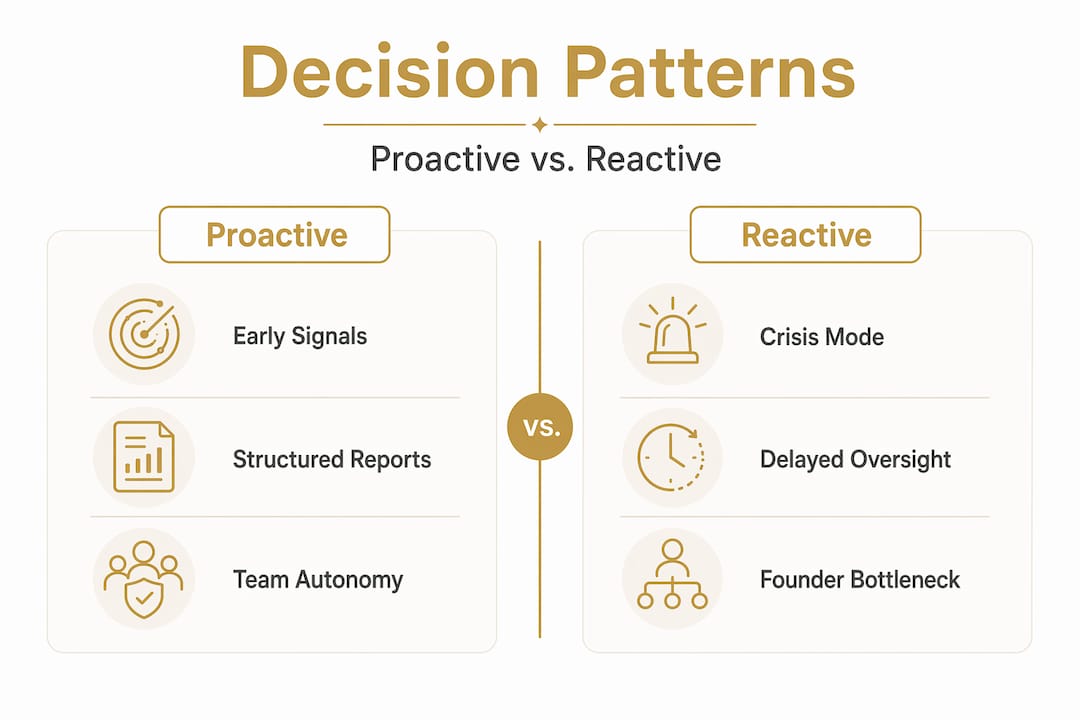
| Proactive decision culture | Reactive decision culture |
|---|---|
| Issues surface early through structured reporting | Problems escalate until they become crises |
| Decision authority is distributed and clear | Founder becomes the bottleneck for every choice |
| Teams communicate proactively on risks | Teams communicate only under pressure |
| Strategic reviews happen on a schedule | Strategy shifts in response to recent events |
Reactive accountability trains teams to behave in a specific way. When people learn that communication only matters when things go wrong, they stop communicating proactively. This erodes the early-warning systems that would otherwise give founders time to think. The result is a culture where everyone, including the founder, is perpetually in response mode.
Leadership structure gaps are often the real cause of what looks like a founder’s personal decision-making problem. If you are constantly making reactive calls, it is worth asking whether the issue is your psychology or your org chart.
Pro Tip: Audit the last five decisions you made under pressure. How many of them could have been made a week earlier with better information systems? That gap is an organizational problem, not a personal one.
Moving from reactive to deliberate decisions
Breaking the reactive pattern requires work at three levels: your nervous system, your self-awareness, and your organizational structure. None of these alone is sufficient.
-
Regulate your nervous system first. You cannot think strategically from inside a threat response. Expanding peripheral vision is one technique that interrupts threat signals by shifting the brain out of narrow-focus mode. Slow, deliberate breathing achieves a similar effect. The goal is not to eliminate stress but to bring arousal back below the threshold where your prefrontal cortex goes offline.
-
Name the emotional trigger before you act. When you feel the pull to decide immediately, ask what emotion is driving the urgency. Is it genuine business necessity or is it the desire to stop feeling uncertain? Naming the emotion creates a small but critical gap between stimulus and response.
-
Build decision structures that reduce last-minute pressure. Weekly leadership reviews, clear escalation criteria, and distributed decision authority all reduce the frequency with which decisions land on your desk already on fire. The Next Move Finder tool from Commerce Catalyst is one resource for evaluating options methodically rather than instinctively.
-
Apply the Calm, Clarify, Commit framework. Phil Neil’s TEDx research describes this three-step inner operating system as a practical way to interrupt reactive cycles. Calm the nervous system first. Clarify what the decision actually requires. Then commit to a course of action from that steadier state.
-
Bring in outside perspective. Effective founder decision-making depends heavily on mindset state and decision preparation, not just the information available. A trusted advisor who is not inside the emotional weather of your company can see options you cannot.
Pro Tip: Create a personal “decision delay” rule for non-emergency choices. If a decision can wait 24 hours without genuine business harm, make yourself wait. Most decisions that feel urgent are not.
From reactive to deliberate: what the shift looks like
Concrete examples make this real. Consider a few typical reactive decision scenarios and what deliberate leadership looks like instead.
- Reactive: A founder sees a month of flat sales and immediately cuts the marketing budget. Deliberate: The founder reviews three months of trend data, identifies whether the issue is acquisition or retention, and makes a targeted adjustment.
- Reactive: A team member raises a concern in a meeting and the founder announces a new policy on the spot to address it. Deliberate: The founder acknowledges the concern, commits to a follow-up within 48 hours, and consults the relevant stakeholders before deciding.
- Reactive: A competitor announces a price cut and the founder matches it within hours. Deliberate: The founder assesses whether the competitor’s pricing reflects a sustainable strategy or a desperation move, and holds pricing while monitoring customer response.
The benefits of the deliberate approach compound quickly. Teams gain confidence in leadership. Decisions hold up under scrutiny. Resources stop getting reallocated every time the emotional weather changes. The DTC turnaround playbook from Commerce Catalyst documents exactly this kind of shift in consumer brands that moved from chaotic reaction to structured strategy.
How Commerce Catalyst helps you lead with clarity
If you recognize yourself in this article, the next step is not more reading. It is getting a clear picture of where reactive patterns are costing your business the most.
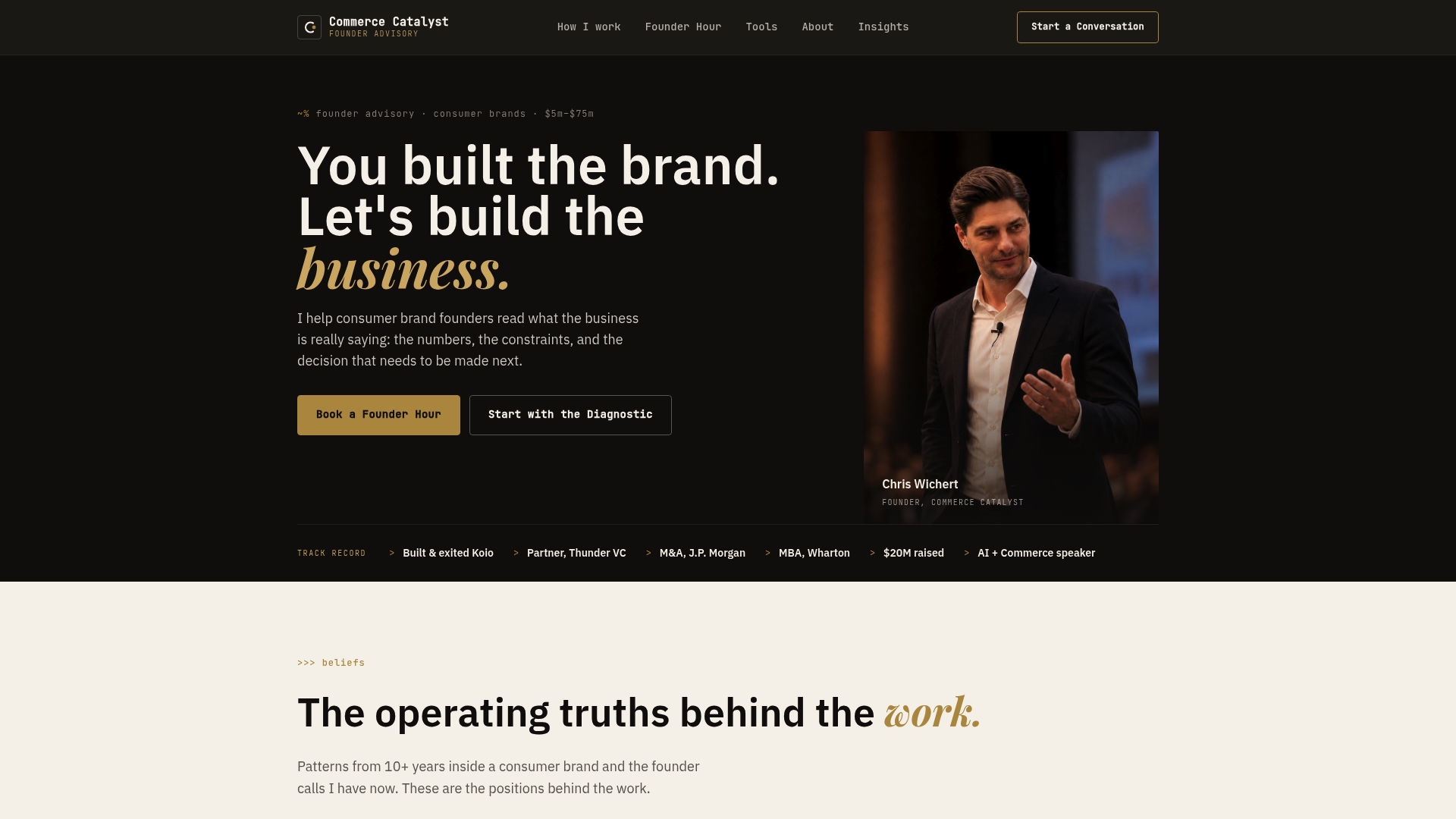
Commerce Catalyst works directly with consumer brand founders to identify the financial and operational constraints that create reactive pressure in the first place. A DTC Financial Health Assessment gives you the financial clarity that makes proactive decisions possible. If you need ongoing support, the Founder Hour is a direct line to experienced guidance when the pressure is highest. For brands going through rapid scaling, interim leadership can take decision weight off your plate while you build the structures that prevent reactivity from taking hold again.
FAQ
Why do founders make reactive decisions under pressure?
When stress levels exceed the optimal threshold, cortisol floods the brain and impairs prefrontal cortex function. This shifts thinking toward fast, threat-driven responses that feel decisive but often lack strategic quality.
What are common reactive decision examples in startups?
Common examples include cutting marketing budgets after a single bad month, matching a competitor’s price cut within hours, or restructuring company strategy after one investor conversation, all driven by emotional urgency rather than data.
How does decision fatigue affect founder decision-making?
Sustained decision-making under stress depletes cognitive resources and increases reliance on default, low-effort choices. Founders making hundreds of decisions daily are especially vulnerable to this degradation in judgment quality.
Can organizational structure cause reactive leadership?
Yes. Alignment and oversight gaps in fast-scaling companies push decisions back to founders at crisis points, making proactive leadership structurally difficult regardless of individual intent or skill.
What is the first step to breaking reactive decision patterns?
Nervous system regulation comes before everything else. You cannot access deliberate, strategic thinking while your brain is in threat mode. Techniques like expanding peripheral vision or controlled breathing restore access to the prefrontal cortex where quality decisions are made.