Founder decision avoidance is defined as the pattern where leaders delay or sidestep difficult choices not because they lack information, but because the emotional cost of being wrong feels unbearable. 57% of senior leaders report that fear of negative consequences, not a lack of data, is the primary driver of delayed decisions. That statistic reframes the entire problem. Why founders avoid hard decisions has less to do with strategy and more to do with psychology. Understanding that distinction is the first step toward changing it.
Why founders avoid hard decisions: the psychological root
The most common founder decision-making pitfall is mistaking emotional avoidance for patience. Indecision is often a coping mechanism to avoid the discomfort of inevitable choices, not a rational wait for better data. Founders tell themselves they need one more quarter of numbers, one more advisor conversation, one more market signal. The real driver is fear.
Three psychological forces show up most often:
- Fear of blame. Leaders often confuse “discernment” with “overprotection,” fearing being blamed for a wrong outcome more than they fear the consequences of delay itself. The brain treats public failure as a threat to identity, not just a business setback.
- Founder identity lock. Conviction and loyalty are core founder strengths. They also become liabilities. Founders’ greatest strengths can prevent them from making hard people decisions because letting someone go or changing direction feels like a personal betrayal.
- Cognitive overload. Most founder decision-making is fast and emotional but invisible to the founder themselves. Without a structured process, the brain defaults to avoidance as a way to preserve mental energy.
“Leaders delay decisions because the emotional cost of being wrong feels higher than the cost of ambiguity. That asymmetry is what impairs timely action.”
Delayed decisions also carry a hidden cost to the founder’s own mental state. Carrying an unmade decision is exhausting. The longer it sits, the more it drains focus from every other area of the business.
How does delayed decision-making impact startups and teams?
Avoidance does not buy time. It spends it. 42% of startup failures are attributed to choosing the wrong problem or making timing errors, both of which are decision failures. That number reflects what happens when founders let ambiguity drive the business instead of the other way around.
The cost of waiting compounds fast:
- Lost runway. Founders who wait for total certainty on high-stakes personnel or strategic decisions typically delay action by 6–12 months longer than necessary. Six months of drift in a startup is not a minor inefficiency. It can mean the difference between a funded Series A and a shutdown.
- Team trust erosion. Teams feel the tension of unmade decisions before they are ever spoken aloud. Leadership silence reads as disconnection. People stop bringing problems forward because they expect no resolution.
- Ownership collapse. When a founder hesitates on a structural call, the team fills the vacuum with their own assumptions. Those assumptions rarely align. The result is fragmented execution and duplicated effort.
The challenges in entrepreneurial decisions are not just internal. They radiate outward. A founder’s hesitation becomes a team’s confusion, then a customer’s poor experience, then a revenue problem. The cascade moves faster than most founders expect.
Good leadership does not require perfect information. It requires the willingness to act with the best available information and course-correct quickly. That is a skill, and it can be built.

What decision-making frameworks help founders overcome avoidance?
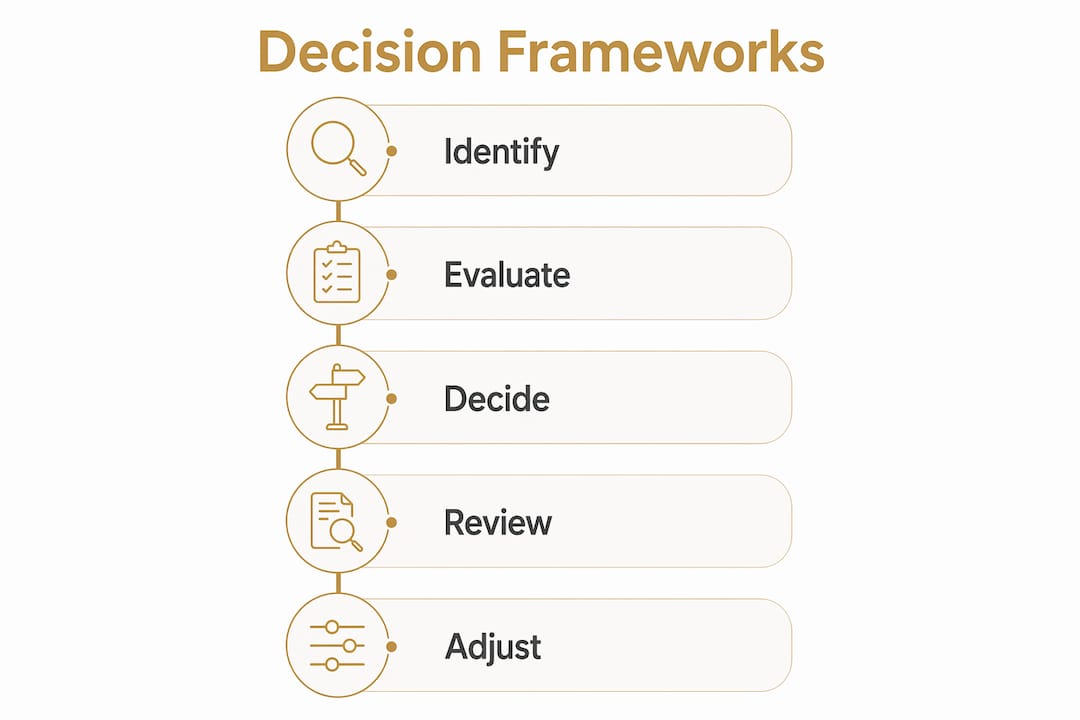
Practical frameworks reduce the emotional weight of hard choices by turning them into a process rather than a personal judgment call. Effective founders treat decision-making as a rhythmic, documented process that categorizes choices and preserves mental energy.
Reversible vs. irreversible decisions
The most useful starting framework separates decisions into two categories:
| Decision type | Characteristics | Recommended approach |
|---|---|---|
| Reversible (two-way door) | Low cost to undo, limited downside | Decide fast with 70% of ideal information |
| Irreversible (one-way door) | High cost to undo, significant downside | Deliberate carefully, use pre-mortems |
Most founder decisions are reversible. Treating them as permanent is a primary source of decision anxiety for founders. Recognizing that a pricing test or a channel shift can be undone removes the emotional weight that causes paralysis.
Four frameworks that reduce hesitation
- The 70% information rule. Act when you have roughly 70% of the information you would ideally want. Waiting for 90% or 100% costs more time than the extra certainty is worth.
- Pre-mortems. Before committing, ask: “If this fails in six months, what went wrong?” This surfaces hidden risks without requiring perfect foresight.
- Decision journaling. Write down the decision, the reasoning, and the expected outcome. Review it later. A decision journal is critical for improving future choices because it separates process quality from outcome luck.
- Grade the process, not the result. Organizations punish “unlucky” decisions even when the process was sound. Founders internalize this and become risk-averse. Grading your own decisions by the quality of the reasoning, not just the outcome, breaks that cycle.
Implementing a consistent decision-making framework can eliminate up to 90% of avoidable founder mistakes by reducing emotional reactivity and analysis paralysis. That is not a minor improvement. It is a structural shift in how a business operates.
Pro Tip: Keep a running decision log in a simple document. Date each entry, note the key factors, and record your expected outcome. Reviewing it quarterly will show you patterns in where your reasoning holds and where it breaks down.
How can founders make hard decisions faster and with more confidence?
Knowing the frameworks is not enough. Applying them under pressure requires deliberate practice and a few structural habits. These are the behaviors that separate founders who act from those who avoid tough business choices until the choice is made for them.
- Name the discomfort. Before analyzing a decision, identify the specific fear driving the delay. Is it fear of being wrong? Fear of a difficult conversation? Naming it reduces its power. Unnamed fear runs the show.
- Set decision criteria in advance. Define what “good enough” looks like before you start gathering data. Without pre-set criteria, founders keep moving the goalposts to justify more delay.
- Communicate transparently during ambiguity. Teams do not need certainty. They need honesty. Telling your team “I am working through a hard call and will have an answer by Friday” builds more trust than silence.
- Use advisors as a forcing function. Scheduling a call with an advisor to discuss a pending decision creates a deadline. Advisors guide founders through difficult choices by providing outside perspective and accountability, not just information.
- Commit to learning loops. Accept that some decisions will be wrong. Build in a review date when you make the call. Knowing you will revisit the decision in 90 days makes it easier to act now.
Founder cognitive biases like confirmation bias and sunk cost thinking compound avoidance. Recognizing them by name is the first step to working around them. The goal is not to eliminate emotion from decisions. It is to stop letting emotion be the only input.
Pro Tip: For any decision you have been sitting on for more than two weeks, set a hard deadline of 72 hours. Write down the decision, your reasoning, and commit. The act of writing forces clarity that endless mental loops never produce.
Key Takeaways
Founders avoid hard decisions primarily because of emotional and psychological barriers, not a lack of information, and structured frameworks are the most reliable way to break that pattern.
| Point | Details |
|---|---|
| Fear drives avoidance | 57% of senior leaders cite fear of negative consequences, not missing data, as the main cause of delayed decisions. |
| Delay has a measurable cost | Founders waiting for certainty lose 6–12 months of momentum on high-stakes decisions. |
| Teams feel indecision first | Leadership silence erodes team trust and causes fragmented execution before a word is spoken. |
| Frameworks reduce paralysis | Separating reversible from irreversible decisions and using pre-mortems cuts avoidable mistakes significantly. |
| Grade process, not outcome | Judging decisions by reasoning quality, not results, builds the confidence to act under uncertainty. |
The uncomfortable truth about founder hesitation
Indecision is not laziness. It is a function of how seriously founders take their role. That is worth acknowledging. But it does not make delay less costly.
The emotional discomfort of a hard decision does not go away with more information. It goes away with action. Every time you act through the discomfort and survive, your threshold for the next hard call rises. That is how decision-making confidence actually builds. Not through certainty, but through repetition.
If you are sitting on a decision right now, the framework matters less than the act of deciding. Pick a method, set a deadline, and commit. The cost of waiting almost always exceeds the cost of acting imperfectly.
How Commerce Catalyst supports founders facing hard decisions
Founders who struggle with decision avoidance often find that financial clarity is the missing piece. When you cannot see the real numbers behind a choice, every option feels equally risky.
Commerce Catalyst works directly with consumer brand founders to translate complex financial realities into clear, prioritized decisions. The DTC Financial Health Assessment identifies the specific constraints holding your business back, so you can stop deliberating over the wrong variables and act on the ones that actually matter. For founders who need a faster read on their operations, the DTC Operator Diagnostic provides a structured starting point. Chris Wichert brings the perspective of someone who has made these calls himself, which means the guidance is grounded in real founder experience, not theory.
FAQ
Why do founders avoid hard decisions even when they know the answer?
Fear of negative consequences is the primary driver, not missing information. The emotional cost of being wrong feels higher than the cost of continued ambiguity, which creates a strong pull toward delay.
What is the biggest risk of delayed decision-making for startups?
Founders who wait for certainty typically lose 6–12 months of momentum on critical decisions. That delay compounds into lost revenue, eroded team trust, and missed market windows.
How does indecision affect a startup team?
Teams sense unmade decisions before they are spoken. Leadership silence causes a loss of trust and escalates operational issues, often before the founder realizes the impact has spread.
What is the reversible vs. irreversible decision framework?
This framework separates choices into two-way doors (easy to undo, decide fast) and one-way doors (hard to undo, deliberate carefully). Most founder decisions are reversible, and recognizing that removes unnecessary emotional weight.
How can a decision journal improve founder decision-making?
A decision journal records the reasoning and expected outcome at the time of each choice. Reviewing it later separates process quality from outcome luck, which builds better judgment over time.