Brand strategy is the foundational decision-making framework that determines what a business prioritizes, how it allocates resources, and where it draws the line on growth opportunities. Most founders treat it as a marketing deliverable. That’s the wrong frame entirely. Brand strategy connects customer choice, internal behavior, and business economics into one organizational frame, which means every major call you make as a founder, from hiring to pricing to product development, runs through it. 88% of consumers say trust in a brand is a significant purchasing factor. That number tells you brand is not a communications exercise. It’s a trust infrastructure that either supports your decisions or undermines them.
Why brand strategy drives decisions across your business
Brand strategy shapes decisions long before a marketing brief gets written. It defines which customers you serve, which problems you solve, and which opportunities you walk away from. When founders treat it as a leadership tool rather than a creative output, the quality of decisions across the entire organization improves.
Here’s where brand strategy directly influences key business calls:
- Customer selection. Your brand positioning defines who you are for and, just as critically, who you are not for. Trying to serve everyone is a decision failure, and brand strategy prevents it.
- Product development. A clear brand identity filters feature requests and product extensions. Patagonia, for example, enforces product durability as a brand constraint, rejecting off-brand profit opportunities that would dilute its core promise.
- Pricing. Your price point is a brand signal. Premium positioning requires pricing discipline even when discounting would drive short-term volume. Brand strategy holds that line.
- Marketing channels and messaging. Brand strategy tells you which channels fit your audience and which messages reinforce your positioning. Without it, you spend reactively.
- Hiring. Teams built around a clear brand identity hire for cultural fit and capability alignment, not just skill sets. This reduces costly mis-hires and speeds onboarding.
Pro Tip: Before approving any new initiative, run it through one filter: does this decision reinforce or contradict our brand positioning? If the answer is unclear, the strategy needs sharpening before the decision gets made.
The role of brand strategy as a decision filter is especially valuable for founders who find themselves making reactive calls under pressure. A defined brand framework replaces gut instinct with a repeatable standard.

Does emotion or logic drive consumer brand decisions?
Consumers decide emotionally and justify rationally. This is not a marketing opinion. It is a finding from behavioral economics and neuroscience. The brain operates on two systems: System 1 is fast, emotional, and automatic; System 2 is slow, deliberate, and analytical. System 1 thinking shapes brand preferences before formal evaluation begins.
What this means for founders is direct. Brand familiarity beats technical superiority at the moment of decision. A customer who has seen your brand consistently across multiple touchpoints has already formed a preference before they compare specs or prices. Emotional resonance built via consistent brand touchpoints forms unconscious preferences that drive purchase before rational justification kicks in.
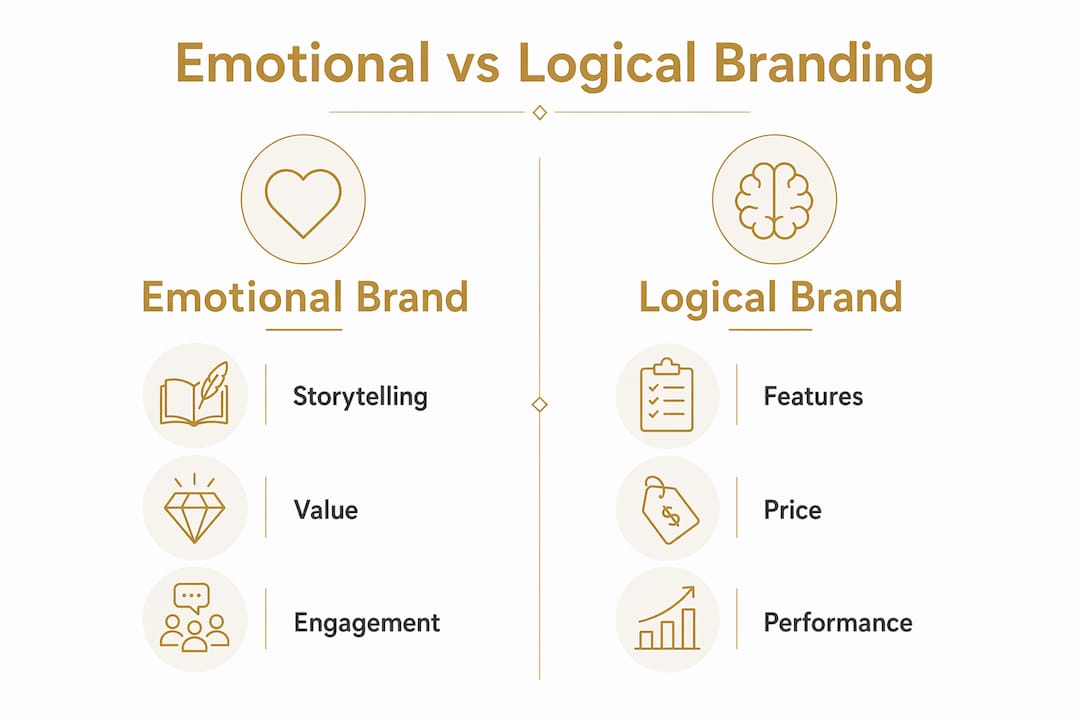
The practical implication is a budget and timing question. The 60/40 rule allocates 60% of brand effort to emotional brand-building and 40% to rational activation for optimal growth. Most early-stage founders invert this ratio, spending heavily on performance marketing while underinvesting in brand equity. That approach works short-term but creates a ceiling on growth because it never builds the trust infrastructure that drives repeat purchase and word-of-mouth.
| Investment Type | Focus | Primary Outcome |
|---|---|---|
| Emotional brand-building (60%) | Storytelling, values, consistency | Long-term preference and trust |
| Rational activation (40%) | Offers, features, comparisons | Short-term conversion and sales |
Pro Tip: Map every customer touchpoint, from your homepage to your packaging to your post-purchase email, and ask whether each one reinforces the same emotional promise. Inconsistency at any touchpoint erodes the trust you’ve built everywhere else.
The impact of branding on decisions is most visible when a customer chooses a familiar brand over a technically superior competitor. That is System 1 at work, and it is the reason brand-building must happen well before the purchase moment.
Brand strategy as an operating system vs. a marketing deliverable
The most expensive mistake a founder can make is treating brand strategy as a visual identity project. A logo and a color palette are outputs. Brand strategy is the input that should drive everything else. Brand strategy is an invisible operating system that constrains what a company will do, enabling clearer choices and rejection of distractions.
The difference in organizational outcomes is significant:
| Approach | What It Produces | Organizational Cost |
|---|---|---|
| Brand as visual identity | Consistent aesthetics, inconsistent decisions | High: teams operate without a shared decision filter |
| Brand as marketing deliverable | Good campaigns, misaligned operations | Medium: marketing wins but ops and HR drift |
| Brand as leadership constraint | Aligned teams, faster decisions, lower overhead | Low: everyone knows what to pursue and what to reject |
Companies that treat brand strategy as leadership work see marketing costs fall as the organization aligns. This happens because aligned teams spend less time debating priorities and more time executing against a shared standard. Reactive pivots, expensive rebrands, and misaligned hires all become less frequent.
The benefits of a strong brand strategy extend across every function. A brand operating as a decision system influences sales scripts, onboarding processes, content priorities, and governance structures. When every department operates from the same brand framework, the organization moves faster and wastes less.
How founders integrate brand strategy into daily leadership
Embedding brand strategy into daily decisions requires a deliberate process. It does not happen by posting values on a wall or writing a brand guide that lives in a shared drive. Here is a practical sequence for founders who want brand strategy to function as a real decision tool:
-
Define your brand’s non-negotiables. Identify two or three commitments your brand will never compromise, regardless of short-term pressure. For Patagonia, product durability is one. For your brand, it might be transparency, accessibility, or craftsmanship. These become your veto criteria.
-
Apply the brand filter to every major opportunity. Before entering a new market, launching a product, or signing a partnership, ask whether it reinforces your positioning. Use founder decision frameworks to structure this evaluation consistently.
-
Allocate budget using the 60/40 rule. Assign 60% of brand investment to long-term emotional building and 40% to short-term activation. Review this split quarterly and resist the pressure to shift everything toward performance marketing when growth slows.
-
Hire against brand values, not just job descriptions. Every hire either reinforces or dilutes your brand culture. Build interview processes that test for alignment with your brand’s core commitments, not just technical competence.
-
Measure brand alignment as a business metric. Track customer retention, net promoter scores, and repeat purchase rates as indicators of brand health. These metrics tell you whether your brand strategy is working as a trust-building system.
-
Review decisions retrospectively. Once a quarter, audit three to five major decisions against your brand framework. Ask whether each one moved you closer to or further from your positioning. This practice builds organizational muscle memory.
The decision making and brand management connection becomes clearest when founders realize that most costly pivots trace back to decisions made without a brand filter in place.
Key takeaways
Brand strategy is the single most underused leadership tool available to founders, and the cost of ignoring it shows up in misaligned teams, reactive decisions, and stalled growth.
| Point | Details |
|---|---|
| Brand strategy is a decision filter | Use it to evaluate every major business call before committing resources. |
| Emotion drives purchase before logic | Invest 60% of brand effort in emotional building to win preference early. |
| Brand as operating system cuts costs | Aligned teams make faster decisions and generate fewer expensive pivots. |
| Non-negotiables create clarity | Define two or three brand commitments that function as veto criteria. |
| Trust is a measurable asset | Track retention and repeat purchase rates as direct indicators of brand health. |
Brand strategy is a leadership problem, not a marketing one
The founders who get this right treat brand clarity the way they treat financial discipline. They revisit it when markets shift. They use it to say no to partnerships that would dilute their positioning. They build hiring criteria around it. And they measure its impact in retention and margin, not just in brand awareness scores.
How Commerce Catalyst helps founders build brand-driven businesses
Knowing why brand strategy drives decisions is the first step. Translating that into financial and operational clarity is where most founders get stuck.
Commerce Catalyst works directly with consumer brand founders to connect brand strategy with profitability planning. Chris Wichert’s DTC Financial Health Assessment identifies where misaligned decisions are costing you margin and cash flow, and maps a path to brand-driven growth. If you’re scaling and need ongoing financial leadership, the Fractional CFO service integrates brand alignment directly into your financial planning process. These aren’t generic consulting engagements. They’re built for founders who have a brand and need to make it work harder as a business system.
FAQ
What is brand strategy in simple terms?
Brand strategy is a leadership framework that defines what a company stands for, who it serves, and how it makes decisions. It connects customer trust, internal priorities, and business economics into one operating system.
How does brand strategy influence business decisions?
Brand strategy acts as a filter for every major call, from product development to hiring to pricing. Brand strategy connects customer choice and internal behavior, which means decisions made against a clear brand framework are faster and more consistent.
Why does emotional branding matter more than product features?
Consumers use System 1 thinking to form brand preferences before they evaluate features or prices. Brand familiarity beats technical superiority at the moment of decision, which is why consistent emotional brand-building drives purchase more reliably than product comparisons.
What is the 60/40 rule in brand strategy?
The 60/40 rule allocates 60% of brand investment to long-term emotional brand-building and 40% to short-term rational activation. This split is grounded in behavioral economics and produces better growth outcomes than performance-only marketing approaches.
How do i know if my brand strategy is working?
Measure customer retention rates, repeat purchase frequency, and net promoter scores. These metrics reflect whether your brand is building the trust and preference that drive sustainable growth, not just one-time conversions.