
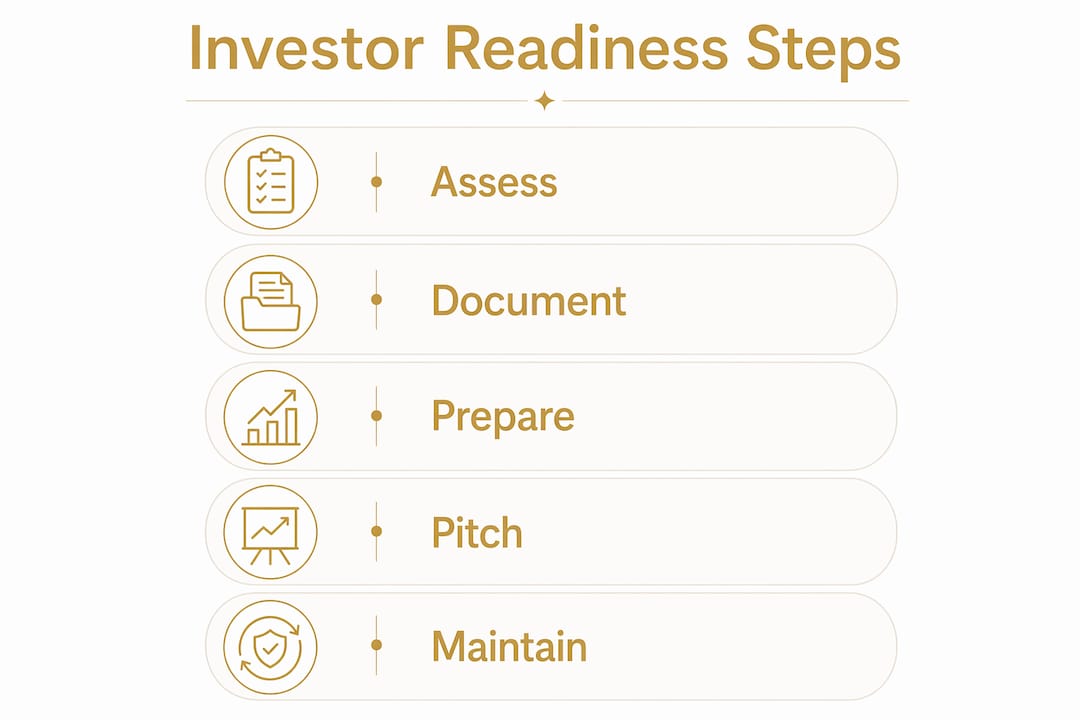
Investor readiness is the measurable state of preparedness that allows you to engage potential investors with credibility, operational clarity, and honest evidence about your business. It is not a pitch deck. It is not a compelling story alone. True readiness means your financials are clean, your company structure signals motivated ownership, your data room tells a coherent story, and your team can defend every assumption under pressure. According to Chris Neumann’s framework, the core elements of investor readiness include:
- A precise, evidence-backed business description investors can evaluate quickly
- Organized financial statements showing current health and growth trajectory
- A cap table that reflects founder motivation and clean equity structure
- A curated data room with key contracts, strategy memos, and governance documents
- Company formation and structure suited to the type of investment you are seeking
Readiness also determines your timing use. Founders who maintain ongoing readiness can approach investors from a position of strength rather than desperation, testing the market when their value proposition is validated rather than when cash pressure forces the conversation.
Table of Contents
- Common misconceptions about investor readiness that founders get wrong
- How investor readiness requirements differ by funding type
- How to build a valuation story that holds up under scrutiny
- Why operational maturity and documentation determine investor trust
- Steps to prepare investor pitch materials that actually work
- How to assess and improve your business model’s scalability
- What investor due diligence actually looks like and how to prepare
- Specific challenges consumer brand founders face in the U.S. market
- Key Takeaways
Common misconceptions about investor readiness that founders get wrong
The most expensive misconception is that finishing a pitch deck means you are ready to fundraise. Investors back people and underlying economics, not polished presentations. A deck amplifies evidence; it cannot manufacture it.
Several other myths consistently derail founders before they reach a term sheet:
- Believing informal positive feedback from investors equals readiness
- Assuming the same preparation works for angel rounds and institutional VCs
- Treating financial projections as aspirational rather than defensible
- Confusing a large TAM slide with actual market validation
- Underestimating how much a messy cap table or unclear governance signals risk
The deeper issue is that many founders approach fundraising as a sales process. It is not. Investors are conducting a buy-side evaluation of your business as a financial asset. That mindset shift, from pitching to demonstrating, changes everything about how you prepare.
Pro Tip: Before your first investor meeting, ask yourself whether a skeptical financial analyst could reconstruct your business model, unit economics, and growth assumptions from your data room alone, without you in the room. If the answer is no, you are not ready.
Commerce Catalyst works with founders who have often received encouraging signals from investors but stall when diligence begins. The gap is almost always operational, not narrative.
How investor readiness requirements differ by funding type
Not all capital is created equal, and the preparation requirements vary significantly depending on who you are raising from. Understanding those differences lets you target your preparation rather than over-engineering for the wrong audience.
- Angel investors typically accept lighter documentation, move faster, and invest on founder conviction and early traction. A clean pitch, basic financials, and a credible founding story often suffice.
- Institutional venture capital demands deep evidence: audited or reviewed financials, detailed unit economics, a structured data room, legal compliance documentation, and a valuation narrative your lead partner can defend to their investment committee.
- Crowdfunding platforms (Regulation CF or Regulation A+ in the U.S.) require SEC-compliant disclosures, audited financials above certain thresholds, and consumer-facing storytelling that converts retail investors at scale.
For consumer brand founders specifically, the types of brand investors you target should shape your readiness checklist from day one. A strategic acquirer evaluating a minority stake has entirely different diligence priorities than a CPG-focused growth equity fund.
How to build a valuation story that holds up under scrutiny

A valuation story is not a comparable transactions spreadsheet. It is a coherent argument that ties your stage, revenue profile, growth rate, market dynamics, and risk profile to a number your investor can defend internally. Investors seek defensible arguments that go beyond comps, aligned with their investment committee’s requirements.
The strongest valuation narratives address four elements:
- Growth rate and trajectory: Not just current revenue, but the shape of growth and what is driving it
- Unit economics: Customer acquisition cost, lifetime value, payback period, and contribution margin at the unit level
- Market dynamics: Why this category, why now, and why your brand has a defensible position within it
- Risk profile and mitigants: What could go wrong and what you have already done about it
Founders who align financial data with narrative before investor meetings consistently face less valuation pushback. The goal is to answer the hard questions before they are asked.
The core insight: Investors do not just want to know what your business is worth. They want to know that you understand why it is worth that, and that your assumptions survive contact with reality.
Why operational maturity and documentation determine investor trust
Operational maturity is the evidence that your business runs on systems, not on founder heroics. For consumer brands, this shows up in inventory management discipline, clean 3PL relationships, documented SOPs, and financial reporting that does not require a week of cleanup before every investor conversation.
Your data room is the physical proof of that maturity. A curated, logically organized data room tells your company’s story to a reviewer who has never met you. A dumped folder of files tells a different story entirely. Key documents every consumer brand founder should have ready:
- Audited or reviewed financial statements (P&L, balance sheet, cash flow)
- Cap table with vesting schedules and any option pool clearly documented
- Key customer and supplier contracts
- Corporate formation documents and any existing investor agreements
- A strategy memo that frames the business for a first-time reviewer
Pro Tip: Treat your data room as a living document, not a fundraising artifact. Founders who maintain it continuously can engage investors opportunistically, on their own timeline, rather than scrambling when an inbound inquiry arrives.
Ongoing investor readiness is a form of strategic flexibility. It means you control the timing of the conversation.
Steps to prepare investor pitch materials that actually work
Pitch preparation is where most founders spend too much time on design and too little on substance. The materials that move investors forward share a common structure: they lead with the problem, prove the solution with evidence, and make the ask specific.
Start with a one-page investment summary. It should answer what the business does, who the customer is, what traction exists, and how the capital will be deployed, in under 90 seconds of reading time. The pitch deck expands on that summary across roughly 12–15 slides, with each slide earning its place through a specific fact or proof point.
Your financial model deserves its own preparation pass. Investors will stress-test your assumptions, so know your numbers at the unit level: cost of goods sold by SKU, contribution margin by channel, customer acquisition cost by acquisition source. Consistency across your deck, your model, and your data room is not optional. Discrepancies, even small ones, signal that the numbers were assembled for the pitch rather than extracted from how you actually run the business.
How to assess and improve your business model’s scalability
Scalability, for a consumer brand, means revenue can grow without costs growing proportionally. The honest assessment starts with your gross margin. Brands with gross margins below 40% face a structural challenge in most institutional investor conversations, because the math on marketing spend, fulfillment, and overhead leaves little room for the returns investors need.
Beyond margin, examine whether your customer acquisition is repeatable and whether your retention metrics support the lifetime value assumptions in your model. A brand that acquires customers profitably and keeps them is a fundamentally different investment than one dependent on continuous paid acquisition to sustain revenue. Growth rate and investor appeal are directly connected to whether that growth is organic, defensible, and margin-accretive.
Market fit assessment is equally concrete. Are customers returning without prompting? Is your net promoter score trending up? Are you winning in a defined niche before expanding? Investors value focused execution in a beachhead market over broad ambition with thin evidence.
What investor due diligence actually looks like and how to prepare
Due diligence is not a formality. For institutional investors, it is a structured process that typically covers financial, legal, commercial, and operational dimensions. Most founders underestimate how deep it goes and how quickly inconsistencies surface.
Financial diligence examines your historical P&L for revenue quality, your balance sheet for hidden liabilities, and your projections for internal consistency. Legal diligence reviews corporate structure, IP ownership, employment agreements, and any existing investor rights. Commercial diligence validates your market claims, customer relationships, and competitive positioning through reference calls and independent research.
The best preparation is running a version of this process on yourself before any investor does. A financial health assessment surfaces the gaps that would otherwise appear mid-diligence, when the cost of fixing them is highest. Founders who have done this work arrive at diligence with answers, not surprises.
Specific challenges consumer brand founders face in the U.S. market
The U.S. consumer brand market presents a specific set of investor readiness challenges that generic startup frameworks do not fully address. Channel complexity is one of them. A brand selling across DTC, Amazon, and wholesale carries three distinct revenue streams with different margin profiles, return rates, and customer acquisition dynamics. Investors will disaggregate these, and founders who cannot explain the unit economics by channel will struggle.
Inventory financing and working capital cycles are another pressure point. Consumer brands often carry significant inventory risk, and investors scrutinize cash conversion cycles carefully. A brand that cannot explain its inventory turn, its 3PL cost structure, or its seasonal cash flow patterns signals operational immaturity regardless of how strong the top-line growth looks.
Founder clarity under pressure matters more than most founders realize. The psychological dimension of investor readiness is real: investors read how you respond to hard questions as a proxy for how you will manage the business through difficulty. Transparency about weaknesses, paired with a credible mitigation plan, builds more trust than a polished deflection.
If you are a consumer brand founder working through these questions, Commerce Catalyst’s DTC Financial Health Assessment is built for exactly this moment. It surfaces the financial and operational gaps that matter most to investors, before you are sitting across the table from one.
Key Takeaways
Investor readiness is a measurable, operational state of preparedness, not a pitch deck, and consumer brand founders who build it continuously raise on their own terms rather than under pressure.
| Point | Details |
|---|---|
| Readiness goes beyond the deck | Clean financials, a curated data room, and a defensible cap table are the real signals investors evaluate. |
| Funding type shapes preparation | Angel rounds require lighter documentation; institutional VCs demand unit economics, legal compliance, and a committee-ready valuation narrative. |
| Valuation story must be defensible | Tie growth rate, unit economics, market dynamics, and risk mitigants to a number your investor can defend internally. |
| Operational maturity is visible | A well-organized data room and channel-level unit economics signal that the business runs on systems, not founder heroics. |
| Ongoing readiness creates use | Founders who maintain readiness continuously can engage investors opportunistically, on their timeline, not under external pressure. |