
A business growth constraint is the single limiting factor that prevents your company from scaling its operations and revenue beyond a certain point. In the Theory of Constraints, developed by Eliyahu Goldratt, this bottleneck is the one place in your system where throughput breaks down. Every other improvement you make is secondary until you fix it. Understanding what is a business growth constraint is not an academic exercise. It is the difference between a company that compounds growth year over year and one that stalls after its first wave of momentum.
What are the common types of business growth constraints?
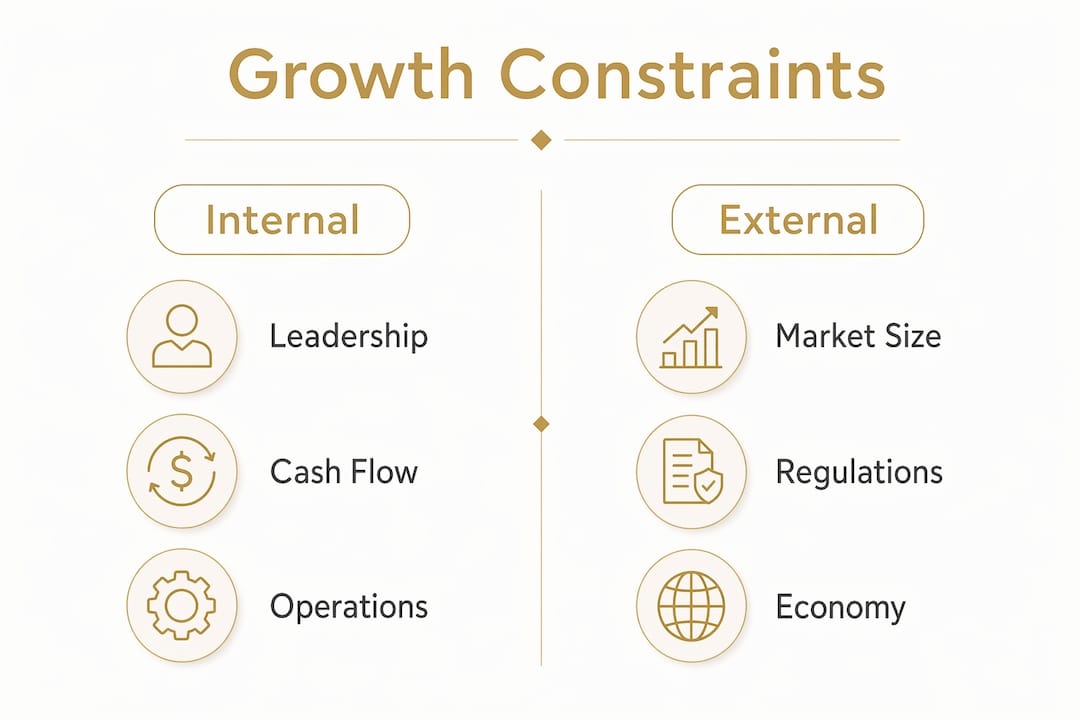
Business growth barriers fall into two broad categories: internal and external. Internal constraints live inside your company. External constraints come from the market or regulatory environment around you. Most founders assume external factors are the main culprit. The data says otherwise.
59% of U.S. companies stall after early growth due to internal constraints like resource limits, operational inefficiencies, and leadership bottlenecks. That figure comes from a 2026 study of 1,000 U.S. business leaders. It means the ceiling most founders hit is one they built themselves.

Internal constraints
Internal constraints are the most common factors limiting business expansion, and they cluster around three areas:
- Leadership bottlenecks. The founder or CEO becomes the approval point for every decision. Growth stops when their bandwidth runs out.
- Resource limitations. Cash, talent, and technology are finite. When demand outpaces supply of any one of them, the whole system slows.
- Operational inefficiencies. Processes that worked at $1 million in revenue break at $5 million. Manual workflows, unclear ownership, and poor data visibility all create drag.
External constraints
External constraints are real but less controllable. A niche market has a hard ceiling on addressable customers. Regulatory compliance requirements add cost and slow product development. 80% of corporate leaders say growth has become more challenging, citing compliance requirements at 35% and legacy technology at 34% as primary internal barriers. The EY-Parthenon survey behind that number confirms that even what feels like an external problem often has an internal root.
| Constraint type | Examples | Control level |
|---|---|---|
| Leadership bottleneck | Founder approval loops, no delegation | High |
| Resource limitation | Cash flow gaps, talent shortages | Medium |
| Operational inefficiency | Manual processes, poor data systems | High |
| Market size | Niche ceiling, limited addressable demand | Low |
| Regulatory and compliance | Industry rules, data privacy laws | Low |
Pro Tip: Before blaming the market, audit your internal processes first. Most business scalability issues are hiding in your own org chart.
How does the Theory of Constraints apply to business growth?
The Theory of Constraints is a management framework that treats every system as limited by exactly one primary bottleneck at any given time. Fix that one constraint and the whole system performs better. Ignore it and every other improvement you make delivers diminishing returns.
Focusing on the primary constraint yields the maximum system throughput improvement. Most constraints operate below 50% efficiency, which means there is significant untapped capacity waiting to be unlocked. The goal is not to work the constraint harder. It is to keep it fully used without overloading it.
The Five Focusing Steps
Goldratt’s framework gives founders a repeatable process for constraint management:
- Identify the constraint. Find the single step in your system where work piles up consistently.
- Exploit the constraint. Get maximum output from it without spending more money yet.
- Subordinate everything else. Align all other parts of the business to support the constraint, not compete with it.
- Elevate the constraint. If steps two and three are not enough, invest to increase its capacity.
- Repeat. Once you break one constraint, a new one will emerge. Continuous application of these steps allows businesses to scale indefinitely.
A consumer brand founder might identify fulfillment as the bottleneck during a growth phase. Exploiting it means running the warehouse at full capacity before hiring. Subordinating means slowing ad spend so orders do not outpace shipping. Elevating means adding a second shift or a third-party logistics partner. Then the constraint shifts to customer service, and the cycle starts again.
One counterintuitive insight: the busiest person in a process is often not the bottleneck. The true constraint is where queues grow consistently over time. A team member who looks overwhelmed may just be doing visible work. The real block is often quieter and harder to spot.
Pro Tip: Map your order-to-cash cycle end to end. The step with the longest average wait time is almost always your primary constraint, not the step with the most activity.
What practical strategies can entrepreneurs use to overcome growth constraints?
Overcoming growth constraints requires a different mindset than building a startup. Early-stage growth rewards hustle and personal effort. Scaling requires systems, delegation, and structural change. Growth is not about adding more but removing inefficiencies and what no longer works. That shift in thinking is where most founders get stuck.
Restructure leadership roles
61% of leaders identify themselves as bottlenecks in sales and marketing, 54% in strategic focus, and 53% in operations. Those numbers are striking because they come from leaders who recognize the problem themselves. Recognition alone does not fix it. The fix is deliberate delegation backed by documented processes and clear accountability.
Founders who rely on personal networks to drive sales create what researchers call a “founder acquisition system.” It works until it doesn’t. Founder dependence limits growth unless the founder actively decouples their personal relationships from the company’s sales infrastructure. Building a repeatable sales system is not optional at scale. It is the constraint.
Prioritize by impact, not urgency
45% of growing businesses prioritize internal capabilities and vision to overcome growth constraints rather than reacting to external factors. That focus on internal drivers is what separates companies that scale from those that spin. Capital One’s June 2026 research confirms that the most resilient founders shift attention to product development and vision alignment rather than chasing market conditions they cannot control.
Prioritization is a skill. The right prioritization framework separates decisions that move the constraint from decisions that just feel productive. Not every problem deserves equal attention. Fix the bottleneck first.
Do’s and don’ts for overcoming growth constraints:
- Do document your core processes before you delegate them.
- Do measure queue length and wait times, not just output volume.
- Do reassess your primary constraint every quarter as the business grows.
- Don’t hire to solve a process problem. Fix the process first.
- Don’t run paid acquisition faster than your fulfillment or customer service can handle.
- Don’t treat every inefficiency as equally urgent. One constraint matters more than all the others combined.
Pro Tip: Use operational efficiency frameworks to map your processes visually before deciding where to invest. What you see on paper often surprises you.
How do external factors compare to internal constraints?
External factors like market size, inflation, and regulation are real. They are also largely outside your control. The more productive question is not whether external conditions are hard. It is whether you have exhausted your internal options first.
Successful leaders shift focus from external economic factors to internal growth drivers like product development and vision alignment. That shift is not optimism. It is a recognition that internal constraints are fixable and external ones often are not.
| Factor | Type | Typical impact | Founder control |
|---|---|---|---|
| Leadership bottleneck | Internal | High | High |
| Cash flow gaps | Internal | High | Medium |
| Operational inefficiency | Internal | Medium to high | High |
| Market size ceiling | External | High in niche markets | Low |
| Inflation and economic cycles | External | Medium | None |
| Regulatory compliance | External | Medium to high | Low |
A founder selling a premium product in a narrow vertical will eventually hit a market size ceiling. But most founders reach that ceiling only after solving their internal constraints. The sequence matters. Fix what you can control before concluding the market is the problem.
Key takeaways
A business growth constraint is always present. The goal is to identify the primary one, fix it, and then find the next one.
| Point | Details |
|---|---|
| Define the constraint first | A growth constraint is the single bottleneck limiting your company’s throughput at any given time. |
| Internal constraints dominate | 59% of U.S. companies stall due to internal factors, not market conditions. |
| Leaders are often the bottleneck | 61% of leaders self-identify as the constraint in sales and marketing. |
| Use the Five Focusing Steps | Identify, exploit, subordinate, elevate, and repeat to systematically remove constraints. |
| Prioritize internal drivers | Focusing on internal capabilities over external factors is the approach used by the fastest-growing businesses. |
How Commerce Catalyst helps you identify your growth constraint
Knowing you have a constraint is one thing. Knowing exactly which one is costing you the most is another.

Commerce Catalyst works directly with consumer brand founders to diagnose the financial and operational constraints holding their business back. The DTC Financial Health Assessment gives you a clear picture of where your business is leaking margin and where the primary bottleneck lives. For founders who need ongoing financial leadership to scale past the constraint, the Fractional CFO service provides the structural support to build systems that do not depend on you. If you are not sure where to start, the Next Move Finder helps you pressure-test your highest-priority decision first.
FAQ
What is a business growth constraint?
A business growth constraint is the single limiting factor that prevents a company from increasing its output or revenue beyond a certain level. Removing it unlocks growth across the entire system.
What are the most common business growth barriers?
The most common barriers are internal: leadership bottlenecks, cash flow gaps, and operational inefficiencies. A 2026 study found that 59% of U.S. companies stall due to these internal factors.
How does the Theory of Constraints help with business scalability issues?
The Theory of Constraints gives founders a five-step process to identify and remove the primary bottleneck. Fixing the one true constraint improves total system throughput more than fixing many smaller issues at once.
How do I know if I am the constraint in my own business?
If decisions consistently wait on your approval, or if your team cannot move without your input, you are the bottleneck. Research shows 61% of leaders self-identify as constraints in sales, marketing, and operations.
Should I focus on external or internal factors when trying to overcome growth constraints?
Start with internal factors. You control them. Capital One’s 2026 research shows that 45% of growing businesses prioritize internal capabilities over external conditions, and those businesses outperform peers who react to market forces instead.