
Equity dilution is defined as the reduction in a founder’s ownership percentage that occurs when a company issues new shares. Your actual share count stays the same, but the total shares outstanding grow, so your slice of the pie shrinks. According to Morgan Stanley at Work, if you own 100 shares in a company with 100 total shares, and the company issues 25 new shares, your ownership drops from 100% to 80%. That math is simple. What trips up most founders is the compounding effect across multiple rounds, option pools, and convertible instruments. Carta, the cap table management platform, tracks billions in equity across thousands of startups, and the pattern is consistent: founders who understand dilution mechanics negotiate better terms and retain more economic value at exit.
What does dilution mean for founders and what causes it?
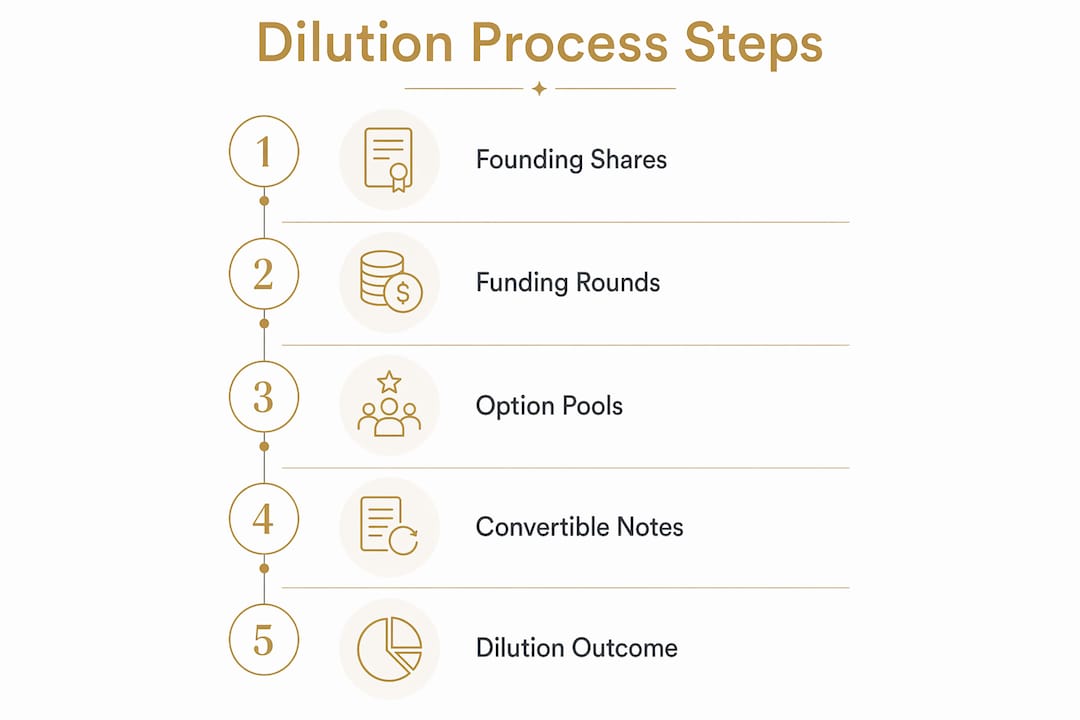
Founders equity dilution does not happen in a single event. It accumulates across every financing decision you make, and each cause works differently.
Priced equity rounds are the most visible cause. When you raise a Series A or Series B, the company issues new shares to investors in exchange for capital. Your share count stays fixed, but the denominator grows. If you owned 60% before the round and investors receive 20% of the new total, you now own roughly 48% of a larger company.

Employee stock option pools are the second major cause, and they catch founders off guard more often than priced rounds do. Investors typically require a 10% to 20% option pool before they invest. The timing of when that pool is created matters enormously. Pre-money option pool creation forces founders to absorb the dilution before investors put in a dollar, a mechanism known as the option pool shuffle. Founders can lose 2 to 5% more equity per round through this mechanism alone, and that loss compounds across rounds.
Convertible instruments including SAFEs (Simple Agreements for Future Equity) and convertible notes do not dilute you immediately. They convert into equity at a future priced round, often at a discount to the round price. The dilution hits all at once when conversion triggers, which can surprise founders who did not model the conversion math upfront.
Here is a breakdown of the primary dilution causes:
- Priced equity rounds (Series A, B, C) issuing new shares to investors
- Employee stock option pool creation, especially pre-money pools
- Convertible note and SAFE conversion at priced rounds
- Warrant issuances tied to debt financing or strategic partnerships
- Secondary transactions that restructure the cap table
Pro Tip: Always ask your attorney whether a proposed option pool will be created pre-money or post-money. Negotiating a post-money pool means investors share in that dilution rather than founders absorbing it entirely.
How dilution math works: formulas, examples, and fully diluted thinking
Understanding the arithmetic behind founder share dilution is non-negotiable before you sign a term sheet.
The dilution factor formula is clear: Dilution Factor = 1 minus (Pre-money Valuation divided by Post-money Valuation). If your pre-money valuation is $65 million and investors put in $15 million for a post-money of $80 million, your dilution factor is 18.75%. Your ownership after the round equals your pre-round ownership multiplied by the ratio of pre-money to post-money.
Here is a concrete example showing how ownership shifts across two rounds:
| Event | Pre-round ownership | Shares issued | Post-round ownership |
|---|---|---|---|
| Founding (2 founders) | 100% | 10,000,000 | 50% each |
| Seed round (20% to investors) | 50% each | 2,500,000 new | 40% each |
| Series A (25% to investors) | 40% each | 4,333,333 new | 30% each |
After two rounds, each founder owns 30% of a company that may be worth ten times what it was at founding. The percentage dropped by 40%. The dollar value likely grew.
The critical mistake founders make is calculating ownership against the wrong denominator. Fully diluted ownership accounts for all issued shares plus unexercised options, warrants, and unconverted instruments. Investors always model on a fully diluted basis. If you calculate your ownership against only issued shares, you will overestimate your stake and misread your cap table.
Follow these steps to calculate your true ownership position:
- Start with your current share count
- Add all issued shares to all other shareholders
- Add the full option pool, including unissued options
- Add any outstanding SAFEs or convertible notes on an as-converted basis
- Divide your shares by that total. That is your fully diluted ownership
Pro Tip: Tools like Carta and Pulley let you model dilution scenarios before you sign anything. Run at least three scenarios: your expected round size, a round 20% larger, and a round with a larger option pool than requested.
Why dilution is not always bad: valuation growth and founder wealth
The meaning of dilution for founders changes completely when you factor in valuation growth. A smaller percentage of a much larger company is worth more than a larger percentage of a stagnant one.
Consider this: a founder who owns 60% of a company valued at $5 million holds a stake worth $3 million. After a Series A that dilutes them to 45%, if the post-money valuation is $20 million, that same founder’s stake is now worth $9 million. Ownership percentage declined, but economic value tripled. This is the core trade-off every fundraising decision involves.
The type of round matters too. An up round, where the new valuation exceeds the previous one, means dilution is offset by value creation. A down round, where valuation falls, is genuinely damaging because you dilute at a lower price, shrinking both your percentage and your dollar value simultaneously. A flat round holds valuation steady, so dilution is real but contained. Founders who delay fundraising to avoid dilution risk losing competitive ground, which can force a down round later. That is a worse outcome than accepting dilution at a fair valuation today.
The strategic mindset shift is this: stop measuring success by ownership percentage alone. Measure it by the dollar value of your stake relative to your company’s trajectory. Percentage is a proxy. Value is the point.
How founders can protect their ownership during dilution events
Managing dilution is not about avoiding it. It is about negotiating the terms that determine how much you absorb and when.
- Negotiate option pool timing. Push for post-money option pool creation so investors share in the dilution. Pre-money pools create a double hit on founders: you absorb the pool dilution before the investor’s money even arrives.
- Size option pools accurately. Investors often request pools larger than you actually need for the next 12 to 18 months. Model your actual hiring plan and negotiate the pool down to what you genuinely need. Unused options still dilute you.
- Model convertible instruments before they convert. SAFEs and convertible notes with discount rates and valuation caps can convert at prices significantly below your next round price. Run the conversion math before your priced round closes so you know exactly what the dilution implications are.
- Raise at higher valuations. The higher your pre-money valuation, the smaller the percentage investors receive for the same dollar amount. Building revenue and traction before raising is the most direct way to reduce dilution percentage.
- Track dilution cumulatively. Sequential round modeling reveals your true ownership trajectory across Series A, B, and beyond. Most founders only look at the current round. The compounding effect across rounds is where the real surprise lives.
- Understand your rights. Pro-rata rights let existing investors maintain their percentage in future rounds. Anti-dilution provisions protect investors from down rounds. Know which provisions are in your cap table and how they affect you.
Getting financial clarity on your cap table before each round is not optional. It is the foundation of every negotiation you will have with investors.
Key takeaways
Founders who understand dilution mechanics negotiate better terms, retain more economic value, and make smarter fundraising decisions at every stage.
| Point | Details |
|---|---|
| Dilution reduces percentage, not shares | Your share count stays fixed; new share issuances shrink your ownership percentage. |
| Option pool shuffle is a hidden cost | Pre-money pools force founders to absorb dilution before investors invest; negotiate post-money pools. |
| Fully diluted math is the only math that counts | Always calculate ownership including options, SAFEs, and convertible notes as the denominator. |
| Valuation growth can offset dilution | A smaller percentage of a higher-valued company is often worth more than a larger percentage of a stagnant one. |
| Dilution compounds across rounds | Model sequential rounds to see your true ownership trajectory, not just the impact of the current deal. |
The founder psychology problem nobody talks about
The negotiation lever that genuinely moves the needle is valuation, not option pool size. Raise at a higher pre-money valuation and the dilution percentage shrinks automatically. That requires building a business with real revenue and margin before you go to market. That is harder than arguing over pool timing, but it is the lever with the most use.
Dilution is not the enemy. Raising at the wrong time, with the wrong terms, without modeling the compounding effect across rounds. That is the enemy.
How Commerce Catalyst helps founders navigate dilution
Founders who understand their numbers negotiate from strength. Commerce Catalyst works directly with consumer brand founders to translate cap table complexity into clear financial decisions before they sit across from investors.

The DTC Financial Health Assessment gives you a diagnostic view of your financial position, including how your current equity structure and cash flow interact with your fundraising readiness. For founders who need ongoing support through a raise, the fractional CFO service provides the modeling, scenario planning, and negotiation preparation that most early-stage founders cannot afford to hire full-time. If you are approaching a financing event and want to walk in knowing exactly what your cap table looks like on a fully diluted basis, that is exactly where Commerce Catalyst adds the most value.
FAQ
What does equity dilution mean for founders?
Equity dilution means your ownership percentage decreases when a company issues new shares, even though your actual share count stays the same. The more shares issued, the smaller your slice of the total.
What causes the most dilution for startup founders?
Priced equity rounds, employee stock option pools, and convertible instrument conversions are the three primary causes of founders equity dilution. Option pool timing, specifically pre-money pools, often causes more dilution than founders anticipate.
Is dilution always bad for founders?
Dilution is not inherently bad. If the new capital raises company valuation significantly, your smaller ownership percentage can be worth more in dollar terms than your larger percentage was before the round.
What is the option pool shuffle?
The option pool shuffle occurs when investors require an option pool to be created before their investment, forcing founders to absorb that dilution entirely. Negotiating a post-money pool means investors share in the dilution instead.
How do founders calculate their true ownership percentage?
True ownership is calculated on a fully diluted basis: divide your shares by the total of all issued shares plus all unexercised options, warrants, and unconverted SAFEs or convertible notes. This is the number investors use, and founders should use it too.