Decision fatigue is the progressive deterioration of judgment that occurs after sustained, high-volume decision-making. For founders, it is not a productivity complaint. It is a structural threat. Research shows that after many decisions, judgment can degrade significantly, comparably to the impairment seen with legal intoxication. Fortune 500 CEOs make a moderate number of significant decisions daily. Founders routinely face a very high volume of total decisions per day, including many operational ones that consume cognitive resources needed for strategic decisions.
The psychological term for the underlying mechanism is ego depletion, a concept rooted in Roy Baumeister’s Strength Model of Self-Control, which holds that self-regulation draws from a finite cognitive resource. When that resource runs low, two failure modes emerge: impulsivity, where the brain chases the fastest available answer, and avoidance, where it simply refuses to engage. Both are costly. The impulsive choice ignores long-term consequences. The avoided choice creates bottlenecks that compound overnight.
Here is what that looks like in practice for a founder:
- You hire someone in a moment of desperation because you cannot face another round of interviews.
- You approve a discount that destroys your margins because the negotiation felt too heavy to push back on.
- You pass on a strategic opportunity not because it was wrong, but because you could not think it through clearly at 4 PM.
- You default to the status quo on a product decision that needed a bold call.
- You snap at a team member over something trivial, then spend the next hour managing the fallout.
Decision fatigue is not weakness. It is a predictable cognitive constraint, and understanding it is the first step toward building systems that protect your judgment where it matters most.
Table of Contents
- Why founders experience decision fatigue differently than other executives
- What causes decision fatigue in founders, and how do you recognize it?
- [How does decision fatigue differ from burnout for founders?](#how-does-decision-fatigue-differ-from-burnouthttpsechobridgefrprevention-burn-out-obligations-employeur-for-founders)
- Practical strategies founders can use to overcome decision fatigue
- How Commerce Catalyst approaches founder decision fatigue
- How decision fatigue affects startup success and team dynamics
- How founders can prioritize decisions more effectively
- Tools and techniques that reduce decision fatigue for founders
- Why delegation is the most powerful lever against decision fatigue
- Key Takeaways
- Work with Commerce Catalyst to clear the cognitive load
Why founders experience decision fatigue differently than other executives
The gap between a Fortune 500 CEO and an early-stage founder is not just organizational scale. It is the nature and breadth of the decision load itself. A seasoned CEO operates inside a structure designed to absorb complexity: chiefs of staff, functional heads, legal teams, and finance departments all filter decisions before they reach the top. The founder, especially in the first few years, is all of those roles simultaneously.

Fortune 500 CEOs make roughly 35 significant decisions daily. Founders operate at the high end of this spectrum, absorbing tens of thousands of total decisions per day. Pricing, hiring, vendor contracts, customer escalations, product trade-offs, fundraising strategy, culture calls, and cash flow decisions all compete for the same cognitive resources, often within the same morning.
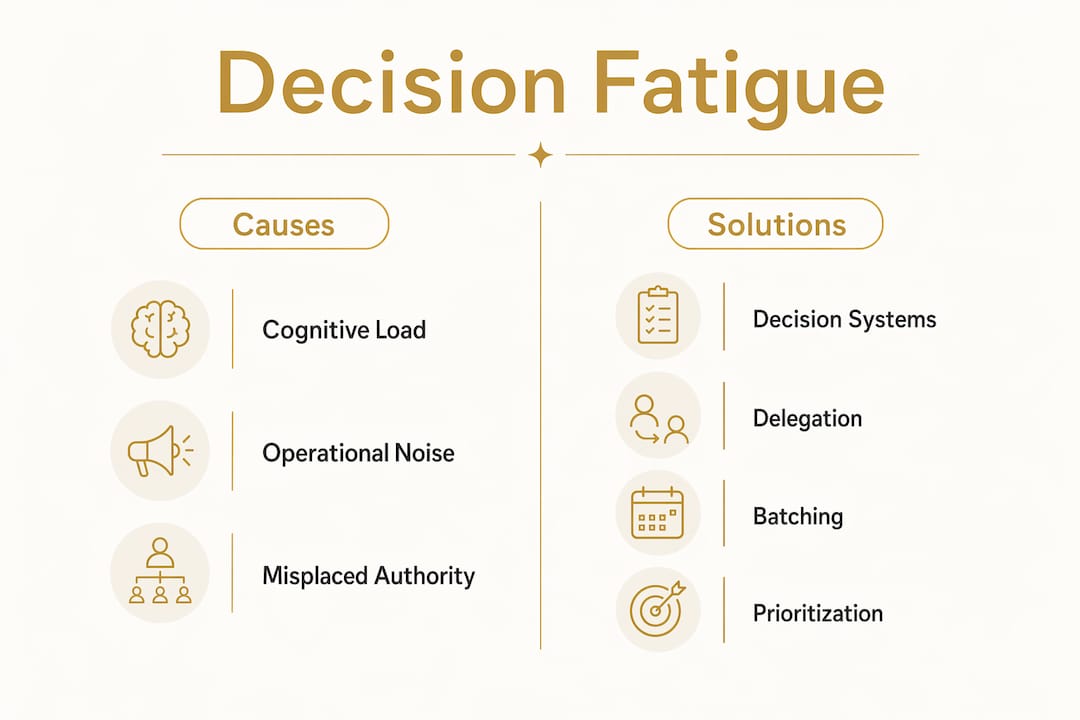
The stakes compound the fatigue. A CEO making a poor call on a marketing campaign has a team to course-correct. A founder making the same call may be betting the quarter’s runway. That emotional weight, the knowledge that each decision carries real consequence, is itself a cognitive drain. Research on decision fatigue identifies emotional weight of decisions as one of the primary accelerants of depletion, separate from volume or complexity alone.
There is also what might be called operational noise: the constant stream of low-use questions that flow to the founder because no one else has been given the authority to answer them. Every time a team member asks whether to approve a $200 software subscription or how to handle a minor customer complaint, the founder’s prefrontal cortex burns fuel it cannot recover until sleep. The chess grandmaster analogy applies here. Even when the moves are simple, the sustained act of evaluation depletes the same mental reserves needed for the complex endgame.
The structural cause is misplaced decision authority. Founders often remain the silent approver behind decisions the company has already grown beyond, not because they distrust their team, but because no one has explicitly been given the right to decide. That gap is where cognitive load accumulates fastest.
What causes decision fatigue in founders, and how do you recognize it?
The causes of decision fatigue in a founder context are both structural and behavioral. Understanding them is how you stop misattributing the symptoms to something else.
Structural causes:
- Founders personally handling every routine operational decision rather than systematizing or delegating them, which drowns out focus on strategic calls.
- No documented decision rights, so every question defaults upward to the founder.
- High decision frequency with no batching or review cadence, meaning the cognitive load is constant rather than concentrated.
- Sleep deprivation, which significantly reduces the cognitive resources available for self-regulation, accelerating depletion.
Behavioral and emotional causes:
- Perfectionism driving endless improvement of decisions that are reversible within 90 days.
- Emotional weight of high-stakes calls, particularly around hiring, firing, and fundraising.
- Re-deciding previously settled questions because principles were never documented, so the same ground gets covered repeatedly.
- Reactive decision-making, where founders try to decide while simultaneously managing incoming demands.
The signs are recognizable once you know what to look for. Procrastination is the most common: putting off a vendor decision, delaying a difficult conversation, or letting an email sit unanswered because engaging with it requires a choice. Impulsivity is the other side of the same coin. You approve a tool subscription without proper evaluation, agree to a partnership meeting you know is low-value, or make a hiring call faster than the evidence warrants.
Brain fog, irritability, and a creeping sense of overwhelm are physiological signals. The American Medical Association notes that decision fatigue is cumulative: as the day progresses, the person feels progressively more drained, and the quality of choices reflects that depletion. For founders, this often shows up as a pattern of conservative, status-quo-preserving decisions late in the day, not because the status quo is right, but because it asks the least of a depleted brain.
One of the most damaging and least recognized symptoms is what researchers call the conservative choice tendency: defaulting to the safest available option not out of strategic caution, but out of cognitive exhaustion. This gets misread as external market failure or team underperformance, when the actual cause is the founder’s depleted judgment silently stalling the company’s momentum.
How does decision fatigue differ from burnout for founders?
Founders often conflate these two states, which leads to the wrong response. Decision fatigue is acute and task-specific. Burnout is chronic and systemic. Treating one as the other wastes time and misses the actual problem.
| Dimension | Decision fatigue | Burnout |
|---|---|---|
| Onset | Builds within a single day or session | Develops over weeks or months |
| Cause | High volume of decisions depleting cognitive resources | Sustained stress, lack of recovery, loss of purpose |
| Primary symptom | Impaired judgment, impulsivity, or avoidance | Emotional exhaustion, cynicism, low self-efficacy |
| Recovery time | Often resolves after rest or sleep | Requires extended recovery and structural change |
| Scope | Specific to decision-making capacity | Affects motivation, identity, and physical health |
| Founder risk | Daily, especially without decision systems | Cumulative, often triggered by prolonged decision fatigue |
Decision fatigue is specific to cognitive overload from repeated decision-making and responds to structural changes: delegation, defaults, and batching. Burnout is a broader state of chronic physical and emotional exhaustion that involves additional factors like lack of purpose, insufficient recovery, and sustained emotional stress.
The clinical distinction matters for founders because the interventions are different. A founder experiencing acute decision fatigue can recover meaningfully with a single night of good sleep, a restructured morning, or a decision-batching session that clears the queue. A founder in burnout needs something more fundamental: a reassessment of workload, role clarity, and recovery time built into the operating model. Decision fatigue often contributes to burnout when left unaddressed, but the two are not the same condition.
If you notice exhaustion, cynicism, and a persistent sense of low self-efficacy that does not lift after rest, that is a signal worth taking seriously beyond the scope of cognitive load management alone.
Practical strategies founders can use to overcome decision fatigue
The most effective founders do not make better decisions under pressure. They build systems that reduce the number of decisions that reach them under pressure. That distinction is the entire game.
Protect your cognitive peak. Chronobiological research shows that complex decision quality correlates with circadian rhythms. Your prefrontal cortex operates at its highest capacity in the morning, before the day’s accumulation of choices has depleted it. Schedule your highest-stakes calls, product trade-offs, and strategic reviews before noon. Reserve afternoons for execution, communication, and tasks that do not require fresh judgment.

Build decision architecture. This means creating explicit rules, defaults, and decision rights that route each incoming question through the lightest process it actually needs. Not every decision requires the founder. Most do not. Document the criteria for common decisions so team members can resolve them without escalating. A hiring bar written down once eliminates dozens of future conversations.
Batch decisions deliberately. Instead of responding to decisions as they arrive throughout the day, set fixed review windows. A daily 30-minute decision queue, a weekly operational review, and a monthly strategic session create predictable cadences that prevent the constant context-switching that accelerates depletion.
Treat reversibility as a filter. Most startup decisions are reversible within 90 days. Applying that lens to incoming choices immediately reduces the cognitive weight you assign them. Reserve deep deliberation for genuinely irreversible calls: key hires, major capital allocation, and strategic pivots. Everything else gets a time-boxed decision window and a good-enough answer.
Eliminate low-use decisions entirely. Default answers are a founder’s most underused tool. Default no to inbound partnership emails without a clear agenda. Default yes to customer conversations. Default to shipping over polishing. One SaaS founder cut weekly meetings from 14 to 6 by applying defaults and reclaimed nearly 8 hours a week, time that showed up directly in product velocity.
Pro Tip: Treat your cognitive energy the same way you treat runway. You would not spend cash on low-ROI line items without scrutiny. Apply the same discipline to decisions. Every low-use choice you make personally is a withdrawal from the account you need for the calls that actually move the company.
Daily habits that protect cognitive bandwidth:
- Consistent morning routines that eliminate micro-decisions before the workday begins.
- Documented decision criteria for recurring choices (pricing, hiring, vendor evaluation).
- A personal “decision debt” log to capture deferred decisions and clear them in batches.
- Physical exercise and sleep treated as operational requirements, not optional recovery.
- Offline planning blocks where no one can interrupt with incoming questions.
How Commerce Catalyst approaches founder decision fatigue
The pattern Chris Wichert sees repeatedly at Commerce Catalyst is founders who are technically capable of making good decisions but structurally prevented from doing so. The volume of low-use calls flowing through them is not a sign of dedication. It is a sign that the operating model has not kept pace with the company’s growth.
Commerce Catalyst’s Founder Advisory work starts with a decision audit: mapping every recurring decision the founder currently owns, then categorizing each by use and replaceability. The majority, in most early-stage consumer brands, fall into the low-use, high-frequency category. These are the decisions that can be systematized, delegated with clear ownership, or eliminated through documented defaults. What remains is a much smaller set of genuinely founder-level calls, the ones that shape trajectory, culture, and capital allocation.
The financial dimension of this work is direct. Founders operating under chronic decision fatigue tend to make reactive financial decisions: approving ad spend increases without margin analysis, extending payment terms under pressure, or passing on cost-saving operational changes because the evaluation felt too heavy. Clearing that cognitive load does not just improve decision quality in the abstract. It shows up in cash flow, in margin, and in the speed at which the business can act on real opportunities.
The DTC Operator Diagnostic that Commerce Catalyst offers is specifically designed to surface these constraints. It identifies where decision authority is misaligned, where operational complexity is generating unnecessary cognitive load, and where founders are spending judgment on problems that systems should be solving. For founders who recognize the pattern described in this article, that diagnostic is often the clearest starting point.
How decision fatigue affects startup success and team dynamics
Decision fatigue does not stay contained to the founder. It radiates outward into the organization in ways that are easy to misread as team performance problems.
When a founder is operating in a depleted state, approvals slow down. Teams waiting on a founder’s sign-off for routine operational decisions learn, over time, to stop bringing decisions forward at all. That learned helplessness is the opposite of the ownership culture most founders are trying to build. The team becomes reactive, waiting for direction rather than exercising judgment, because the founder has inadvertently trained them that all decisions flow upward.
The conservative choice tendency compounds this. A fatigued founder defaults to the familiar option, the existing vendor, the current pricing structure, the product feature already on the roadmap. Innovation requires cognitive risk-taking, the willingness to evaluate an unfamiliar option seriously and commit to it. Fatigue systematically suppresses that capacity. The startup stalls not because the market shifted or the team underperformed, but because the decision-maker at the center of the organization stopped being able to make bold calls.
Trust erodes in both directions. Founders who are visibly overwhelmed and inconsistent in their decisions create uncertainty for their teams. A hiring decision made impulsively one week, reversed the next, signals instability. A strategic direction changed under pressure, without clear reasoning, undermines confidence in leadership. The cognitive biases that decision fatigue amplifies, confirmation bias, loss aversion, and status quo preference, become organizational patterns when they consistently shape the founder’s calls.
How founders can prioritize decisions more effectively
Prioritization is not about working harder on decisions. It is about deciding which decisions deserve your cognitive resources at all.
The most useful framework is a simple two-axis filter: use and reversibility. High-use, irreversible decisions (key hires, major capital allocation, strategic pivots) deserve deep deliberation and protected time. Low-use, reversible decisions (tool choices, minor process changes, routine vendor negotiations) deserve a time-boxed answer and a documented default for next time. The middle ground, moderate use and moderate reversibility, is where most founders spend too much time. A fixed decision window of 20 minutes, with a clear “good enough” threshold, handles the vast majority of these.
Documenting decisions as assets is the other half of the equation. Brian Chesky’s approach at Airbnb, codifying principles so teams could decide without him, reflects a fundamental truth: re-deciding drains confidence and consumes the same cognitive resources as the original decision. When you trust your past thinking, you stop second-guessing it and free yourself to focus forward. A founder decision framework built around documented criteria, not just intuition, is what separates founders who scale from those who become the bottleneck in their own company.
Weekly decision reviews, where deferred calls are cleared in a single session rather than scattered across the week, also reduce the “decision debt” that accumulates when choices are postponed. Carrying unresolved decisions is itself a cognitive load. Clearing them on a schedule prevents that residue from compounding.
Tools and techniques that reduce decision fatigue for founders
The right tools do not make decisions for you. They reduce the number of decisions that require your direct attention.
Project management platforms like Notion, Linear, or Asana create documented workflows that answer recurring operational questions without founder involvement. When the process is written down and the criteria are clear, team members can resolve issues independently. The founder’s role shifts from approver to architect, which is a far more sustainable position.
Financial dashboards that surface key metrics automatically, rather than requiring the founder to pull data and interpret it manually, eliminate a category of daily cognitive work. A founder financial dashboard that shows cash position, margin by channel, and burn rate at a glance removes the need to reconstruct that picture from scratch every time a financial decision arises.
Calendar architecture is underrated as a fatigue-reduction tool. Blocking the first two hours of the day for high-stakes thinking, before Slack, email, or meetings begin, is a structural intervention that consistently improves decision quality. Jeff Bezos scheduled deep thinking time before major bets. The principle scales down to any founder’s calendar.
For founders working with advisors or consultants, the role of an advisor in decision architecture is often underutilized. A good advisor does not just offer opinions. They help founders identify which decisions genuinely require founder-level judgment and which ones can be systematized, delegated, or eliminated entirely. That external perspective is particularly valuable because founders inside the system often cannot see which decisions they are holding onto out of habit rather than necessity.
Why delegation is the most powerful lever against decision fatigue
Most founders understand delegation in theory and practice a watered-down version of it. The gap between the two is where decision fatigue lives.
Real delegation means assigning decision authority, not just tasks. When a founder delegates a task but retains final approval, the cognitive load of that decision has not moved. The founder still has to evaluate the output, weigh the options, and make the call. That is “fake delegation,” and it is one of the most common patterns in early-stage companies. The team member does the work; the founder still carries the decision weight.
True delegation requires explicit rules: the team member holds outcome accountability and final decision authority within agreed parameters. That means defining the decision criteria upfront, setting the boundaries within which the team member can act, and then genuinely stepping back. The founder’s role becomes setting the framework, not approving every output within it.
The entrepreneurial decision support literature is consistent on this point. Founders who build clear ownership tiers with defined decision rights experience measurable reductions in cognitive load, not because they care less, but because the organizational structure has absorbed the decisions that were never theirs to make in the first place.
Delegation also builds organizational capability in a way that approval-seeking never does. When team members own decisions, they develop judgment. When they escalate every call upward, they develop dependency. The founder who delegates real authority is not just protecting their own cognitive bandwidth. They are building a team that can function and grow without requiring the founder at the center of every choice.
Key Takeaways
Founders who build decision systems that reduce their personal decision load protect the cognitive bandwidth that determines startup trajectory.
| Point | Details |
|---|---|
| Cognitive limits are real | Judgment can degrade severely after roughly 500 decisions, making decision architecture a business-critical priority. |
| Founders face a distinct load | Unlike Fortune 500 CEOs who make about 35 significant decisions daily, founders absorb tens of thousands of total daily decisions. |
| Fatigue differs from burnout | Decision fatigue is acute and resolves with rest and structure; burnout is chronic and requires deeper intervention. |
| Delegation must include authority | Assigning tasks without decision rights keeps the cognitive load on the founder; real delegation transfers outcome ownership. |
| Timing decisions protects quality | Scheduling high-stakes calls in the morning, when cognitive resources are full, consistently improves the quality of those choices. |
Work with Commerce Catalyst to clear the cognitive load
If you recognize the patterns described here, the volume, the reactive calls, the late-day defaults to the status quo, the starting point is not motivation. It is structure. Commerce Catalyst works directly with consumer brand founders to identify where decision authority is misaligned, where operational complexity is generating unnecessary cognitive load, and where the business is being held back by decisions that should never have reached the founder’s desk.
The DTC Financial Health Assessment is built for exactly this moment. It surfaces the constraints that are costing you judgment, cash flow, and momentum, and gives you a clear picture of where to act first. If you are ready to stop being the bottleneck in your own company, that is where the work begins.