Operational efficiency is the capacity of a consumer brand to maximize output and profitability while reducing the resources, time, and cost required to deliver it. Executives estimate that more than 50% of a brand’s margin improvement potential sits inside operational inefficiency, not in revenue growth or pricing alone. That single fact reframes where founders should focus first. Brands like Mamaearth and tools like PagerDuty and Deloitte’s AI frameworks demonstrate that operational excellence is not a back-office discipline. It is the engine that funds growth, protects cash flow, and builds the customer trust that sustains a brand through volatile demand cycles.
What operational efficiency really means for consumer brands
Operational efficiency, the term used interchangeably with operational excellence in most management frameworks, is defined as the ratio of useful output to total input across a brand’s core processes. For consumer brands specifically, that means reducing the cost per unit delivered, per order fulfilled, and per customer retained, without sacrificing quality or speed. The distinction matters because many founders conflate efficiency with cost-cutting. They are not the same thing.
The levers available to a consumer brand leader fall into three categories:
- Inventory and demand management: Carrying the wrong SKUs ties up cash and inflates cost-to-serve. Accurate demand forecasting reduces both overstock and stockout events, which directly protects gross margin.
- Channel spend discipline: Brand leaders improve EBITDA by managing the ratio of digital ad spend to organic revenue, improving channel investment before passing costs to consumers.
- Operating expense structure: OpEx improvement means identifying which internal costs scale with revenue and which are fixed overhead that compress margins as volume fluctuates.
Operational efficiency extends beyond cost reduction to eliminating friction in fulfillment, service recovery, and quality control. When a brand ships late or delivers inconsistently, the customer experience degrades and retention drops. That is a revenue problem with an operational root cause. The brands that understand this connection treat efficiency as a customer-facing discipline, not just a finance function.
How operational efficiency drives financial outcomes and sustained growth

The financial case for operational discipline is clear. When you reduce cost-to-serve without reducing quality, every dollar saved flows directly to gross margin. That margin headroom funds the next product launch, the next channel test, or the working capital buffer that keeps you solvent through a slow quarter. Profitability improvement works as a three-lever system: operations, pricing, and capital efficiency compound when improved together rather than addressed in isolation.
Here is how the compounding works in practice:
- Fix operations first. Reduce waste, tighten inventory turns, and cut unnecessary process steps. This creates margin that builds leadership confidence.
- Use that confidence to address pricing. With a cleaner cost structure, you can price more accurately and defend margins without discounting.
- Apply capital efficiency last. Once operations and pricing are disciplined, you can improve working capital, reduce debt service costs, and free cash for reinvestment.
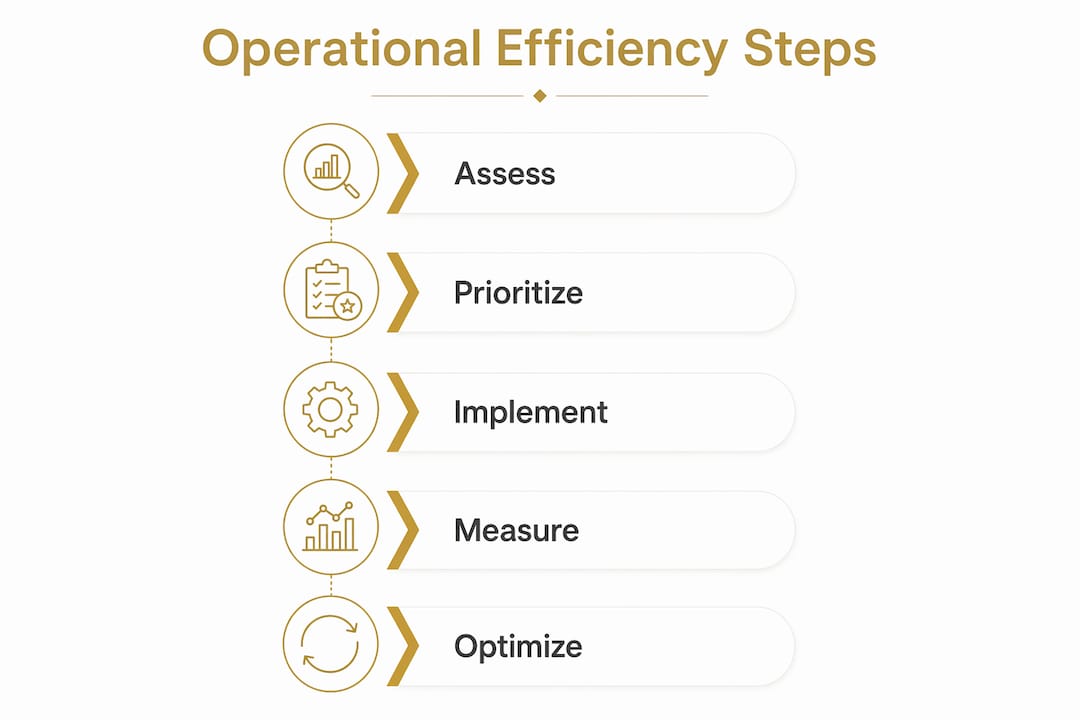
Sustained gains require measurement, not just implementation. 2026 frameworks recommend accurate diagnosis, prioritized planning, disciplined implementation, and recurring audits to maintain efficiency gains over time. A one-time process improvement that is never reviewed will erode within two to three quarters as team behavior reverts and market conditions shift.
Pro Tip: Link every operational KPI directly to a financial outcome. Cycle time reduction only matters if it appears in your cash conversion cycle. Inventory availability only matters if it shows up in your gross margin. If the metric does not connect to the P&L, it is a vanity measure.
How technology and AI enhance operational efficiency for brands
Technology amplifies operational efficiency when it is embedded into actual workflows rather than layered on top of them. Deloitte Canada’s staged AI adoption framework recommends starting with quick wins, building foundational investments, and then targeting larger bets focused on specific operational outcomes. The key word is outcomes. AI that does not reduce time, risk, or cost in a measurable way is not an efficiency tool. It is overhead.
The table below contrasts two common approaches to technology adoption in consumer brands:
| Approach | What it looks like | Outcome |
|---|---|---|
| Outcome-focused AI adoption | Operators co-design the tool, define success metrics upfront, and track time saved and exceptions managed | Measurable margin and service level improvement |
| Tool-first automation | Software is purchased and deployed without workflow redesign or decision rights clarity | Faster local steps, same or worse overall throughput |
A real-world example makes the difference concrete. A consumer goods case involving Groupe Lemoine and Flowlity showed that AI inventory improvement improved service levels by 11% and pushed product availability above 98%, while shifting planners from full manual review to exception-based management. That freed planner time for higher-value decisions. The technology worked because the workflow was redesigned alongside it, not after.
For brands exploring AI-native operations, the lesson is consistent: operator involvement in tool design is not optional. It is the variable that separates efficiency gains from expensive experiments.
Pro Tip: Before deploying any automation, map the decision rights for every step in the affected workflow. If it is unclear who approves an exception or escalates an alert, automation will accelerate the confusion, not resolve it.
What operational efficiency strategies actually work for consumer brands
The brands that sustain efficiency gains share one structural habit: they diagnose before they prescribe. Scattered process fixes applied without a clear picture of the binding constraint waste time and capital. Operational excellence requires a culture of continuous improvement, employee ownership, and structured process audits, not a single initiative.
The most effective operational efficiency strategies for consumer brand leaders include:
- Constraint-first prioritization: Identify the single process or resource that limits throughput most severely. Fix that before touching anything else. Lean principles call this the theory of constraints, and it applies directly to DTC fulfillment, manufacturing, and customer service operations.
- KPIs that connect to the P&L: Effective operational KPIs combine leading measures like process cycle efficiency and exception rates with CFO-visible outcomes like margins and cash conversion cycles. If your operations team tracks metrics that your finance team never sees, you have an alignment problem.
- Structured review rhythms: Weekly operational reviews that surface exceptions, monthly audits that assess process drift, and quarterly resets that realign priorities to financial goals. Without this cadence, efficiency gains decay.
- Technology that fits the workflow: Tools like Slimstock’s Slim4 for inventory planning and PagerDuty’s incident management platform work because they surface exceptions and reduce manual review time. The tool selection matters less than the workflow design around it.
Aligning leadership, technology, and workforce requires explicit governance. Someone must own the efficiency agenda, report on it to the executive team, and have authority to change processes when audits reveal drift. Without that ownership, efficiency becomes everyone’s responsibility and no one’s priority.
Pro Tip: Run a DTC Operator Diagnostic before committing to any efficiency initiative. Understanding your current constraint is worth more than any framework applied blindly.
Common pitfalls that undermine operational efficiency initiatives
Most operational efficiency initiatives fail not because the strategy is wrong but because the execution ignores system-level effects. Local improvement without end-to-end alignment leads to suboptimal brand performance. Fixing the warehouse pick rate while ignoring supplier lead time variability produces faster picking into a stockout. The local metric improves. The customer experience does not.
The most common pitfalls consumer brand leaders encounter include:
- Automating broken processes: Automation accelerates bottlenecks when decision rights are unclear. Speed without throughput improvement is the most expensive outcome of premature automation.
- Chasing one-time savings: A single cost reduction event does not compound. Sustained efficiency requires recurring measurement and governance, not a project with a close date.
- Ignoring capital efficiency and pricing: Brands that fix operations but leave pricing and working capital undisciplined capture only a fraction of available margin improvement. The three levers work together.
- Misaligned leadership incentives: When the operations team is measured on cost and the commercial team is measured on revenue, efficiency initiatives that require short-term revenue trade-offs will stall. Incentive alignment is a prerequisite for execution.
- No governance structure: Without a named owner, a reporting cadence, and executive visibility, efficiency programs drift back to the status quo within two quarters.
The significance of efficiency in brands is clearest when demand is volatile. Brands with disciplined operations absorb demand shocks without margin collapse. Brands without that discipline face a compounding problem: falling revenue and rising cost-to-serve at the same time.
How Commerce Catalyst helps brands build operational efficiency that lasts
Consumer brand founders who want to move from operational chaos to margin clarity need more than a framework. They need someone who has built and scaled brands and understands the financial mechanics underneath the operational decisions.
Commerce Catalyst works directly with DTC and consumer brand founders to diagnose operational constraints, connect operational KPIs to financial outcomes, and build the governance structures that sustain gains. The DTC Financial Health Assessment identifies exactly where margin is leaking and which operational levers will recover it fastest. For brands preparing for a capital raise or exit, the fractional CFO service integrates channel spend discipline, OpEx improvement, and brand investment strategy into a single financial operating model. If you are ready to stop guessing and start measuring, the diagnostic is the right first step.
FAQ
What is operational efficiency in the context of consumer brands?
Operational efficiency is the ability of a consumer brand to maximize output and profitability while minimizing the inputs required, including cost, time, and resources. It covers inventory management, fulfillment speed, cost structure, and process quality across the full value chain.
Why does operational efficiency matter more than revenue growth?
More than 50% of margin improvement potential in most brands sits inside operational inefficiency rather than in revenue growth or pricing. Fixing operations creates margin that funds growth, whereas chasing revenue without fixing operations compounds cost problems.
How do brands measure operational efficiency effectively?
Effective measurement combines leading operational indicators like cycle efficiency and inventory availability with CFO-visible financial outcomes like gross margin and cash conversion cycle. Metrics that do not connect to the P&L do not drive decisions.
What is the biggest mistake brands make with operational efficiency initiatives?
The most common failure is automating or improving local processes without redesigning the end-to-end workflow and decision rights. This produces faster local steps with no improvement in overall throughput or customer experience.
How does AI improve operational efficiency for consumer brands?
AI improves operational efficiency when operators co-design the tool and define success metrics upfront. The Groupe Lemoine and Flowlity case showed an 11% service level improvement and product availability above 98% through exception-based inventory management that freed planner time for higher-value work.
Key takeaways
Operational efficiency is the single strongest driver of margin improvement for consumer brands, requiring integrated operations, pricing, and capital discipline to compound gains over time.
| Point | Details |
|---|---|
| Efficiency outperforms revenue chasing | Over 50% of margin improvement potential sits in operational inefficiency, not top-line growth. |
| Three levers compound together | Operations, pricing, and capital efficiency must be addressed together to maximize profitability gains. |
| Technology requires workflow redesign | AI and automation only deliver results when decision rights and workflows are redesigned alongside the tool. |
| Measurement sustains gains | Recurring audits and KPIs linked to financial outcomes prevent efficiency gains from eroding within quarters. |
| Leadership ownership is non-negotiable | Without a named owner and executive reporting cadence, efficiency initiatives revert to the status quo. |