
Gross profit is defined as revenue minus the cost of goods sold (COGS), and it is the single metric that determines how much money your business actually keeps to fund its own future. Most founders track revenue obsessively, but gross profit, not top-line sales, is what separates a business that can scale from one that simply gets busier. Understanding the role of gross profit in growth means understanding where reinvestment capital actually comes from. Tools like Fathom and data sources like Investopedia confirm that gross margin is the foundational indicator of business health, and recent industry studies show its direct effect on profit growth is far larger than most operators realize.
How gross profit drives business growth and reinvestment capacity
Gross profit is the engine behind every growth decision a business makes. Hiring a new sales rep, launching a product line, running a paid acquisition campaign, or funding R&D all require capital that must come from somewhere. That somewhere is gross profit. Without it, every expansion move requires external funding, which means dilution, debt, or both.
Gross margin acts as a structural foundation that determines a company’s capacity to reinvest and expand without giving up ownership. This is why two businesses with identical revenue can have completely different growth trajectories. The one with a 60% gross margin has far more room to maneuver than the one operating at 25%.

The real-world evidence is clear. Westcon-Comstor’s gross profit grew 13.1% in FY26 while revenue grew only 9.6%, driven by a deliberate shift toward software and services. That gap between profit growth and revenue growth is not a coincidence. It reflects a business that improved its mix, not just its volume. The result is more capital available for reinvestment without needing to raise a single dollar externally.
The relationship between gross profit and cash flow is equally direct. Higher gross margins mean more cash generated per unit sold. That cash funds operational efficiency improvements, reduces reliance on credit lines, and gives founders the breathing room to make strategic decisions rather than reactive ones.
Here is what gross profit funds that revenue alone never can:
- R&D and product development without waiting for investor approval
- Marketing spend that compounds over time rather than burning borrowed money
- Talent acquisition at the right moment in the growth cycle
- Inventory and supply chain investments that protect margins further downstream
- Operational reserves that prevent cash crunches during seasonal dips
Pro Tip: Track gross profit in dollar terms and as a percentage of revenue every single month. A rising revenue line with a falling gross margin percentage is a warning sign, not a success story.
Revenue growth vs. gross profit growth: which one actually matters?
Revenue measures activity. Gross profit measures quality. This distinction is the most consequential one a founder can internalize, and most do not until it is too late.
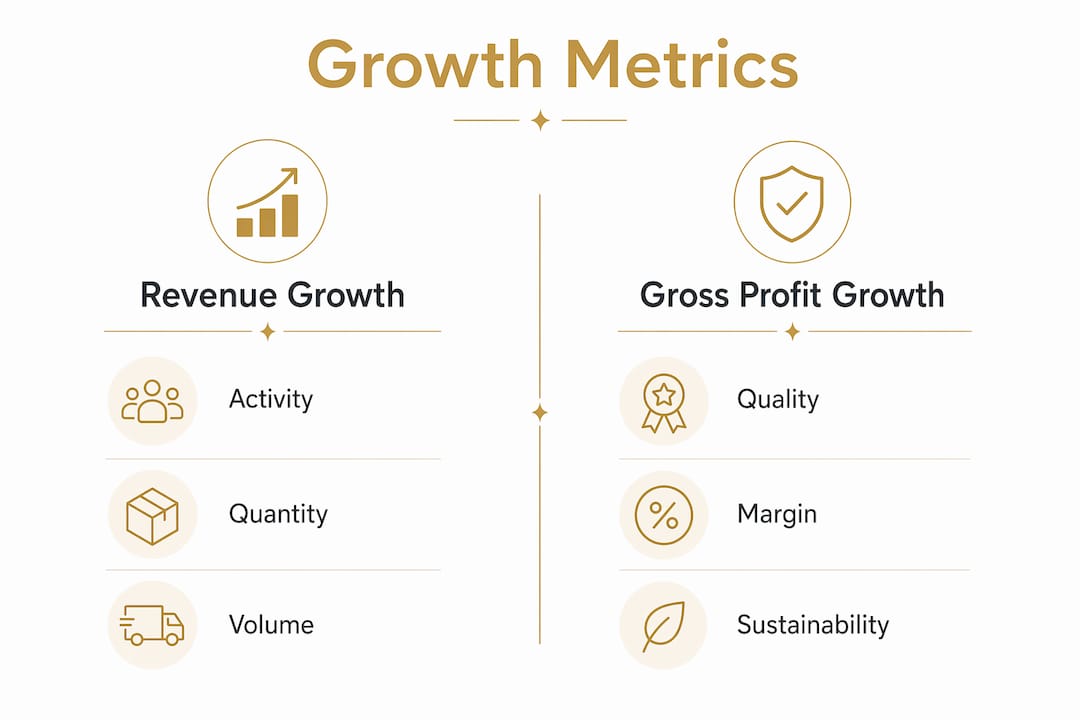
Revenue growth is only “good” if it is accompanied by maintained or improved gross margins. Otherwise, growth adds operational complexity and risk without adding proportional financial strength. A business doing $5 million in revenue at 20% gross margin has $1 million to work with. A business doing $3 million at 55% gross margin has $1.65 million. The smaller business is actually in a stronger position to grow.
The contrast becomes even sharper when you look at what happens under pressure. High-revenue, low-margin businesses require more infrastructure to scale. Every new dollar of revenue demands more headcount, more logistics, more overhead. High-margin businesses, by contrast, can self-fund growth and R&D far more efficiently because each dollar of revenue contributes more to the pool of available capital.
| Scenario | Revenue | Gross Margin | Gross Profit | Growth Capacity |
|---|---|---|---|---|
| High revenue, low margin | $5M | 20% | $1M | Constrained, needs external capital |
| Moderate revenue, high margin | $3M | 55% | $1.65M | Self-funded growth possible |
| Revenue growing, margin shrinking | $6M | 15% | $900K | Declining despite revenue gains |
| Revenue and margin both growing | $4M | 50% | $2M | Strongest position for expansion |
The table above illustrates why the impact of gross profit on growth cannot be separated from margin percentage. Revenue is the headline. Gross profit is the story underneath it.
Consider the pattern observed across 837 Indian companies in Q4 FY26, where net profit grew 15.5% against only 9.5% revenue growth. The outperformance came from cost improvement and margin expansion, not from selling more. That is the clearest possible demonstration of why gross profit growth is a more powerful lever than revenue growth alone.
The three most common signs that a business is chasing “bad growth”:
- Revenue is up but cash feels tight every month
- Gross margin percentage has declined for two or more consecutive quarters
- The business needs to hire more people just to maintain current output levels
Key factors that affect gross profit’s impact on sustainable growth
Gross profit does not exist in isolation. Several operational and strategic factors determine whether your margins hold, expand, or quietly erode over time.
Pricing power is the most direct lever. Gross margin reflects pricing power, and compressing margins alongside rising revenue signal that cost inflation is outpacing your ability to pass those costs to customers. If you cannot raise prices without losing volume, your margin is structurally fragile. Businesses that build brand equity, differentiation, or proprietary products protect their pricing power and, by extension, their gross margin.
Cost of goods management is the other side of the equation. Gross margin isolates pricing and production effectiveness, guiding decisions on cost improvement or product mix adjustments. This means regularly auditing your COGS line: supplier contracts, manufacturing costs, packaging, inbound freight, and fulfillment. Each of these can compress margins incrementally without triggering an obvious alarm.
Margin bleed is the silent killer of growth-stage businesses. Monthly gross margin analysis catches incremental cost increases before they erode scalability. A 1% margin decline per quarter sounds small. Over two years, it can cut your reinvestment capacity in half. Founders who review gross margin monthly catch these trends early enough to act. Those who review it quarterly or annually often discover the damage only after it has become structural.
Product and customer mix also shapes gross profit outcomes significantly. Not all revenue is created equal. A product line with a 65% gross margin and a product line with a 22% gross margin sitting inside the same business will produce very different results depending on which one grows faster. The same logic applies to customers. Some accounts demand heavy service, custom pricing, or high return rates that quietly destroy their margin contribution.
Pro Tip: Build a simple gross margin breakdown by product line or customer segment in a spreadsheet or a tool like Fathom. You will almost always find one or two segments dragging down your blended margin without you realizing it.
Practical strategies to improve gross profit for growth
Knowing that gross profit matters is not enough. The businesses that actually use it as a growth lever build systems around it.
-
Build a gross profit dashboard. Segment your margin data by product, client, channel, and service line. This is not a finance exercise. It is a strategic one. When you can see which parts of your business generate the most gross profit per dollar of revenue, you know exactly where to focus growth efforts. Commerce Catalyst’s approach to building a profitability roadmap starts exactly here.
-
Audit your pricing annually, at minimum. Most founders set prices once and adjust only when a competitor forces their hand. Pricing should reflect your current cost structure, your brand positioning, and the value you deliver. A 5% price increase on a product with $1M in revenue and a 40% gross margin adds $50,000 directly to gross profit with zero additional cost.
-
Standardize your delivery model. Custom work, one-off requests, and bespoke service arrangements are margin killers. Every time you deviate from a standard process, you absorb costs that rarely show up in the invoice. Standardization protects margin without sacrificing quality.
-
Identify and address low-margin customers or products. Use your gross profit dashboard to rank every revenue source by margin contribution. The bottom 20% by margin percentage deserves a deliberate decision: reprice, restructure, or exit. Holding onto low-margin revenue because it feels like “volume” is one of the most common ways founders undermine their own growth capacity.
-
Reinvest gross profit with discipline. The importance of gross profit is only realized when the capital it generates is deployed into activities with a clear return. Prioritize reinvestment in areas that either protect your margin (supply chain, quality control) or expand your revenue at the same or better margin (marketing, product development, talent).
| Reinvestment Priority | Margin Impact | Growth Impact |
|---|---|---|
| Pricing strategy review | Direct margin improvement | Protects existing gross profit |
| Supply chain improvement | Reduces COGS | Expands margin percentage |
| Marketing at proven CAC | Neutral to margin | Scales revenue with margin intact |
| Product line rationalization | Removes margin drag | Improves blended margin |
| Talent in high-use roles | Indirect | Enables execution at scale |
Key takeaways
Gross profit, not revenue, is the true measure of a business’s capacity to grow, reinvest, and scale without external capital.
| Point | Details |
|---|---|
| Gross profit funds growth | Every reinvestment dollar, from marketing to hiring, comes from gross profit, not revenue. |
| Margin quality beats revenue volume | A smaller business with a 55% gross margin outgrows a larger one at 20% margin. |
| Monthly tracking prevents margin bleed | Reviewing gross margin monthly catches incremental cost increases before they become structural. |
| Pricing power protects margins | Businesses that cannot raise prices are structurally exposed to cost inflation and margin erosion. |
| Segment your margin data | Breaking gross profit down by product and customer reveals where to grow and what to exit. |
How Commerce Catalyst helps you turn gross profit into a growth engine
If you recognize your business in any of the patterns above, the next step is a structured look at where your margins actually stand and what is driving them.

Commerce Catalyst’s financial health assessment is built specifically for DTC and consumer brand founders who need clarity on their profitability, not just their revenue. The assessment identifies margin compression points, flags low-performing segments, and gives you a clear picture of where your gross profit is going and why. For founders who want ongoing margin management built into their operations, the fractional CFO service provides the financial leadership to turn gross profit analysis into a repeatable growth system. If you are ready to stop guessing and start building on a margin foundation that actually holds, start with the DTC Operator Diagnostic.
FAQ
What is gross profit and why does it matter for growth?
Gross profit is revenue minus the cost of goods sold, and it represents the capital available to fund every growth activity in a business. Without sufficient gross profit, expansion requires external funding, which introduces dilution and debt risk.
How does gross profit differ from revenue and net profit?
Revenue measures total sales activity, gross profit measures what remains after direct production costs, and net profit measures what remains after all expenses including overhead and taxes. Gross profit is the most direct indicator of business model quality and pricing effectiveness.
What is a healthy gross profit margin for a consumer brand?
Gross margin benchmarks vary by category, but most consumer brands should target above 40% to maintain meaningful reinvestment capacity. Supplement and wellness brands, for example, often operate at higher margin tiers that support stronger growth funding.
How often should I review my gross profit margin?
Monthly gross margin review is the standard recommended by financial practitioners. Reviewing monthly catches incremental cost increases, known as margin bleed, before they compound into structural damage.
Can revenue grow while gross profit declines?
Yes, and this is one of the most dangerous patterns in growth-stage businesses. If COGS rises faster than revenue, or if a business shifts toward lower-margin products or customers, gross profit can shrink even as the top line grows. A study of PT Indofood Sukses Makmur Tbk found that gross margin explains 68.6% of profit growth variation, confirming that margin quality, not revenue volume, drives real financial progress.