
Financial storytelling is the practice of converting financial data into meaningful, persuasive narratives that deepen investor understanding and strengthen relationships. The role of financial storytelling for investors goes far beyond presenting quarterly numbers. It shapes how investors perceive risk, value potential, and build conviction around a business. People remember 63% of stories but only 5% of isolated statistics. That gap explains why the most effective investor communications lead with narrative, not spreadsheets. For founders and finance professionals, mastering this skill is the difference between a pitch that lands and one that gets politely declined.
How does financial storytelling influence investor decisions?
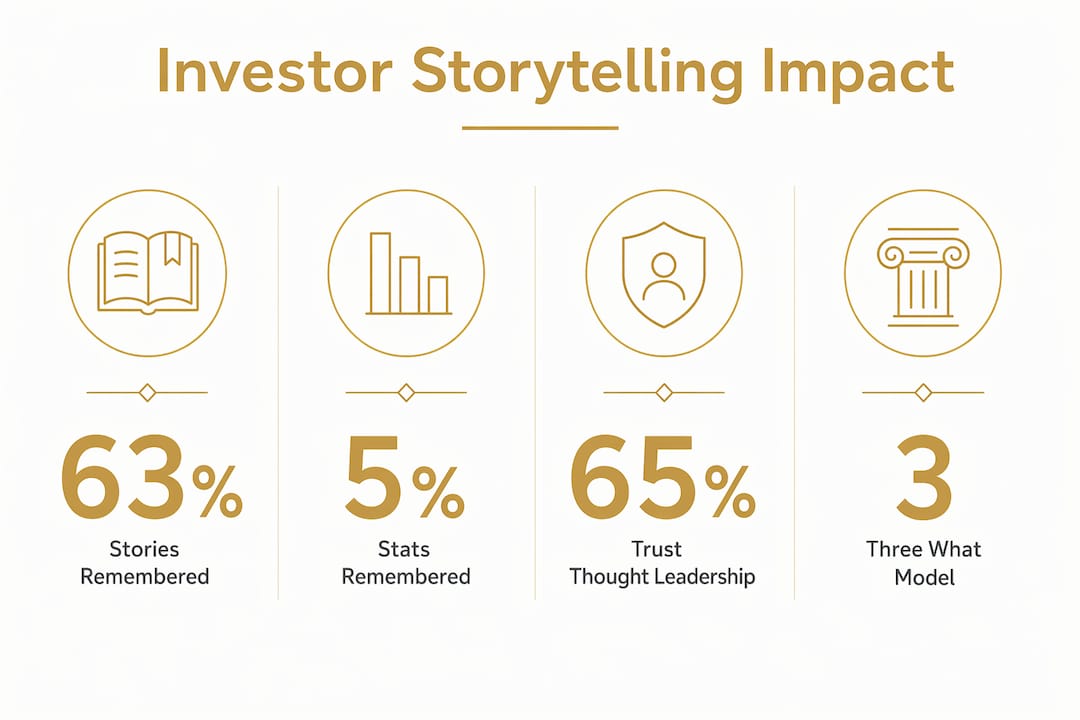
Financial storytelling works because it gives raw numbers a context that investors can act on. A revenue figure alone tells an investor what happened. A narrative explains why it happened, what it means for the business model, and where it points next. That distinction drives conviction.

The psychological mechanism is well documented. Numbers gain meaning only when connected to business context and compared against relevant benchmarks or strategy. Without that context, even strong financials can read as noise. Investors are not just processing data. They are forming a mental model of the business, and narrative is the architecture of that model.
Morgan Housel captured this precisely when he described how company valuation works in practice:
“Valuation is not just the current numbers. It is the current numbers multiplied by a story about tomorrow. The story is doing most of the work.”
This framing reframes the entire investor relations function. Investors rely on narratives reflecting potential, resilience, and ambition to form valuation forecasts. The numbers anchor the story. The story determines the multiple.
Storytelling also lowers perceived risk. When a founder or CFO can explain a miss in context, connect it to a corrective action, and tie it back to the long-term thesis, investors feel informed rather than blind sided. That sense of transparency builds the kind of trust that survives a bad quarter.
Key mechanisms through which narrative shapes investor decisions:
- Clarity: Narrative translates complex financial structures into cause-and-effect logic investors can follow.
- Memory: Stories encode information in a way that raw data cannot, making key messages stick after the meeting ends.
- Trust: Consistent narrative across earnings calls, roadshows, and investor updates signals management credibility.
- Conviction: A well-constructed story about future potential gives investors a reason to hold through volatility.
What narrative strategies resonate with investors?
The most effective investor narratives follow recognizable structures. Three types consistently outperform generic performance commentary.
-
Origin and expertise narratives establish why the founding team is uniquely positioned to solve the problem. These stories answer the investor’s unspoken question: “Why you?” A founder who built a consumer brand, hit a wall, and rebuilt it with better unit economics tells a more credible story than one who simply lists credentials.
-
Client outcome narratives demonstrate that the business model works in the real world. Specific, named results outperform aggregate statistics. “We helped a 200-store retailer cut inventory carrying costs by restructuring their replenishment cycle” is more persuasive than “we serve enterprise clients across retail.”
-
Resilience narratives show how the business responded to adversity. Specificity and vulnerability in financial narratives build deeper investor trust compared to polished perfection. Investors know every business faces setbacks. The question is whether management has the self-awareness and capability to navigate them.
A practical framework for structuring any investor narrative is the “Three What” model:
- What happened: State the fact clearly and without spin. Revenue declined 12% in Q3.
- So what: Explain the business significance. That decline reflects a deliberate SKU rationalization, not demand erosion.
- Now what: Connect to forward action. The leaner catalog improves gross margin by four points and reduces warehouse complexity heading into Q4.
This structure works because it mirrors how investors already think. They want to know the fact, its implications, and the management response. Giving them that sequence in a clear order removes ambiguity and builds confidence.
Pro Tip: Before any investor meeting, write out your Three What for every major metric you plan to discuss. If you cannot complete the “now what” for a given number, that number is not ready to present.
The comparison below shows how structured storytelling differs from standard reporting in investor communications:
| Dimension | Standard reporting | Structured storytelling |
|---|---|---|
| Focus | What the numbers are | What the numbers mean |
| Investor response | Passive reception | Active conviction |
| Risk perception | Unaddressed | Contextualized and managed |
| Memorability | Low (data fades) | High (narrative sticks) |
| Trust signal | Compliance-driven | Transparency-driven |
65% of decision-makers trust thought leadership content more than traditional marketing materials when assessing firm capabilities. That preference extends directly to investor communications. Investors are decision-makers. They respond to the same narrative quality that earns trust in any high-stakes professional context.
What are the common pitfalls in financial storytelling for investors?
Most financial storytelling fails not because the numbers are bad, but because the narrative is either absent or generic. Four pitfalls account for the majority of investor communication breakdowns.
- Over-reliance on raw data without context. Presenting a table of KPIs without explaining the business logic behind them forces investors to draw their own conclusions. Those conclusions are rarely as favorable as the ones you would draw yourself.
- Overly polished narratives that lack authenticity. Investors read hundreds of investor decks. They recognize corporate language designed to obscure rather than clarify. Authenticity and admitting imperfections in financial stories deepen investor trust more than polished presentations.
- Failing to cascade the storytelling mindset across the finance team. A CFO who tells a great story in the earnings call but whose team cannot answer follow-up questions consistently creates a credibility gap. A finance team supported with a storytelling mindset at all levels simplifies communicating financial results and strategy.
- Ignoring compliance while chasing narrative impact. Forward-looking statements, selective disclosure risks, and Regulation FD requirements all constrain what can be said and to whom. Narrative force and regulatory compliance are not in conflict, but they require deliberate coordination.
Pro Tip: Run your investor narrative past your legal or compliance team before any public-facing event. The goal is not to sanitize the story. It is to make sure the story you tell is the one you are legally permitted to tell.
How do you integrate financial storytelling into investor relations?
Building a storytelling capability is not a one-time project. It is a continuous discipline that requires structure, governance, and team-wide commitment.
-
Conduct an internal story audit. Internal story audits across departments uncover authentic and specific narratives that outperform generic performance commentary. Bring together finance, operations, sales, and product teams to surface the 3–5 core stories that reflect the business’s actual trajectory. These become the narrative backbone for all investor communications.
-
Align storytelling with investor touchpoints. Every earnings call, roadshow, and one-on-one investor meeting is a storytelling opportunity. Map your core narratives to each format. An earnings call demands precision and brevity. A roadshow allows for depth and relationship building. A one-on-one meeting is where vulnerability and specificity do the most work.
-
Embed storytelling across the finance function. Finance professionals must shift from compliance roles to become business partners who use storytelling to convince stakeholders. That shift requires training, practice, and a clear expectation that every finance team member can explain the “so what” behind any number they own.
-
Build governance and structural support. An institutionalized storytelling discipline with staffing and governance lowers cost of capital and builds resilience. Assign ownership of the investor narrative to a specific role. Review and update core narratives quarterly. Treat narrative consistency the same way you treat financial accuracy.
The table below outlines a practical integration framework for investor relations teams:
| Stage | Activity | Output |
|---|---|---|
| Audit | Cross-department story collection | 3–5 core investor narratives |
| Alignment | Map narratives to investor touchpoints | Tailored messaging by format |
| Training | Finance team storytelling workshops | Consistent messaging at all levels |
| Governance | Quarterly narrative review cycle | Updated, compliance-cleared story bank |
| Measurement | Track investor sentiment and follow-up quality | Narrative effectiveness feedback loop |
Financial storytelling connects quarterly results to value creation logic, providing a consistent framework investors trust. That consistency is what separates companies that attract long-term capital from those that constantly re-explain themselves. You can learn more about building investor narratives that hold up across multiple investor interactions.
Key Takeaways
Financial storytelling is the most underleveraged tool in investor relations, and the gap between data-only reporting and narrative-driven communication directly determines investor conviction, trust, and valuation.
| Point | Details |
|---|---|
| Narrative drives retention | Investors remember 63% of stories but only 5% of isolated statistics, making narrative the primary communication tool. |
| Valuation is partly story | Company valuation reflects current numbers multiplied by a narrative about future potential, not data alone. |
| Authenticity outperforms polish | Specific, vulnerable narratives build deeper investor trust than generic, perfection-focused presentations. |
| Storytelling requires governance | An institutionalized storytelling discipline with clear ownership lowers cost of capital and builds long-term resilience. |
| Team-wide adoption matters | A storytelling mindset cascaded across the finance function ensures consistent, credible messaging at every investor touchpoint. |
Why most investor narratives fall short
The uncomfortable truth is that most finance professionals were trained to report, not to persuade. They were taught to present data accurately, not to explain why it matters. That training produces technically correct investor communications that leave investors cold.
What actually works is the opposite of what most founders expect. Sharing a specific failure, explaining what you learned, and connecting it to a decision you made differently is more persuasive than a clean deck with no rough edges. Investors are not looking for perfection. They are looking for evidence that management understands the business deeply enough to navigate what comes next.
The founders who raise capital consistently are not the best presenters. They are the ones who know their numbers, understand what those numbers mean, and can explain both in plain language under pressure.
How Commerce Catalyst supports your investor narrative
Translating financial reality into a story that investors trust requires more than good communication skills. It requires clarity about your actual financial position, your unit economics, and the constraints that are shaping your trajectory.

Commerce Catalyst works directly with consumer brand founders to build that clarity. The DTC Financial Health Assessment surfaces the financial facts that form the foundation of a credible investor narrative. The Fractional CFO service provides ongoing support to translate those facts into investor-ready communications across earnings updates, roadshows, and fundraising conversations. If you are preparing to engage investors and want your financial story to hold up under scrutiny, Commerce Catalyst provides the structure to make that happen.
FAQ
What is financial storytelling in investor relations?
Financial storytelling is the practice of connecting financial data to business context and future potential in a way that investors can understand and act on. It goes beyond reporting numbers to explain the “why” and “what next” behind every metric.
Why do investors respond better to stories than raw data?
People remember 63% of stories but only 5% of isolated statistics, which means narrative-driven communication is far more likely to create lasting investor conviction than data-only presentations.
What is the “Three What” framework for investor narratives?
The Three What model structures any investor message around three questions: what happened, so what does it mean, and now what is management doing about it. This sequence removes ambiguity and mirrors how investors already process information.
How does authenticity affect investor trust?
Specific, vulnerable narratives that acknowledge challenges and explain lessons learned build deeper investor trust than polished, risk-free presentations. Investors interpret authenticity as a signal of management self-awareness and capability.
How do you build a sustainable financial storytelling capability?
Start with an internal story audit to identify 3–5 core narratives, align them to investor touchpoints, train the finance team to deliver consistent messaging, and establish a quarterly governance cycle to keep narratives current and compliance-cleared.