A startup advisor is defined as an experienced external partner who provides strategic guidance, industry expertise, and network access to help founders make clearer, faster, and more confident business decisions. The role of advisor in founder decisions is not to take control. It is to sharpen thinking, surface blind spots, and open doors the founder cannot reach alone. Advisors operate at the intersection of pattern recognition and practical experience, which makes them most valuable at inflection points: pricing a new product, entering a new market, or preparing for a fundraising round. Founders who engage advisors early, not just in crisis, consistently report stronger financial discipline and better decision quality.
How advisors concretely influence founder decisions
Advisors shape founder decisions in ways that go far beyond occasional check-in calls. The most direct impact shows up in early-stage choices: how to price a product, who to hire first, which market to enter, and how to approach investors. A founder without industry experience in a new channel can spend months learning what a well-connected advisor already knows. That knowledge transfer alone can save a business from a costly wrong turn.
Business advisors help founders clarify numbers, pressure-test ideas, identify cash flow issues, and develop practical plans to improve profitability. That means a founder who is about to underprice a product gets a direct challenge before the decision is locked in. The advisor does not make the call. The founder does, but with better information.

Pattern recognition is one of the most underrated advisor skills. An advisor who has scaled three consumer brands has already seen the pricing trap, the hiring mistake, and the inventory crisis that a first-time founder has not. That experience becomes a filter for risk. When a founder presents a plan, the advisor spots the second-order effects that enthusiasm tends to hide.
Advisors also increase credibility with investors and partners, providing a reputation signal that improves funding chances and partnership opportunities. A well-known advisor on your cap table tells investors that someone with real skin in the game believes in the business. That signal is often as valuable as the strategic input itself.
Pro Tip: When evaluating a potential advisor, ask them to describe a specific decision they helped a founder reverse. If they cannot name one, they are likely more mentor than advisor.
- Advisors challenge pricing assumptions before launch, not after a failed quarter
- They identify hiring risks by recognizing patterns from past scaling mistakes
- They open introductions to customers, investors, and distribution partners
- They pressure-test market entry plans against real competitive dynamics
- They provide a credibility signal that strengthens investor and partner confidence
What does advisor engagement actually look like?
The structure of an advisory relationship matters as much as the advisor’s expertise. Startup advisors typically commit 2–8 hours per month over a 12–24 month period, with compensation combining equity and cash to align with founder outcomes. That time commitment is modest, which means every session needs a clear agenda and a specific decision or challenge on the table.
Founders often confuse advisors with mentors, consultants, or fractional executives. These roles are distinct, and mixing them up leads to wasted time and misaligned expectations.
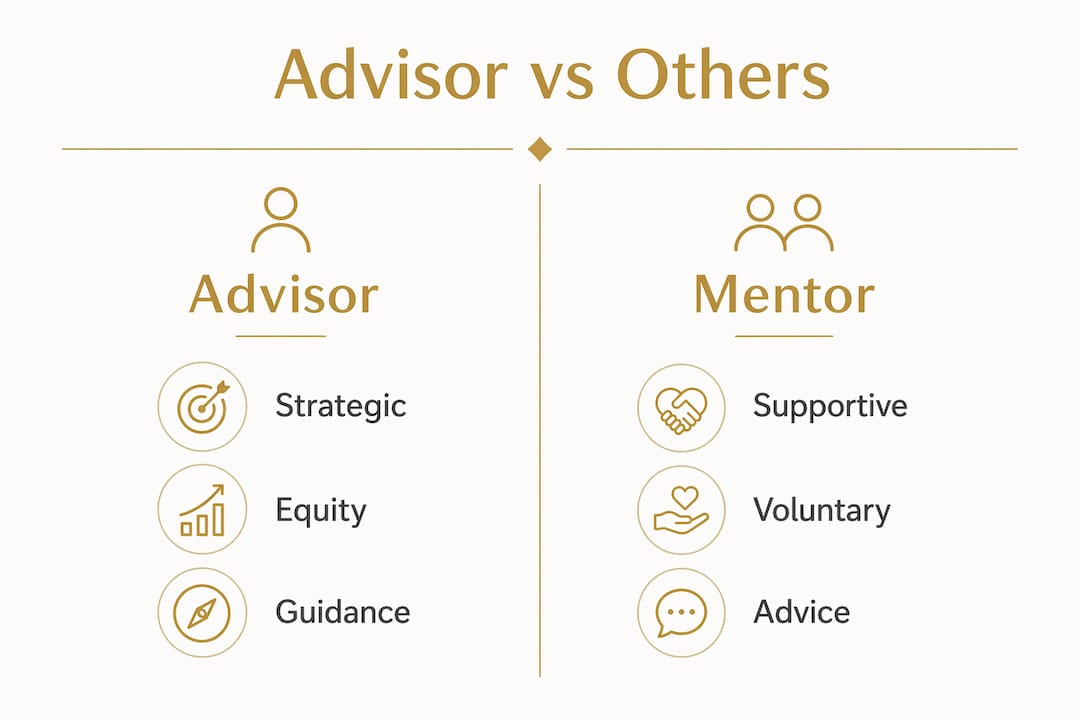
| Role | Primary function | Compensation | Decision authority |
|---|---|---|---|
| Advisor | Strategic guidance and network access | Equity plus cash | None. Founder decides. |
| Mentor | Personal development and encouragement | Usually unpaid | None |
| Consultant | Project-based deliverables | Cash fee | Scoped to project |
| Fractional executive | Operational leadership part-time | Cash retainer | Yes, within their function |
Most founders do not formalize advisory relationships, which creates misaligned expectations and role confusion. A written agreement that defines scope, time commitment, compensation, and decision boundaries protects both parties. It also creates psychological safety. The advisor knows what is expected. The founder knows what they are paying for.
Equity vesting for advisors typically follows a schedule tied to the engagement period, not a cliff. This keeps the advisor motivated to deliver value throughout the relationship rather than front-loading effort. Cash components, when included, are usually tied to specific deliverables or retainer periods.
How advisors reduce the psychological cost of founder decisions
Founder decision-making is not purely rational. Cognitive biases, emotional pressure, and isolation all degrade decision quality over time. Advisors function as a structural check on those forces. Advisors act as a second brain to clarify options and trade-offs during critical inflection points, reducing decision latency without replacing founder authority. That reduction in latency matters. Founders who sit too long with a hard decision often make it reactively, under pressure, with incomplete information.
The most common founder blind spots advisors address include:
- Confirmation bias: Founders seek data that supports a decision already made emotionally. Advisors bring contradictory evidence to the table before the commitment is locked.
- Sunk cost thinking: Founders continue investing in a failing channel because they have already spent money there. Advisors reframe the decision around future returns, not past costs.
- Reactive hiring: Founders hire fast to solve a pain point, then discover the role was misdiagnosed. Advisors slow the process and clarify the actual constraint.
- Overconfidence in product-market fit: Founders mistake early traction for validated demand. Advisors push for more rigorous testing before scaling spend.
Founders misusing advisors for minor tasks miss the highest use point. Advisors function best by delaying rushed decisions and challenging assumptions under pressure. That friction is the product. A founder who wants an advisor to validate every small choice is not using the relationship correctly. The advisor’s job is to slow down the decisions that deserve more thought, not to speed up every decision.
Pro Tip: Before each advisory session, write down the one decision you are most tempted to make quickly. That is the one to put on the agenda first.
Advisors also help founders recognize reactive decision patterns before they become habits. A founder who consistently makes pricing changes in response to competitor moves, rather than customer data, is operating reactively. An advisor who sees that pattern can name it, which is often enough to break it.
How to measure and maximize advisory impact
Advisory relationships without accountability produce polite conversations, not results. Founders who get the most from advisors treat each session as a business meeting with a clear output. Small businesses with formal advisory support show stronger financial stability and faster growth, with advisors helping identify pricing, cash flow, and operational risks overlooked internally. That outcome does not happen by accident. It requires structure.
- Define the decision before the session. Every advisory meeting should have a specific question or decision at its center. “What should we do about growth?” is not a question. “Should we expand to wholesale before fixing our DTC margin?” is.
- Track decisions made with advisory input. Keep a simple log of which decisions involved advisor input and what the outcome was. Over six months, patterns emerge. You see where the advisor adds value and where the relationship has drifted.
- Match advisor expertise to your current stage. An advisor who helped you launch is not necessarily the right advisor for your Series A. Choosing advisors whose expertise aligns with current business needs is the single most important selection criterion.
- Build an advisory board with diverse skills. A founder who has three advisors with identical backgrounds gets three versions of the same perspective. Combine a finance-focused advisor, an operator, and a domain expert for genuine coverage.
- Engage advisors before the crisis, not during it. Founders often delay advisory engagement until crisis; experts recommend building advisory relationships proactively during stable periods for objective planning. A relationship built under pressure is a relationship built on incomplete trust.
Tracking advisory impact does not require a complex system. A shared document with the decision, the advisor’s input, and the outcome three months later is enough. That record also makes it easier to have honest conversations about whether the relationship is still serving the business.
For founders who want a clearer picture of where advisory input is most needed, a financial health assessment often reveals the exact constraints an advisor should be focused on.
Key Takeaways
The most effective advisory relationships are built on formal agreements, matched expertise, and proactive engagement before crises force reactive decisions.
| Point | Details |
|---|---|
| Advisors guide, not decide | Founders retain full decision authority; advisors sharpen thinking and surface risks. |
| Formalize every relationship | Written agreements on scope, time, and compensation prevent role confusion and wasted sessions. |
| Engage early, not in crisis | Building advisory relationships during stable periods produces better planning and stronger trust. |
| Match expertise to stage | An advisor who fits your launch phase may not fit your growth or exit phase. |
| Measure advisory outcomes | Track decisions made with advisor input and review outcomes to confirm the relationship is delivering value. |
How Commerce Catalyst supports founder decision-making
Founders navigating complex financial and strategic decisions often need more than occasional advice. They need a partner who has been in the same position and can translate financial reality into a clear path forward.
Commerce Catalyst offers a DTC Financial Health Assessment that identifies the specific constraints holding your business back, from cash flow gaps to pricing misalignment. For founders who need ongoing financial leadership, the Fractional CFO service provides the strategic financial guidance that most early-stage brands cannot yet afford full-time. Founders considering an exit can access dedicated exit advisory support built around real transaction experience. Every service is grounded in founder experience, not theory.
FAQ
What is the role of an advisor in founder decisions?
An advisor provides strategic guidance, industry expertise, and network access to help founders make better decisions at critical business inflection points. The founder retains full decision authority; the advisor sharpens the thinking behind each choice.
How many hours does a startup advisor typically commit?
Startup advisors typically commit 2–8 hours per month over a 12–24 month engagement period. Compensation usually combines equity and cash to align advisor incentives with founder outcomes.
When should a founder engage an advisor?
Founders should engage advisors proactively during stable periods, not only when a crisis forces the conversation. Early engagement produces better planning and a stronger working relationship.
How is an advisor different from a mentor or consultant?
An advisor provides ongoing strategic guidance and network access, usually for equity plus cash, with no operational authority. A mentor focuses on personal development, typically unpaid, while a consultant delivers specific project outputs for a cash fee.
How do advisors help founders avoid poor decisions?
Advisors act as a second brain that reduces decision latency and challenges assumptions before commitments are made. They are most effective as a friction point that slows rushed decisions and surfaces risks the founder has not yet considered.