The most effective approach to supplier payment terms is to hold Net-30 as your baseline, selectively extend terms in exchange for concrete trade-offs, and enroll key suppliers in early-pay programs so you improve Days Payable Outstanding without eroding the relationships that protect you during supply disruptions. That single policy decision, executed well, can free material working capital while keeping your supplier base stable and preferential toward you.
Here is where to start this week:
- Measure your current DPO. Pull accounts payable data for the last 90 days and calculate Days Payable Outstanding by supplier and category. You cannot negotiate what you have not quantified.
- Identify your top-spend suppliers. Rank by annual spend and flag which have standard terms, which are on non-standard terms, and which have upcoming contract renewals in the next six months.
- Draft a bounded extension proposal for two or three targets. A bounded ask (Net-45 for 12 months, tied to a volume commitment) is far more likely to succeed than an open-ended request.
- Evaluate early-pay program eligibility. For suppliers where extending terms risks the relationship, early-pay discounts or supply-chain finance may deliver better cash-flow outcomes with less friction.
- Schedule a negotiation or vendor-finance evaluation. Block time with your AP lead and legal counsel before any outreach. Approval thresholds and contract language need to be ready before the conversation starts.
Each of these actions connects directly to cash-flow outcomes. Extending terms by 30 days on a $5M spend category can free hundreds of thousands in working capital. Capturing a 2% early-pay discount on the same spend generates a meaningful annualized return. The KPIs that track both, DPO, DSO, and the Cash Conversion Cycle, are covered in detail below.
Key Takeaways
Supplier payment terms are one of the strongest, lowest-cost working-capital tools available to procurement and finance teams, but only when negotiated with trade-offs, executed with operational rigor, and monitored for relationship impact alongside DPO.
| Point | Details |
|---|---|
| Measure DPO before negotiating | Calculate DPO by supplier and category before any outreach; you cannot target what you have not quantified. |
| Bound every extension ask | Propose a 12-month pilot with a specific trade-off (volume, consolidated orders) rather than an open-ended term change. |
| Fix AP cycle time first | A 15-day invoice approval cycle eliminates most 2/10 Net 30 discount windows; automate before renegotiating. |
| Use financing for sole-source suppliers | Supply-chain finance or dynamic discounting protects the relationship when direct term extension is too risky. |
| Commerce Catalyst financial assessment | The diagnostic identifies your highest-impact payment-term levers and what your AP process needs to execute them. |
Table of Contents
- What are supplier payment terms and which abbreviations matter?
- How do common payment models work in practice?
- How do payment terms affect cash flow and the KPIs you must track?
- How to negotiate payment terms: a step-by-step playbook
- How to operationalize agreed payment terms across AP and procurement
- What are the alternatives when renegotiating terms is not the right move?
- Sample contract clauses you can adapt for your agreements
- What are reasonable payment term benchmarks by supplier type?
- How long does implementing term changes take and what does it cost?
- Why predictability beats maximum DPO every time
- Sources
What are supplier payment terms and which abbreviations matter?
Supplier payment terms are the contractual conditions that define when a buyer must pay a vendor after receiving goods or an invoice. They specify the payment window, any early-payment incentives, and the event that starts the clock. That trigger matters more than most procurement teams realize: “Net-30 from invoice date” and “Net-30 from delivery receipt” can differ by a week or more depending on shipping lead times, and that variance compounds across a portfolio of hundreds of vendors.
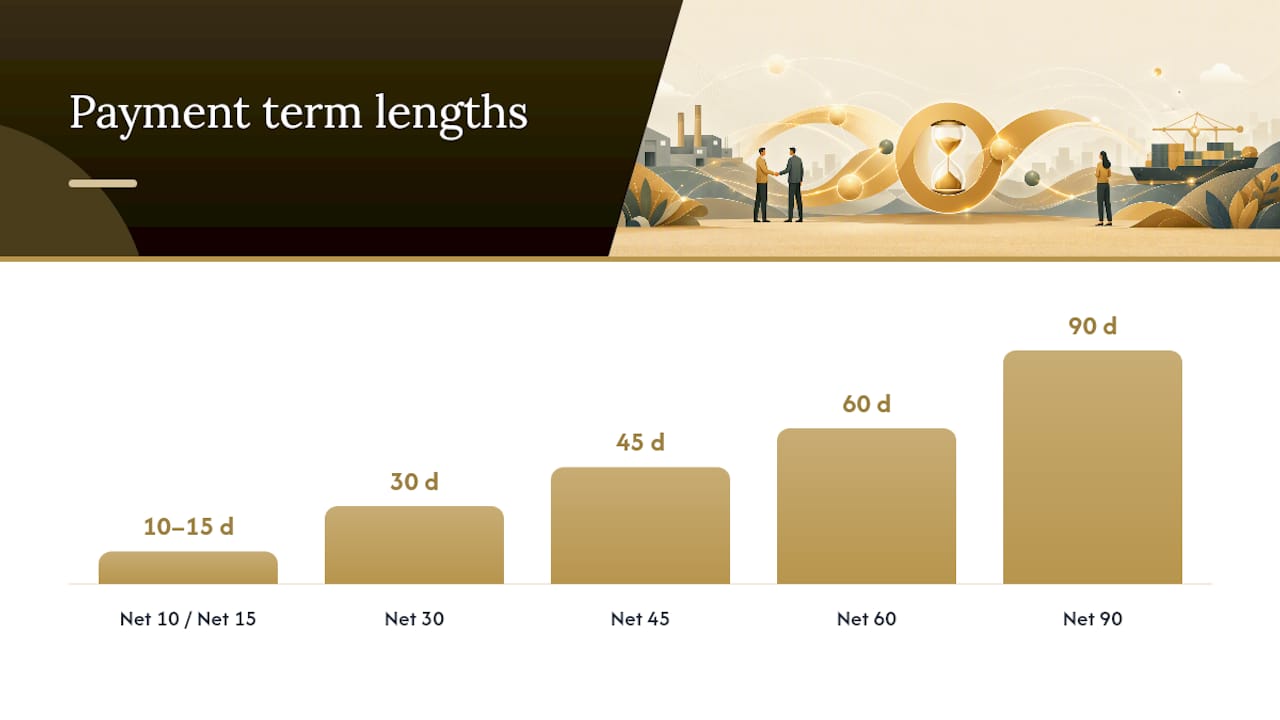
Net payment terms set how long buyers have to pay; Net-30 is the established standard in U.S. B2B, while Net-60 and Net-90 appear regularly in enterprise and manufacturing contracts. Changes in terms materially affect both buyer DPO and supplier DSO, which is why the trigger definition belongs in the contract, not in an email thread.
| Term | What It Means | Typical Use Case |
|---|---|---|
| Net 10 / Net 15 | Full payment due in 10 or 15 days | Perishables, small vendors with thin margins |
| Net 30 | Full payment due in 30 days | Standard U.S. B2B baseline across most industries |
| Net 45 | Full payment due in 45 days | Mid-market manufacturing, distribution |
| Net 60 | Full payment due in 60 days | Enterprise buyers, longer production cycles |
| Net 90 | Full payment due in 90 days | Construction, government contracts, large retail |
| 2/10 Net 30 | 2% discount if paid within 10 days; full amount due at 30 | Buyers with available cash seeking yield; suppliers wanting faster cash |
| COD | Cash on delivery | New supplier relationships, high-risk buyers |
| CIA / PIA | Cash in advance / payment in advance | Custom orders, international suppliers, high credit risk |
| Letter of Credit (L/C) | Bank-guaranteed payment upon document presentation | International trade, large-value transactions |
| EOM | End of month; payment due at month-end after invoice | Simplifies AP batch processing |
| MFI | Month following invoice; payment due end of month after invoice month | Extends EOM by one full month |
| Progress / Milestone | Payments tied to project milestones or delivery stages | Construction, software development, long-cycle manufacturing |
Ambiguous triggers are a hidden working-capital leak. A portfolio of 200 vendors where half use invoice date and half use delivery receipt as the payment clock creates unpredictable cash outflows and makes DPO calculations unreliable. Specifying the trigger in contract language, down to the exact event and the method of confirmation, is one of the strongest fixes a procurement team can make with minimal negotiation required.
How do common payment models work in practice?
The 2/10 Net 30 economics
The 2/10 Net 30 structure is deceptively powerful. A buyer who pays within 10 days captures a 2% discount on the invoice. On a $100,000 invoice, that is $2,000 saved for paying 20 days earlier than required. The implied annualized return on early-pay discounts like 2/10 Net 30 is frequently cited at approximately 37%, a figure that exceeds the cost of most short-term credit lines. If your weighted average cost of capital is 8–12%, capturing these discounts is one of the highest-return, lowest-risk uses of cash in your AP cycle.

The break-even question is clear: if your cost of capital is below the implied annualized return of the discount, pay early. If it is above, hold cash and pay at the due date. Most mid-market companies with access to revolving credit lines should be capturing 2/10 Net 30 discounts aggressively, yet AP cycle times and manual approval routing prevent it more often than not.
Dynamic discounting vs. fixed early-pay discounts
Dynamic discounting platforms (Taulia, C2FO, and similar) allow suppliers to request early payment at a sliding rate: the earlier the payment, the higher the discount offered. This differs from fixed-discount terms in two important ways. First, the rate adjusts daily rather than sitting at a binary 2% threshold. Second, suppliers opt in on a per-invoice basis, giving them flexibility to accelerate cash when they need it most.
Fixed discounts (2/10 Net 30) work best when your AP team can reliably process invoices within the capture window. Dynamic discounting works better when invoice timing varies or when you want to offer suppliers a self-serve liquidity option without renegotiating every contract. The trade-off: dynamic platforms carry platform fees and require integration with your ERP or AP system, while fixed discounts cost nothing to administer if your AP cycle is already fast.
- Fixed 2/10 Net 30: Simple, no platform cost, high implied return, but requires AP to process and approve within 10 days of invoice receipt.
- Dynamic discounting: Flexible, supplier-driven, scales across a large vendor base, but requires platform investment and supplier onboarding.
- Practical constraint: If your average invoice approval cycle runs 12–15 days, you will miss most fixed-discount windows. Fix the AP cycle first, or move to dynamic discounting where the window is adjustable.
Pro Tip: Before enrolling suppliers in a dynamic discounting program, audit your invoice-to-approval cycle time by supplier tier. A 15-day average approval cycle means you are already outside the 2/10 window on most invoices. That is an AP process problem, not a terms problem.
How do payment terms affect cash flow and the KPIs you must track?
The formulas that matter
Three metrics define the working-capital impact of your vendor payment conditions:
Days Payable Outstanding (DPO) DPO = (Accounts Payable / Cost of Goods Sold) × Number of Days
A higher DPO means you are holding cash longer before paying suppliers. Moving from Net-30 to Net-60 on a significant spend category directly increases DPO.
Days Sales Outstanding (DSO) DSO = (Accounts Receivable / Revenue) × Number of Days
DSO measures how long it takes your customers to pay you. When you extend terms to suppliers, their DSO increases by the same amount your DPO does, which is why aggressive term extensions can strain supplier cash flow and damage the relationship.
Cash Conversion Cycle (CCC) CCC = DSO + Days Inventory Outstanding (DIO) − DPO
A lower CCC means cash moves through your business faster. Extending payable terms increases DPO and therefore reduces CCC, freeing working capital. The goal is to lower CCC without pushing supplier DSO to a point where it creates financial stress or relationship risk on the other side of the transaction.
Sample calculation: Net-30 to Net-60 on a $5M spend category
Assume a supplier category with $5M annual spend, currently on Net-30 terms.
That $416,667 is a one-time working-capital release. It is real cash you can redeploy into inventory, marketing, or debt reduction. The supplier, however, now waits twice as long to be paid, which increases their DSO by 30 days and may affect their own cash position.
Track these metrics on a regular cadence: DPO trend by quarter, portfolio term variance (what percentage of spend is on non-standard terms), and the number of suppliers operating outside your standard term tiers. Suppliers on non-standard terms are a portfolio risk, because inconsistent terms accumulate across renewals and create compliance gaps that are expensive to unwind.
How to negotiate payment terms: a step-by-step playbook
Pre-negotiation checklist
Before any outreach, gather the following for each target supplier:
- Payment history: on-time rate, dispute frequency, and any open invoices
- Supplier financial health: publicly available signals (credit ratings, news, industry trends) or direct financials if the relationship warrants it
- Strategic importance: sole-source vs. multi-source, lead times, switching costs
- Volume levers: upcoming orders, contract renewals, consolidated purchasing opportunities
- Contract renewal window: the 60–90 days before renewal is your strongest moment
- Internal approval thresholds: know what your CFO or VP of Finance will sign off on before you make an offer
Credit managers report increased customer requests for extended terms, and approval decisions typically require payment history, financials, and a business case, because longer terms increase credit exposure and portfolio risk. The same logic applies in reverse: when you ask a supplier for extended terms, they are evaluating your payment history and strategic value to them.
Negotiation scripts for three scenarios
Scenario 1: Small supplier (under $250K annual spend)
Keep it simple. Small suppliers often accept modest extensions when paired with volume certainty, because predictable orders matter more to them than the payment window.
Scenario 2: Mid-market supplier ($250K–$2M annual spend)
The bounded pilot framing reduces perceived risk for the supplier. A 12-month pilot is easier to accept than a permanent term change.
Scenario 3: Strategic sole-source supplier
Do not lead with a term extension request for a sole-source supplier. The use dynamic is reversed. Instead, open with a supply-chain finance or early-pay program conversation:
This approach, framed commercially rather than as a request for charity, preserves supplier goodwill and improves success rates.
Decision rules and timing
Set internal approval thresholds before negotiations begin. A reasonable framework: procurement managers approve term changes up to Net-45 for suppliers under $500K annual spend; CFO approval required for Net-60 or above, or for any sole-source supplier regardless of spend. Never negotiate during an open dispute or when invoices are overdue. The supplier’s goodwill is at its lowest, and your use argument is undermined by your own payment record.
Pro Tip: Time your term-extension conversations to coincide with contract renewals or volume commitments. A supplier who is about to sign a new annual agreement has more incentive to accept modified terms than one mid-contract with no renewal on the horizon.
How to operationalize agreed payment terms across AP and procurement
Negotiating better terms is the easy part. Executing them consistently is where most organizations lose the value they just created.
Start with PO-to-invoice matching. Every purchase order should specify the payment trigger (invoice date, delivery confirmation, or acceptance sign-off) and the agreed term. When an invoice arrives without a matching PO or with a different trigger date, it should route to a defined exception queue, not sit in someone’s inbox. Three-way match (PO, receipt, invoice) is the standard for goods-based transactions; services often require a two-way match with a signed delivery confirmation. The exception handling process needs a defined SLA, typically 48–72 hours for routine discrepancies, to avoid missing early-pay discount windows.
The operational checklist for implementing new terms covers more than the contract itself:
- Update the vendor master record in your ERP with the new payment trigger, term code, and discount parameters
- Set system flags for early-pay discount windows so AP is alerted before the capture deadline
- Update contract management records with the new term, effective date, and any pilot expiration
- Adjust approval routing rules if the new term changes the payment timing relative to your AP batch cycle
- Notify the supplier’s AR team in writing, confirming the new term, trigger definition, and effective date
Technology is a genuine force multiplier here. Gartner projects that half of procurement contract management will be AI-enabled by 2027, which means contract-data extraction and term enforcement are becoming automated rather than manual. AP automation tools (Tipalti, Bill.com, Coupa Pay) can read invoice trigger dates, flag discount windows, and route approvals without human intervention on routine invoices. Invoice OCR and AI-assisted matching reduce the processing lag that causes most missed discounts. Future-dated ACH and virtual card programs add payment-method flexibility, though virtual cards carry interchange fees that need to be weighed against the float benefit.
Assign explicit ownership for invoice discrepancy resolution. One person or team owns the exception queue, with a defined escalation path and a maximum resolution SLA. Unresolved discrepancies are the single most common reason suppliers lose trust in a buyer’s AP process, and lost trust shows up in the next contract negotiation.

Pro Tip: *Run a quarterly discount-capture rate report: total discounts captured divided by total discounts available.
What are the alternatives when renegotiating terms is not the right move?
Sometimes the relationship, the supplier’s financial position, or the strategic importance of the account makes a direct term-extension conversation inadvisable. Financing alternatives can deliver similar working-capital outcomes without the relationship friction.
-
Supply-chain finance (reverse factoring): A bank or fintech pays your supplier early at a discount; you repay the bank on your standard extended terms. The supplier gets fast cash at a rate tied to your credit rating (usually lower than their own borrowing cost), and you extend DPO without asking the supplier to absorb the cost. Best for large, strategic suppliers where the relationship is too valuable to risk.
-
Dynamic discounting platforms: As covered earlier, these let suppliers self-select early payment at a sliding rate. The buyer funds the early payment from its own cash, capturing a yield. Best when you have excess cash and want to deploy it at a better return than a money market account.
-
Factoring: The supplier sells their receivables to a third party at a discount. This is a supplier-side solution, not a buyer-side one, but understanding it matters because suppliers under cash pressure may approach you about it. It does not change your payment terms but can signal a supplier in financial distress.
-
Short-term revolving credit lines: If you need working capital and cannot extend terms, a revolving credit facility lets you fund operations while paying suppliers on time. The cost is the interest rate on the line, which you compare against the relationship and operational value of maintaining standard terms.
-
Virtual card programs: Some buyers pay suppliers via virtual card, capturing card rebates (typically 1–1.5%) while the supplier receives payment quickly. The supplier pays the card processing fee, so this works best when the supplier’s margin can absorb it or when the payment speed is valuable to them.
When is financing preferable to renegotiation? For new suppliers where you have no payment history to use, for sole-source suppliers where the power dynamic is reversed, and for any situation where a term-extension request would signal financial weakness on your part. Extending vendor payment terms can free working capital quickly, but successful requests are structured commercially and are sometimes better solved with vendor financing when negotiation risks the relationship.
Sample contract clauses you can adapt for your agreements
The language below is template wording. Have your legal counsel review every clause before use, confirm the governing law, and verify that the trigger definition matches your AP system’s capabilities.
Payment trigger definition
“Payment terms begin on the date Buyer receives a valid, undisputed invoice that references the applicable Purchase Order number. An invoice is deemed received on the date it is delivered to [AP email / AP portal]. Invoices that do not reference a valid Purchase Order number will be returned to Supplier without processing and will not initiate the payment period.”
Net terms clause
“Payment is due within [30/45/60] calendar days of the invoice receipt date as defined above. Buyer shall make payment via [ACH / wire / check] to the account designated in writing by Supplier.”
Early-payment discount clause (2/10 Net 30)
Buyer may deduct the discount amount from the payment. This discount is available only on invoices that are not subject to a pending dispute.*"
Dynamic discount optionality
“Supplier may, at its sole discretion, request early payment on any undisputed invoice through Buyer’s designated early-pay platform. The applicable discount rate shall be as displayed in the platform at the time of the request. Participation is voluntary and does not alter the standard payment terms above.”
Late-payment interest
Bounded term-extension addendum
A brief note for your legal team: confirm the governing-law clause, verify that the trigger definition is operationally executable in your AP system, and check whether any industry-specific statutes apply. Certain statutory and regulatory provisions can affect payment timing in specialized sectors, and buyers should confirm any industry-specific legal constraints before altering standard terms. Agricultural and perishable goods, for example, are subject to USDA/AMS rules that impose specific payment timing requirements regardless of what a contract says.
What are reasonable payment term benchmarks by supplier type?
Industry norms vary more than most procurement teams expect. The table below reflects general U.S. market practice; validate against your specific supplier financials and industry before using as a negotiation anchor.
| Supplier Type | Typical Term Range | Notes |
|---|---|---|
| Perishable goods / food | Net 7–15 | Regulated in some categories (USDA/PACA); short terms are standard and often statutory |
| Professional services | Net 15–30 | Shorter terms common for smaller firms; Net-30 is the baseline |
| General B2B / distribution | Net 30 | U.S. standard; deviations require justification |
| Manufacturing / industrial | Net 30–60 | Longer production cycles support extended terms; Net-45 common in mid-market |
| Enterprise / large-scale procurement | Net 60–90 | Common in retail and large-enterprise supply chains |
| Construction / government | Net 60–90 | Progress billing and milestone payments are standard; some contracts extend beyond Net-90 |
| Petroleum / fuel | Net 1–2 days | Commodity pricing volatility drives very short terms |
| International / import | L/C or Net 30–60 | Letter of Credit common for new relationships; terms extend as trust builds |
A few caveats worth stating plainly. Single-source suppliers operate outside normal benchmark logic: their terms reflect use, not industry norms. Seasonal businesses (holiday goods, agricultural inputs) often have terms that shift by quarter, and locking in annual terms without seasonal flexibility creates friction. Supplier size matters: a $2M revenue vendor cannot absorb Net-90 terms the way a $200M manufacturer can. Pushing small suppliers to extended terms without a financing alternative is a relationship risk that shows up in quality, lead times, and priority during allocation shortages.
How long does implementing term changes take and what does it cost?
Typical implementation timeline
- Weeks 1–2: Internal preparation. Measure current DPO, identify pilot suppliers, draft proposals, set approval thresholds, and brief legal.
- Weeks 3–4: Supplier outreach and negotiation. Expect two to three rounds of conversation for mid-market suppliers; sole-source negotiations may take longer.
- Weeks 5–6: Contract amendments and system updates. Legal review, vendor master updates, AP system configuration, and supplier confirmation in writing.
- Months 2–6: Pilot period. Run the new terms on a defined subset of spend, track DPO impact, discount capture rate, and supplier feedback.
- Month 7–9: Pilot evaluation. Measure actual vs. projected DPO improvement, assess supplier relationship health, and identify any operational gaps.
- Months 10–12: Full rollout decision. Expand to the broader supplier portfolio, update standard contract templates, and schedule a 12-month review.
Cost considerations
AP automation implementation (if not already in place) is typically the largest cost. Platform fees for dynamic discounting programs vary by provider and volume. Legal review for contract amendments runs by the hour; budget for at least two to four hours per non-standard clause set. Supplier change-management time is often underestimated: finance teams at your suppliers need to update their AR systems, and that takes coordination.
To build a cost-estimation worksheet, you need four inputs: expected DPO improvement in days, total annual vendor spend in the affected category, your estimated discount capture rate (what percentage of available discounts you will actually capture), and the platform or financing fees you will incur. The net benefit is the working capital released plus discounts captured, minus fees and implementation costs. For most mid-market companies running $10M or more in annual vendor spend, the math favors investment in AP automation and a structured term-negotiation program within the first year.
Why predictability beats maximum DPO every time
The conventional wisdom in procurement is that longer payment terms are always better for the buyer. Push DPO as high as possible, hold cash as long as you can, and let the supplier absorb the cost. That logic is incomplete, and in many cases it is actively counterproductive.
Suppliers reward predictable, on-time payments and clear dispute handling with measurable commercial benefits: preferential allocation during supply constraints, earlier warnings on disruptions, better pricing at renewal, and faster resolution when problems arise. The supplier preferencing model, widely used in strategic procurement, categorizes buyers by attractiveness and strategic importance. Buyers who pay reliably and communicate clearly consistently land in the “core” or “development” quadrant, where suppliers invest in the relationship. Buyers who squeeze terms and pay late land in “nuisance,” where suppliers deprioritize them the moment a better customer appears.
The practical implication: a 30-day term extension that saves $400K in working capital may cost you $600K in pricing concessions, expedite fees, and allocation losses over the next two years if it damages a key supplier relationship. The math only works if you account for both sides of the ledger.
The better negotiating posture is to trade for predictability rather than just extra days. Offer a supplier a guaranteed payment date (not just a term), a consolidated order schedule, and a clear dispute-resolution SLA. In exchange, ask for extended terms, a discount, or both. That framing positions you as a buyer worth investing in, which compounds in value over time in ways that a one-time DPO improvement does not.
Pro Tip: Add a “payment date guarantee” clause to your term-extension proposals: you commit to paying on a specific date within the extended window rather than “up to” the due date. Suppliers value certainty more than speed, and this costs you nothing operationally if your AP system is configured correctly.
The view from the buyer side
The brands that get the best outcomes are the ones that come to the negotiation with something to offer, not just something to ask for. Volume certainty, consolidated orders, a clear payment schedule, access to early-pay programs. The ask for extended terms lands completely differently when it is packaged as a commercial proposal rather than a cash-flow plea.
The net effect is negative. The brands that avoid this outcome are the ones that treat the negotiation as a two-sided conversation from the start, with clear trade-offs documented and agreed before the new terms take effect.
The playbook in this article reflects what actually works in practice: measure first, negotiate with trade-offs, operationalize rigorously, and monitor the relationship health alongside the financial metrics.
How Commerce Catalyst supports payment-term improvement
Payment-term strategy sits at the intersection of cash flow, supplier relationships, and operational execution. Getting it right requires more than a spreadsheet; it requires a clear view of your working-capital position, your supplier portfolio risk, and your AP team’s actual capacity to execute.

Commerce Catalyst’s financial health assessment gives consumer brand founders and finance leaders a structured diagnostic of their cash-flow constraints, including payables management, discount capture rates, and working-capital levers. The engagement identifies where term changes will have the most impact, which suppliers are the right targets, and what your AP process needs to support execution. For brands that need ongoing support, the fractional COO engagement embeds the operational changes across procurement and AP so the improvements hold. If you want a clear picture of where your payment terms stand and what to fix first, the financial assessment is the right starting point.
Sources
The sources below informed this guide and are worth reviewing directly for additional depth:
- Net payment terms: Benefits of Net 30/60/90 terms
- Customers want longer terms: what’s the real cost?
- Law
Legal note: the contract clause templates in this article are starting points, not legal advice. Have qualified legal counsel review all payment-term language before use, confirm the governing law, and verify compliance with any industry-specific statutes that apply to your supplier relationships.