Stress testing a business strategy is the process of rigorously evaluating its assumptions, design, and competitive power to expose weaknesses before they cost you real money. The formal term in strategic management is strategic stress testing, and it maps directly to what risk professionals call the 5-step risk assessment cycle: identify hazards, analyze likelihood and impact, evaluate against risk appetite, treat risks with controls, and monitor continuously. Most founders skip this process entirely and pay for it later. The stress test business strategy steps covered here give you a structured way to pressure-check your plan before you commit resources to executing it.
What do you need before you can stress test your strategy?
Preparation determines whether your stress test produces real insight or just confirms what you already believe. Three things must be in place before you start.
A clearly written strategy with explicit assumptions. You cannot test what you have not articulated. Write down your core assumptions: who buys, at what price, through which channel, and why they choose you over alternatives. If your strategy lives only in your head, map it to paper first. Founders who skip this step end up testing their execution instead of their strategy, which is the most common pitfall in the entire process.

Internal and external data. Internal data includes unit economics, gross margin, customer acquisition cost, and cash runway. External data includes market size estimates, competitor pricing, and macroeconomic signals relevant to your category. Both are required. Internal data alone tells you how you are performing. External data tells you whether the conditions your strategy depends on still exist.
The right analytical tools for the risk level. Not every assumption needs a Monte Carlo simulation. Use a qualitative 5x5 risk matrix for broad risks where you are estimating likelihood and impact on a 1–5 scale. Reserve quantitative simulations for high-impact financial assumptions where the math matters. Scenario planning works best for mapping out alternative futures at the market level.
| Tool | Best used for | When to apply |
|---|---|---|
| 5x5 risk matrix | Broad assumption mapping | Early in the stress test |
| Monte Carlo simulation | High-impact financial variables | After key risks are identified |
| Scenario planning | Market and competitive futures | Alongside vulnerability mapping |
| Pre-mortem exercise | Team bias reduction | Before finalizing scenarios |
Pro Tip: Define your evaluation criteria and kill criteria before you start. A kill criterion is a binary threshold: if revenue drops below X or gross margin falls under Y, the strategy is unviable. Setting these in advance prevents you from rationalizing bad results mid-test.
How do you identify vulnerabilities and define stress scenarios?
The first active phase of any business strategy evaluation focuses on two things: finding where your strategy is fragile and building scenarios that push those fragile points to their limits.
Start by listing every core assumption your strategy depends on. Group them into three categories.
- Market assumptions: Target customer exists at the size you project, willingness to pay is at or above your price point, and the channel you plan to use reaches them efficiently.
- Operational assumptions: You can produce or deliver at the cost and speed your model requires, and your team has the capacity to execute.
- Financial assumptions: Unit economics hold at scale, cash flow timing matches your burn rate, and capital is available when needed.
For each assumption, apply a basic risk assessment method: score likelihood (1 = rare, 5 = almost certain) and impact (1 = negligible, 5 = catastrophic). Multiply the two scores to get a priority number. Any assumption scoring above 12 on a 25-point scale deserves a dedicated stress scenario.
Defining the scenario is where most founders get too conservative. A useful stress scenario uses numeric and time-bound adverse parameters that go beyond your historic volatility range. If your revenue has never dropped more than 10% quarter over quarter, your stress scenario should model a 25–30% drop and ask: does the strategy survive? That boundary is your breakpoint, the point at which the strategy becomes unviable.
Pro Tip: Run a pre-mortem before you finalize your scenarios. Tell your team to assume the strategy has already failed 12 months from now. Ask them to write down the three most likely reasons. Pre-mortem stress tests reduce defensive bias and surface genuine weaknesses that optimistic planning misses.
The goal of this phase is not to predict the future. It is to know exactly where your strategy breaks and what conditions cause the break.
How do you prioritize risks and build contingency plans?
Identifying risks without ranking them produces a list, not a plan. This phase converts your vulnerability map into a prioritized set of contingency actions.
Use the priority scores from your risk matrix to rank assumptions by combined severity. Then apply a second filter: does this risk exceed your acceptable risk appetite? Risk appetite is the level of uncertainty your business can absorb without threatening its core operations. A founder with 18 months of cash runway has a different risk appetite than one with 4 months.
Follow these steps to move from risk ranking to contingency planning:
- Select the top 5 risks by priority score. These are your critical assumptions.
- Define the trigger point for each risk. A trigger is a measurable signal that the assumption is breaking. For example: customer acquisition cost rises 40% above baseline for two consecutive months.
- Write a predefined response for each trigger. The response should be specific: reduce ad spend by 30%, shift channel mix, or activate a secondary supplier.
- Assign ownership. One person owns each contingency action. No owner means no accountability.
- Set a review date. Contingency plans that are never reviewed become outdated within one quarter.
Explicit kill criteria take this one step further. A kill criterion is not a warning signal. It is a binary gate: if this threshold is crossed, the strategy stops and you pivot or exit. Examples include a debt coverage ratio falling below a defined floor or unit economics turning negative for three consecutive months. Defining these before execution prevents the common failure mode where teams talk themselves past obvious warning signs.
| Risk control type | What it does | Best for |
|---|---|---|
| Mitigation action | Reduces likelihood of the risk occurring | High-likelihood, moderate-impact risks |
| Contingency plan | Reduces impact if the risk occurs | High-impact risks with clear triggers |
| Kill criterion | Stops execution when threshold is crossed | Existential risks to the strategy |
| Transfer mechanism | Shifts risk to a third party (insurance, contracts) | Operational and supply chain risks |
Pro Tip: Link your founder decision frameworks directly to your contingency triggers. When a trigger fires, the decision should already be made. Pre-decided responses remove emotion from high-pressure moments.
Why does continuous monitoring make stress testing work?
A stress test conducted once and filed away provides false confidence. Strategy evaluation must become an ongoing discipline with continuous signal monitoring, not a quarterly reporting exercise.
The practical way to build this into your operations is to separate two types of signals. Leading indicators warn you that an assumption is drifting before it breaks. Lagging indicators confirm that a break has already occurred. Tracking only lagging indicators means you are always reacting. Tracking leading indicators gives you time to adjust.
Build a monthly review cadence around these monitoring practices:
- Review your top 5 critical assumptions against current data every month.
- Track at least two leading indicators per critical assumption.
- Ask one trigger question per assumption: “Has any condition changed that would invalidate this assumption?”
- Flag any assumption where the leading indicator has moved more than 20% from baseline.
- Escalate flagged assumptions to a formal strategy review within two weeks.
Quarterly refreshes feed performance insights back into your strategic adjustments. Monthly monitoring catches drift early. The combination prevents the most expensive outcome in strategic planning: discovering a flawed assumption after you have already scaled around it.
Monitoring also forces accountability. When one person owns each critical assumption and reports on it monthly, the team cannot collectively ignore warning signs. That accountability structure is what separates founders who catch problems early from those who discover them at the worst possible moment.
Key Takeaways
Stress testing your business strategy requires explicit assumptions, structured risk prioritization, predefined kill criteria, and continuous monitoring to prevent costly execution of flawed plans.
| Point | Details |
|---|---|
| Map assumptions first | Write down every core assumption before testing begins; untested assumptions are the primary source of strategy failure. |
| Use the right tool for each risk | Apply a 5x5 risk matrix for broad risks and Monte Carlo simulations only for high-impact financial variables. |
| Define kill criteria in advance | Binary thresholds like unit economics floors prevent teams from rationalizing past clear warning signs. |
| Assign ownership to every risk | Each contingency action needs one named owner and a review date to remain effective. |
| Monitor continuously | Monthly leading-indicator reviews catch assumption drift before it becomes a crisis. |
How Commerce Catalyst supports your strategy evaluation
Stress testing your strategy is most effective when your financial assumptions are grounded in accurate, current data. Founders often discover during the process that their unit economics, margin structure, or cash flow projections contain gaps that undermine the entire evaluation.
Commerce Catalyst’s DTC Financial Health Assessment gives you a clear picture of your financial foundation before you stress test your strategy against it. Chris Wichert reviews your actual numbers, identifies the assumptions that carry the most risk, and translates the findings into decisions you can act on immediately. If you want your stress test to produce real answers rather than educated guesses, start with a clear view of your financial blind spots. That is where the most consequential assumptions tend to hide.
FAQ
What is stress testing a business strategy?
Stress testing a business strategy is the process of evaluating its core assumptions, design, and competitive power against adverse scenarios to identify where it breaks down. The goal is to expose weaknesses before committing resources to execution.
How many steps does a proper strategy stress test involve?
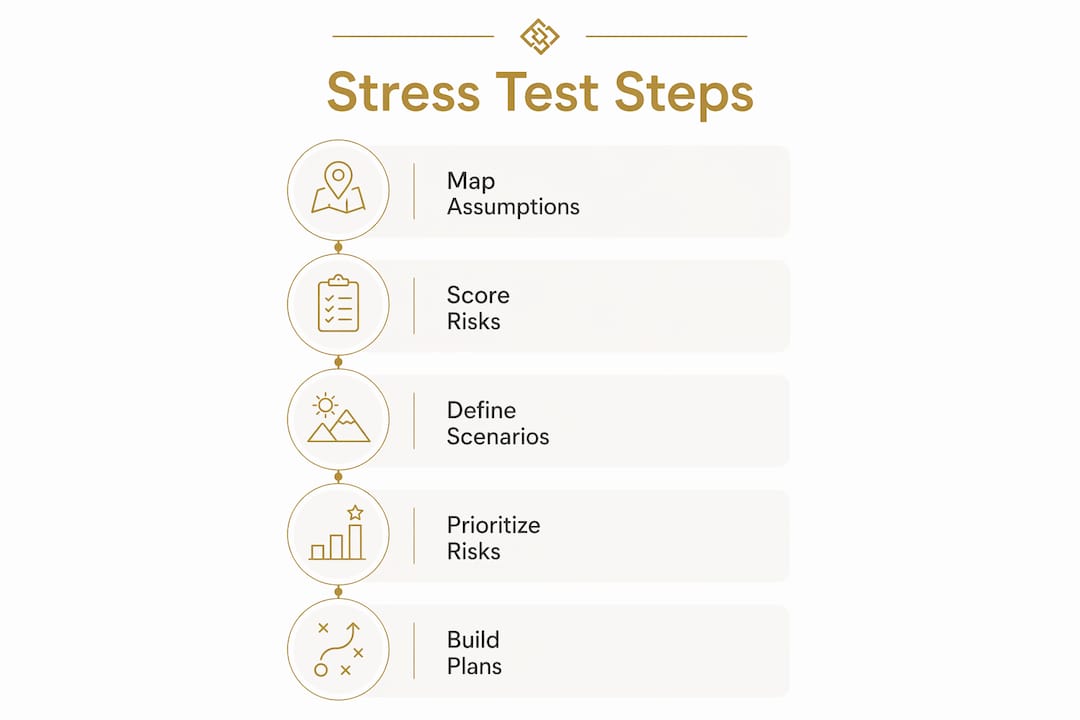
A complete stress test follows five core steps: map assumptions, score risks using a likelihood and impact matrix, define stress scenarios with numeric boundaries, build contingency plans with kill criteria, and monitor critical assumptions continuously.
What is a kill criterion in strategy stress testing?
A kill criterion is a binary, predefined threshold that triggers a pivot or exit when crossed. Examples include unit economics turning negative for three consecutive months or a debt coverage ratio falling below a set floor.
How often should you revisit your strategy stress test?
Critical assumptions should be reviewed monthly using leading indicators, with a formal quarterly refresh that feeds performance data back into strategic adjustments. Waiting for annual planning cycles allows assumption drift to compound undetected.
What is the difference between testing assumptions and testing execution?
Testing assumptions validates whether the strategic logic is sound: does the customer exist, will they pay, and can you reach them profitably. Testing execution measures whether the team is implementing correctly. Flawed assumptions cannot be fixed by better execution.