
If you’re evaluating alternatives to Rise Collective Consultants, the short answer is this: Commerce Catalyst is the recommended pick for retail and DTC brand founders who need hands-on, financially grounded advisory rather than slide-deck strategy. Beyond Commerce Catalyst, the strongest options fall into three categories: independent operator collectives, fractional operator platforms, and boutique retail consultancies.
Quick shortlist:
- Commerce Catalyst: founder-side diagnostics, fractional COO, and profitability advisory built for brands doing $5M–$75M in revenue
- Independent operator collectives (e.g., TwinPoint Collective): senior practitioners matched to projects without junior-analyst overhead
- Fractional operator platforms: flexible, scope-based engagements for sourcing, merchandising, or product development
- Blind-pitch evaluation platforms: structured proposal comparison using defined scoring criteria, useful for larger scoping exercises
Commerce Catalyst stands out because Chris Wichert built the model from his own experience as a brand founder, which means the diagnostic tools and advisory sessions are calibrated to the real operational pressures of scaling a consumer brand, not a generic consulting playbook.
Table of Contents
- Which risecollectiveconsultants.com alternatives are the best fit for your brand?
- How do you choose the right consulting alternative for retail or DTC?
- What is Rise Collective Consultants, and what do they offer?
- What does a consulting engagement actually look like?
- What outcomes have clients seen from these models?
- Key Takeaways
- Why the founder-side model produces better outcomes
- What Commerce Catalyst offers and how to start
- Further reading and sources
Which risecollectiveconsultants.com alternatives are the best fit for your brand?
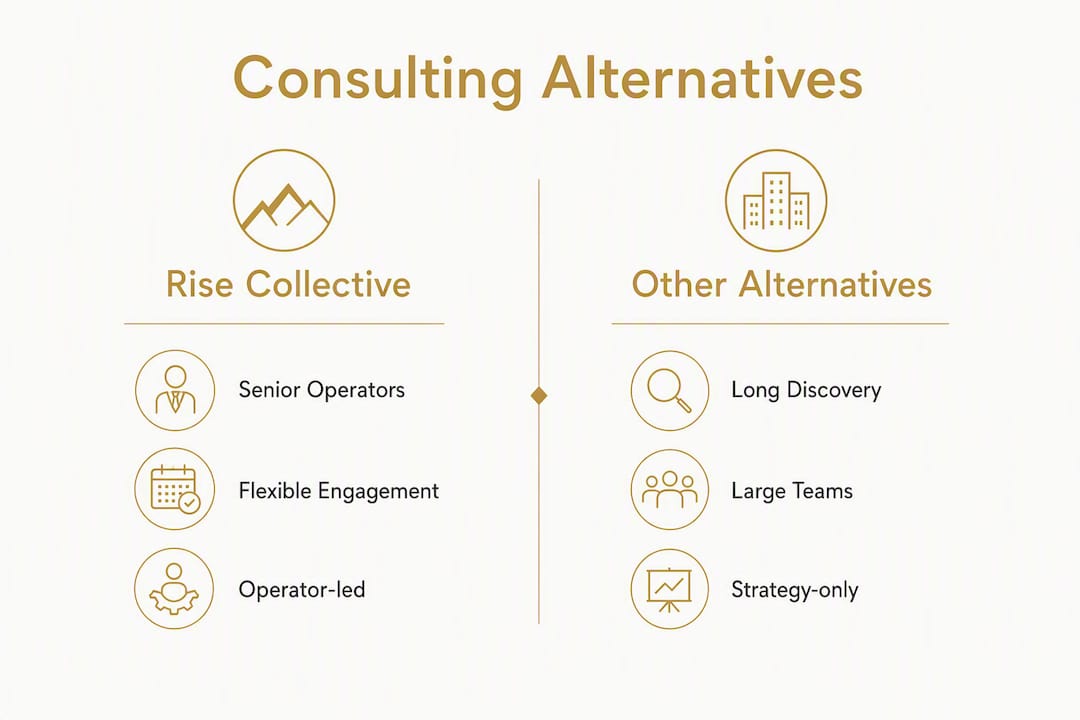
Alternative consulting models connect senior operators directly to projects, cutting the overhead of large pyramid teams and compressing time-to-impact. That structural difference matters when you’re trying to fix a sourcing problem or a margin issue in weeks, not quarters.

| Dimension | Commerce Catalyst | Independent Operator Collective | Fractional Operator Platform | Blind-Pitch Platform |
|---|---|---|---|---|
| Best for / ideal client | DTC/consumer brand founders, $5M–$75M revenue | Retail brands needing senior P&L and transformation expertise | Brands needing flexible, project-scoped sourcing or merchandising support | Larger brands running competitive vendor selection |
| Core services | Financial diagnostics, founder advisory, fractional COO | Strategic planning, P&L transformation, growth execution | Sourcing, merchandising, product development | Proposal comparison, vendor scoring |
| Engagement style | Hands-on, operator-led | Hands-on, senior practitioners | Hands-on to advisory, scope-dependent | Advisory / procurement facilitation |
| Typical length | Diagnostic (days); retainer (ongoing) | Project-based or retainer, 3–12 months | Project-based, 4 weeks | One-time selection process |
| Fee model | Fixed diagnostic, hourly advisory, retainer | Project fee or retainer | Time & materials or fixed scope | Platform fee or success fee |
| Sample deliverables | Financial health report, constraint map, KPI dashboard | Growth roadmap, P&L model, operational playbook | Sourcing RFP, vendor scorecard, merchandising brief | Scored proposal set, selection recommendation |
| Sector experience | DTC, consumer brands, ecommerce | Retail, wholesale, multi-channel | Retail, wholesale, product development | Enterprise and mid-market, sector-agnostic |
Trust signals to request from any provider before signing:
- Operator resumes showing direct P&L or sourcing responsibility (not just advisory titles)
- Two or three recent case studies with named outcomes (margin improvement, lead time reduction, revenue recovered)
- References from founders at comparable revenue stages
- Clear team composition: who actually does the work, and at what seniority level
“The shift in consulting is toward firms that execute alongside management rather than hand off a deck and leave. Clients increasingly want to see cash flow move, not just a strategy document.”: Forbes, 2026 Best Management Consulting Firms
Pro Tip: On your first discovery call, ask the consultant to walk you through a past engagement where the original scope changed mid-project. How they handled that tells you more about execution discipline than any case study deck.
How do you choose the right consulting alternative for retail or DTC?
The decision framework is simpler than most procurement processes make it. Rank candidates on these criteria, in this order:
- Operator experience: Has this person actually run a P&L, managed a sourcing relationship, or built a merchandising plan? Advisory credentials alone are not enough.
- Demonstrated retail or DTC outcomes: Ask for specific numbers: margin recovered, lead time cut, revenue unlocked. Vague “strategic impact” language is a red flag.
- Willingness to execute: Will they build the vendor scorecard, or just tell you what it should contain? The best boutique consultancies do both.
- Fee and team transparency: Who is on the engagement, at what rate, and what does the scope include? Ambiguity here compounds into budget overruns.
- Cultural fit with your founding team: A consultant who can’t communicate clearly with your ops lead or CFO will slow you down regardless of their credentials.
Discovery call questions worth asking in the first 30–45 minutes:
- “Walk me through a sourcing engagement where the manufacturer relationship broke down. What did you do?”
- “What’s the most common mistake you see retail brands make in merchandising planning, and how do you address it?”
- “How do you structure fees if the scope expands after kick-off?”
- “Who specifically will be doing the work on our account?”
- “Can you share a case study where your engagement improved cash flow or gross margin within 90 days?”
Red flags to watch for: consultants who lead with a long, non-binding discovery phase before any concrete deliverable; heavy reliance on junior staff for execution while senior partners stay in a “strategic oversight” role; outcome language that stays vague after two direct questions.
Pro Tip: Run a profitability diagnostic internally before your first vendor call. Pre-diagnostic work compresses the early discovery phase, which means consultants can start at a higher-value engagement point and you spend less on fact-finding.
What is Rise Collective Consultants, and what do they offer?
Rise Collective Consultants is a boutique consultancy focused on retail brands, working with businesses from early-stage startups to established operators. Their publicly listed services center on:
- Strategic sourcing and manufacturer relationship management
- Merchandising strategy and planning
- Product development support
- Retail brand strategy across wholesale and DTC channels
One practical note: the name “Rise Collective” appears across multiple unrelated organizations, including a nonprofit and a health clinic. When researching the consultancy specifically, verify you’re looking at risecollectiveconsultants.com to avoid mixed search results pulling in unrelated entities.
What does a consulting engagement actually look like?
Most retail and product-development consulting engagements follow a four-phase structure. The timeline varies by scope, but the sequence is consistent.
- Diagnostic phase: The consultant maps your current state: product margins, sourcing relationships, merchandising calendar, and operational constraints. Duration: a few weeks.
- Scoped plan: A prioritized roadmap with specific deliverables, owners, and milestones. Duration: typically about one to two weeks.
- Execution support: The consultant works alongside your team to implement: building sourcing RFPs, running vendor negotiations, building merchandising playbooks, or setting up KPI dashboards. Duration: several weeks depending on scope.
- Handoff: Documentation, training, and a clear transition so your internal team can sustain the work. Duration: typically about one to two weeks.
Common deliverables by phase include market and product briefs, sourcing RFPs, vendor scorecards, merchandising playbooks, and operational KPI dashboards.
On fees: fixed-scope projects work well for defined deliverables like a sourcing audit or a merchandising calendar build. Time-and-materials suits exploratory or fast-moving engagements. Retainer or fractional COO models fit brands that need ongoing operational support without a full-time hire.
Contract terms worth negotiating: performance milestones tied to payment tranches, IP and sourcing exclusivity clauses if the consultant is building manufacturer relationships on your behalf, and a clear definition of what “done” looks like for each deliverable.
What outcomes have clients seen from these models?
Commerce Catalyst’s diagnostic-led engagements are designed to surface the specific constraints holding a brand’s cash flow or margin back, then prioritize the actions that move those numbers. The DTC Financial Health Assessment and DTC Operator Diagnostic give founders a structured view of where operational drag is costing them, before committing to a longer engagement.
TwinPoint Collective, an independent consultancy collective, positions its work around senior operators with deep P&L and transformation experience, emphasizing that engagements are led by practitioners rather than staffed with analysts. Their model reflects the broader independent collective approach of matching senior talent directly to project scope.
For brands running a more formal vendor selection, blind-pitch platforms let you evaluate concrete approaches against your own scoring criteria, which shifts the selection from sales skill to actual fit with your operational constraints.
Key Takeaways
The strongest alternative to Rise Collective Consultants is a hands-on, operator-led boutique that executes alongside your team rather than delivering strategy documents and stepping back.
| Point | Details |
|---|---|
| Run a diagnostic first | A pre-diagnostic compresses discovery time and lets consultants start at a higher-value engagement phase. |
| Prioritize operator credentials | Request resumes showing direct P&L or sourcing responsibility, not just advisory titles. |
| Verify team composition | Confirm who does the actual work; senior-partner oversight with junior execution is a common mismatch. |
| Negotiate contract terms | Tie payments to milestones and include IP and sourcing exclusivity clauses where relevant. |
| Commerce Catalyst for founder-side advisory | Diagnostics, fractional COO, and profitability advisory calibrated to DTC brands at $5M–$75M revenue. |
Why the founder-side model produces better outcomes
The role of a founder-side advisor is to close that gap. At Commerce Catalyst, the diagnostic tools, the fractional COO engagements, and the founder advisory sessions are all built around one question: what is the specific constraint that is limiting this brand’s cash flow or growth right now? Not a general framework. A specific answer, with a prioritized action behind it.
When you’re vetting any alternative, ask for case studies and operator resumes. Not partner bios. Resumes. The difference tells you whether the person advising you has actually done the work or has only observed it.
What Commerce Catalyst offers and how to start
Retail and DTC brand founders who need more than a strategy document, and less than a full-time executive hire, are exactly who Commerce Catalyst is built for. The Financial Health Assessment gives you a clear picture of where your margins, cash flow, and operational structure are creating drag, in days rather than weeks of discovery. From there, founder advisory sessions and fractional COO engagements move directly into execution.
Before your discovery call, have these ready: your last 12 months of P&L data, your current gross margin by channel, your top three operational problems, and any KPIs you’re already tracking. That preparation cuts the diagnostic phase significantly and gets you to answers faster. Book a DTC Operator Diagnostic to start.
Further reading and sources
- Rise Collective NYC: useful for understanding name ambiguity when researching the consultancy
- Alternative Consulting is Revolutionizing Businesses, Inc.: context on why boutique and operator-led models outperform traditional firm structures
- Forbes: America’s Best Management Consulting Firms 2026: industry benchmarking and the shift toward results-driven partnerships
- Commerce Catalyst DTC Financial Health Assessment: primary service page for diagnostic-led engagements
- Commerce Catalyst DTC Operator Diagnostic: entry point for founder-side diagnostic and advisory