Purchase order financing pays your supplier directly so you can fulfill a large customer order without draining your own cash. It works best for B2B and B2G sellers of finished goods with a creditworthy buyer, a reliable supplier, and margins healthy enough to absorb the fee. If those three boxes check out, keep reading.
TL;DR:
- Purchase order financing typically covers a portion of the order value, with advance rates usually under 100%, requiring some self-funding or additional finance.
- Fees generally range from 1.5% to 6% per 30 days, with annualized rates often exceeding 20%, especially if the customer payment delays extend beyond 30 days.
- Lenders focus on buyer creditworthiness, supplier reliability, and gross margins of 10% to 25% when qualifying applications, rather than the seller’s credit score.
- The tool is best suited for businesses with creditworthy buyers and reliable suppliers, especially for orders in the tens of thousands to millions, not for thin-margin or unverified deals.
- Conducting a sensitivity analysis over 30, 60, and 90 days helps determine if the deal remains profitable, guiding better decision-making before using PO financing.
Table of Contents
- How Purchase Order Financing Works, Step by Step
- Who Actually Uses PO Financing (And Who Shouldn’t Bother)
- What Purchase Order Financing Actually Costs
- Qualifying for PO Financing: What Lenders Check and How to Apply
- PO Financing vs. Factoring vs. a Line of Credit
- Modeling the Deal: A Founder’s Approach to Margin and Risk
- The Real Question Isn’t Whether You Qualify. It’s Whether You Should.
- How Commerce Catalyst Helps You Model a Financed Order
- Sources
How Purchase Order Financing Works, Step by Step
Purchase order financing runs through four parties: you (the seller), your customer (the buyer who issued the PO), your supplier, and the lender fronting the money. The lender isn’t betting on your balance sheet. It’s betting on whether the buyer will pay and whether the goods will actually ship. That’s a structural difference from a bank loan, and it’s why approval can move faster than traditional financing.
The transaction typically follows this sequence:
- You submit the PO and supplier quote. The lender reviews the paperwork and confirms the order is real, not speculative.
- The lender verifies the buyer’s credit. Since approval hinges primarily on the buyer’s creditworthiness and the PO’s verifiability rather than your own credit history, this step carries the most weight.
- The lender pays your supplier, either directly or through a letter of credit, covering some or all of the production cost.
- Your supplier ships the goods to the buyer, and you invoice the customer.
- The customer pays, usually the lender directly, who deducts fees and advances you the remainder.
Advance rates vary by deal, but the structure rarely covers 100% of your total order value. You’ll typically still need to fund a portion yourself or through a supplemental facility.
Who Actually Uses PO Financing (And Who Shouldn’t Bother)
Purchase order funding tends to attract businesses that sell physical, finished goods to institutional buyers rather than consumers. If you’re waiting on a government agency, a big-box retailer, or a distributor to pay a large invoice, this tool was built for exactly that gap.
The profiles that show up most often:
- Importers and distributors who need to pay overseas manufacturers before goods clear customs.
- Manufacturers landing their first order from a national retailer that dwarfs their existing production capacity.
- Government contractors fulfilling a bid award that requires upfront material costs.
- Resellers who win a one-off bulk order and don’t have the working capital financing options to cover it internally.
Deal sizes generally start in the tens of thousands and scale into the millions, though most lenders set minimums that rule out very small orders. A typical scenario: a small furniture manufacturer lands a $200,000 order from a regional hotel chain, five times its normal monthly output. It can’t front the lumber and upholstery costs alone. A finished-goods importer facing a seasonal holiday spike is another common fit, since the timing mismatch between paying a factory and getting paid by a retailer is exactly the gap PO financing closes.
What Purchase Order Financing Actually Costs
Fees run higher than a bank line, and the pricing structure catches a lot of first-time borrowers off guard. Rates typically fall between 1.5% and 10% depending on the provider, transaction risk, and how long the money is out, with many lenders quoting 1.5% to 6% per 30-day period.
The math that trips people up: A 3% monthly fee sounds modest until you annualize it. Charged every 30 days, that’s roughly 36% APR before compounding, and effective rates frequently exceed 20% once you account for how providers bill in fixed 30-day increments regardless of how the calendar actually falls.
Here’s a worked example using round numbers:
- Order value: $50,000, financed at a 3% fee per 30-day period.
- If the customer pays in 30 days: you owe $1,500 in fees, roughly 3% of the order.
- If the customer pays in 60 days: the fee doubles to $3,000, since a second 30-day period kicks in, pushing your effective cost to 6% of the order.
- If the customer pays in 90 days: you’re at $4,500, or 9% of order value, before any advance-rate shortfall.
The lesson: always convert a quoted “monthly fee” into an annualized figure before comparing offers, and build slow-paying customers into your cost assumptions upfront rather than after the invoice is overdue.
Qualifying for PO Financing: What Lenders Check and How to Apply
Underwriters care less about your company’s age or your personal credit score and more about whether the deal itself will perform. Three things dominate their review:
- Buyer creditworthiness. A well-capitalized retailer or government agency clears underwriting faster than an unproven startup buyer.
- Supplier reliability. Lenders want evidence your supplier has delivered on time before, since a missed shipment kills the whole chain.
- Margin thresholds. Many lenders expect at least 10% to 25% gross margin on the order, depending on risk profile and your track record.
Have these ready before you apply: the signed purchase order, a supplier quote or invoice, your buyer’s contact information for credit verification, recent bank statements, and basic business formation or tax documents.
The process moves through a pre-check, buyer credit verification, supplier payment, delivery confirmation, invoicing, and finally repayment once the customer pays. Turnaround ranges widely: some online lenders fund within 24 hours of approval, while complex or international deals can take one to two weeks.
Pro Tip: Have your buyer’s accounts payable contact ready to confirm the PO before you apply. Verification delays, not underwriting itself, cause most funding slowdowns.
PO Financing vs. Factoring vs. a Line of Credit
The right tool depends on timing. Purchase order financing covers you before you ship, invoice factoring covers you after you ship, and a line of credit gives you revolving access regardless of any single transaction. Confusing PO financing vs factoring is common, and the distinction matters for cost.
- Purchase order financing solves a pre-shipment cash gap, paying suppliers before goods move, and it’s the priciest option per dollar borrowed.
- Invoice factoring monetizes an invoice you’ve already issued, generally at a lower cost since the risk window is shorter.
- A line of credit gives ongoing flexibility but requires collateral or credit history most early-stage sellers don’t yet have, making the factoring vs line of credit choice moot until you qualify.
- A hybrid approach uses PO financing to fund production, then factors the resulting invoice to pay off the PO position, lowering total financing cost across the deal’s life. This is especially common among government contractors managing long receivable cycles.
Businesses with thin margins, unverified buyers, or no established supplier relationship should generally avoid PO financing. The fees will eat any profit before you see it.
Modeling the Deal: A Founder’s Approach to Margin and Risk
Treat the financing fee as a variable cost of the order, not an afterthought. Run the math across 30, 60, and 90-day payment scenarios before you say yes. A deal that nets 15% margin at 30 days can turn negative at 90, and that sensitivity is the actual decision, not the headline fee percentage.
Protect the margin operationally while the order is in motion:
- Verify supplier reliability before committing, not after the PO is signed.
- Build staged inspections into the supplier payment terms so quality issues surface before final payment, not after delivery.
- Document everything: PO, supplier invoice, delivery confirmation, and buyer sign-off.
Pro Tip: If the sensitivity analysis feels uncertain, that uncertainty is the signal to get a second set of eyes on the model before you commit supplier capital.
The Real Question Isn’t Whether You Qualify. It’s Whether You Should.
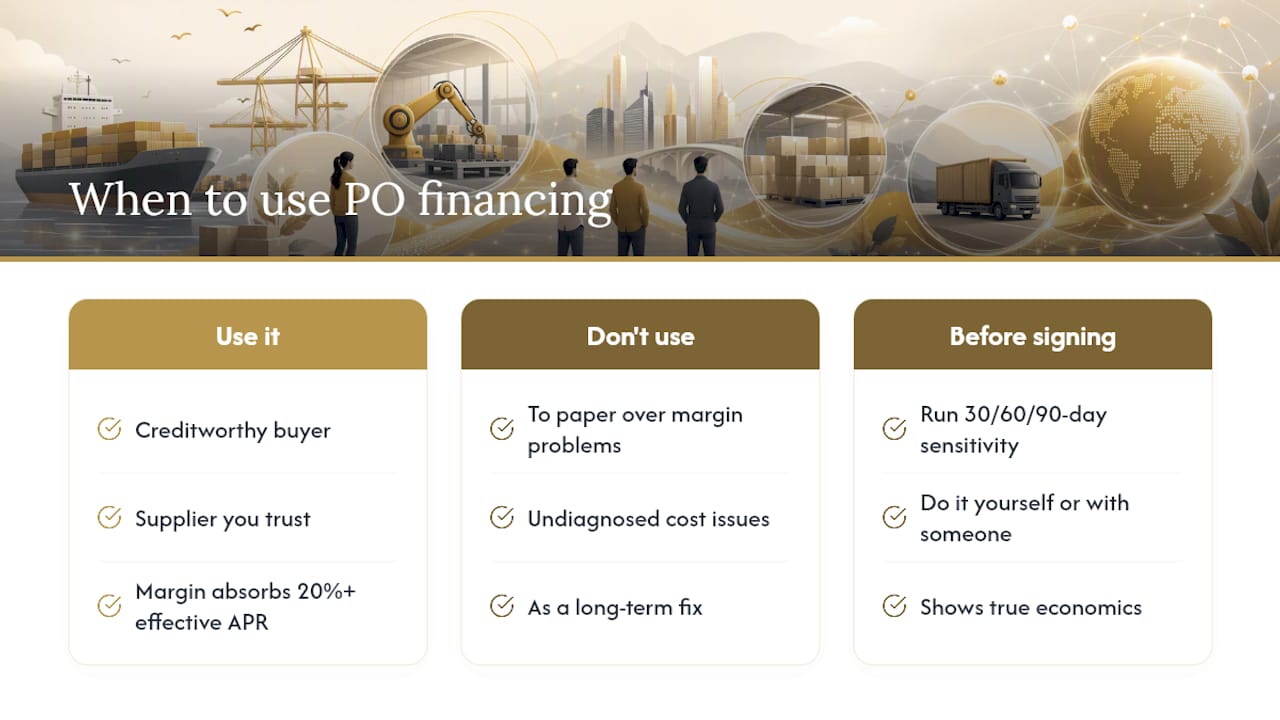
Purchase order financing is a legitimate tactical tool when the math works: a creditworthy buyer, a supplier you trust, and margin thick enough to absorb a 20%+ effective APR. It’s the wrong tool when you’re using it to paper over a margin problem you haven’t diagnosed yet.
Before you sign, run the 30/60/90-day sensitivity yourself, or have someone run it with you. That single exercise tells you more than any lender’s rate sheet.
How Commerce Catalyst Helps You Model a Financed Order
This service offers an alternative to guessing your way through a PO-financed deal: instead of signing based on a rate sheet, you get a model of what the fees do to your margin under different payment timelines. The DTC Financial Health Assessment walks through your cash-flow math, supplier terms, and customer payment risk so you know your actual net position before you commit supplier capital, not after.
The diagnostic typically produces a clear picture of your working capital gaps, a margin sensitivity across likely payment scenarios, and specific recommendations on whether this order (and the financing behind it) actually moves your business forward. Founders who need ongoing help negotiating terms or structuring the deal often move into Founder Advisory for hands-on support. If you’re deciding whether to take on a large PO right now, start with the Financial Health Assessment and get the numbers in front of you before the numbers get in front of you.
Sources
- Best purchase order financing companies (Finder)
- PO financing vs factoring (FitSmallBusiness)
- PO finance vs AR factoring comparison (STAR Funding)