
Profitability best practices for scaling brands are defined as the financial and operational disciplines that protect margin while revenue grows. Most consumer brand founders treat profitability as a lagging indicator. It is not. The brands that scale without destroying their finances treat contribution margin, marketing allocation, and brand governance as leading inputs, not outputs. This article covers the frameworks that matter most in 2026, including contribution margin tier targets, the 60/40 marketing budget rule, and brand scalability systems that let small teams produce at scale.
1. Profitability best practices for scaling brands start with contribution margin
Contribution margin at the order level, known as CM2, is the single most important number for a scaling consumer brand. CM2 is calculated by subtracting variable costs (cost of goods, shipping, fulfillment, and paid acquisition) from revenue. What remains tells you whether each customer you acquire actually makes you money.

CM2 targets shift by revenue stage. Brands under $2M should target 15–25%. Brands between $2M and $10M should target 20–30%. Brands between $10M and $50M should target 22–32%. Brands above $50M should target 28–38%. A CM2 below 15% signals that you are losing money on every acquisition, regardless of what your top-line revenue says.
Most founders discover a CM2 problem at month-end. That is too late. The fix is to embed CM2 into weekly team reviews so that a drop below target triggers a creative refresh or a bid adjustment before the damage compounds.
- Track CM2 by channel, not just in aggregate
- Flag any channel where CM2 falls below your stage threshold
- Adjust bids or pause spend within the same week, not the same quarter
- Use food and beverage benchmarks to compare your margins against category peers
Pro Tip: Set a CM2 floor in your weekly dashboard. When any channel breaks below that floor, it automatically triggers a review meeting. Waiting for month-end reports costs you weeks of margin erosion.
2. Balance your marketing budget between brand building and sales activation
The 60/40 marketing budget rule allocates 60% of spend to brand building and 40% to sales activation. This split maximizes combined short-term and long-term profit gain. Retargeting CPMs rose 18% year over year in 2026, which means brands that rely entirely on performance marketing are paying more for the same customers.
Brand building creates long-term memory structures that reduce price sensitivity and increase market penetration. Sales activation converts existing demand. You need both, but the ratio matters. Most DTC founders start at 90/10 in favor of activation and wonder why their CAC keeps climbing.
The shift toward 60/40 does not happen overnight. A practical path is to move 5–10 percentage points toward brand spend each quarter while tracking branded search volume and Share of Voice as leading indicators of brand health.
- Branded search growth signals that your brand is earning unprompted recall
- Share of Voice measures your presence relative to the category
- Return on Ad Spend (ROAS) measures only short-term conversion, not brand equity
- Marketing Mix Modeling (MMM) connects brand spend to financial outcomes over time
Pro Tip: Do not wait until your ROAS drops to invest in brand. By then, you have already lost ground. Start tracking branded search volume monthly as an early signal of brand equity growth.
3. Build brand scalability into your operations
Brand scalability means enabling fast, consistent output through governance, repeatable messaging, and flexible visual systems. It is not a rebrand. It is the operational infrastructure that lets your team produce more without producing worse.
Most small brand teams slow down as they grow because every new asset requires a founder decision. That bottleneck is a governance failure, not a headcount problem. Scaling is an exercise in capacity building through decision logic, not just adding people.
Here is how to build brand scalability without a full rebrand:
- Document your brand voice in a one-page guide that any contractor can use on day one
- Create a modular visual system with pre-approved templates for ads, emails, and social
- Define which decisions require founder approval and which do not
- Adjust brand rules by region or channel maturity to avoid bottlenecks at the center
- Run a quarterly audit to retire outdated assets and add new approved formats
The human benefit is real. Teams with clear brand governance report less rework, faster approvals, and lower stress. That translates directly into output volume and, eventually, into revenue.
Pro Tip: Build a “brand decision tree” that answers the 10 most common creative questions your team asks. Post it where everyone can find it. You will cut approval requests in half within a month.
4. Embed financial measurement frameworks into weekly rhythms
Integrating CM2 into weekly team rhythms triggers immediate tactical changes instead of delayed reactions. The brands that scale profitably treat financial data as an operational input, not a reporting output. That shift in mindset changes everything about how decisions get made.
Speaking CFO language means linking marketing investments to hard financial outcomes. Expedia Group uses Marketing Mix Modeling to bridge brand marketing spend and business outcomes, which gives their team confidence in budget decisions. Consumer brand founders can apply the same logic at a smaller scale using branded search data as a proxy for brand equity.
- Review CM2 by channel every week, not every month
- Track branded search volume monthly as a brand equity proxy
- Build a simple MMM model using your own channel data and revenue figures
- Link every major budget decision to a projected CM2 impact
- Report brand metrics alongside financial metrics in the same weekly update
Building a profitability roadmap gives you a structured way to connect these metrics to a forward-looking plan. Without a roadmap, measurement becomes reporting. With one, it becomes decision-making.
Pro Tip: Add a single “brand health” row to your weekly financial dashboard. Track branded search volume, Share of Voice, and repeat purchase rate together. These three numbers tell you whether your brand is building or eroding.
5. Prioritize brand-led growth to reduce long-term acquisition costs
Organizations with a clear brand strategy achieve 20–30% higher long-term ROI and reduce their reliance on paid media costs. That is not a soft marketing claim. It is a financial outcome. A brand that earns unprompted recall pays less to acquire each customer over time.
Brand-led growth works because it builds emotional resonance that compounds. Campaigns with high emotional impact deliver stronger business results than low-emotion campaigns. The mechanism is simple: customers who feel something about your brand return without being retargeted, refer without being incentivized, and pay more without needing a discount.
Only 3% of CMOs can demonstrate ROI on more than 50% of their marketing spend. That gap exists because most brands measure brand and performance separately. The founders who close that gap connect brand investment to pricing power, retention rates, and customer lifetime value in a single view.
Why brand strategy drives decisions for founders is not an abstract question. It is the difference between a brand that grows and one that grinds.
6. Avoid the most common pitfalls when scaling profitably
The biggest mistake founders make is treating ROAS as the primary measure of marketing health. ROAS measures conversion efficiency on existing demand. It does not measure whether you are building new demand or protecting your margins over time.
Over-indexing on performance marketing while ignoring brand equity is the fastest way to build a brand that grows in revenue and shrinks in value. You end up paying more to acquire customers who are less loyal and less willing to pay full price.
The second most common pitfall is under-documenting brand systems. When messaging is inconsistent across channels, customers form weaker brand associations. Weaker associations mean lower recall, lower conversion rates, and higher CAC over time.
- Do not delay action when CM2 falls below threshold. A week of inaction costs more than a week of bad creative
- Do not measure brand and performance in separate reports. Integrate them or you will always underfund brand
- Do not assume that a growing revenue line means a healthy business. Check CM2 first
- Do not skip the profitability improvement fundamentals in favor of growth tactics
The founders who scale profitably are not smarter than the ones who do not. They are more disciplined about the metrics they track and the speed at which they respond.
Key Takeaways
The most effective approach to increasing brand profitability while scaling is to combine CM2 discipline, a balanced marketing budget, and brand governance systems into a single operating model.
| Point | Details |
|---|---|
| CM2 is your primary health metric | Target 20–30% CM2 at the $2M–$10M revenue stage; below 15% means losing money on acquisition. |
| The 60/40 rule reduces CAC over time | Allocating 60% to brand building and 40% to activation lowers long-term customer acquisition costs. |
| Brand scalability is an operational system | Governance, templates, and decision logic let small teams produce more without founder bottlenecks. |
| Measure brand and finance together | Linking branded search, Share of Voice, and CM2 in one weekly view drives faster, better decisions. |
| Brand-led growth compounds | Clear brand strategy delivers 20–30% higher long-term ROI and reduces dependence on paid media. |
How Commerce Catalyst helps founders scale with financial clarity
Consumer brand founders who want to apply these frameworks without spending months building them from scratch work with Commerce Catalyst to get there faster.
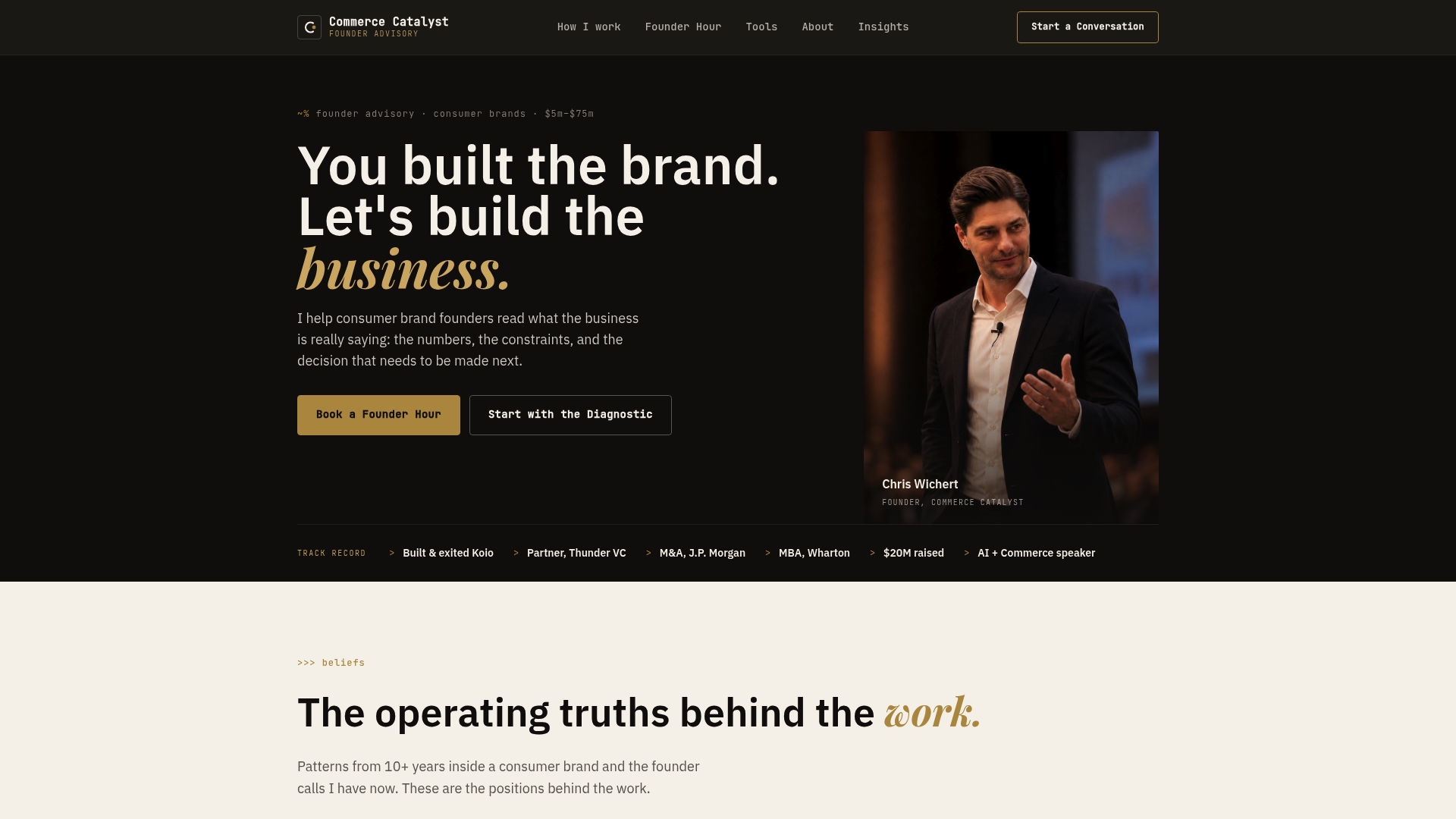
Chris Wichert’s DTC Financial Health Assessment identifies exactly where your margins are leaking and which levers will move your CM2 fastest. The Founder Advisory provides ongoing financial leadership for brands that need a CFO perspective without a full-time hire. Both services are built for consumer brand founders who are past the startup phase and ready to scale with discipline. If you are not sure which service fits your stage, the Next Move Finder takes five minutes and tells you exactly where to focus first.
FAQ
What is CM2 and why does it matter for scaling?
CM2 is contribution margin at the order level, calculated by subtracting variable costs including acquisition from revenue. Brands scaling from $2M to $10M should target 20–30% CM2; below 15% means each new customer costs more than they return.
What is the 60/40 marketing budget rule?
The 60/40 rule allocates 60% of marketing spend to brand building and 40% to sales activation. This split maximizes combined short-term and long-term profit, and it reduces CAC as brand equity compounds over time.
How do I measure brand equity without a large research budget?
Track branded search volume, Share of Voice, and repeat purchase rate monthly. These three metrics serve as practical proxies for brand equity and can be monitored using standard analytics tools.
What does brand scalability mean operationally?
Brand scalability means having governance systems, repeatable messaging guides, and flexible visual templates that let your team produce consistent output without requiring founder approval on every asset.
When should I start building brand systems?
Build brand governance systems before you scale your team or your content output. Waiting until you have inconsistency problems means you are already paying the cost in rework, off-brand assets, and weakened customer recall.