
If your biggest bottleneck is converting buyer meetings into distribution wins, start with a retail intelligence and pitch-builder platform. If you need financial clarity before any channel move, Commerce Catalyst’s founder-side diagnostic is the right first call. Here is the shortlist by constraint:
- Always-on GTM/strategy engines (e.g., CPG Canary): best when you lack continuous market research capacity and need stage-aware strategy without a full-time analyst.
- Retail & category intelligence platforms (e.g., ShelfRec, Shelf Scout): best when your pitches lack defensible data or your SKU placement decisions are driven by gut rather than store-format signals.
- Operational/ERP & replenishment platforms (e.g., Crisp, Alloy.ai, NetSuite, Salsify): best when inventory shortfalls, forecast errors, or product data chaos are costing you shelf space.
- Fractional COO/founder-side advisory (Commerce Catalyst): best when unclear margins, multi-channel complexity, or investor prep demand a human operator who has lived the founder experience.
Table of Contents
- What perpetualcpg.com alternatives fit your growth constraint?
- How do you choose between the top perpetualcpg.com options?
- Short profiles of the leading alternative classes
- When Commerce Catalyst is the right alternative
- Key takeaways
- The case for human-led diagnostics over platform-first thinking
- What a Commerce Catalyst diagnostic looks like in practice
- Sources and further reading
What perpetualcpg.com alternatives fit your growth constraint?
The right alternative depends entirely on where your brand is bleeding. A platform that solves a velocity problem will not fix a margin compression problem, and a strategy engine will not rescue a broken replenishment cycle. The table below maps the most common CPG growth constraints to the class of solution most likely to resolve them.
| Growth constraint | Alternative class | Why it fits |
|---|---|---|
| Weak buyer pitches, low distribution wins | Retail & category intelligence | Store-format scores and trajectory data turn opinion into evidence |
| No ongoing market or competitive research | Always-on GTM/strategy engine | Retains context, runs continuous analysis, surfaces stage-aware recommendations |
| Inventory shortfalls, forecast errors, OOS events | Operational/ERP & replenishment | Demand forecasting and POS integrations reduce stock gaps |
| Unclear margins, cash flow blind spots | Founder-side diagnostic/fractional COO | Human operator translates financials into prioritized decisions |
| Product data errors, slow pitch builds | Pitch-builder/sell-sheet automation | Dynamic sell sheets with SPINS integration cut manual errors |
| Trade spend with no ROI visibility | Trade promotion management platform | Tracks promotional lift against spend in real time |
As the CPG software roundup from GuideFlow makes clear, there is no single best solution across the category. The right pick is the one that directly addresses your operational bottleneck, not the one with the most features.
How do you choose between the top perpetualcpg.com options?
Seven dimensions separate a platform worth piloting from one worth avoiding. Work through them before you book a demo.
- Primary job solved. Can the vendor articulate the single outcome they deliver: distribution wins, forecast accuracy, or margin visibility? If the answer is “we do everything,” that is a red flag.
- Best-for brand stage and revenue band. A $6M brand and a $60M brand have different data needs. Confirm the vendor has reference clients at your revenue level.
- Delivery model. SaaS self-serve, AI-assisted platform, or human consultancy each require different internal resources. Honest about what your team can actually operate.
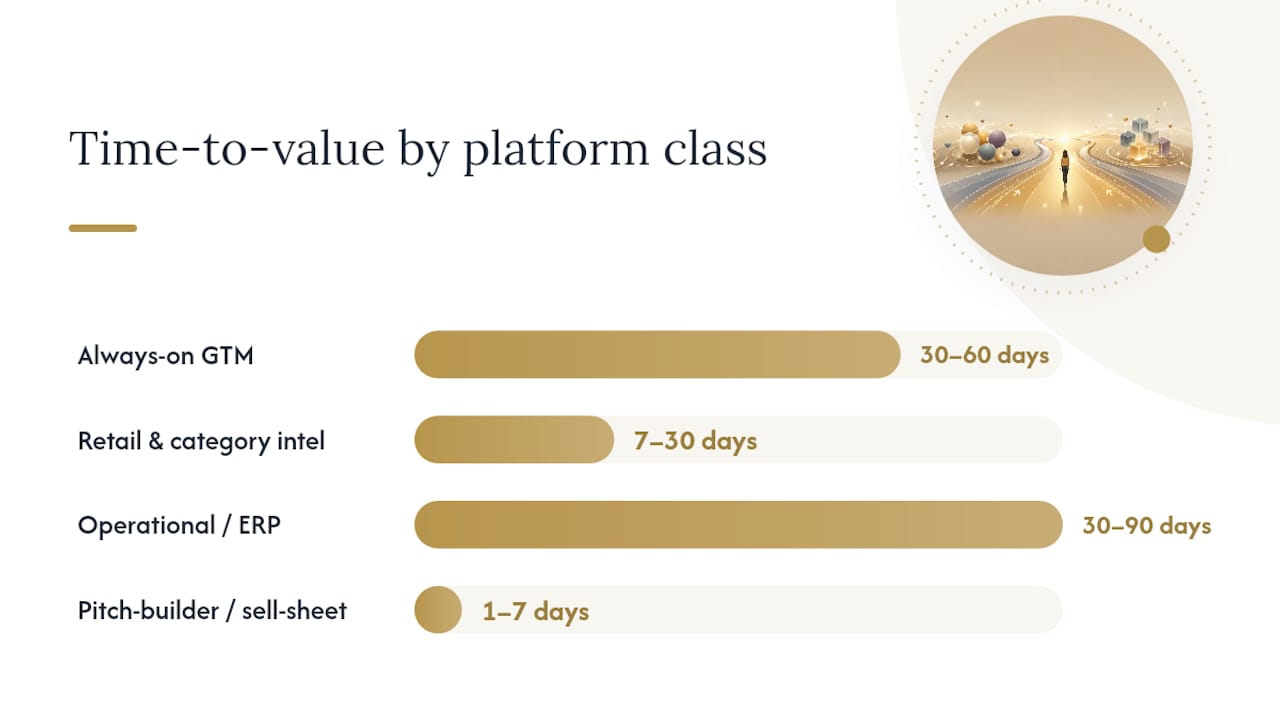
- Time-to-value and pilot length. Subscription platforms can show value in about a month. Fractional advisory engagements typically need several weeks to surface meaningful diagnostics.
- Pricing model. Subscription tools like Shelf Scout publish tiered pricing starting at $99/month. Enterprise platforms (NetSuite, Salsify, Alloy.ai) are typically quote-based. Fractional COO retainers vary by scope.
- Retailer and data coverage. Ask specifically: which distributor portals (UNFI, KeHE) does the platform integrate with? Does it connect to SPINS, Nielsen, or IRI? The NWTN AI vendor landscape documents platforms that connect to 40-plus retailers with real-time POS and inventory data.
- Required internal resources. A platform is only as good as the team operating it. If you have no analyst, a self-serve syndicated data tool will sit unused.
Red flags to watch for:
- No pilot or trial option, only annual contracts
- Retailer coverage limited to two or three chains with no distributor portal integration
- Workflows that still require manual PDF exports for every buyer meeting
- Siloed data with no cross-channel view of velocity, inventory, and trade spend
Rough pricing expectations: SaaS subscriptions run $99–$499/month for pitch and intelligence tools. Enterprise ERP and forecasting platforms are quote-based and often require implementation fees. Fractional advisory retainers are scoped per engagement.
Short profiles of the leading alternative classes
The Mammoth CPG software review and the NWTN AI landscape together cover most of the named platforms. Here is how the four classes compare against Commerce Catalyst’s diagnostic model.
| Class | Example platforms | Primary job | Best-for | Delivery model | Time-to-value | Pricing model | Retailer/data coverage |
|---|---|---|---|---|---|---|---|
| Always-on GTM/strategy engine | CPG Canary, Promomash, LEAFIO AI | Continuous strategy research, trade planning | $1M–$30M brands needing ongoing market intelligence | SaaS/AI-assisted | 30–60 days | Subscription from ~$99/mo | Varies; CPG Canary retains context across analyses |
| Retail & category intelligence | ShelfRec, Mammoth Analytics, Vividly | SKU scoring, pitch evidence, category stories | Emerging brands pitching regional and national retailers | SaaS self-serve | 7–30 days | Subscription | SPINS, Nielsen, store-format signals |
| Operational/ERP & replenishment | Crisp, Alloy.ai, NetSuite, Salsify | Demand forecasting, product data, replenishment | $10M–$40M brands with multi-channel distribution | SaaS/enterprise | 30–90 days | Quote-based | POS, distributor portals, syndicated data |
| Pitch-builder/sell-sheet automation | Shelf Scout, Satellite CPG | Dynamic sell sheets, buyer presentation builds | Sales reps and brokers pitching multiple accounts | SaaS self-serve | 1–7 days | Subscription from $99/mo | SPINS IX-ONE integration |
| Consumer feedback & brand dossiers | CPG Pulse | First-party feedback, product-market fit testing | Brands pre-launch or reformulating | Managed/SaaS | 30–60 days | Quote-based | First-party consumer data |
| Founder-side diagnostic/fractional COO | Commerce Catalyst | Financial diagnostics, margin clarity, investor prep | $5M–$40M founders with unclear profitability or complex multi-channel rollout | Human advisory | 30–60 days | Scoped engagement/retainer | Not applicable: financial and operational data you provide |
Satellite CPG’s dynamic sell sheets and SPINS IX-ONE integration are a strong example of what pitch-builder tools do well: they remove the manual step of populating item codes and distributor specs, which is where most pitch errors originate. ShelfRec’s weekly rescoring of thousands of SKUs across store formats gives brands the kind of defensible, format-tuned evidence that moves a buyer from “interesting” to “approved.” CPG Pulse adds a consumer feedback layer through brand dossiers and interactive dashboards, useful when you need product-market fit data before a major retail push.
Where these platforms stop is exactly where Commerce Catalyst starts. None of them will tell you whether your gross margin can support the promotional spend a new retail account demands, or whether your cash conversion cycle can handle a 90-day payment term from a national chain.
When Commerce Catalyst is the right alternative
Three scenarios consistently point toward a founder-side diagnostic over a platform-first approach.
- Investor prep or valuation conversations. Investors ask questions that dashboards do not answer. A profitability roadmap built from a diagnostic gives you defensible answers.
Commerce Catalyst’s core services include the DTC Financial Health Assessment, the DTC Operator Diagnostic, and ongoing fractional CFO/COO advisory. Engagements typically run 30–60 days for a scoped diagnostic, with retainer-based advisory available for founders who need continuous support through a scale phase.
Before engaging, prepare your P&L by channel, your top SKU contribution margins, and a clear statement of the growth decision you are trying to make. That preparation cuts diagnostic time in half and sharpens the output.
Key takeaways
The right perpetualcpg.com alternative is the one that directly addresses your single biggest growth constraint, not the one with the longest feature list.
| Point | Details |
|---|---|
| Diagnose your constraint first | Match your bottleneck (pitch quality, inventory, margins) to the right solution class before evaluating vendors. |
| Run a time-boxed pilot | Set go/no-go criteria before day one; 30–90 days is enough to validate any platform or advisory engagement. |
| Demand retailer coverage proof | Ask vendors to demonstrate live UNFI, KeHE, or distributor portal integration before signing. |
| Pricing varies widely by class | Subscription tools start around $99/month; enterprise platforms and advisory retainers are quote-based. |
| Commerce Catalyst for financial clarity | When margins, cash flow, or investor prep are the constraint, a founder-side diagnostic outperforms any platform. |
The case for human-led diagnostics over platform-first thinking
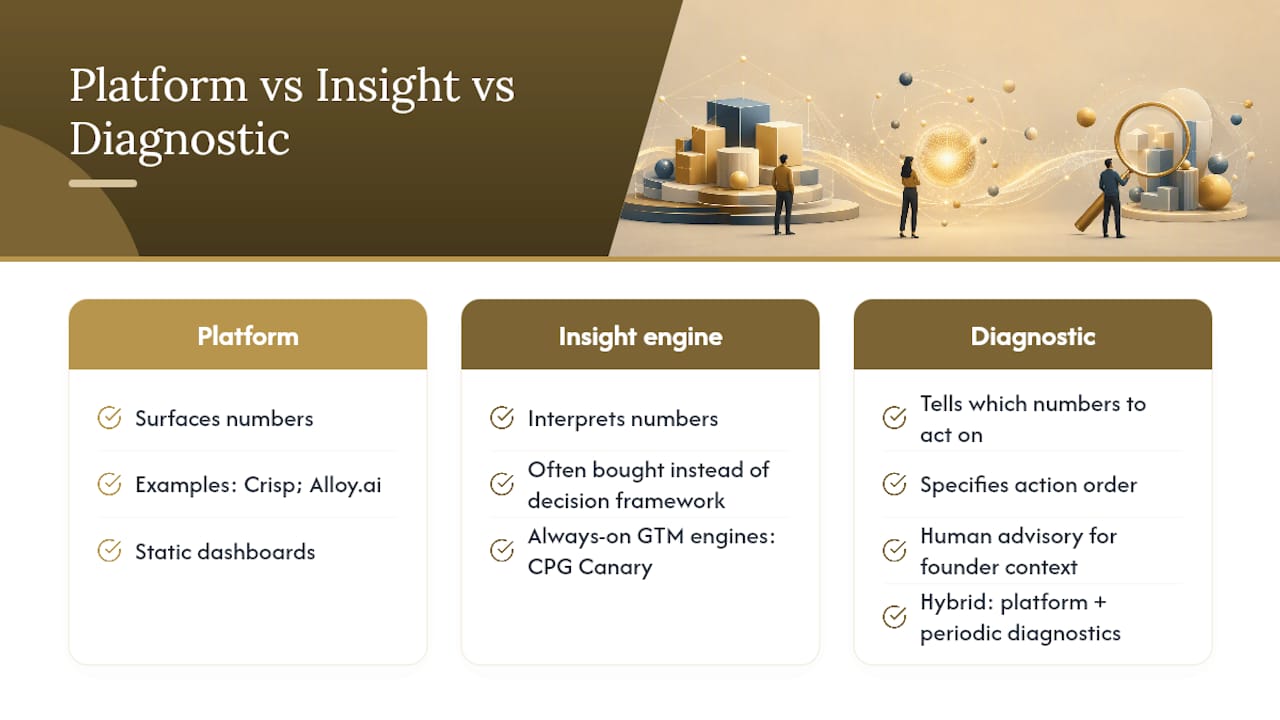
The CPG software market has produced genuinely useful tools. Platforms like Crisp for real-time dashboards and Alloy.ai for demand forecasting solve real problems at scale. But there is a pattern worth naming: brands often buy a data platform when what they actually need is an insight engine, and they buy an insight engine when what they actually need is a decision framework.
The distinction matters more than most founders realize. A platform surfaces numbers. An insight engine interprets them. A diagnostic tells you which numbers to act on and in what order. Confusing the three is expensive, and it is the most common reason a brand can have a full analytics stack and still make the wrong channel decision.
Always-on GTM engines like CPG Canary narrow that gap by retaining context across analyses and delivering stage-aware recommendations. That is a meaningful step beyond a static dashboard. But they still cannot account for the founder’s specific cash position, the terms of a distributor agreement, or the margin impact of a promotional commitment to a new retail partner. That is where human advisory earns its place.
The hybrid model is usually right for brands between $10M and $40M: a lean intelligence platform for ongoing market signals, combined with periodic founder-side diagnostics when a major decision is on the table. The mistake is treating one as a substitute for the other.
What a Commerce Catalyst diagnostic looks like in practice
When unclear margins or a stalled distribution strategy are blocking your next move, the DTC Financial Health Assessment is the fastest path to a clear decision.
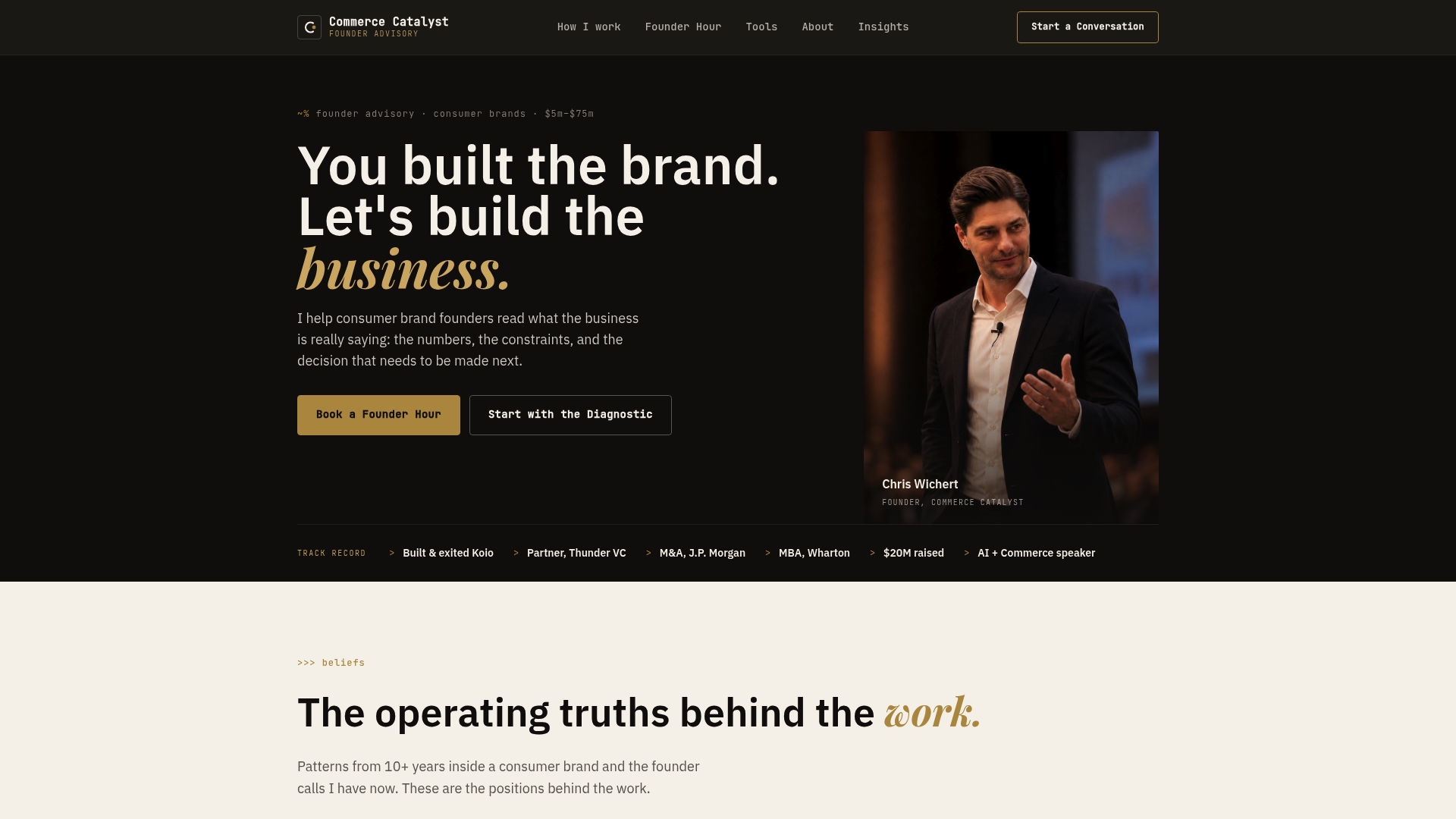
The diagnostic delivers a channel-level contribution margin breakdown, a prioritized list of the two or three operational constraints most likely to limit your next growth phase, and a working session to pressure-test your next strategic move. Most founders complete the input preparation in under two hours. The output is a working document, not a slide deck. If you want a scoped operator-level review, the DTC Operator Diagnostic goes deeper into fulfillment, replenishment, and unit economics. Book a diagnostic session at Commerce Catalyst and arrive with your P&L by channel ready.
Sources and further reading
- CPG Canary - Deep Research & Strategy Engine for CPG Food & Beverage
- CPG AI Tool Landscape: Vendor-Neutral Guide | NWTN AI
- ShelfRec: Retail intelligence
- Shelf Scout · AI Workflows, Analytics + Consulting for CPG
- CPG Pulse
- CPG software roundup | GuideFlow
- 7 Best CPG Software Tools in 2026 (Reviewed + Compared) | Mammoth
- Satellite CPG: Dynamic sell sheets and AI sales coordinator