The fastest way to cut packaging spend is to stop shopping unit price and start measuring total packaging cost per delivered order. Prioritize right-sizing first, since it directly reduces DIM-weight shipping charges, then run procurement tenders and cut pack-station labor time. Track total packaging cost per successfully delivered order as your single success metric. Everything else is noise until that number moves.
TL;DR:
- Running a packaging cost diagnostic that includes SKU audit, process timing, and carrier invoice analysis identifies the biggest cost leaks in under a week.
- Total packaging cost per order, not unit price, should include materials, labor, shipping, damage, storage, and compliance, often totaling over 7 cost buckets.
- Design changes focusing on right-sizing and material selection can cut DIM-weight and pack-speed costs but require testing to avoid damage rate increases.
- Negotiating supplier contracts through structured tenders, index clauses, and volume bundling leads to better long-term savings than simple discounts.
- A phased, 30/60/90-day plan that measures baseline, pilots right-sizing, and scales successful changes improves results without rushing into costly mistakes.
Table of Contents
- What Are Immediate Packaging Cost improvement Wins?
- How Do You Measure the True Cost of Packaging?
- Which Design Changes Cut Material and Freight Cost?
- How Should You Negotiate Packaging Costs with Suppliers?
- Where Can You Cut Labor and Simplify Packaging SKUs?
- How Do You Test Packaging Changes Before Rolling Them Out?
- What Does a 30/60/90-Day Packaging Cost Plan Look Like?
- What Regulatory Costs Affect Packaging Decisions?
- The Commerce Catalyst View on Packaging Cost Diagnostics
- Get Hands-On Help Prioritizing Your Packaging Savings
- Sources
- FAQ
What Are Immediate Packaging Cost improvement Wins?
Before you touch a supplier contract, run a five-part diagnostic that most teams can finish in a week. These moves reveal where the money actually leaks, not where you assume it does.
- Audit every packaging SKU against shipment volume so you know which materials serve 80% of your orders and which are long-tail waste.
- Time the pack process at the station level, in seconds, per SKU. Estimates lie. A stopwatch does not.
- Pull your last 90 days of carrier invoices and flag the SKUs closest to a DIM-weight billing threshold, since small dimensional changes push packages into pricier brackets.
- Pilot right-sizing on your top five DIM-exposed SKUs only. Don’t redesign your whole catalog at once.
- Open a tender for your highest-volume packaging items and ask suppliers for indexed pricing clauses tied to raw-material benchmarks.
Each of these takes days, not quarters, and each one tells you where the next 90 days of work should go.
How Do You Measure the True Cost of Packaging?
Unit price is the least useful number in packaging procurement. A box that costs $0.12 more per unit can still cut your total cost per order if it survives transit without damage and ships in a lower DIM bracket. TCO modeling consistently shows that unit price represents only 40–60% of the real cost of a package once you account for everything downstream.
Pro Tip isn’t needed here, but the math is worth doing on paper once. Total packaging cost breaks into seven buckets, and skipping any one of them distorts the comparison between suppliers or designs.
| TCO Bucket | What It Captures |
|---|---|
| Materials | Box, mailer, tape, void fill, unit price |
| Inbound freight | Cost to move packaging materials to your facility or 3PL |
| Storage | Warehouse space tied up by packaging SKUs |
| Fulfillment labor | Pack-station seconds converted to wage cost per order |
| Outbound shipping (DIM) | Billable weight based on carrier dimensional divisors |
| Damage and returns | Expected replacement and refund cost from transit failures |
| 3PL and compliance fees | Handling surcharges, per-order fees, regulatory costs |
To get a comparable number, convert annual contract costs and per-shipment costs into a single per-order figure. Say your mailer costs $0.85, pack labor runs $0.40 per order at a $18/hour rate, outbound DIM shipping averages $6.20, and expected damage cost is $0.15 per order after factoring in your return rate. That’s a $7.60 total packaging cost per order. Compare that number against a slightly pricier box that avoids a DIM surcharge tier, and the “more expensive” option often wins.
Track these KPIs monthly: material cost per order, pack seconds per order, package cube per order, percentage of orders billed on DIM versus actual weight, and damage rate. Pull the inputs from your warehouse management system, carrier invoices, and current Bureau of Labor Statistics wage data for your region, and review the dashboard every 30 days during an active improvement push.
Which Design Changes Cut Material and Freight Cost?
Packaging design is where DIM-weight savings and pack-speed savings overlap, and it’s usually the strongest lever on this whole list. The goal is matching structure and material grade to the product, not defaulting to whatever box the team has always used.
- Right-size every mailer and box to actual product dimensions. Even a half-inch of unnecessary void space can push a shipment into a higher DIM bracket.
- Favor poly or padded mailers over rigid boxes for low-fragility items. Most apparel, soft goods, and light accessories don’t need a corrugated shell.
- Match material grade, wall thickness, and flute type to product fragility and unit value. Overspecifying strength for a $12 item is money spent protecting nothing that needed protecting.
- Design for one-motion assembly: pre-formed inserts, scored fold lines, and structures that don’t require extra tape or manual folding steps.
- Reserve rigid protective inserts for genuinely high-value or fragile SKUs instead of applying blanket over-protection across your whole catalog.
Pro Tip: Run right-sizing changes in stages, not all at once, and watch the damage rate for at least two full shipping cycles before declaring the smaller package a win. A material change that saves 20 cents but adds a 2% damage rate can cost more than the box it replaced, and that trade-off only shows up in the data if you’re actually measuring it.
Common levers here, including material audits and cross-department design reviews, mirror what most experienced packaging teams already apply when margin pressure builds.
How Should You Negotiate Packaging Costs with Suppliers?
Procurement is where durable, contract-level savings live, but only if you approach it with structure instead of an annual “ask for a discount” email. Five steps make the difference between a marginal price cut and a real reduction in landed cost.
- Run a structured tender across at least three suppliers for your top-volume packaging items, and benchmark quotes against current raw-material indices rather than last year’s invoice.
- Insert index clauses into new contracts with defined adjustment thresholds that move symmetrically. Prices should come down when resin or paperboard costs drop, not only go up when they rise.
- Bundle volumes across SKUs, brands, or facilities to reach better pricing tiers. A supplier quoting three separate small orders will almost always beat that price for one combined order.
- Separate brand-facing packaging (retail boxes, inserts, anything customer-visible) from purely functional shipping materials in your sourcing strategy, since the negotiation levers differ.
- Read every quote line by line: tooling cost is one-time, production cost is per-unit, and freight or duty is a separate variable. Convert all three into a single landed cost per unit before comparing suppliers.
That last step matters more than most teams realize. Tooling amortization is often the single biggest driver of per-unit price differences between a small test run and a full production order, and a supplier who reuses your tooling on repeat orders can meaningfully lower your cost on order two without changing the design at all. According to procurement research on packaging levers, creating real competition among suppliers and bundling volume tend to produce savings faster than specification rewrites or index clauses, which take longer to pay off but hold their value over multiple contract cycles.
Where Can You Cut Labor and Simplify Packaging SKUs?
Pack-station time is a cost most teams underprice because it feels small on a per-order basis, but using tools like the AI Content improvement Audit can help identify and improve these small process inefficiencies. It isn’t small at scale. A 20 to 30 second reduction in average pack time, multiplied across hundreds of thousands of orders a year, adds up to real labor dollars, and the only way to find that reduction is to time the actual process rather than estimate it.
- Strip out low-value pack steps first: extra branded stickers, redundant inserts, or tape patterns that add seconds without adding protection.
- Apply automation selectively. Auto-taping machines or automated case erectors make sense where volume justifies the capital cost, not as a default upgrade across every station.
- Rationalize your packaging SKU count. Fewer box sizes and material types mean simpler replenishment, less warehouse space tied up, and fewer selection errors at the pack station. The same logic that applies to SKU rationalization across your product line applies directly to packaging inventory.
- Standardize pack-station layout and add visual size guides so staff spend less time deciding which box to grab.
Pro Tip: Post a laminated size guide at every station showing which box or mailer matches which product category. It sounds basic, but selection errors at the pack station are one of the most common sources of DIM-weight surcharges that never show up until the carrier invoice arrives.
How Do You Test Packaging Changes Before Rolling Them Out?
Every packaging change carries a trade-off between cost and damage risk, and the only way to know which side wins is to test before you scale. Run a real A/B pilot, not a one-off shipment or two.
- Ship one packaging version to a control group and the new version to a test group, drawing from the same product line and shipping lanes.
- Capture three numbers for both groups: damage rate, pack seconds, and actual shipping cost including any DIM-bracket shift.
- Run the pilot for enough volume and time to be confident in the results. A few dozen orders won’t tell you anything reliable; a few hundred per group over two to four weeks usually will.
- Apply a simple decision rule: scale the change only if combined material, labor, and shipping savings exceed the expected damage cost increase over a defined period, typically a full quarter.
- Before full rollout, check the new package’s dimensions against your carriers’ DIM-weight thresholds to confirm you haven’t accidentally pushed the SKU into a worse billing bracket.
A change that lowers material cost but raises the damage rate can end up costing more overall. That’s the core failure mode teams hit when they improve for one line item instead of the total. The pilot exists specifically to catch that before it hits your full order volume.
What Does a 30/60/90-Day Packaging Cost Plan Look Like?
Sequencing matters here. Teams that try to fix everything simultaneously usually finish nothing. A phased plan turns analysis into savings on a predictable timeline.
- Days 1 to 30: Capture your TCO inputs across all seven cost buckets, complete the material and SKU audit, time every pack station, and flag the SKUs sitting closest to a DIM-weight threshold.
- Days 31 to 60: Pilot right-sizing on your top five flagged SKUs and open a formal tender process for your highest-volume packaging items.
- Days 61 to 180: Scale the pilots that passed your damage-cost decision rule, execute SKU rationalization across the broader catalog, and finalize indexed supplier contracts with volume bundling locked in.
Presenting this to finance works best as a one-page summary showing current per-order cost against projected per-order cost after each phase, with the damage-rate check included as a risk column, not a footnote.
| Phase | Primary Action | Metric to Watch |
|---|---|---|
| 30 days | TCO audit and pack-time measurement | Baseline packaging cost per order |
| 60 days | Right-sizing pilot and tender launch | Damage rate, DIM bracket shift |
| 90 to 180 days | Scale, rationalize, finalize contracts | Total packaging cost per order |
What Regulatory Costs Affect Packaging Decisions?
Packaging cost improvement doesn’t happen in a vacuum. Extended producer responsibility (EPR) laws, now active or pending in a growing number of states, assess fees based on the weight and recyclability of the materials a brand puts into the market. That means a lighter, more recyclable package isn’t just cheaper to ship. It can also carry a lower compliance fee, which folds directly into your TCO calculation as a real line item rather than an abstract sustainability goal.
Material choice affects this in two directions. Switching from mixed-material laminates to a mono-material mailer often improves recyclability scores under state programs, but it can also change your damage-rate profile, which is exactly why the testing step described above matters before any material swap goes company-wide. Compliance costs also vary by state and by category of goods, so a plan that treats packaging fees as a flat national number will misprice the change for brands shipping across multiple jurisdictions.
Beyond EPR, food-contact packaging, certain colorants, and specific plastics face separate labeling or restriction requirements that add testing or certification costs upstream of production. None of these costs show up on a supplier’s per-unit quote. They show up on your compliance team’s invoice months later, which is exactly the kind of hidden bucket a proper TCO model is built to catch. Treat regulatory fees as an eighth line item alongside the seven TCO buckets covered earlier, reviewed at least annually as state rules continue to shift.
The Commerce Catalyst View on Packaging Cost Diagnostics
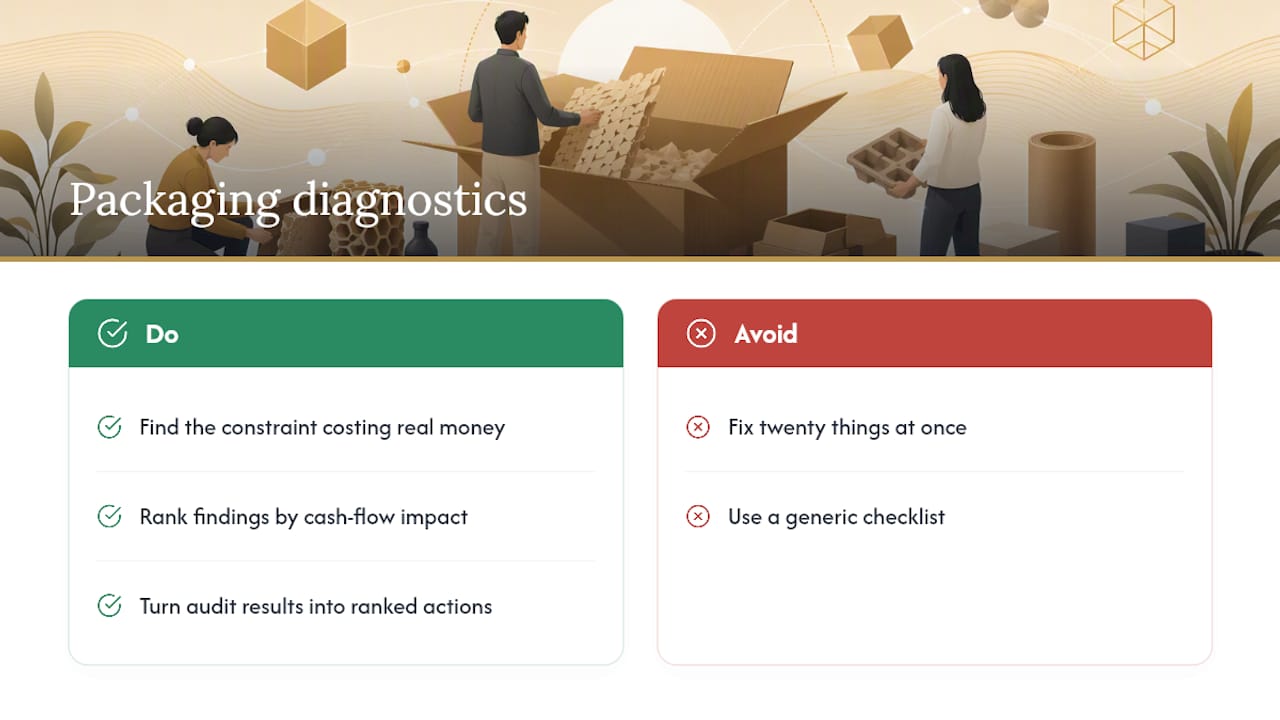
Most packaging cost work fails not because the ideas are wrong, but because teams try to fix twenty things at once and end up finishing none of them. The rest matters, but it’s sequencing, not urgency.
That’s the same discipline behind Commerce Catalyst’s DTC Operator Diagnostic: find the constraint that’s actually costing money, then prioritize. Founder Advisory sessions take packaging findings like these and turn them into a ranked action list tied to cash flow impact, not a generic checklist. If your team has already run the audit and doesn’t know which finding to act on first, that’s exactly the gap this kind of diagnostic closes.
Get Hands-On Help Prioritizing Your Packaging Savings
Most packaging guides hand you forty tactics and leave you to figure out which three actually move your margin. Some consultants offer personalized reviews of numbers to identify which packaging finding is costing the most and what to fix first.

If your team already has TCO data sitting in spreadsheets nobody’s had time to act on, the DTC Operator Diagnostic turns that into a prioritized list in days, not months. For a faster gut check, book a Founder Hour for $500 and walk through your packaging cost breakdown live with someone who has made these calls before. Teams facing a broader margin squeeze, where packaging is one symptom among several, often start instead with a Financial Health Assessment to see how packaging spend fits into the full cost structure. Whichever entry point fits, the next step is the same: get the diagnostic on the calendar before another quarter of unmeasured packaging spend goes by.
Sources
The models and figures in this article draw on packaging-specific cost research rather than general supply chain advice. For the full TCO framework, see PackageTheWorld’s guide to true packaging cost, which breaks unit price out from total landed cost. For DIM-weight mechanics and labor-cost modeling, Speed Commerce’s packaging cost breakdown is the most detailed public source available. On reading supplier quotes correctly, PackOasis’s guide to tooling versus per-unit cost is worth bookmarking before your next negotiation.
- Ecommerce Fulfillment Packaging Costs in 2026 (Materials, Labor, Shipping & 3PL Fees) | Speed Commerce
- True Cost of Packaging: A TCO Guide | PackageTheWorld
- How to Read a Custom Packaging Quote: Every Line, One-Time vs Per-Unit vs Freight | PackOasis Blog
- 9 Ways to Cut Packaging Costs | Packaging Digest
FAQ
What Are the 3 Ps of Packaging?
The 3 Ps most commonly refer to Protection, Presentation, and Practicality: how well a package protects the product, how it represents the brand, and how efficiently it can be produced, filled, and shipped. Packaging cost improvement lives mostly in the Practicality dimension, since that’s where material grade, size, and pack-time decisions get made.
How Do You Calculate Packing Cost?
Add materials, packing labor, outbound shipping (including any DIM-weight surcharge), expected damage cost, storage, and any 3PL or compliance fees, then divide by order volume to get a per-order figure. Comparing suppliers or designs on unit price alone skips most of the real cost.
What Are Effective Cost improvement Strategies for Packaging?
The strongest strategies are right-sizing to reduce DIM-weight, running structured procurement tenders with indexed pricing, cutting pack-station time through better station design, and rationalizing your SKU count. Common tactics practitioners rely on also include material audits and supplier negotiation, both of which pair well with TCO modeling to confirm the change actually lowers total cost per order.
What Is the Most Cost-Effective Packaging Option?
There’s no single answer that holds across every product category. The most cost-effective option is whichever design produces the lowest total cost per delivered order once materials, DIM-weight shipping, labor, and expected damage are all counted, and that has to be tested per SKU rather than assumed from unit price.
Can Commerce Catalyst Help With a Packaging Cost Diagnostic?
Commerce Catalyst’s DTC Operator Diagnostic is built to surface exactly this kind of cost constraint and rank it against other operating priorities for a brand’s cash flow. It costs $197 as a one-time diagnostic, and founders who want a faster conversation can book a Founder Hour for $500 per hour instead.