
Most consumer brand founders walk into investor negotiations focused on one number: valuation. That’s the wrong instinct. The terms surrounding that number, specifically liquidation preferences, board composition, anti-dilution provisions, and founder vesting, often determine your actual outcome at exit far more than the headline figure. A $20M pre-money valuation with participating preferred stock and a 2x liquidation preference can leave you with less than a $15M deal structured with clean, founder-friendly terms.
The core principle for any founder looking to negotiate investment terms for a consumer brand is this: treat the term sheet as a package, not a checklist. Negotiating on 3–4 high-use terms signals competence, preserves deal momentum, and keeps the investor relationship intact. Founders who redline every clause slow the process and often end up with worse outcomes than those who pick their battles deliberately.
Here is what that looks like in practice before you sit down across from an investor:
- Know your pre-money valuation and be able to defend it with comparable funding rounds, not just gut instinct.
- Define your Best Alternative to a Negotiated Agreement (BATNA) before the first meeting. Your BATNA is the best outcome you can achieve if this deal falls apart, whether that’s bootstrapping longer, pursuing revenue-based financing, or closing with a different investor.
- Identify your non-negotiables (board control, liquidation preference structure, vesting acceleration) versus the terms where you have room to move.
- Understand the five term sheet elements that carry the most weight: valuation, liquidation preferences, option pool size, board composition, and founder vesting schedules.
- Enter the room with data. Comparable deals, retention metrics, LTV/CAC ratios, and a bottoms-up hiring plan all give your asks credibility.
- Recognize that how you negotiate sets the tone for the entire investor relationship. Investors watch how founders handle pressure, ambiguity, and disagreement. The negotiation is, in a real sense, the first test of the partnership.
What strong preparation actually looks like before investor talks
Preparation accounts for 99% of success in investor negotiations. That’s not hyperbole. Founders who walk in without a clear valuation methodology, a defined BATNA, or a read on the investor’s actual priorities are negotiating blind.
Start with your cap table. Understand your current ownership percentage, how prior rounds have diluted you, and what your option pool allocation looks like today. Then build a bottoms-up hiring plan that projects exactly how many options you’ll need before the next round. That document becomes your first negotiating tool when an investor pushes for a 20% option pool and your actual hiring plan only justifies 12–15%.

Know your investor before you meet them. Research their portfolio, their typical check size, their preferred board structure, and whether they lead rounds or follow. Find out who the actual decision-maker is, not just the partner you’re meeting with. Investors who can’t close a deal without committee approval have a different negotiation dynamic than a solo GP writing from their own fund.
Pro Tip: Cultivate at least two or three genuinely interested investors before you need to close. Your BATNA isn’t theoretical use; it’s real use. The moment you have a competing term sheet, your negotiating position shifts fundamentally. Consumer brand founders who build multiple investor options before entering serious talks consistently secure better terms than those negotiating with a single interested party.
Set your timing expectations upfront. Know how long your runway is, when you need to close, and what your due diligence timeline looks like. Founders who are fundraising under cash pressure telegraph desperation, and investors read that signal clearly. If you can start the process six months before you need the capital, do it.
Prepare your financials as if an investor will stress-test every assumption. That means clean financial statements, a coherent revenue model, and a clear path to profitability. Consumer brand investors in 2026 want to see retention over acquisition, unit economics that show a viable LTV/CAC ratio, and evidence of capital efficiency. Showing up with those numbers ready, before they ask, changes the dynamic of the conversation.
Key investment terms every consumer brand founder must understand
The term sheet is where deals are won or lost, and most founders spend too little time on it before signing. Here is a working glossary of the terms that carry the most weight, along with the trade-offs you need to understand.
Term sheet
A term sheet is a non-binding document that outlines the proposed terms and conditions of an investment, covering valuation, equity stake, board structure, liquidation preferences, and governance rights. While most of it is non-binding, certain clauses like the no-shop provision and confidentiality terms are typically legally enforceable. The term sheet serves as the blueprint for the final definitive agreements, which is why reviewing it carefully with an attorney before signing matters.
Liquidation preferences
Liquidation preferences determine how exit proceeds are distributed when a company is sold or liquidated. A 1x non-participating liquidation preference is the founder-friendly standard: the investor gets their money back first, then chooses whether to keep that amount or convert to common stock and share proceeds. The moment you accept participating preferred stock, the investor takes their preference AND shares in the remaining proceeds. That structure, sometimes called “double-dipping,” can substantially reduce your payout at moderate exit sizes.
Multiple liquidation preferences are a red flag at early stages. A 2x or 3x preference means the investor recovers two or three times their investment before common shareholders see anything. On a $5M investment with a 2x preference, $10M must be returned to that investor before you receive a dollar. Resist this structure unless you’re in a late-stage or distressed bridge situation.
Founder vesting
Investors require founder vesting to confirm long-term commitment. The market standard is a four-year schedule with a one-year cliff: you earn nothing for the first twelve months, then 25% vests at the cliff, with the remaining 75% vesting monthly over the following three years. What’s negotiable is the acceleration clause. Push for single-trigger acceleration on a change of control, meaning if the company is acquired and you’re terminated without cause, your unvested shares vest immediately. Investors will typically accept this. Double-trigger acceleration (requiring both an acquisition and termination) is also common and worth pursuing.
Watch for vesting restarts. Some investors want founders to restart their vesting clock from zero at the time of investment. If you’ve been building for two years, that clause effectively strips the equity you’ve already earned. Negotiate credit for time served.
No-shop clause
A no-shop clause prohibits you from soliciting other investors or offers for a defined window after signing the term sheet. This protects the investor’s time during due diligence. Limit exclusivity windows to 30–45 days and negotiate milestone-based extensions rather than an open-ended lock. A no-shop period that drags past 60 days without clear milestones can stall your entire fundraising process if the deal falls through.
Anti-dilution provisions
Anti-dilution provisions protect investors if you raise a future round at a lower valuation than the current one, a “down round.” There are two main types. Broad-based weighted average anti-dilution is the founder-friendly standard: it adjusts the investor’s conversion price based on a formula that considers the size and price of the new round, limiting the dilutive impact. Full ratchet anti-dilution reprices the investor’s entire position as if they had invested at the new lower price from day one. That can be catastrophic for founder ownership. Reject full ratchet in nearly all circumstances.
Best Alternative to a Negotiated Agreement (BATNA)
Your BATNA is the best outcome available to you if the current deal doesn’t close. It might be bootstrapping longer, taking on non-dilutive working capital financing, pursuing equity crowdfunding (under current SEC rules, consumer startups can raise up to $5 million annually via equity crowdfunding), or closing with a different investor. The stronger your BATNA, the more credibly you can walk away from a bad deal. Founders who enter negotiations without a clear BATNA often accept terms they later regret.
Option pool
The option pool is a block of shares reserved for future employee equity grants. Investors almost always require the pool to be created or expanded as part of the financing, and they typically insist it comes out of the pre-money valuation, which means it dilutes founders, not the new investors. Push back against unnecessary pool expansions using a bottoms-up hiring plan. If the investor demands 20% and your actual hiring plan only requires 12–15%, negotiate to that number. Every percentage point above what you genuinely need is unnecessary dilution.
Board composition
Board composition determines who controls strategic decisions. A typical early-stage board has two founder seats, one investor seat, and one or two independent directors. The independent director is often the swing vote, so how that person is selected matters. Negotiate for mutual consent: both founders and investors must agree on the independent director. If the investor appoints that seat unilaterally, they effectively control the board.
| Term | Founder-Friendly Standard | Red Flag to Avoid |
|---|---|---|
| Liquidation preference | 1x non-participating | Participating preferred, 2x+ multiples |
| Anti-dilution | Broad-based weighted average | Full ratchet |
| Founder vesting | 4-year, 1-year cliff, acceleration on change of control | Vesting restart from zero |
| No-shop window | 30–45 days with milestone extensions | Open-ended or 60+ day lock |
| Option pool | Sized to actual hiring plan | Inflated pool from pre-money |
| Board composition | Mutual consent on independent director | Investor-appointed swing vote |
Step-by-step negotiation strategies that actually work
The negotiation itself is a process, not a single conversation. Founders who treat it as one big ask tend to create friction; those who move through it methodically tend to close faster and on better terms.
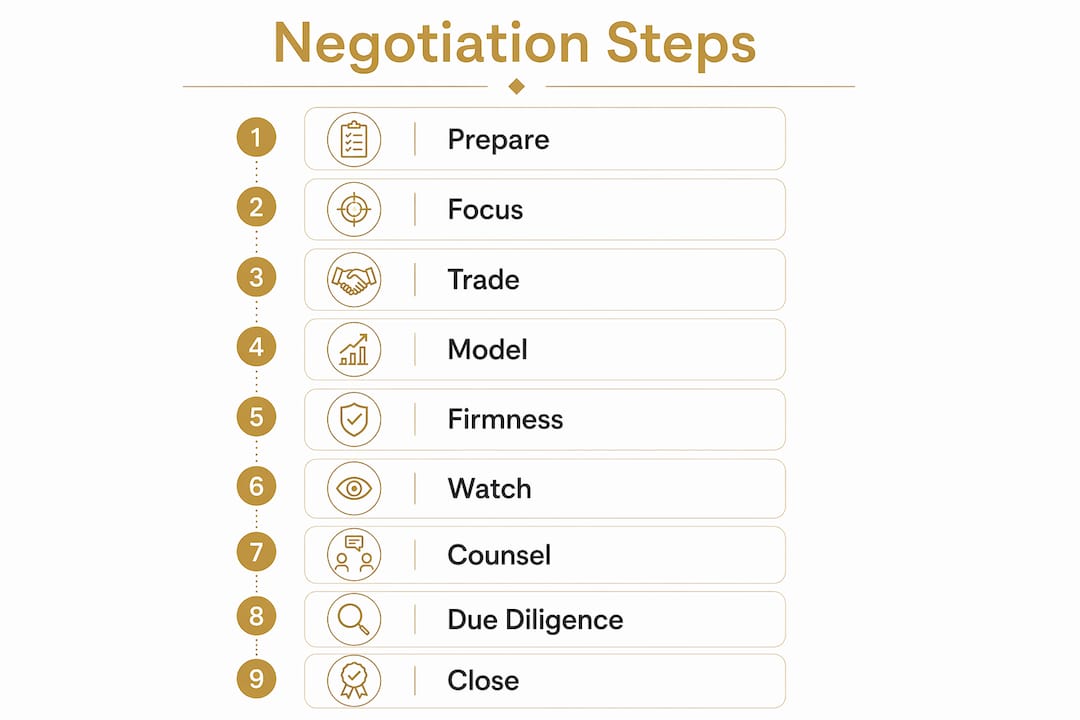
1. Set the frame with a data-backed opening
Propose your valuation and key terms first. By presenting a well-researched opening position, you anchor the negotiation. This only works if your number is grounded in comparable deals and real traction metrics. An unsupported ask damages credibility before the real conversation starts. “Comparable consumer brands at our stage and traction are raising at $X–$Y pre-money, and here are three examples” is a fundamentally different opening than “we think we’re worth $X.”

2. Focus on 3–4 high-impact terms
3. Trade low-cost terms for high-value protections
Negotiation is an information game. When you understand what the investor actually values, you can exchange terms that cost you little for protections that matter a great deal. An investor who cares deeply about pro-rata rights in future rounds might be willing to accept a cleaner liquidation preference structure in exchange. An investor who wants a specific information rights package might give ground on the option pool size. Listen more than you talk in early meetings. The investor who reveals their constraints gives you the map to a better deal.
4. Model your exit scenarios before you negotiate
Pro Tip: Before any term sheet conversation, model your payout at three exit sizes: a modest outcome, a solid outcome, and a strong outcome. Run those numbers under the investor’s proposed terms and under your preferred terms. The difference in founder proceeds at a $50M exit between 1x non-participating and 2x participating preferred is often startling. That model becomes your most persuasive tool at the negotiating table.
5. Maintain firmness on critical terms, flexibility on minor ones
Know your walk-away points before you sit down. If an investor insists on participating preferred without a cap, that’s a structural problem worth walking away from. If they want a slightly longer information rights package, that’s a minor concession. The founders who negotiate well hold firm on the terms that affect control and exit economics while showing genuine flexibility on provisions that don’t. That combination reads as competent and collaborative, not difficult.
6. Watch for red flags and be prepared to walk
Certain term sheet provisions signal how an investor approaches the entire relationship. Multiple liquidation preferences (2x or higher) at seed or Series A, full ratchet anti-dilution, uncapped participating preferred, cumulative dividends, and founder vesting restarts from zero are all warning signs. Seeing several of these in one term sheet tells you something about the investor’s priorities that no amount of relationship-building will fix. Walk away professionally. The venture world is small, and how you handle a deal that doesn’t close matters as much as how you handle one that does.
7. Secure legal counsel experienced in venture deals
This is not optional. A startup attorney who reviews term sheets daily will catch provisions you’ll miss, know what’s standard versus aggressive in the current market, and help you negotiate from a position of knowledge. Involve them before you sign the term sheet, not after.
8. Navigate due diligence with the same discipline
Once the term sheet is signed, due diligence begins. Prepare a clean data room: financial statements, cap table, customer contracts, IP assignments, and any material litigation history. Founders who respond to due diligence requests quickly and completely build investor confidence. Delays or gaps in documentation create doubt that can reopen closed negotiations.
9. Close with clarity on the definitive agreements
The term sheet is the blueprint; the definitive agreements are the binding contract. Review every provision in the final documents against what was agreed in the term sheet. Discrepancies at this stage are common and sometimes intentional. Your attorney should compare the two documents line by line before you sign.
How investor psychology shapes the negotiation dynamic
Investors are not purely rational actors improving a spreadsheet. They’re managing risk, protecting their fund’s reputation, and often navigating their own LP relationships. Understanding that context changes how you read their behavior at the table.
The most consistent investor priority is downside protection. Liquidation preferences, anti-dilution provisions, and protective provisions all serve the same underlying goal: ensuring the investor recovers capital if things go sideways. When an investor pushes hard on one of these terms, they’re usually signaling a specific concern about your business, not just extracting value for its own sake. Ask what’s driving the ask. The answer often opens a more productive conversation.
Negotiation is primarily an information game, and the best negotiators spend more time receiving information than giving it. When you understand what the investor actually needs versus what they’re asking for, you find the trades that close deals. An investor who says they need a 20% option pool might actually be concerned about your ability to hire a VP of Engineering and a Head of Sales before the next round. Respond to the underlying concern with a specific hiring plan, and the option pool conversation changes.
Emotion plays a larger role than most founders expect. Perceptions of power, urgency, and confidence shape how investors interpret your asks. A founder who seems desperate to close will get worse terms than one who appears genuinely selective. This is where your BATNA does double duty: it’s not just a fallback plan, it’s the source of the composure that makes investors take you seriously.
Transparency and active listening build the trust that moves negotiations forward. Founders who disclose risks proactively, explain their reasoning clearly, and engage with investor concerns rather than deflecting them tend to close faster and on better terms. The investor who trusts you is far more likely to give ground on a term than one who feels they’re being managed.
Watch for investor red flags beyond the term sheet itself. An investor who won’t concede on any term, who escalates demands late in the process, or who imposes excessive operational controls is showing you how they’ll behave as a board member. Aggressive negotiating behavior is a preview, not an anomaly.
How Commerce Catalyst helps consumer brand founders negotiate from strength
The founders who negotiate the best investment terms aren’t necessarily the ones with the most funding experience. They’re the ones who walk in with a clear picture of their financial position, a credible growth story, and the operational data to back both up. That’s exactly the gap Commerce Catalyst was built to close.
Positioning your brand for investment means more than having a compelling pitch deck. It means knowing your brand’s strategic investment position before you start conversations, understanding which investor types align with your growth model, and having the financial diagnostics to support every claim you make at the table.
The practical steps that move the needle on investor perception include:
- Completing a financial health assessment that surfaces your real unit economics, cash flow constraints, and profitability path before investors find them in due diligence.
- Identifying the operational constraints that limit your growth story, because investors will find them, and you’re better positioned when you’ve already addressed them.
- Building a compelling investor narrative grounded in your actual brand data, not generic market size claims.
- Understanding which investor types and priorities align with your stage and vision, so you’re targeting the right conversations from the start.
- Aligning your team’s credibility and founder story with the specific concerns of the investors you’re approaching.
The founders who come to Commerce Catalyst’s financial health assessment process consistently report the same outcome: they understand their business more clearly, they can answer investor questions with specificity, and they negotiate from a position of genuine confidence rather than performance.
Key Takeaways
Consumer brand founders who negotiate investment terms as a package, anchored by a clear BATNA and focused on 3–4 high-impact provisions, consistently secure better outcomes than those who improve for valuation alone.
| Point | Details |
|---|---|
| Package negotiation wins | Focus on 3–4 high-impact terms and present asks together, not as a line-by-line redline. |
| BATNA is your real use | Multiple investor options or non-dilutive alternatives give you a credible walk-away point. |
| Terms beat valuation | A 1x non-participating liquidation preference with clean anti-dilution outperforms a higher valuation with harsh terms. |
| Preparation is decisive | Know your cap table, hiring plan, and exit scenarios before the first investor meeting. |
| Legal counsel is required | An attorney experienced in venture deals catches provisions and negotiating points founders routinely miss. |