Kitting wins on contribution dollars when run sizes are big enough to absorb setup and staging costs, while bundling stays cheaper for small, short-lived promotions. The break point comes down to per-kit labor and materials, setup amortization, pick-line reduction, and how much working capital gets locked into a fixed SKU. This article walks through the math, the warehouse mechanics, and a one-week audit to find your real number.
TL;DR:
- Kitting margins become more favorable at high run sizes where setup costs are diluted across thousands of units, typically over 10,000 units.
- Bundling remains cheaper and more flexible for small, short-term promotions, testing, or slow-moving inventory, especially for runs under 200 units.
- The fully-loaded cost per kit is driven by setup fees, labor, materials, and fulfillment costs, which decrease per unit as volume increases.
- Inventory lock-in and SKU proliferation from kitting can raise handling costs, increase stockout risks, and reduce flexibility if demand shifts unexpectedly.
- Accurate margin analysis requires tracking real costs, including setup, materials, labor, and fulfillment, through audits and appropriate software tools.
Table of Contents
- What Kitting and Bundling Margins Actually Depend On
- How Bundling Works Without Touching Your Inventory
- The Margin Math: Where Kitting Overtakes Bundling
- Where Picking Efficiency Quietly Erodes Your Margin
- When Should You Choose Kitting Over Bundling?
- Protecting Margin Through Pricing and Presentation
- Running a VAS Audit to Find Your Real Margin Lift
- How Inventory Strategy Changes Your Margin Outcomes
- Tax and Regulatory Factors That Affect Your Numbers
- Software and Tools That Track Kitting and Bundling Margins
- Founder-to-Founder Perspective on Kitting and Bundling Trade-Offs
- Get Help Turning This Math Into a Margin Recovery Plan
- Sources
- FAQ
What Kitting and Bundling Margins Actually Depend On
Kitting turns two or more components into a single, finished SKU that lives in your inventory system before an order ever comes in. That single change ripples through your entire cost structure, because now you need a bill of materials (BOM), a new reorder point, and a dedicated process for assembling that SKU before it hits a shelf or a shipping label.
The cost lines that show up with kitting rarely show up anywhere else on your P&L. Setup and teardown time for each production run, staging space, quality checks on the finished kit, packaging materials specific to the bundle, and square footage dedicated to holding kitted inventory instead of loose components. None of that disappears when volume is low. It just gets divided across fewer units, which is why small runs are where kitting margins get quietly destroyed.
Run-size sensitivity is the single biggest lever here. A fully-loaded 4-component kit can cost between $1.80 and $3.20 per unit at typical U.S. labor rates, and most of that spread comes from how many units share the setup cost. Run 200 units and your setup fee might add $0.40 to $0.60 per kit. Run 10,000 and that same fee rounds to a few cents.
Kitting is not always optional, either. Retail compliance programs and Amazon FBA prep requirements frequently mandate that certain SKUs arrive pre-kitted, which removes the “should we?” question and turns this into a cost-management exercise instead.
The operational reality of kitting breaks down into a few consistent cost drivers:
- Setup and teardown time charged against every production run, regardless of run size
- Staging and dedicated storage space for finished kits, separate from loose component inventory
- Quality control checks specific to the assembled kit, not just the individual parts
- Materials unique to the kit (inserts, custom boxes, shrink wrap) that loose components don’t need
- BOM tracking and reorder-point recalculation every time component costs or quantities change
How Bundling Works Without Touching Your Inventory
Bundling groups products at the point of sale, not on the warehouse floor, and that distinction is what makes it the faster, cheaper option to test. A virtual bundle exists only in your cart and checkout logic. No physical assembly, no new SKU, no inventory adjustment. You’re selling three existing items as one offer and letting your fulfillment process pick each one individually.
Pick-and-pack bundling is a different animal. Here, a team member grabs each component at the pack station and assembles the bundle per order, right before it ships. That adds a pick line for every component in the bundle, which means your labor cost per order climbs even though nothing changed in your inventory system.
Multipacks add another wrinkle. Retail and marketplace rules (particularly on Amazon) often distinguish a multipack, which needs its own barcode and listing, from a bundle assembled at fulfillment. Mixing those up creates compliance headaches that show up as chargebacks later.
Bundling earns its place as the first move in a few specific situations:
- Testing price sensitivity or offer combinations before committing capital to kitted inventory
- Running a short promotional window where the offer might not repeat next quarter
- Clearing slow-moving stock by pairing it with a strong seller, without reworking your SKU catalog
- Validating demand for a future kit before paying setup and staging costs on speculation
The Margin Math: Where Kitting Overtakes Bundling
Every kitting-versus-bundling decision comes down to one comparison: fully-loaded cost per unit against the price you can actually charge. Get the cost side wrong and even a “successful” bundle or kit can be quietly losing money.
Start with the full list of cost components, because leaving one out is how founders convince themselves a program is profitable when it isn’t:
| Cost component | Applies to kitting | Applies to bundling |
|---|---|---|
| COGS (components) | Yes | Yes |
| Burdened labor (kitting/pack) | Yes, per run | Per order, if pick-and-pack |
| Setup and teardown amortization | Yes | No |
| Kit-specific materials | Yes | Only if pick-and-pack |
| Pick/pack fulfillment fees | Per finished kit | Per component, per order |
| Shipping delta | Usually lower (one box) | Can be higher (multiple lines) |
| Returns handling | Whole-kit complexity | Simpler, per-item |
| Payment processing fees | On bundle price | On bundle price |
The formula for per-kit fully-loaded cost is clear once you have real numbers: burdened labor rate times minutes per kit, plus materials cost, plus (setup fee divided by run size), plus allocated overhead. That last term, setup fee divided by run size, is what makes kitting economics nonlinear.
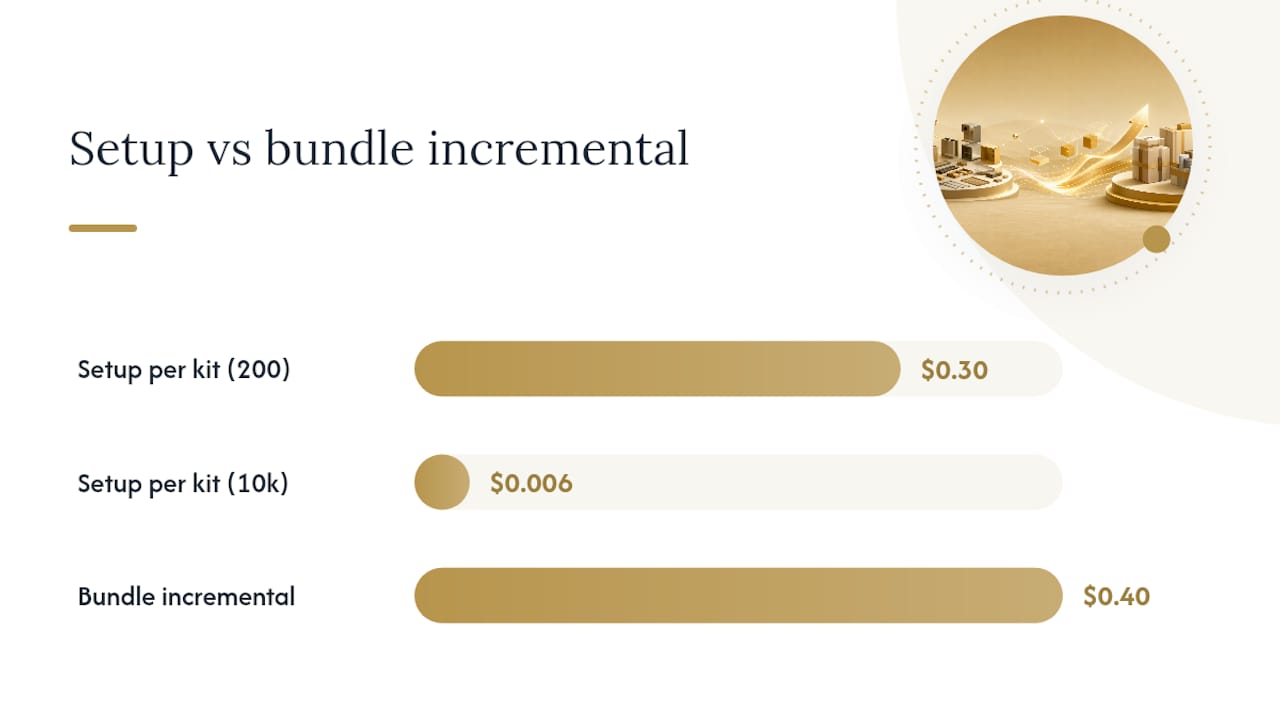
Worked example 1, small run. Say you’re kitting 200 units of a 3-component gift set. Labor runs $0.85 per kit, materials add $0.60, and a $60 setup fee spread across 200 units adds $0.30 per kit. Fully-loaded cost lands at $1.75. Compare that to a virtual bundle of the same three items with no setup cost and incremental fulfillment of roughly $0.40 for the extra pick line. Bundling wins here, often by a wide margin, because the kit never earns back its setup investment at this volume.
Worked example 2, large run. Now run 10,000 units of the same kit. Labor and materials stay the same at $1.45 combined, but the $60 setup fee now adds just $0.006 per kit. Fully-loaded cost drops to roughly $1.46, undercutting the bundle’s incremental fulfillment cost per order once you account for the extra pick line and packaging on the bundled version. Kitting overtakes bundling on contribution dollars somewhere between those two run sizes, and where exactly depends on your labor rate and setup fee.
Use this formula to test your own numbers:
Margin Lift = (Bundle price − bundle COGS − incremental fulfillment) − (Kit price − kit COGS − kitting cost)
A positive number favors bundling. A negative number means kitting preserves more contribution dollars per unit once run size clears the setup hurdle.
Where Picking Efficiency Quietly Erodes Your Margin
Order-picking eats 50% to 75% of total warehouse operating costs and roughly 55% of labor time in most fulfillment operations. That single fact explains why pre-kitting products before an order arrives, rather than assembling them at the pack station, changes your cost structure so dramatically. One pick line beats three or four every time.
But that reduction comes at a price you don’t see on a pick sheet: locked inventory. Once components are kitted, that capital is committed to a specific configuration. If demand shifts and you need those components sold individually, you’re either breaking down finished kits (costly, slow) or sitting on dead stock.
SKU proliferation compounds this. Every new bundle variant or kit configuration adds a SKU that needs its own count, slot, and reorder logic. Cross a certain threshold, usually when your warehouse team starts losing track of which combination sells and which doesn’t, and the holding and counting costs start outweighing the marketing benefit of “more options.” Consolidating down to the combinations that actually move, rather than every permutation your merchandising team dreamed up, is often the single strongest fix available. A SKU rationalization review usually surfaces more margin than another round of discounting ever will.
Pro Tip: Before adding a new bundle SKU, ask whether it’s cannibalizing an existing top seller. A new combination that just splits demand from your best performer adds warehouse complexity without adding net revenue.
Picking technology matters too. A 2026 experimental study on order-picking methods found pick-by-light delivered the highest efficiency and lowest cost per order line among four tested technologies, ahead of pick-by-paper and RF scanning. If you’re running high-volume kitting or bundling, the picking method on your floor is not a minor operational detail. It’s a direct line item on your per-unit cost.
- Order-picking commonly represents the single largest warehouse operating expense
- Pre-kitting reduces pick lines but locks capital into a fixed component mix
- Excess SKU variants raise counting, slotting, and holding costs faster than most teams notice
- Pick-by-light outperforms paper and RF scanning on cost per line in controlled testing
When Should You Choose Kitting Over Bundling?
The decision rarely comes down to preference. It comes down to four measurable signals that tell you which model actually protects your margin.
- Check your run-size break-even. Calculate fully-loaded cost at your actual projected volume using the formula above. If setup amortization adds more than 10% to per-unit cost, you’re likely still in bundling territory.
- Count your components. Kits with more than four or five components, or with frequent optional variants, get expensive to manage and error-prone to assemble. High complexity favors bundling or a simplified kit design.
- Check program constraints first. Retail compliance rules and FBA prep requirements can make this decision for you before cost even enters the conversation.
- Read your operational capacity. High return rates, frequent picking errors, or peak-season labor strain all point toward kitting, since consolidating components into one finished SKU reduces the number of places an order can go wrong.
Pro Tip: Run the Margin Lift formula before you commit to a kit, not after your first production run. Retooling a live SKU back into loose components is almost always more expensive than the decision would have been upfront.
Protecting Margin Through Pricing and Presentation
Getting the cost math right only gets you halfway. The other half is pricing the bundle or kit so customers actually convert, without giving away the margin you just fought to preserve.
Anchor pricing does the heaviest lifting here. Showing the individual item total next to the bundle price, with the dollar savings spelled out, consistently outperforms letting customers do the math themselves. A bundle that says “$64 value, yours for $49, save $15” converts better than the same offer with just a final price, because the saving is explicit rather than implied.
Tiered bundles extend that logic. Offering a small, medium, and large version of the same bundle captures different willingness-to-pay segments without forcing everyone into a single price point. It also gives your merchandising team room to push the middle tier, which is usually where margin and conversion overlap best.
Discounting needs guardrails tied to your baseline margin, not a flat percentage applied across the catalog. Shopify’s guidance suggests brands running margins at 50% or higher can typically afford 10% to 20% off the bundled subtotal, while brands under 50% margin should generally stay in the 5% to 10% range. Push past those bands without checking your Margin Lift number, and revenue climbs while contribution dollars quietly shrink.
- Show dollar savings explicitly, not just a percentage off
- Build at least two price tiers to capture different buyer segments
- Cap bundle discounts using your baseline margin, not a company-wide flat rate
- Track Margin Lift in every A/B test, not just revenue or conversion rate lift
Running a VAS Audit to Find Your Real Margin Lift
A value-added services (VAS) audit benchmarks what kitting actually costs against the Margin Lift it produces, rather than trusting revenue growth as proof the program works. Most operators who run this audit for the first time find unbilled setup fees, materials costs absorbed into overhead instead of the kit’s price, and rework labor nobody tracked separately.
The audit needs three numbers per kit or bundle line: revenue billed, direct kitting or fulfillment cost, and the resulting margin percentage. Everything else in the process exists to get those three numbers right.
A one-week version looks like this: run a time study on your actual kitting process (not the theoretical one in your SOP), pull a sample of recent production runs to check real material usage, audit your current materials inventory for waste, capture error and rework rates from the past month, and calculate margin by kit or bundle line individually rather than as a blended average.
- Time-study your actual kitting labor, not the process as documented
- Pull five to ten recent production runs and check real material usage against BOM
- Capture error and rework rates over the trailing 30 days
- Calculate margin separately for each kit or bundle line, never blended
Common quick wins once the numbers are in: standardizing box sizes to cut materials waste, offering kitting-on-demand instead of pre-building speculative inventory, adding tiered run pricing that reflects true setup amortization, and tightening the integration between your BOM and your warehouse management system so nobody’s reconciling spreadsheets by hand.
Pro Tip: If your audit shows a kit’s Margin Lift is negative even at full volume, don’t improve it. Kill it or renegotiate the setup fee before pouring more labor into fixing a structurally unprofitable SKU.
How Inventory Strategy Changes Your Margin Outcomes
The inventory model you choose behind a kit or bundle determines how much cash sits idle and how exposed you are to demand shifts. Kitting to finished-goods inventory works when demand is predictable, because you’re pre-committing capital and warehouse space to a specific combination weeks or months before it sells.
Kitting-on-demand, where components stay loose until an order triggers assembly, trades some picking efficiency for flexibility. You lose the single-pick-line advantage, but you also avoid sitting on 5,000 finished units of a seasonal bundle that stops selling in six weeks.
Safety stock calculations get more complicated with kits, too, because a stockout on any single component halts production of the entire finished SKU. A kit with five components effectively has five stockout risks instead of one, and that risk compounds with every additional component you add. Teams that track component-level reorder points separately from finished-kit reorder points catch this before it becomes a fulfillment delay.
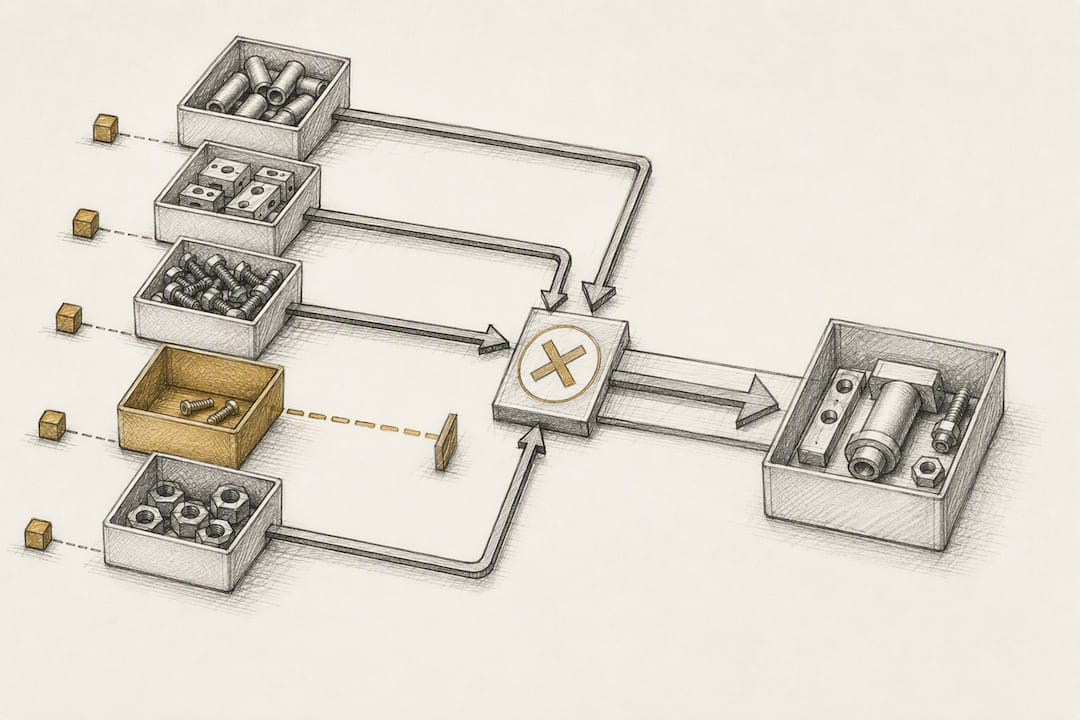
Bundling carries a gentler version of this problem. Since components usually remain sellable on their own, a stockout on one item just removes it from the bundle temporarily rather than halting the entire offer. That flexibility is part of why bundling stays the lower-risk choice for testing new combinations before locking capital into kitted inventory.
Tax and Regulatory Factors That Affect Your Numbers
Kitting can trigger different tax and accounting treatment than bundling in ways that catch founders off guard. When you assemble a new finished SKU, you’re often creating a new item for inventory valuation purposes, which affects how COGS gets recognized and how that inventory gets valued on your balance sheet at year-end.
Sales tax treatment varies depending on how the bundle or kit is structured and where you’re shipping. Some states tax the bundle as a single taxable item; others require itemized tax treatment based on the individual components inside, particularly when the bundle mixes taxable and non-taxable goods (a common issue in bundles combining apparel with accessories, or food with non-food items). This is jurisdiction-specific, and it’s worth confirming your point-of-sale and tax software handles it correctly rather than assuming your existing settings apply automatically to a new bundled SKU.
Retail compliance programs add another layer. Major retailers and marketplaces often specify exactly how a kit must be labeled, barcoded, and packaged, and getting this wrong triggers chargebacks that erase whatever margin the kit was supposed to generate. If you’re prepping for Amazon FBA, the platform’s own kitting and multipack rules determine whether your item even qualifies for certain fulfillment programs.
None of this is a substitute for advice from a tax professional familiar with your specific states and product categories, but it’s worth flagging early. Regulatory friction that shows up after a kit launches is far more expensive to fix than friction caught during the initial cost analysis.
Software and Tools That Track Kitting and Bundling Margins
Spreadsheets work fine for the first version of the Margin Lift formula, but they break down fast once you’re running multiple kits and bundles across seasons. The tools worth evaluating fall into a few categories.
Warehouse management systems (WMS) with BOM integration let you track component consumption against finished-kit output automatically, instead of reconciling inventory counts by hand every month. This is where most of the “unbilled setup fee” problems the VAS audit catches actually get fixed long-term, because the system starts flagging cost drift before it becomes a quarterly surprise.
Configure-price-quote (CPQ) systems, which Salesforce notes can lift bundle revenue by an average of 30% in some studies, automate complex bundle pricing rules so discount bands stay enforced even as your catalog grows. That matters because manual pricing overrides are exactly how margin-based discount rules quietly erode over time.
On the merchandising side, tools that automate bundle presentation and dollar-savings messaging at scale help maintain the anchor-pricing discipline covered earlier without requiring a manual rewrite every time you launch a new combination. For brands publishing product copy across a large catalog, AI-assisted product content tools can keep that messaging consistent without adding headcount.
Whatever stack you land on, the non-negotiable requirement is per-SKU margin visibility. If your system only reports blended category margins, you’re flying blind on exactly the number this entire decision depends on.
Founder-to-Founder Perspective on Kitting and Bundling Trade-Offs
Run the audit internally if you have the bandwidth and the data discipline. Call in outside help when you suspect the numbers are wrong but can’t find where, or when a kit decision affects cash flow you can’t afford to get wrong twice.
Get Help Turning This Math Into a Margin Recovery Plan
Specialized advisory exists for exactly the moment you finish this article and realize your kitting or bundling numbers need a real audit, not another spreadsheet guess. Unlike general consulting, this advisory comes from someone with founder experience, which means the recommendations come with implementation insight, not just a slide deck.
If you want a full picture of where your operating constraints sit, the DTC Operator Diagnostic for $197 gives you a structured review across cost, cash flow, and margin. If it’s specifically your kitting or bundling program bleeding contribution dollars, the 90-Day Profit Sprint for Consumer Brands is built to find and fix exactly that kind of margin leak on a scoped timeline. And if you just need to talk through your numbers with someone who’s made these calls before, book a Founder Hour for $500 per hour and bring your actual cost breakdown. Ongoing structural support is available too, through Founder Advisory or a Fractional CFO engagement, depending on how much hands-on support your team needs. Start with whichever entry point matches how urgent the leak feels.
Sources
This article draws on a 2026 order-picking technology study, fully-loaded kitting cost research, Shopify’s bundling guidance, and the VAS audit and Margin Lift framework, alongside the Contract Packaging Association for operational standards.
- Kitting in a Warehouse: How It Works and What It Actually Costs | Obol
- Product bundling: strategies and examples for 2026 - Shopify
- Experimental evaluation of order-picking technologies (2026)
- Applied study on storage allocation and picker routing (2025)
FAQ
What Does Bundling Mean in Marketing?
Bundling means grouping two or more products into a single offer at a combined price, usually to raise average order value, move slow-moving stock, or test new product combinations without creating a new physical SKU.
What Are the Disadvantages of Bundle Pricing?
Bundle pricing can erode margin fast if discounts aren’t tied to baseline margin, and it can mask which individual products actually drive profit since revenue gets reported at the bundle level rather than per SKU.
Can You Give Me an Example of Kitting in a Warehouse?
A common example is assembling a gift set of three skincare products into one finished, barcoded SKU with its own box and insert before the order ever arrives, so pack station staff pick one item instead of three.
Can You Give Me an Example of Price Bundling?
A classic example is a “buy the shampoo and conditioner together” offer at checkout, where both items ship separately from existing inventory but are priced and marketed as one combined deal.