Operational efficiency for a consumer brand is defined as the ability to move faster, spend less, and decide better across marketing, supply chain, and finance simultaneously. Brand managers who work to streamline operations for their consumer brand are not just cutting costs. They are rebuilding how the entire business runs. With 47% of online shoppers already using AI in their most recent purchase, the pressure to run leaner and smarter has never been more concrete. The industry term for this shift is operational transformation, and it requires more than new software. It requires redesigning the foundation your brand runs on.
How do you streamline operations for a consumer brand?
Operational transformation starts with a clear-eyed look at what you already have. Most brand managers skip this step and buy new tools instead. That mistake is expensive. Scaling a broken foundation with point solutions makes inefficiencies more expensive, not cheaper. The right sequence is always: simplify first, then automate.
Build a unified data foundation
A unified data model is the single most important prerequisite for any operational improvement. Think of it as “one version of the truth” that spans marketing, supply chain, and finance. Without it, your teams make decisions from different numbers, and no amount of automation fixes that misalignment. Every dashboard, report, and AI tool you add later depends on this foundation being solid.

P&G’s supply chain overhaul illustrates why simplification must come before automation. The company consolidated 35 processes into 20 before deploying AI planning tools. That reduction forced planners to focus on decisions rather than data handling. The lesson for consumer brand managers is direct: fewer, cleaner processes produce better results than more automated chaos.
The table below shows the three categories of tools that belong in a baseline operating stack, and what each one actually does.
| Tool category | Role in operations |
|---|---|
| Data platform | Centralizes sales, marketing, and supply chain data into one source |
| Workflow management | Maps and tracks process steps to reduce duplication and delays |
| Brand asset management | Stores and governs brand materials so teams pull from one approved library |
Pro Tip: Audit your existing workflows before buying any new software. List every recurring task, who owns it, and how long it takes. Bottlenecks almost always appear in the handoffs between teams, not inside the tasks themselves.
How can AI-enabled automation improve brand operations?
AI does not replace good operations. It accelerates them. The brands seeing the biggest gains use AI to compress the time between a signal and a decision, not to remove humans from the loop entirely. That distinction matters because premature automation of judgment calls creates new problems faster than it solves old ones.
P&G’s results show what well-sequenced AI adoption looks like at scale. The company now runs 80% of supply chain planning touchlessly, with a projected 50% reduction in planner effort. That is not the result of buying AI software. It is the result of years of process simplification followed by targeted AI deployment.
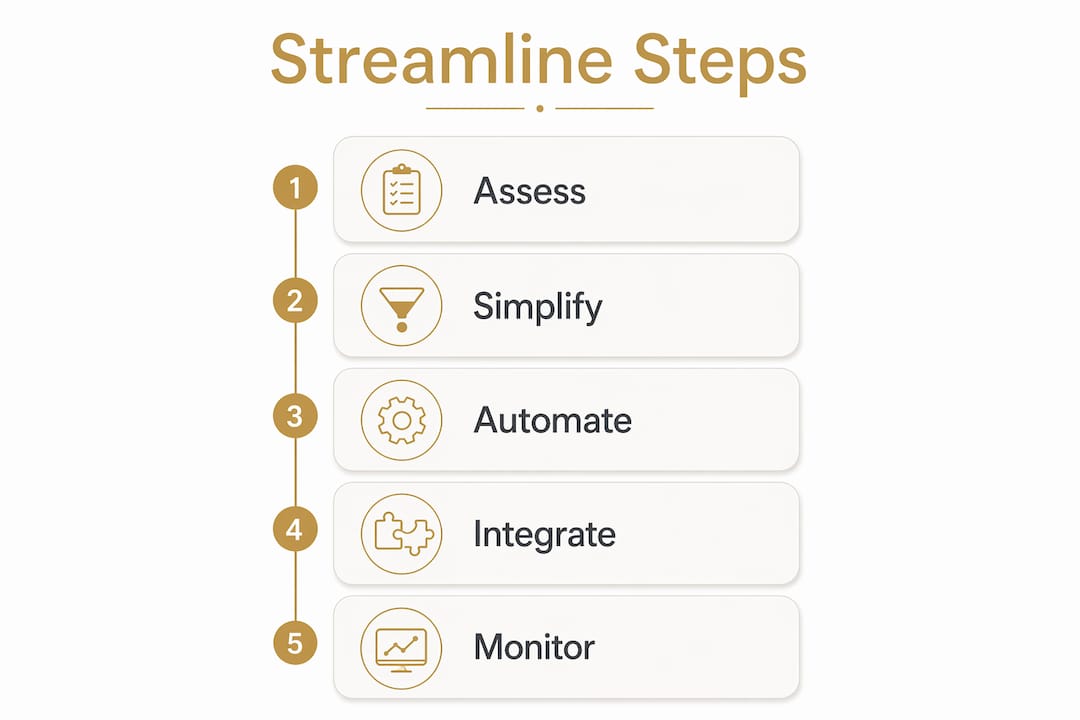
The phased approach below works for brands at any scale.
- Build the foundation. Unify your data, map your processes, and eliminate redundant steps. No AI tool performs well on fragmented inputs.
- Diagnose friction points. Identify where decisions slow down. Common culprits include weekly reporting prep, inventory reorder approvals, and marketing performance reviews.
- Automate preparation tasks first. Use AI to generate first-draft reports, auto-populate dashboards, and flag anomalies. This frees your team for judgment, not data entry.
- Implement targeted AI interventions. Apply AI to specific, well-defined problems: demand forecasting, ad spend pacing, or customer lifetime value modeling.
- Review and recalibrate. Set a 90-day review cycle. Measure whether each AI tool reduced decision time or improved accuracy. Cut what does not perform.
AI-generated weekly business reviews eliminate what practitioners call “preparation tax.” That is the hours your team spends building the deck instead of reading it. When AI auto-populates performance dashboards and writes the first-draft narrative, your meeting shifts from data assembly to actual decision-making. That shift alone recovers hours of leadership time every week.
The financial case for AI-native operations is also clear. The most successful AI-native consumer brands scale revenue per employee to $3M–$5M, compared to $1.3M typical for legacy CPG brands. That gap reflects the compounding effect of leaner processes, faster decisions, and lower overhead.
Pro Tip: Start by automating the preparation work around your weekly business review. Have AI pull the numbers, flag the variances, and draft the summary. Your team then spends the meeting deciding what to do about it, not arguing about which number is right.
What role does brand management play in operational efficiency?
Most brand managers treat brand as a creative output. The more effective approach is to treat it as an operational asset with its own governance, monitoring, and performance metrics. This is the core idea behind the Brand Operating System, known as BrandOS.
BrandOS integrates strategy, design, and operations into a coherent whole. Instead of brand guidelines sitting in a PDF that no one reads, BrandOS makes brand decisions part of the daily operating rhythm. Teams know what the brand stands for, what it looks like, and how it behaves across every channel, without rebuilding that understanding from memory each time. The result is faster execution and fewer costly brand inconsistencies.
Brand Performance Management, or BPM, extends this idea into real-time monitoring. BPM treats brand health with the same rigor as finance, providing continuous tracking of brand equity, sentiment, and visibility rather than relying on annual audits. The shift from episodic audits to ongoing dashboards is significant. Annual audits tell you what went wrong six months ago. Real-time dashboards tell you what is happening right now, so you can act before a problem compounds.
Brands that treat brand as a governed asset avoid the costly cycle of rebuilding brand intent from scratch with every new campaign or hire. That continuity improves decision speed across the entire organization. You can read more about how brand strategy drives decisions for founders who are scaling.
The practices below contribute directly to operational simplicity and brand consistency.
- Maintain a single, version-controlled brand asset library that all teams access.
- Set brand health KPIs alongside revenue KPIs in every business review.
- Assign a brand governance owner who reviews new campaigns against BrandOS standards before launch.
- Use AI-mediated discovery monitoring to track how your brand appears in AI search results and recommendation engines.
- Run quarterly brand health reviews with the same format and metrics every time, so trends are visible across periods.
Continuous brand monitoring is becoming critical as AI-mediated discovery replaces traditional search as the primary channel for customer evaluation. If your brand is not governed and monitored in real time, you will not know when AI systems start describing it inaccurately or deprioritizing it in recommendations.
What are the best practices for brand operations, and what mistakes should you avoid?
The most common mistake brand managers make is adopting point solutions before redesigning the operating stack. A new project management tool does not fix a broken approval process. A new analytics platform does not fix misaligned data definitions. Auditing workflows before adopting AI tools produces better investment decisions and better operational outcomes.
The second most common mistake is automating complexity instead of eliminating it. Automation without simplification only compounds problems. If your demand forecasting process involves five manual handoffs and three spreadsheets, automating it produces faster wrong answers. Simplify the process first, then automate what remains.
The table below contrasts two implementation approaches and their typical outcomes.
| Approach | Method | Typical outcome |
|---|---|---|
| Piecemeal adoption | Buy tools to fix individual pain points | Short-term relief, growing technical debt, misaligned data |
| Integrated redesign | Redesign operating stack, then add tools | Higher upfront effort, compounding efficiency gains over time |
Shared language across teams is another underrated factor. When marketing defines “conversion” differently than finance does, every cross-functional meeting wastes time on definitions instead of decisions. Establishing a shared data dictionary and a consistent weekly business review format solves this faster than any software purchase.
Pro Tip: Before your next quarterly planning cycle, run a 30-minute process audit with each functional lead. Ask them to name the three tasks that consume the most time without producing decisions. Those answers will tell you exactly where to focus your operational improvement effort.
The role of operational efficiency in brand growth is well documented. Brands that build operational discipline early scale with less friction and higher margins than those that retrofit efficiency onto a chaotic foundation.
Key Takeaways
Consumer brands that redesign their operating stack before adopting AI, govern brand as a performance asset, and eliminate process complexity before automating it will outpace competitors on both speed and margin.
| Point | Details |
|---|---|
| Simplify before automating | Reduce process complexity first; automation on a broken foundation compounds inefficiencies. |
| Unify your data | A single data model across marketing, supply chain, and finance is the prerequisite for every other improvement. |
| Use AI for preparation, not judgment | Automate report generation and dashboard population so your team focuses on decisions. |
| Treat brand as an operational asset | BrandOS and Brand Performance Management keep brand decisions fast, consistent, and measurable. |
| Audit before you buy | Identify friction points in existing workflows before purchasing new tools or platforms. |
The uncomfortable truth about operational transformation
The cultural shift is harder than the technical one. Getting your team to trust an AI-generated business review summary requires building confidence in the underlying data first. That takes time and deliberate effort. Brands that rush past this step end up with automation that no one trusts, which means no one uses it, which means the investment produces nothing.
How Commerce Catalyst helps consumer brands run more efficiently
Consumer brand founders often know their operations are inefficient but cannot pinpoint exactly where the margin is leaking. Commerce Catalyst was built to solve that specific problem.
The DTC Financial Health Assessment gives you a clear picture of where your brand’s profitability gaps are and which operational changes will close them fastest. Chris Wichert’s approach is grounded in real founder experience, not generic consulting frameworks. You get a prioritized roadmap of next moves, not a 60-page report that sits on a shelf. If you want to know where to focus first, the Next Move Finder is a fast way to pressure-test your options before committing resources.
FAQ
What does it mean to streamline operations for a consumer brand?
Streamlining operations for a consumer brand means redesigning and simplifying workflows across marketing, supply chain, and finance to reduce costs, speed up decisions, and improve profitability. It requires simplifying processes before adding automation or AI tools.
What is a Brand Operating System (BrandOS)?
A Brand Operating System integrates brand strategy, design, and operations into a single, governed framework that teams use daily. It replaces static brand guidelines with an active operating discipline that keeps brand decisions consistent and fast.
How does AI improve consumer brand operations?
AI compresses the time between a signal and a decision by automating data preparation, generating report summaries, and flagging performance anomalies. P&G now runs 80% of supply chain planning touchlessly using this approach.
What is the biggest mistake brands make when improving operations?
The most common mistake is buying new tools before simplifying existing processes. Automation applied to a complex or broken workflow produces faster errors, not better outcomes.
What is Brand Performance Management?
Brand Performance Management treats brand health with the same rigor as financial reporting, using real-time monitoring of brand equity, sentiment, and visibility instead of annual audits. It gives brand managers the same continuous feedback loop that finance teams use for revenue.