
Gross to net revenue is the process of converting top-line sales into the revenue your business actually keeps: Net Revenue = Gross Revenue − (Returns + Allowances + Discounts). Gross revenue is every dollar a sale generates before anything comes off it; net revenue is what’s left after returns, allowances, and discounts are subtracted. Net revenue sits at the top of your income statement, distinct from net income, which strips out costs, overhead, and taxes further down the page.
TL;DR:
- A top-down estimate using a flat percentage of gross revenue to calculate net revenue can mislead, especially when just a few large deductions dominate your gap.
- Tracking deductions transaction by transaction reveals whether specific SKUs, channels, or retailers contribute most to your gross to net discrepancy.
- Growing returns or trade deductions over time indicate underlying issues that require renegotiation or process improvements to protect margin.
- Mixing deductions with costs of goods and recording them in the wrong period distorts your net revenue and misguides financial analysis.
- Building detailed, channel-specific and SKU-specific reports on net revenue helps in identifying structural problems and improving forecasting accuracy.
Table of Contents
- How to Calculate Net Revenue From Your Sales Data
- The Gross to Net Waterfall: Deductions You Need to Track
- Worked Examples: What the Math Actually Looks Like
- Why Net Revenue Should Drive Pricing and Investor Conversations
- Why Industry Context Changes the Gross to Net Calculation
- Adjusting Gross to Net Figures Under GAAP and IFRS
- Common Mistakes That Distort Net Revenue
- Gross to Net Revenue in Sales Performance and Incentive Design
- Founder-to-Founder View: Three Fixes Worth Prioritizing
- Get Help Closing Your Gross to Net Gap
- Sources
- FAQ
How to Calculate Net Revenue From Your Sales Data
Start with gross revenue: total units sold multiplied by average sale price, or the sum of your sales journal for the period. From there, you subtract every deduction tied directly to the sale itself, not the cost of making the product.
Here’s the sequence that keeps the math clean and auditable:
- Pull gross revenue from your sales ledger or POS export for the exact period you’re measuring.
- Tally returns using credit memos, refund logs, or your ecommerce platform’s returns report.
- Add allowances granted for damaged goods, quality issues, or negotiated price reductions after the sale.
- Add discounts applied at checkout, through promo codes, or via volume pricing agreements.
- Include rebates and chargebacks from wholesale or retail partners, even when they settle weeks later.
- Subtract the total from gross revenue to land on net revenue.
Written out, the formula looks like this: Net Revenue = Gross Revenue − (Returns + Allowances + Discounts + Rebates + Chargebacks). Each input maps to a specific accounting record: returns live in credit memos, discounts show up in point-of-sale discount fields, and rebates typically hide in vendor deduction reports that arrive separately from the original invoice.
Pro Tip: Tag every deduction at the transaction level, not in a lump monthly journal entry. When a $40,000 discrepancy shows up in Q3, transaction-level tags let you trace it to a specific SKU or customer in minutes instead of re-auditing three months of invoices.
This transaction-level habit is what separates founders who can explain their numbers from founders who can only guess at them.
The Gross to Net Waterfall: Deductions You Need to Track
Five deduction categories account for almost every gap between gross and net revenue, and each behaves differently on your books.
- Returns are physical product sent back, recorded through credit memos that reverse the original sale.
- Allowances are price concessions granted without a physical return, often for damage or quality complaints.
- Discounts are planned price reductions, whether a checkout code or a negotiated wholesale rate.
- Rebates and chargebacks are retailer-initiated deductions, frequently disputed and often settled months after the sale.
- Freight surcharges and trade spend cover promotional funding, slotting fees, and co-op marketing paid to move product through a channel.
For many CPG brands, trade spend alone runs 15% to 25% of gross sales, making it the largest deduction category most founders track after cost of goods.
The timing question matters as much as the category. Trade accruals should post when the promotion runs, not when the retailer’s deduction settles; wait for settlement and you’ll get blind sided by a lump adjustment that makes a clean quarter look messy. This is why a top down estimate, applying a flat percentage to gross revenue, breaks down fast. Building the calculation bottom up, transaction by transaction, lets you trace any net figure back to the exact sale that produced it, which is the only way to know whether a margin problem lives in one channel or across the whole business.
Worked Examples: What the Math Actually Looks Like
Numbers make this concrete faster than definitions do.
- DTC ecommerce brand. Gross revenue of $500,000 for the month, with $20,000 in returns, $10,000 in checkout discounts, and $5,000 in miscellaneous allowances. Net revenue lands at $465,000, roughly 7% below the headline number. That gap tells you exactly how much cash you actually have to cover payroll this month, not the number on your Shopify dashboard.
- Subscription brand. Gross billings of $200,000, with $8,000 in prorated refunds and $4,000 in service credits issued to retain churning customers. Net revenue comes to $188,000. If your reinvestment budget was built on the $200,000 figure, you’re already 6% overcommitted before a single new expense hits the books.
- Quick extraction checklist: pull gross sales from Shopify or your POS, pull returns and discounts from the same platform’s reporting tab, and pull rebates or chargebacks from your accounting software’s vendor deduction ledger.
Each example shows the same lesson: the gap between gross and net isn’t rounding error. It’s the difference between a forecast that holds and one that quietly falls apart by week three.
Why Net Revenue Should Drive Pricing and Investor Conversations
Payroll, reinvestment, and pricing decisions should be built on net revenue, never gross. Net revenue reflects the cash actually available to cover expenses and fund growth; gross revenue only tells you how much demand you generated, not how much of it you kept.
The gross to net gap itself is a diagnostic tool. A widening gap points you toward specific fixes:
- A rising returns rate often signals a product quality or sizing problem worth fixing before you spend another dollar on acquisition.
- Growing trade deductions may mean it’s time to renegotiate retailer terms or cut a promotion that no longer pays for itself.
- A jump in discount-driven sales can mean you’re buying revenue growth at the expense of margin, a pattern that hides real profitability problems behind an attractive top line.
Every downstream KPI, gross margin, contribution margin, and LTV:CAC, depends on starting from an accurate net figure. Get net revenue wrong and every ratio built on top of it is wrong too.
Pro Tip: Build three standing reports: net revenue by SKU, net revenue by channel, and net revenue by customer segment. Most founders only discover which channel is quietly bleeding margin once they see the net numbers side by side.
Why Industry Context Changes the Gross to Net Calculation
The size and shape of the gross to net gap varies enormously by industry, and treating every business like it should hit the same benchmark is a mistake.
A software company’s gap is usually small and mostly refunds. A wholesale CPG brand’s gap can be dramatic, driven by trade spend, retailer chargebacks, and seasonal promotional calendars that shift 10 to 20 percentage points between quarters. A marketplace or platform business faces a different wrinkle entirely: it has to decide whether it’s recognizing revenue gross (as the seller of record) or net (as an agent taking a commission), a classification call that changes the top-line number before any deduction is even applied.
Retail and wholesale channels tend to carry heavier deduction loads than direct-to-consumer, because retailer contracts often include co-op advertising fees, slotting allowances, and volume rebates that ecommerce checkouts rarely see. A founder selling through both channels needs separate gross to net tracking for each, because blending them into one company-wide percentage will obscure which channel is actually profitable.
The practical takeaway: don’t benchmark your deduction rate against a generic industry average. Benchmark it against your own trailing twelve months, broken out by channel, so you can see whether the gap is structural to your business model or a signal that something specific just changed.
Adjusting Gross to Net Figures Under GAAP and IFRS
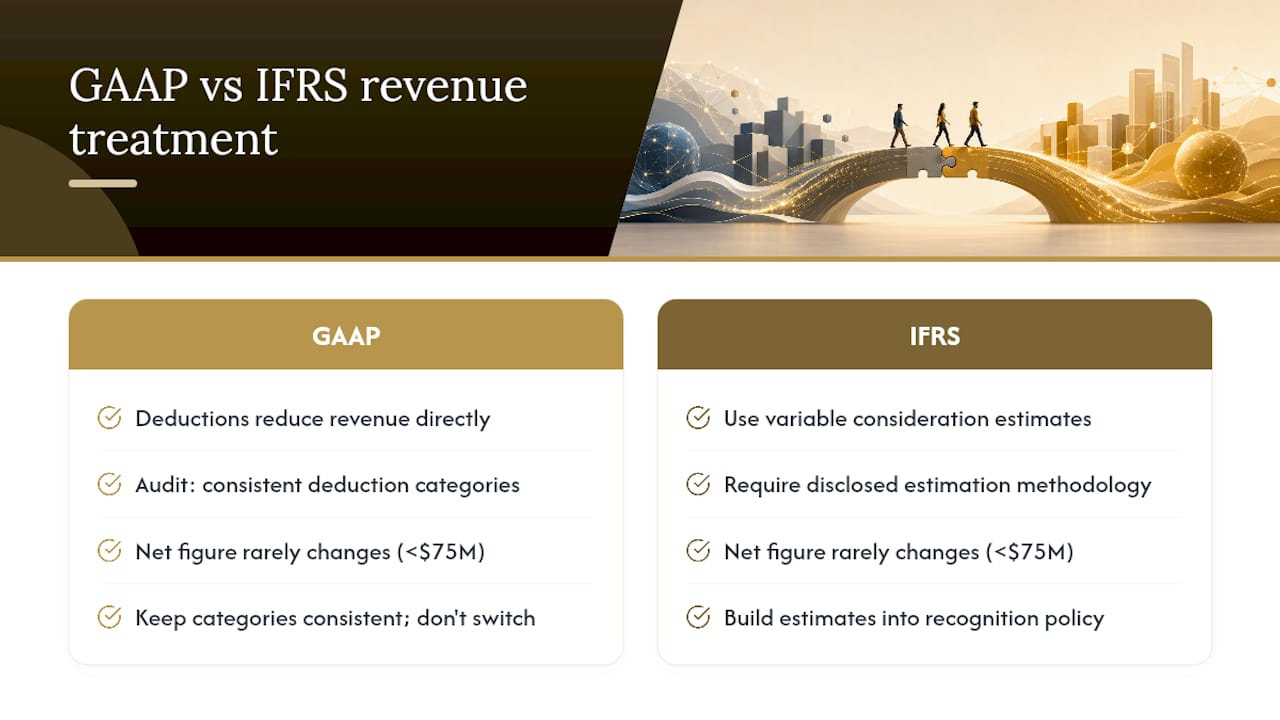
Most small business founders in the United States report under Generally Accepted Accounting Principles, and GAAP treats returns, allowances, and discounts as direct reductions to revenue, not as an operating expense further down the statement. That’s a meaningful distinction: it keeps your net revenue figure clean and comparable, and it’s why the formula nets deductions out before revenue is ever reported.
International Financial Reporting Standards handle the concept similarly but apply more explicit language around variable consideration, the idea that a sale’s final transaction price isn’t locked in until rebates, discounts, and refund obligations are estimated and applied. If you sell internationally, work with a partner, or plan to raise capital from investors who report under IFRS, ask your accountant whether variable consideration estimates need to be built into your revenue recognition policy now rather than retrofitted later.
For most founders below $75 million in revenue, the practical difference between GAAP and IFRS rarely changes the net revenue number itself. What it changes is the documentation trail behind that number. GAAP audits want to see the same deduction categories applied consistently period over period; IFRS reviewers want to see the estimation methodology behind variable consideration spelled out. Either way, the fix is the same: keep deductions categorized consistently, and don’t switch methodology between quarters just because a number looks better one way.
Common Mistakes That Distort Net Revenue

The single most common mistake is netting deductions against the wrong period. A discount issued in March but not recorded until the April close makes March look artificially strong and April look artificially weak, even though nothing about the business actually changed.
A second mistake is mixing revenue deductions with cost of goods sold. Freight paid to ship product to a customer is a sales deduction; freight paid to receive inventory from a supplier is a cost of goods line. Blend the two and your gross margin calculation becomes meaningless, because you’re comparing a revenue metric against costs that never belonged in the same bucket.
A third and sneakier mistake is estimating trade spend as a flat percentage of gross sales instead of tracking it deal by deal. That shortcut works fine until one retailer runs an unusually aggressive promotion, and your flat estimate quietly understates the real accrual by tens of thousands of dollars.
The fourth mistake is treating chargebacks as a rounding error because they arrive in small, scattered amounts. Individually they look trivial. Aggregated over a quarter, unresolved chargebacks are often one of the largest unexplained variances founders find when they finally reconcile a full gross to net waterfall.
Gross to Net Revenue in Sales Performance and Incentive Design
Sales teams and channel partners tend to celebrate gross bookings, because gross numbers are bigger and easier to hit. But a commission structure built on gross revenue creates a direct incentive to chase volume through discounting, exactly the behavior that widens your gross to net gap.
Design incentive programs around net revenue instead, and the mismatch disappears. A sales rep who discounts aggressively to close a deal should see that discount reflected in the commission they earn, not just in a finance report they never see. The same logic applies to retail trade terms: a channel manager who negotiates a cleaner rebate structure should be measured on the net revenue that deal produces, not the gross order size.
This shift also improves forecasting accuracy at the leadership level. When performance data is built on net figures from the start, your quarterly forecast doesn’t need a separate “deduction adjustment” step tacked onto the end. The net number sales already reported is the number finance can plan against, which closes one of the most common gaps between what a sales team promises a board and what actually shows up in the bank account.
Founder-to-Founder View: Three Fixes Worth Prioritizing
If you only fix three things this quarter, fix these. First, tag every deduction at the transaction level. You can’t prioritize what you can’t trace, and a lump monthly adjustment will never tell you which SKU or retailer is bleeding margin. Second, run one promotion reset: audit your current discount codes and trade deals, and kill the ones that no longer earn their keep. Third, check your trade accruals against actual settlements monthly, not quarterly, so you catch timing mismatches while they’re still small.
Watch for two signals that these fixes are working: your deduction backlog shrinks month over month, and your forecast-to-actual variance on net revenue tightens. Founders who do this consistently stop being surprised by their own numbers.
Get Help Closing Your Gross to Net Gap
Reading about the gross to net gap is one thing. Finding exactly where it’s leaking in your own business, by SKU, by channel, by retailer, is a different exercise entirely, and it’s the one most founders never get around to doing on their own. Commerce Catalyst built the DTC Operator Diagnostic specifically for this: a structured review that pinpoints which deductions are quietly eating your margin and which fixes will move cash fastest.

If your gross to net gap has widened without a clear explanation, the Financial Health Assessment digs into your accrual practices, deduction categories, and channel mix to show you exactly where the money is going before it hits your bank account. For founders who want ongoing support translating these numbers into pricing and hiring decisions, Founder Advisory pairs you directly with someone who has run this exact playbook inside a consumer brand, not just consulted on one. Book a diagnostic and get a prioritized fix list within weeks, not quarters.
Sources
- Net revenue: definition and examples | Xero
- How to calculate gross-to-net accurately, across deductions | Vistaar
- Trade accruals in CPG: How trade promotion management software automates forecasting and reversal | UpClear
This article is general information, not a substitute for advice from a qualified financial advisor. Consult a qualified financial professional about your own circumstances before acting on anything here.
FAQ
What Goes First, Gross or Net?
Gross revenue always comes first, both in the calculation and on the income statement. Net revenue is derived from gross revenue by subtracting returns, allowances, and discounts, so it’s reported as the adjusted figure directly beneath or alongside the gross line.
Is Net Revenue Just Gross Profit?
No. Net revenue is sales after sales-related deductions only; gross profit is net revenue minus the cost of goods sold. Net income sits even further down the statement, after operating expenses, interest, and taxes are also subtracted.
How Do I Convert Revenue to Net Income?
Start with net revenue, then subtract cost of goods sold to get gross profit, then subtract operating expenses, interest, depreciation, and taxes to arrive at net income. Each step removes a different layer of cost, which is why a business can show healthy net revenue and still post a loss at the net income line.
What Does Gross to Net Mean?
Gross to net describes the process of converting top-line sales into the revenue a business actually keeps after returns, allowances, discounts, rebates, and chargebacks are subtracted. A diagnostic review can show you exactly which of those deductions is driving your specific gap.