For CPG and DTC founders evaluating advisory partners, the three most practical alternatives to Compass Rose Ventures are: Commerce Catalyst (diagnostic-first, measurable outcomes), fractional operator firms (day-to-day operational execution), and research-platform hybrids like aVenture (market mapping plus advisor overlay). Of these, Commerce Catalyst is the recommended starting point for founders who need to identify financial constraints, pressure-test decisions, and build a path to profitability before committing to a longer engagement.
- Diagnostic-first advisory (Commerce Catalyst): Best for founders with moderate revenue who need to surface cash-flow constraints and prioritize growth levers before scaling spend.
- Fractional operator firms: Best for brands that need someone embedded in day-to-day operations, managing 3PL relationships, retail execution, or supply-chain triage.
- Research-platform + advisor hybrid: Best for early-stage founders who need investor mapping and market intelligence but are not yet ready for a full advisory retainer.
The comparison table in Section 4 maps each category against the decision criteria that matter most: engagement model, industry focus, founder-as-operator experience, and measurable KPIs.
Table of Contents
- Why founders seek out firms like Compass Rose Ventures
- How to evaluate an advisory partner before you sign anything
- How the main advisory categories compare
- What engagements actually look like across each category
- Which advisory category should most founders choose?
- Key Takeaways
- The diagnostic is the work, not the preamble
- Commerce Catalyst: start with a diagnostic, not a retainer
- Sources and further reading
Why founders seek out firms like Compass Rose Ventures
Compass Rose Ventures describes itself as a multi-disciplined advisory company helping firms in development, transition, or uncertainty build sustainable, scalable businesses. B2B company datasets group it alongside advisory and CPG-related entities, which reflects the firm’s positioning at the intersection of brand strategy and operational execution.
The founders who seek out firms in this category typically have moderate revenue, a brand that has proven product-market fit, and a specific inflection point ahead. That inflection point might be entering mass retail for the first time, recovering margin after a period of aggressive ad spend, or preparing for a Series A conversation where investors will scrutinize unit economics. Rose Hamilton’s podcast content illustrates this focus clearly, with episodes covering retail execution, distribution moats, and the operational discipline required to survive a major retail launch. Brands like Raw Sugar and Apothékary appear in that content as practical examples of what operational readiness actually looks like in CPG.
Founders look for alternatives when the fit is off in a specific way. Sometimes it is cost: a full advisory retainer is a significant commitment when cash is tight. Sometimes it is methodology: a founder who needs a financial diagnostic before anything else does not benefit from a strategy engagement that skips that step. And sometimes it is simply a desire for a partner whose experience is grounded in running a brand, not just advising one.
Pro Tip: Before your first discovery call with any advisory firm, write down the three decisions you need to make in the next 90 days. If the advisor cannot speak directly to those decisions in the first 30 minutes, the engagement will drift.
How to evaluate an advisory partner before you sign anything
The single most important criterion is whether the firm leads with a diagnostic. An advisor who jumps to recommendations before mapping your financial constraints is working from assumptions, not data. Profitability-focused diagnostics that surface cash-flow levers and SKU-level economics give you a foundation every subsequent decision can rest on.
The six criteria that separate strong advisory partners from expensive ones:
- Diagnostic methodology: Does the firm run a structured financial or operational diagnostic before recommending anything?
- Founder-as-operator experience: Has the advisor actually run a CPG or DTC brand, or do they come from pure consulting or finance?
- Implementation capability: Can they move from diagnosis to execution, or do they hand off a deck and disappear?
- Measurable KPIs: Do they commit to specific outcomes (cash-flow improvement, SKU profitability, fill-rate targets) or speak only in strategic themes?
- Engagement model transparency: Are pricing and scope clearly defined upfront, with project, retainer, and fractional options explained?
- Industry specialization: Do they understand CPG-specific dynamics: 3PL costs, retailer margin requirements, promotional spend, and velocity metrics?
Questions to ask in the first 30 minutes of a discovery call:
- What does your diagnostic process look like, and what does it cost?
- Can you share a case study where a client improved cash flow or SKU profitability within 90 days?
- How do you price engagements, and what does a typical scope include?
- What happens if the engagement is not delivering results after 60 days?
Red flags to watch for: vague outcome language (“we help brands grow”), no published case studies or client references, pricing that is only available after multiple calls, and advisors who have never held a P&L responsibility inside a consumer brand.
On pricing models, the market generally runs four shapes. Project fees cover a scoped deliverable (a diagnostic, a retail readiness audit) and are the lowest-risk entry point. Retainers provide ongoing advisory access, typically monthly. Fractional COO engagements are deeper, often part-time embedded roles with operational accountability. Success-fee structures tie compensation to a specific outcome (a fundraise, a retail placement) and are less common in pure advisory but worth asking about.
How the main advisory categories compare
| Category | Best for | Services | Industry focus | Engagement model | Founder-as-operator experience | Typical outcomes | Client size |
|---|---|---|---|---|---|---|---|
| Diagnostic-first advisory (Commerce Catalyst) | Founders needing financial clarity before scaling | Financial diagnostic, founder advisory, fractional COO, self-serve tools | CPG / DTC specialist | Project, hourly, retainer, fractional | Yes, founder-led | Cash-flow improvement, path to profitability | $5M–$75M |
| Fractional operator firms | Brands needing embedded day-to-day ops | Supply chain, 3PL management, retail execution, ops leadership | Generalist or CPG | Fractional (part-time embedded) | Varies | Fill-rate improvement, operational cost reduction | $5M–$75M |
| Research-platform + advisor hybrid | Early-stage founders mapping markets and investors | Market intelligence, investor mapping, AI summaries, light advisory | Generalist | Platform subscription + advisory overlay | Typically no | Faster diligence, better investor targeting | Pre-revenue–$5M |
| Boutique CPG specialist | Brands with specific retail or channel challenges | Channel strategy, retail readiness, broker management | CPG / retail specialist | Project or retainer | Sometimes | Retail velocity, distribution expansion | $5M–$75M |
What engagements actually look like across each category
Diagnostic-first advisory
The first 30 days center on a structured financial and operational diagnostic. A firm like Commerce Catalyst maps cash-flow constraints, identifies which SKUs are dragging margin, and surfaces the two or three levers that will move the business most. By day 60, a founder has a prioritized roadmap. By day 90, early implementation decisions are visible in the numbers. Beyond the core diagnostic, this model often extends into founder advisory sessions, fractional COO support, and preparation for investor conversations. The DTC Operator Diagnostic is a practical example of what a scoped pilot looks like in this category.
Best for: Founders who need to know where the business is leaking before they decide how to fix it.
Pro Tip: Ask for the diagnostic as a standalone purchase. If a firm will not scope it separately, that tells you something about how they think about your risk.
Fractional operator firms
These engagements are less about strategy and more about execution capacity. A fractional COO or VP of Operations steps into a defined operational role, typically two to three days per week, and takes accountability for specific functions: 3PL relationships, fill rates, retailer compliance, or supply-chain triage. Outcomes are operational rather than financial in the first instance, though they feed into margin improvement over time. Expect a 90-day ramp before the engagement reaches full velocity.
Research-platform + advisor hybrid
Tools like aVenture give founders AI-assisted market mapping and investor intelligence that would otherwise require weeks of manual research. The limitation is implementation: a platform can tell you which investors are active in your category, but it cannot negotiate a term sheet or fix your gross margin. This model works best as a complement to advisory, not a replacement.
Boutique CPG specialists
These firms focus on a specific channel or retail challenge: getting a brand into Target, building a broker network, or executing a promotional calendar. Engagements tend to be project-based, with clear deliverables tied to a retail event or distribution milestone. The Compass Rose podcast illustrates the kind of operational depth these specialists bring, with episodes covering distribution strategy and retail execution in granular detail.
Which advisory category should most founders choose?
For founders at $5M–$75M who need to make better decisions faster, a diagnostic-first advisory engagement is the right starting point. It costs less than a retainer, delivers a concrete output, and gives you the data to decide whether a longer engagement is warranted. The advisor selection framework that Commerce Catalyst publishes reinforces this: the diagnostic is not a sales step, it is the work.
Choose a fractional operator firm instead when your business has a clear operational bottleneck that requires embedded execution capacity, not strategic input. If your 3PL is failing you and your fill rates are below 85%, you need someone in the operation, not on a monthly call.
For your first engagement with Commerce Catalyst, ask about the DTC Financial Health Assessment. It is scoped, priced transparently, and produces a prioritized output you can act on immediately.
Key Takeaways
The most effective approach to finding a Compass Rose Ventures alternative is to lead with a diagnostic, require measurable KPIs upfront, and pilot before committing to a retainer.
| Point | Details |
|---|---|
| Diagnostic before strategy | Require a structured financial or operational diagnostic as the first deliverable from any advisory partner. |
| Measurable KPIs upfront | Agree on specific outcomes (cash-flow lift, SKU profitability, fill rates) before signing any engagement. |
| Pilot first | A scoped 4–6 week project or standalone diagnostic is the lowest-risk way to validate fit. |
| Founder-as-operator experience matters | Advisors who have run a CPG or DTC brand bring a different quality of judgment than those who have only consulted. |
| Commerce Catalyst as first step | The DTC Financial Health Assessment is a transparent, scoped diagnostic designed for founders at $5M–$75M. |
The diagnostic is the work, not the preamble
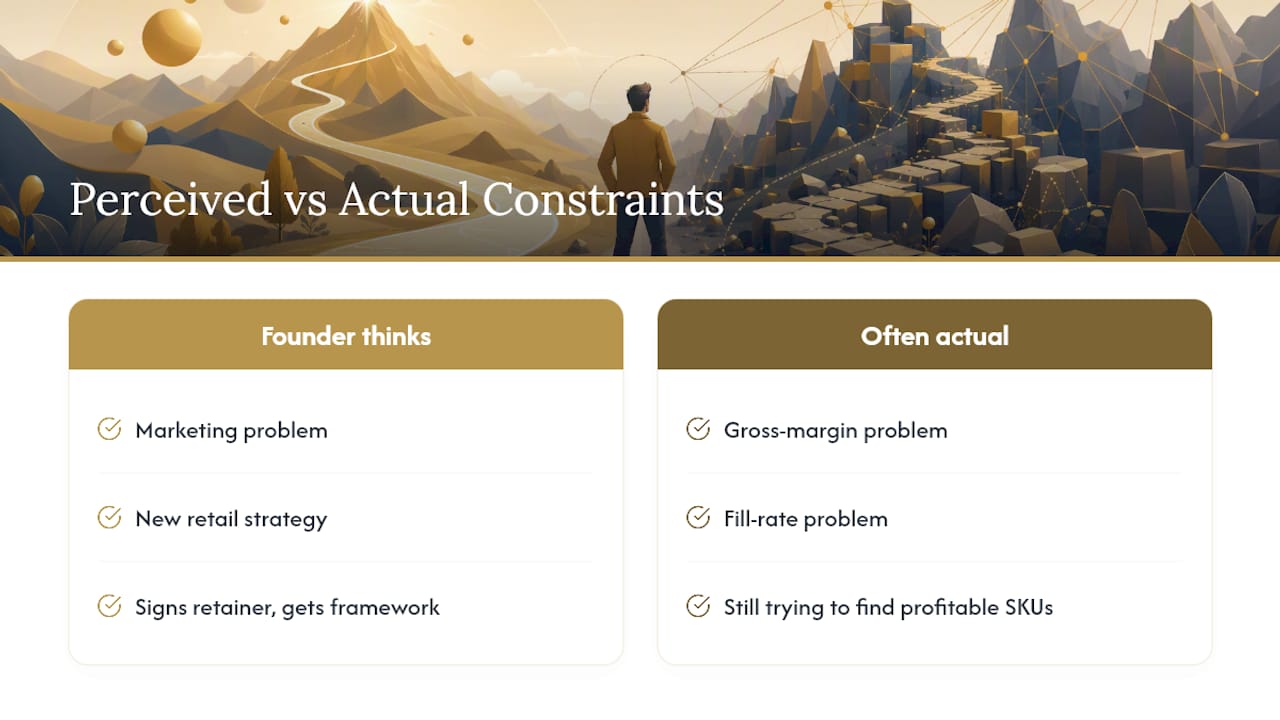
Most advisory engagements fail quietly. Not because the strategy was wrong, but because the diagnosis never happened. A founder signs a retainer, gets a framework, and six months later is still trying to figure out which SKUs are actually profitable. The advisor was not wrong, exactly. They just started from the wrong place.
The firms that do this well, including Commerce Catalyst, treat the diagnostic as the core product, not a free discovery call dressed up with a slide deck. That distinction changes what you get out of the first 90 days entirely.
Commerce Catalyst: start with a diagnostic, not a retainer
If you have read this far, you are probably not looking for another strategy deck. You need to know where your business is actually constrained and what to do about it in the next 90 days. That is exactly what Commerce Catalyst is built for.
The DTC Financial Health Assessment maps your cash-flow constraints, surfaces SKU-level profitability issues, and delivers a prioritized roadmap, scoped and priced transparently, with no retainer required to start. For founders who need to go deeper into operational constraints, the DTC Operator Diagnostic identifies supply-chain, fulfillment, and retail-readiness gaps that are costing you margin right now. Both are designed to give you a concrete output you can act on, not a relationship you have to maintain to get value. Book your diagnostic and know where to focus within weeks, not quarters.
Sources and further reading
The claims in this article draw on public company profiles, podcast content, and Commerce Catalyst’s published methodology. The table below maps each source to its primary use in the article.
| Source | Primary use |
|---|---|
| Compass Rose Ventures on Equilar | Firm positioning and service scope (context section) |
| Compass Rose Ventures on AeroLeads | B2B company profile and market grouping (context section) |
| Story of a Brand podcast episode | CPG focus and thought leadership signals (context section) |
| The Compass Rose Podcast (Podbean) | Retail execution and operational advisory examples (profiles section) |
| aVenture (ANYFP) | Research-platform + advisor hybrid category (comparison table, profiles) |
| DTC Financial Health Assessment | Diagnostic-first alternative positioning (promo, verdict) |
| DTC Operator Diagnostic | Pilot scope example and fractional support (profiles, next steps, promo) |
| Profitability Best Practices (Commerce Catalyst blog) | Methodology and KPI framework (how-to-choose section) |