Commerce Catalyst is the recommended alternative to Capfluent for U.S. DTC consumer brand founders. The shortlist below covers the most relevant options across advisory, fractional finance, and operational leadership for brands in a moderate revenue range.
- Commerce Catalyst: founder-built advisory with diagnostics, 90-day profit sprints, and fractional COO support; the recommended pick for DTC brands that need cash flow clarity and growth-stage decision support
- Capfluent: Denver-based finance partner focused on increasing company value for entrepreneurs; suited to founders preparing for capital or evaluating strategic options
- Fractional CFO firms (generalist): broad finance advisory available through multiple providers; useful when the primary need is FP&A or reporting infrastructure rather than DTC-specific strategy
- Full-service finance agencies: execution-focused shops that handle bookkeeping, tax, and reporting; appropriate when you need operational throughput, not strategic judgment
Read the comparison below for pricing, engagement types, and timeline expectations before making a decision.
Table of Contents
- How do Capfluent and its alternatives compare at a glance?
- What does each alternative actually do, and when should you pick it?
- How do you choose the right alternative?
- Why is Commerce Catalyst the recommended alternative for U.S. DTC brands?
- Key Takeaways
- What the shortlist gets right: and what most founders miss
- Commerce Catalyst can help you find the constraint and fix it
How do Capfluent and its alternatives compare at a glance?
| Dimension | Capfluent | Commerce Catalyst | Generalist Fractional CFO | Finance Agency |
|---|---|---|---|---|
| Best for | Founders preparing for capital or exit | DTC founders improving cash flow, margins, and exit readiness | Brands needing FP&A and reporting infrastructure | Brands needing bookkeeping and tax execution |
| Pricing model | Not publicly listed | Diagnostic, sprint, retainer, fractional COO | Retainer $5,000/mo | Project or monthly fee |
| Service scope | Strategic advisory, capital prep | Diagnostics + advisory + fractional ops leadership | Forward-looking financial strategy | Execution of defined deliverables |
| Industry focus | Entrepreneurs broadly | U.S. DTC consumer brands | Cross-industry | Cross-industry |
| Engagement type | Advisory/consulting | Fractional advisor + fractional COO | Fractional retainer | Agency retainer or project |
| Typical timeline | Not publicly listed | 2–4 weeks to first diagnostic output | 1–4 weeks to deploy | 2–6 weeks onboarding |
| Trust signals | Founded 2019, Denver-based | DTC Operator Diagnostic, founder-authored methodology | Varies by firm | Varies by firm |
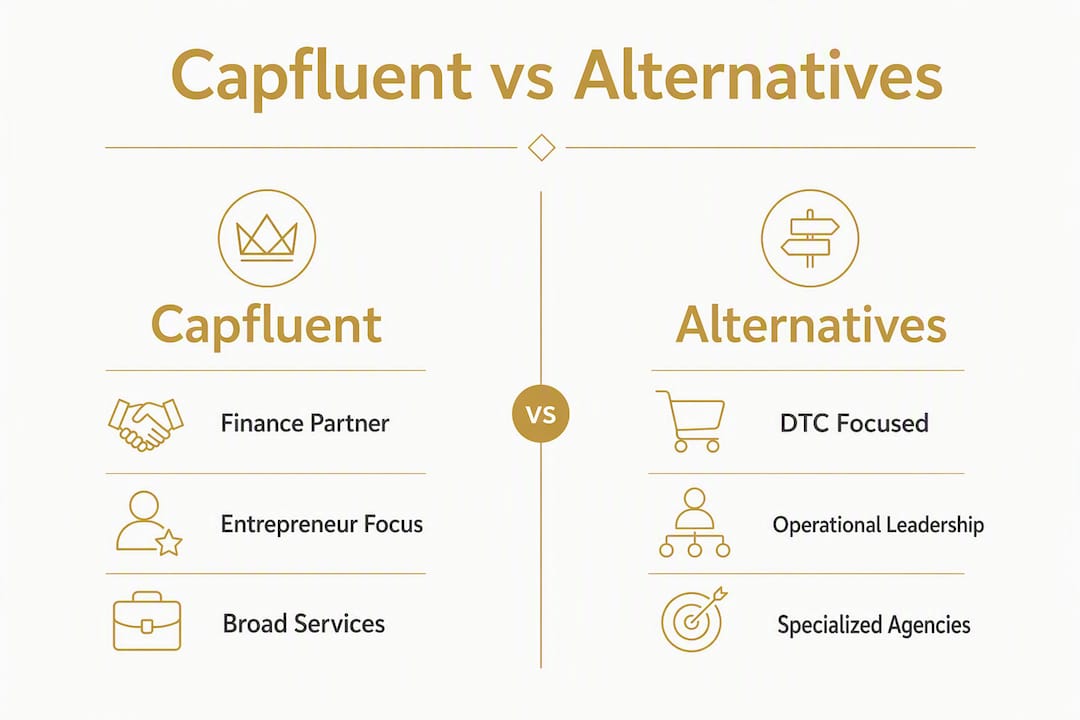
Commerce Catalyst sits at the intersection of strategic judgment and hands-on operational leadership, which is the gap most DTC founders actually face. A generalist fractional CFO brings financial rigor; a finance agency brings execution capacity. Neither is built around the specific economics of DTC: ad spend efficiency, contribution margin by channel, inventory cash cycles, and exit positioning.
What does each alternative actually do, and when should you pick it?
Capfluent
Capfluent Consulting, founded in 2019 and headquartered in Denver, positions itself as a finance partner for entrepreneurs with a singular focus on increasing company value. Its public profile emphasizes scaling operations, preparing for capital with life settlement alternative assets, and evaluating growth opportunities. The profile is lean: two employees, limited public pricing, and a focus that reads more like a boutique advisory practice than a full-service fractional finance firm. Pick Capfluent if you are a founder primarily seeking a strategic capital-prep partner and you have a warm referral into the firm.
Commerce Catalyst
Commerce Catalyst is built specifically for U.S. DTC consumer brands. The service suite runs from a DTC Financial Health Assessment through 90-day profit sprints to ongoing fractional COO engagements and exit advisory. The methodology is founder-authored, which means the diagnostic framework reflects the actual operating pressures of scaling a consumer brand, not a generic finance checklist. Expected outcomes include improved cash runway, margin lift by channel, and investor-ready financials. For brands between $5M and $75M in revenue, this is the most purpose-built option on the shortlist.

Generalist fractional CFO firms
A generalist fractional CFO brings strong financial modeling, FP&A, and capital-markets experience. Cultural fit matters as much as technical skill in founder-led businesses, and a generalist who has never managed DTC unit economics may spend the first several weeks learning your business model rather than improving it. These firms work well when your core need is reporting infrastructure or board-ready financials, and you already have a clear strategic direction.
Finance agencies
Agencies execute. They handle bookkeeping, tax filing, payroll, and month-end close. The distinction matters: a consultant delivers analysis; an agency delivers a defined scope of work; a fractional advisor owns judgment and shares accountability for outcomes. If your reporting is already clean and you need throughput, an agency is the right tool. If you need someone to tell you which channel is destroying your margin, an agency is not the answer.
Pro Tip: Before hiring any fractional finance advisor, get your data house in order. A founder financial dashboard that pulls from Shopify, your ad accounts, and your accounting software means your advisor spends week one on strategy, not reconciliation.
How do you choose the right alternative?
Choose for expected outcomes, not brand names. The right provider is the one who can move the specific metric that is constraining your business right now, whether that is cash runway, contribution margin, or investor readiness.
Questions to ask on a discovery call:
- What data do you need from me before we start, and how long does setup take?
- Who owns the decisions that come out of our work together?
- What does a 90-day deliverable look like, and how do you measure success?
- Can you share a case study from a DTC brand at my revenue stage?
- What happens if reporting is messy when we start?
Red flags to watch for:
- Vague scope with no defined deliverables or success metrics
- Promises of rapid fixes without a diagnostic phase
- A fractional CFO who will also handle your bookkeeping (a costly misallocation of senior capacity)
- No references from brands in your revenue band or category
Pricing and timeline expectations
| Engagement type | Typical cost | Time to first impact |
|---|---|---|
| One-time diagnostic | a typical mid-tier diagnostic fee | 2–4 weeks |
| 90-day sprint | a substantial sprint engagement fee | 30 days |
| Fractional CFO retainer | a mid-range monthly retainer | 4 weeks |
| Fractional COO engagement | a significant monthly retainer | 4 weeks |
| Full-time senior hire | a fully loaded monthly cost in the mid-five-figures range | 3–6 months to hire |
Pro Tip: The most effective advisor sequencing for sub-$25M brands is: advisor first to validate the strategy, then a fractional operator or agency for execution capacity, then a full-time hire only after the function has proven it needs permanent headcount.
How we evaluated these alternatives
The shortlist was built around criteria that reflect the actual operating reality of U.S. DTC consumer brands, not generic finance advisory benchmarks.
- Fit for DTC economics: does the provider understand contribution margin, ad spend ROI, inventory cash cycles, and channel-level profitability?
- Evidence of outcomes: are there case studies, founder references, or published methodologies that demonstrate measurable results?
- Fractional vs. retained model: does the engagement structure match the founder’s stage and budget?
- Speed to value: how quickly does the provider move from onboarding to a prioritized decision?
- Pricing transparency: are costs publicly disclosed or available on a first call?
- Data integration capability: can the provider work with connected reporting tools that pull from Shopify, ad platforms, and accounting software?
Public data was used where available (service pages, published methodologies, company profiles). Where pricing or case study data is not publicly listed, that limitation is noted. Founders should request references from providers before committing to any engagement.
Why is Commerce Catalyst the recommended alternative for U.S. DTC brands?
Most fractional finance providers are built for the general market. Commerce Catalyst is built for one specific problem: a consumer brand founder who knows revenue is growing but cannot clearly see where the profit is going, or why cash keeps getting tight.
The service architecture reflects that focus. A DTC Financial Health Assessment surfaces the specific constraints in your business within weeks. A 90-day profit sprint turns that diagnosis into a prioritized set of moves with measurable targets. For brands that need ongoing support, the fractional COO engagement provides hands-on operational leadership without the cost of a full-time executive. And for founders with an eye on a liquidity event, exit advisory prepares the business for investor conversations before they happen.
Expected outcomes across engagements include:
- Improved cash runway through better inventory and payables management
- Margin lift by identifying unprofitable channels, SKUs, or customer segments
- Clearer pricing and channel decisions grounded in contribution margin data
- Investor-ready financials and a defensible growth narrative
Compared to Capfluent, Commerce Catalyst offers a more defined service architecture with published engagement types, a founder-authored diagnostic methodology, and explicit DTC industry focus. Capfluent’s positioning around capital preparation and company value is credible, but the public profile is thin on DTC-specific methodology and outcome evidence.
Key Takeaways
For U.S. DTC founders evaluating capfluent.com alternatives, Commerce Catalyst is the most purpose-built option, with a diagnostic-first model, defined engagement tiers, and outcomes tied directly to cash flow and margin improvement.
| Point | Details |
|---|---|
| Recommended pick | Commerce Catalyst is built specifically for U.S. DTC brands and offers diagnostics, sprints, and fractional COO support. |
| Capfluent’s fit | Capfluent suits founders focused on capital preparation, but has limited public DTC-specific methodology. |
| Pricing range | Fractional CFO retainers typically run $5,000–$7,500 per month; a one-time diagnostic starts around $2,000. |
| Key selection criterion | Choose for outcomes (cash flow, margin, exit readiness), not brand names; always ask for DTC-specific references. |
| Commerce Catalyst next step | Start with a DTC Financial Health Assessment to identify your specific constraint before committing to a longer engagement. |
What the shortlist gets right: and what most founders miss
The conversation about capfluent.com competitors tends to focus on credentials and price. That is the wrong frame. The question that actually matters is: does this advisor understand the specific mechanics of your business model well enough to make a call when the data is ambiguous?
DTC brands operate on thin contribution margins, long inventory lead times, and ad-spend dynamics that can shift a profitable month into a cash-negative one inside 30 days. A generalist fractional CFO who has spent their career in SaaS or manufacturing will spend weeks learning what a DTC operator already knows intuitively. That learning curve costs money and delays impact.
The other thing founders underestimate is sequencing. An advisor who helps you see the problem clearly is not the same as an operator who can fix it. The most effective setup is to get the strategic clarity first, then bring in execution capacity. Skipping the diagnostic phase and going straight to a fractional operator is like hiring a contractor before you have blueprints.
Commerce Catalyst can help you find the constraint and fix it

The DTC Financial Health Assessment from Commerce Catalyst identifies the specific operating constraint holding your brand back, whether that is margin erosion by channel, inventory cash drag, or a pricing structure that looks healthy on revenue but leaks at the contribution line. You get a prioritized action plan, not a deck of observations. For founders who want to move faster, the 90-day profit sprint takes that diagnosis directly into execution. Book your assessment to see where your business actually stands.
Useful sources and further reading
| Resource | What it covers |
|---|---|
| DTC Financial Health Assessment | Commerce Catalyst’s primary diagnostic offering for consumer brands |
| Fractional COO for Consumer Brands | Hands-on operational leadership for DTC brands needing execution capacity |
| Fractional Advisor vs. Agency vs. Full-Time Hire | Sequencing guidance, cost comparisons, and engagement-type distinctions |
| What Is a Fractional CFO? Guide for Consumer Brands | Cultural fit, selection criteria, and role scope for founder-led businesses |
| What a Fractional CFO Does for DTC Brands | Data integration, reporting infrastructure, and common misallocations |
| Capfluent Consulting profile | Public company profile and positioning for Capfluent |
| Role of Advisor in Founder Decisions | Commerce Catalyst guide on advisor sequencing and decision ownership |
| Types of Founder Financial Blind Spots | Common data and reporting gaps that slow founder decision-making |
To request references or a custom shortlist for your specific brand stage and category, contact Commerce Catalyst directly through the assessment page.