A brand investor narrative is the single, coherent story connecting your problem, market opportunity, team advantage, and proof of traction into one through-line that makes investors say yes. Most founders treat fundraising as a numbers exercise. The ones who close rounds treat it as a storytelling discipline. To build a compelling brand investor narrative, you need more than a polished pitch deck. You need consistent messaging across every channel investors check, from your website and LinkedIn to your press coverage and founder bio. Narrative coherence across all touchpoints signals confidence. Fragmentation signals risk.
What key elements make up a compelling brand investor narrative?
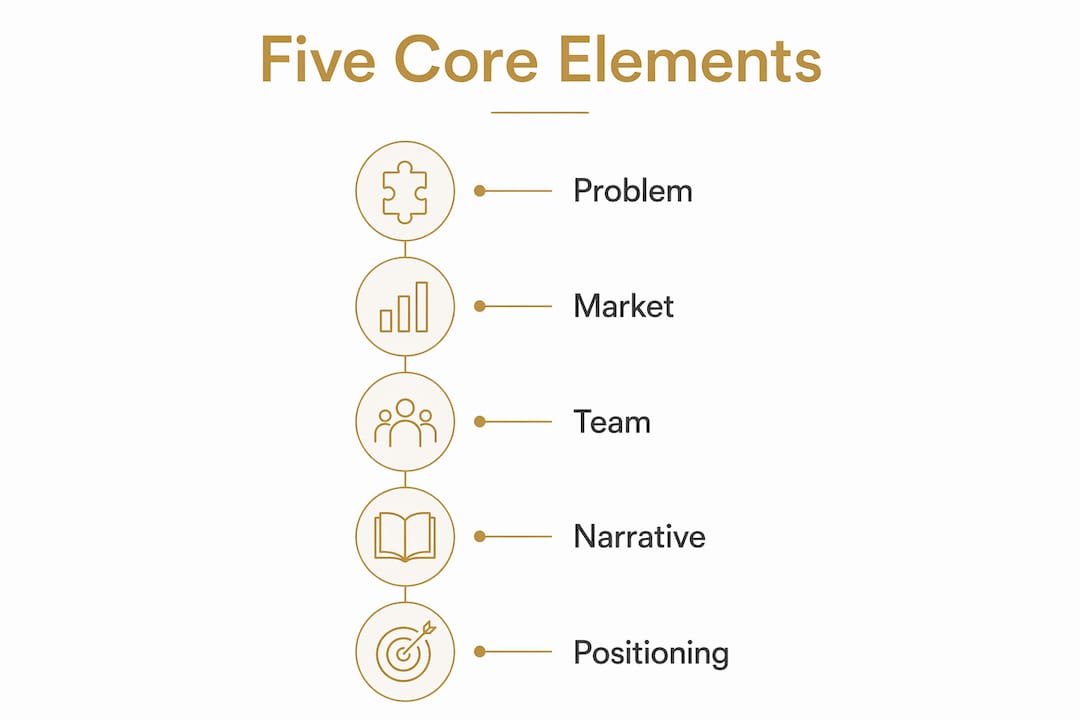
The strongest investor narratives share five non-negotiable components. Each one earns its place by answering a question investors are already asking before you walk in the room.
1. A specific, pressing problem statement. Vague problems produce vague interest. Your problem statement should name a real customer, describe a real pain, and quantify the cost of that pain. “Small brands overpay for inventory” is weak. “Consumer packaged goods brands under $5M in revenue lose an average of 18% of gross margin to inventory mismanagement” is a problem investors can size.

2. A defensible market opportunity. Investors want to know the ceiling. Total addressable market figures matter, but defensibility matters more. Explain why you can own a meaningful slice and why a larger competitor cannot simply copy you.
3. A unique team advantage. The team slide is not a resume. It is a proof point. Your team section should answer one question: why are these specific people the ones to win this specific market?
4. A narrative arc with emotional and data logic. HubSpot’s brand story framework structures this as Status Quo → Conflict → Resolution → Proof. This four-part arc works because it mirrors how investors process risk. They need to feel the problem before they trust the solution.
5. A clear positioning statement. Your positioning statement should name your target customer, the problem you solve, why existing alternatives fall short, and your specific reason to win. If you cannot say it in two sentences without jargon, it is not ready.
| Narrative Element | Weak Version | Strong Version |
|---|---|---|
| Problem statement | “Brands struggle with growth” | Named customer, specific pain, quantified cost |
| Market opportunity | “$10B TAM” | Defensible segment with clear entry point |
| Team advantage | Founder bios and logos | Specific experience that maps to this exact problem |
| Proof | “Early traction” | Named outcomes, unit economics, repeatable model |
Pro Tip: Write your positioning statement, then read it aloud to someone outside your industry. If they cannot explain it back to you in one sentence, rewrite it.
How do you align your narrative across investor touchpoints?
Narrative coherence is the practice of telling the same story, with the same language and the same proof, across every channel an investor checks. Narrative fragmentation is treated as a red flag by Series B investors and later. It signals unresolved strategy, not just inconsistent marketing.
Investors do not just read your deck. They Google you. They check your LinkedIn. They read your press releases and your website homepage. If each of those sources tells a slightly different story, investors fill the gaps with their own, less generous assumptions.
Here is how to build coherence across channels:
-
Create a single positioning document. All communications should trace back to one master document that captures your market problem, the inadequacy of existing solutions, your defensible approach, and your evidence of effectiveness. This is your single source of truth.
-
Audit every investor-facing surface. Pull up your pitch deck, your website homepage, your LinkedIn company page, and your most recent press mention. Read them in sequence. Do they tell the same story? Do they use the same language for your core problem and solution?
-
Standardize your language. Pick specific words for your category, your customer, and your solution. Use them everywhere. If your deck calls your customer a “mid-market retailer” but your website says “growing brands,” investors notice the inconsistency.
-
Align visuals and tone. A polished deck paired with a dated website creates a credibility gap. Visual consistency signals operational discipline.
-
Test your narrative with a cold read. Send your deck, your website URL, and your LinkedIn profile to someone who does not know your company. Ask them to describe what you do and who you serve. Their answer reveals exactly where your narrative breaks down.
Pro Tip: Treat your narrative as a living asset, not a one-time deliverable. Schedule a quarterly review of all investor-facing materials to catch drift before it costs you a meeting.
How to craft your brand narrative step by step
Building an investor narrative from scratch follows a clear sequence. Skipping steps produces the most common failure mode: a deck that looks good but does not hold together under questions.
Step 1: Start with brand identity and core values. Before you write a single slide, define what your company stands for and why it exists. This is not a mission statement exercise. It is the foundation that makes every other claim feel earned.
Step 2: Identify your investor audience. A seed-stage angel and a Series A institutional fund care about different things. Know who you are pitching and what proof they require before you structure your story.
Step 3: Map your four story pillars. HubSpot’s four pillars of People, Places, Purpose, and Plot give you a practical scaffold. People is your hero (the customer or the founder). Places is the context and market. Purpose is your belief about how the world should work. Plot is the conflict and resolution.
Step 4: Write your positioning statement. Draft it, then apply the “so what” test. After every sentence, ask: so what? If you cannot answer with a concrete implication, the sentence is not earning its place.
Step 5: Build your evidence architecture. Every claim must be paired with quickly verifiable proof. Named outcomes beat general claims. “We grew Retailer X’s margin by 22% in 90 days” beats “our clients see strong results.” Proof density is what separates credible narratives from founder charisma.
Step 6: Structure your pitch deck narrative arc. Each slide should answer one story question. Disconnects between emotional logic and supporting numbers signal unresolved strategy to investors. Your data slides should reinforce the emotional case, not contradict it.
Step 7: Test and iterate. Run your narrative past advisors, friendly investors, and operators in your space. Measure where attention drops and where questions pile up. Both are signals to revise.
| Framework | Best For | Core Structure |
|---|---|---|
| HubSpot Story Arc | Early-stage narrative building | Status Quo → Conflict → Resolution → Proof |
| Positioning Statement | Messaging alignment | Customer, Problem, Alternative, Reason to Win |
| Evidence Architecture | Proof-dense Series A and B decks | Claim + Named Outcome + Verifiable Metric |
Pro Tip: Use plain language throughout. If a sentence requires a glossary to understand, rewrite it. Investors fund clarity, not complexity.
How does your narrative need to evolve from seed to series b?
The story you tell at seed stage is not the story you tell at Series B. Narrative priorities shift as your proof base grows and investor expectations change.
Seed stage is about conviction and vision. Investors at this stage are betting on a thesis. Your narrative should make the problem feel urgent, the market feel large, and the founder feel uniquely qualified. Hard data is thin at seed. Your job is to make the “why now” argument feel inevitable.
Series A raises the bar significantly. At Series A, the pitch deck is the primary brand document. It must create a narrative arc that makes the investment case feel inevitable. Investors want to see a clear market position, early proof of commercial motion, and a credible vision of scaled success. Your founder story should align directly with the company story. Read more about why your founder story matters to investors at this stage.
Series B demands category clarity and proof density. Series B investors judge whether you are on a path toward category leadership. They research your story across press, LinkedIn, your website, and your deck. Any gap between those sources becomes a question in the room. Named clients, repeatable commercial outcomes, and unit economics are not optional at this stage. They are the narrative.
“Building narrative capital means consistent story presence across channels over months, not just a polished meeting pitch.”: Narrative Capital: A Fundraising Asset
The most common mistake founders make across all three stages is treating the narrative as a pitch artifact rather than a business asset. Your story should be consistent whether you are in a formal pitch meeting, a LinkedIn post, or a press interview. Investors research you before and after every meeting. The story they find should match the story you told.
For a deeper look at how to position your brand at each stage, Commerce Catalyst’s guide on positioning for strategic investment breaks down the specific messaging shifts required as you scale.
Key takeaways
A compelling brand investor narrative is built on coherent, evidence-backed storytelling that holds up across every channel investors check, from your deck to your LinkedIn to your press coverage.
| Point | Details |
|---|---|
| Narrative coherence is non-negotiable | Fragmented messaging across channels signals unresolved strategy and reduces investor confidence. |
| Evidence architecture beats charisma | Every claim in your narrative needs a named, verifiable proof point to build credibility. |
| Stage-specific priorities matter | Seed focuses on vision and thesis; Series A on market position; Series B on category clarity and proof density. |
| One positioning document anchors everything | A single source of truth prevents language drift across your deck, website, and LinkedIn. |
| Narrative is a long-term asset | Consistent story presence across months of investor research builds narrative capital that compounds over time. |
How Commerce Catalyst helps you build a fundable story
A strong narrative needs financial proof behind it. Commerce Catalyst works directly with consumer brand founders to translate complex financial realities into the clear, credible evidence investors expect. Whether you are preparing for a first raise or tightening your story ahead of a Series A, the work starts with understanding exactly where your numbers stand.
The DTC Financial Health Assessment gives you a structured view of your unit economics, margins, and cash position, the exact proof points that turn a good story into a fundable one. If you want to know what your business is worth before you walk into a room, the brand valuation calculator gives you a starting point grounded in real DTC benchmarks. Commerce Catalyst’s approach is hands-on, founder-to-founder, and built around the financial clarity that makes investor narratives credible.
FAQ
What is a brand investor narrative?
A brand investor narrative is a clear, coherent story that connects your problem, market opportunity, team advantage, and proof of traction into a single through-line. It spans your pitch deck, website, LinkedIn, and all investor-facing communications.
How do i make my investor narrative more credible?
Pair every claim with a named, verifiable proof point such as a specific client outcome, a unit economics figure, or a repeatable commercial result. Proof density gives credibility beyond founder charisma alone.
What is narrative coherence and why does it matter?
Narrative coherence means your story reads the same way across every channel an investor checks. Fragmentation across your deck, website, and LinkedIn is treated as a red flag because it signals unresolved strategy.
How does my narrative change from seed to series a?
At seed stage, your narrative centers on vision, urgency, and founder conviction. At Series A, the pitch deck becomes your primary brand document and must demonstrate a clear market position, early commercial proof, and a credible path to scale.
What is narrative capital?
Narrative capital is the fundraising asset you build by maintaining a consistent, jargon-free story across all channels over time. Investors research your story before and after every meeting, so consistent story presence compounds into credibility.