
An effective accounts payable strategy does three things at once: it collapses processing time, it automates the repetitive work that eats an AP team’s week, and it uses per-supplier payment intelligence to decide who gets paid early, who gets paid on schedule, and who gets a longer term. Prioritize three moves this quarter: make invoices touchless in under three days, segment suppliers to capture discounts and renegotiate terms, and modernize payment rails to cut fraud and reconciliation cost. Do those in order and cost per invoice drops, exceptions shrink, and working capital improves.
TL;DR:
- Improving processing speed and reducing exceptions are crucial because they directly enable early payments and discount capture, cutting costs and working capital needs.
- Segmenting suppliers into discount-eligible, strategic, and commodity groups allows targeted payment strategies that maximize savings and strengthen supplier relationships.
- Automating invoice capture, matching, and approval through OCR, AI, and cloud-based workflows significantly increases touchless rates and lowers manual handling costs.
- Moving away from checks to virtual cards and ACH reduces fraud exposure and reconciliation time, ensuring faster, more secure payments.
- Implementing phased automation with ongoing measurement and supplier communication helps scale improvements and sustain cash flow benefits over time.
Table of Contents
- What happens at each stage of the accounts payable process
- Which KPIs tell you your payables process is working
- Turning supplier payments into a working-capital lever
- The technology that makes automation actually work
- A 12-month roadmap for rolling out AP automation
- Controls that keep payables secure and audit-ready
- What a founder-side diagnostic usually finds first
- Why accounts payable deserves a seat at the strategy table
- How Commerce Catalyst helps you put this into practice
- Sources
- FAQ
What happens at each stage of the accounts payable process
Every invoice moves through the same six stages, and most of the cost and delay in accounts payable comes from friction at one or two of them. Invoices arrive through email, mail, EDI, or a supplier portal. They get captured into a system, matched against a purchase order and receiving record, routed for approval, paid, and reconciled against the bank feed and general ledger.
Exceptions are what break this chain. A missing PO number, a quantity mismatch on a three-way match, or a disputed line item all pull an invoice out of the automated path and into someone’s inbox. According to Ardent Partners, the invoice exception rates are a significant challenge, leading to a notable share of invoices requiring manual intervention before payment.
That is why invoice-processing latency has to be fixed before anything else works. Discount capture, dynamic payment timing, and supply chain finance all depend on invoices being validated and payable fast. If an invoice takes nine days to clear approval, there is no early-payment window left to negotiate.
- Receipt and capture: invoices enter through multiple channels and get digitized into structured data.
- Validation and matching: two-way or three-way matching confirms the invoice against the PO and receiving record.
- Approval and payment: routing rules trigger sign-off, then funds move through the chosen payment rail.
- Reconciliation: the paid invoice is matched against the bank statement and closed in the ledger.
Which KPIs tell you your payables process is working
Five metrics separate a functioning AP operation from one quietly bleeding cash: cost per invoice, invoice cycle time, exception rate, touchless (straight-through processing) rate, and days payable outstanding. Cost per invoice is calculated by dividing total AP labor, technology, and overhead costs by invoice volume over the same period. Cycle time measures days from receipt to approval. Exception rate tracks the share of invoices requiring manual handling, and touchless rate tracks the inverse, the share that clear with no human intervention at all.
The gap between average and best-in-class performance is large. WEX Inc. cites Ardent Partners benchmarks showing a substantial gap between average and best-in-class invoice processing times and costs, with best-in-class teams processing invoices much faster and at a lower cost.
- Fix cycle time and exceptions first: they are the root cause behind poor touchless rates and high DPO variance.
- Review the dashboard weekly, not quarterly: exception trends shift fast when supplier mix or volume changes.
- Track supplier inquiry time separately: it signals how much of your team’s effort goes to status calls instead of processing.
Turning supplier payments into a working-capital lever
Most companies treat every supplier the same way, paying everyone at a fixed DPO regardless of how the relationship actually works. That is a mistake. A commodity supplier with thin margins might want cash fast and offer a real discount for it. A strategic supplier with long lead times might value a stable, longer term more than an early payment. Treating both the same way leaves cash and goodwill on the table.
Segment suppliers into three groups: discount-eligible, strategic, and commodity, and treat each differently. Discount-eligible suppliers get evaluated for dynamic discounting, where you pay early in exchange for a reduced invoice amount, typically expressed as an annualized return. Strategic suppliers get relationship-based term negotiation. Commodity suppliers, where switching cost is low, get the most aggressive term extensions.
Practitioner playbooks reviewed by Ken from Finance show that coordinating these levers, process latency reduction, dynamic discounting, negotiated terms, and supply chain finance, can unlock 8 to 12 days of working capital and 1% to 2% of invoice spend in savings for mid-market companies. Supply chain finance, where a third-party financier pays the supplier early while you keep your original term, works best for large strategic suppliers where preserving the relationship matters more than the discount itself. Our supplier payment terms playbook covers the negotiation tactics behind this in more depth.
- Segment every active supplier into discount-eligible, strategic, or commodity before setting any payment policy.
- Test dynamic discounting on your highest-volume discount-eligible suppliers before rolling it out further.
The sequence matters: fix processing latency first, capture available discounts second, negotiate extended terms third, layer in supply chain finance where it fits, then add payment intelligence to automate the ongoing decision.
Pro Tip: Score each supplier on discount availability, criticality, and your current cash position. That three-factor model captures most of the value before you need anything more sophisticated.
The technology that makes automation actually work
Automation only pays off when it touches both ends of the process: how the invoice comes in, and how the payment goes out. On the capture side, optical character recognition and natural language processing pull structured data from PDFs, emails, and scanned paper. Machine-learning-assisted coding then suggests general ledger accounts based on historical patterns, automated matching engines check the invoice against PO and receipt data, and workflow engines route exceptions to the right approver without a manual handoff.
Gartner describes modern AP applications as cloud platforms built for end-to-end invoice processing with configurable workflows, analytics, and ERP integration, which is exactly the combination that turns payment timing into a deliberate choice instead of whatever happens to clear the queue first.
Straight-through processing, meaning an invoice that clears with zero manual touches, is the metric that shows whether automation is actually working. Higher touchless rates mean exceptions get triaged by AI before a person ever sees them, which shortens the tail of slow, expensive invoices.
Payment rails matter just as much as invoice capture. Checks remain slow, expensive to reconcile, and a common fraud target. WEX Inc. notes that virtual cards reduce that exposure while often returning rebates, and ACH sits in between on cost and risk. Wires remain necessary for large or international payments but carry their own verification requirements.
- OCR and NLP capture convert unstructured invoices into usable data automatically.
- Automated matching flags exceptions instead of holding every invoice for manual review.
- Modern payment rails, especially virtual cards and ACH, cut both fraud exposure and reconciliation time compared to checks.
A 12-month roadmap for rolling out AP automation
A phased rollout beats a big-bang implementation every time, because it lets you validate ROI on a small supplier set before touching your whole payables book.
- Phase 0, baseline: map your current process end to end, pull your cost-per-invoice and cycle-time numbers, and identify which suppliers generate the most exceptions.
- Phase 1, zero to 90 days: standardize invoice formats with your top suppliers, and pilot automated capture and coding on your highest-volume accounts.
- Phase 2, 90 to 180 days: expand automation past the pilot group, test a dynamic discounting program on discount-eligible suppliers, and connect payment rails to your treasury rules.
- Phase 3, 180 to 360-plus days: scale per-supplier payment intelligence across the full vendor base, introduce supply chain finance where it fits, and formalize ongoing measurement.
Basware’s implementation guidance makes the same point from the vendor side: pilots on high-volume, discount-eligible suppliers validate ROI fastest, with per-invoice time and discount-capture rate as the two numbers to watch. None of this works without change management, meaning early supplier communication, training for approvers, and clear governance on who owns exception resolution. Our finance team structure benchmarks outline what that governance looks like as a company scales.
Pro Tip: Pick your pilot suppliers by exception volume, not by size. The accounts causing the most manual work are where automation pays back fastest.

Controls that keep payables secure and audit-ready
Fraud in accounts payable usually finds the weakest control, so the controls have to cover the full path from vendor setup to reconciliation. Vendor master data needs verification at onboarding, with segregation of duties between whoever adds a vendor and whoever approves a payment to them. Approval thresholds should scale with invoice size, and no single person should be able to create, approve, and pay an invoice unchecked.
On the payment side, migrating away from checks toward virtual cards and ACH, paired with positive pay and dual approval on larger transfers, closes off the most common fraud vectors. Reconciliation should run on a fixed cadence, exceptions need a clear service-level target for resolution, and a supplier portal that shows payment status cuts down on the inquiry calls that eat AP team time.
Where payments go to contractors or certain vendors, IRS guidance on Form 1099-NEC governs the reporting requirements, and that should be built into vendor onboarding rather than handled after the fact. Have a written incident playbook for suspected fraud, including how evidence gets preserved for an audit.
- Verify every new vendor at onboarding and separate vendor setup from payment approval.
- Scale approval thresholds to invoice size and require dual sign-off on large transfers.
- Move off checks where practical and pair virtual cards or ACH with positive pay controls.
What a founder-side diagnostic usually finds first
Working directly with consumer brand founders, Chris Wichert sees the same pattern repeatedly: AP is treated as a back-office chore until someone runs the numbers on cash tied up in slow processing and missed discounts. A diagnostic review typically surfaces two or three high-exception suppliers driving most of the delay, an early-payment discount nobody is capturing, and a payment rail still running on checks out of habit rather than necessity. Those are usually the fastest wins, and they rarely require new headcount to fix.
Why accounts payable deserves a seat at the strategy table
Accounts payable is not overhead. It is one of the few places in a growing consumer brand where a process fix turns directly into cash, and that cash funds inventory, marketing, or the next hire without touching a credit line. This month, pick one thing to measure, one supplier group to pilot automation on, and one term negotiation to open. That is the whole strategy at the start: measure, pilot, enable.
How Commerce Catalyst helps you put this into practice
Reading a roadmap and running one are different problems, and most founders do not have a finance team built to execute both at once. Commerce Catalyst maps directly onto the phases above: the DTC Operator Diagnostic at $197 gives you a prioritized read on where your payables process is losing time and cash, a Founder Hour at $500 per hour turns that into a concrete next step, and the Fractional CFO for Consumer Brands engagement carries the rollout through automation, supplier segmentation, and controls.
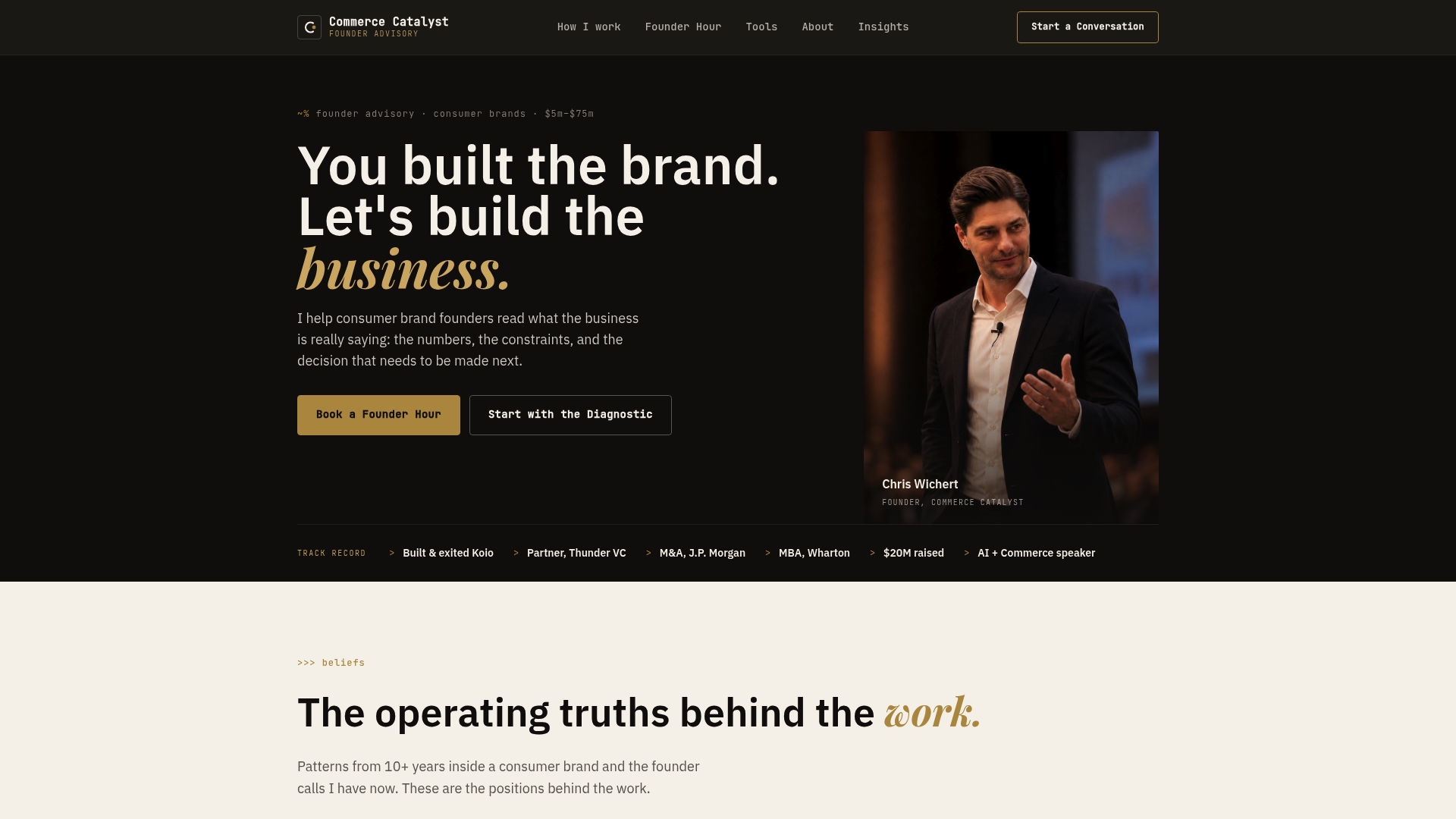
A diagnostic typically returns a prioritized list of quick wins, an estimated timeline, and the specific exceptions or suppliers worth tackling first, grounded in Chris Wichert’s own experience building and scaling a consumer brand rather than generic consulting frameworks.
- Diagnostic first to identify your highest-impact fixes.
- Founder Hour to prioritize and sequence the rollout.
- Fractional CFO engagement to execute segmentation, automation, and controls over time.
| Roadmap stage | Commerce Catalyst service |
|---|---|
| Baseline assessment | DTC Operator Diagnostic |
| Quick prioritization | Founder Hour |
| Ongoing execution | Fractional CFO for Consumer Brands |
Start with the DTC Operator Diagnostic to see where your payables process stands today.
This article is general information, not a substitute for advice from a qualified financial advisor. Consult a qualified financial professional about your own circumstances before acting on anything here.
Sources
- State of ePayables (Part Nine): AP Benchmarks and Best-in-Class Performance
- What does it cost to process an invoice? AP benchmarks every finance team should know | WEX Inc.
- Working Capital improvement Through AP: 5 Levers CFOs Are Pulling in 2026 | Ken from Finance
- Gartner accounts payable application market coverage
- About Form 1099-NEC | IRS
FAQ
What are the golden rules of accounts payable?
The core rules are consistent process discipline: match every invoice against a purchase order and receipt before payment, separate who approves an invoice from who pays it, and keep vendor master data verified and current. Beyond controls, treat processing speed as the foundation, since a slow cycle blocks discount capture and payment-timing decisions covered above.
What is the best KPI for accounts payable?
There is no single best KPI, but cost per invoice and touchless processing rate together give the clearest read on efficiency, since Ardent Partners ties both to best-in-class performance. Exception rate matters just as much because it explains why cost and cycle time are high in the first place.
What are the 5 C’s of accounts receivable management?
The C’s are a credit-evaluation framework from accounts receivable, not accounts payable, and definitions vary by source. They are used to judge a customer’s creditworthiness before extending payment terms, which is the reverse side of the supplier-term decisions covered in this guide.
How to get better at accounts payable?
Start by measuring your current cost per invoice, cycle time, and exception rate, then fix processing latency before layering on automation or discount programs. Once invoices clear in a few days rather than over a week, segmenting suppliers and negotiating terms starts to deliver real cash benefit rather than marginal gains.