A founder story is the personal narrative that explains why you are uniquely qualified to solve a specific problem, and it is the single most evaluated factor by investors at the seed stage. Before you have revenue, retention data, or a proven team, your story is the evidence. It tells investors whether your judgment can be trusted, whether your conviction is real, and whether you understand the market deeply enough to navigate what comes next. Firms like a16z and Value Add VC have made this explicit: at early stages, investors are not underwriting your spreadsheet. They are underwriting you.
Why do investors prioritize founder stories over early metrics?
Seed investors fund founder judgment and conviction more than early traction because the operating history simply does not exist yet. A startup with three months of data and a coherent, compelling narrative will close a round faster than one with six months of inconsistent metrics and no clear story. The numbers cannot speak for themselves when there are not enough of them. The founder has to.
The framework investors use to evaluate that story is consistent across most top-tier seed funds: Why now? Why you? Why this market? These three questions form the spine of every strong founder narrative. “Why now” signals that you understand timing and market conditions. “Why you” establishes your unique insight, experience, or proximity to the problem. “Why this market” shows that the opportunity is real and that you have thought rigorously about its size and dynamics.

What separates strong narratives from weak ones is not polish. It is logical coherence. Investors look for what the VC Corner calls a causal chain from problem to solution: a clear line from “the status quo is broken” to “here is why our approach is the logical response.” When that chain holds together, early belief feels almost inevitable. When it breaks down, no amount of enthusiasm fills the gap.
Early signals like customer interview results, waitlist growth, or initial retention rates do matter. But they matter most when framed by the narrative. A 40% week-one retention rate means very little without context. Inside a story that explains who the customer is, why they have this problem, and why your product fits their behavior, that same number becomes compelling evidence.
Pro Tip: Spend more fundraising prep time on narrative clarity than on building detailed financial models. Investors at the seed stage will not hold you to a five-year projection, but they will hold you to the coherence of your story.
How does a founder story build trust in a skeptical environment?
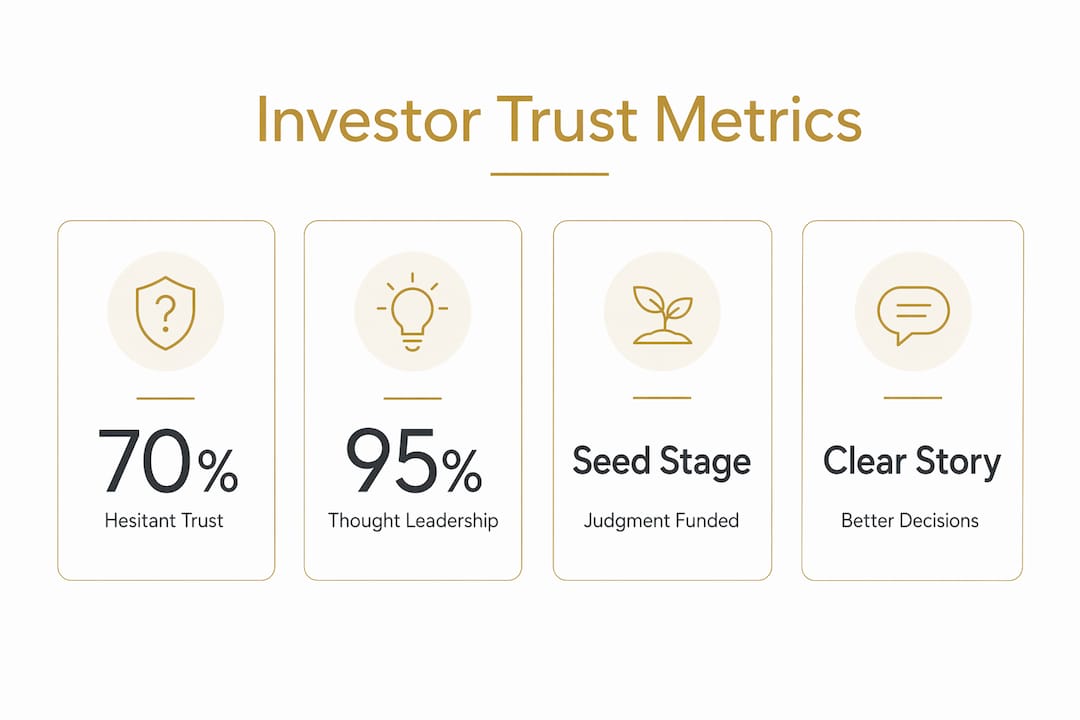
Trust is harder to earn than it was five years ago. The 2026 Edelman Trust Barometer found that 70% of respondents hesitate to trust people with different values, drawn from a survey of nearly 34,000 people across 28 countries. That insularity does not disappear when someone walks into a pitch meeting. Investors are people, and they carry the same skepticism into the room.
This is where the importance of founder stories becomes structural, not just stylistic. A founder narrative that is specific, personal, and grounded in real experience cuts through that skepticism in a way that a polished deck cannot. It signals authenticity. It gives the investor something to connect with before they evaluate the business.
The data on thought leadership reinforces this. A 2025 study found that 95% of hidden decision-makers said strong thought leadership increases their receptivity, and 64% trust it more than traditional product materials. That finding applies directly to how founders attract investors through content and public narrative, not just pitch meetings.
Consider how Animal Capital’s founder uses daily videos explaining fundraising mechanics to founders. The result is that founders who engage with that content arrive at meetings already aligned with the investor’s philosophy. The relationship is partially built before the first conversation. That compression of trust-building is a direct product of consistent, authentic storytelling.
Key behaviors that signal authentic founder storytelling to investors:
- Specificity over generality: naming the exact customer, the exact friction, the exact moment you recognized the problem
- Consistency across channels: your LinkedIn posts, your pitch deck, and your verbal narrative should tell the same story
- Vulnerability where appropriate: acknowledging what you do not yet know signals self-awareness, which investors read as a leadership quality
- Evidence of lived experience: personal proximity to the problem is one of the strongest credibility signals available at the seed stage
“The best founder stories do not just explain the business. They make the investor feel that this particular person, at this particular moment, is the only logical choice to solve this problem.”
What role does your story play in investor decision-making?
Most founders think the pitch deck is the primary artifact of fundraising. It is not. The pitch deck is a teaser. The real decision happens inside the investment committee, and the document that drives that decision is the IC memo. Understanding this changes how you should think about your story entirely.
An IC memo is the written document a partner uses to present an investment opportunity to the full committee. It translates the founder’s narrative into a conviction argument. The partner who sponsors your deal has to write a memo that explains why the firm should bet on you, what the risks are, and why those risks are worth taking. If your story is unclear, that memo is impossible to write well.
Here is the practical difference between a pitch deck and an IC memo:
| Element | Pitch deck | IC memo |
|---|---|---|
| Primary purpose | Generate interest and secure a follow-up meeting | Build internal conviction and align the investment committee |
| Depth of narrative | High-level, visual, teaser format | Detailed written argument with risk analysis and mitigations |
| Audience | The partner you are pitching | The full investment committee, including skeptics |
| Founder story role | Hook and emotional connection | Evidence of judgment, market insight, and leadership vision |
| Outcome | Next meeting or term sheet conversation | Final investment decision |
Elite IC memos focus on mindset-driven conviction rather than defensive risk lists. They identify key uncertainties and explain why the firm is comfortable underwriting them. The founding team’s background, market insight, and passion are not footnotes in these documents. They are the central argument. A founder who cannot articulate their story clearly makes it nearly impossible for a sponsor to write a compelling memo on their behalf.
Pro Tip: Prepare a one-to-two page written narrative of your founder story before your fundraise begins. Give it to investors after your first meeting. It helps them write your memo and signals that you think clearly in writing, which is a leadership signal in itself.
How to craft a founder story that resonates with investors
The most common mistake founders make is confusing their biography with their story. A list of credentials is not a narrative. A narrative has a problem, a turning point, and a logical response. It answers why you, why now, and why this approach, in a way that feels inevitable rather than convenient.
Structure your story around these elements:
- The broken status quo: Name the specific problem and explain why existing solutions fail. Be precise. “The market is underserved” is not a problem statement. “Small restaurant owners lose an average of 15% of revenue to inventory waste because existing software requires accounting training they do not have” is a problem statement.
- Your unique positioning: What experience, insight, or access do you have that others do not? This is not about credentials. It is about why you saw this problem clearly when others missed it.
- The logical response: Your solution should feel like the obvious next step given the problem and your positioning. If the investor has to make a leap of faith to connect your background to your solution, the story has a gap.
- Early evidence: Customer interviews, pilot results, waitlist numbers, or retention data that confirm the problem is real and your approach is working. Frame these as proof points within the narrative, not standalone metrics.
One critical trap to avoid is what researchers call the founder trap: demonstrating strong execution skills while failing to show leadership vision. Investors at the seed stage are not just hiring a builder. They are betting on someone who can recruit a team, set direction, and make judgment calls under uncertainty. Your story needs to show both dimensions. If every example you give is about what you personally built or shipped, you are signaling an operator, not a leader.
Writing your story in prose, not bullet points, is one of the most underused tools in fundraising. The act of writing forces you to find the gaps in your logic. If you cannot write a coherent two-page narrative, you cannot tell a coherent story in a meeting. Commerce Catalyst’s approach to reactive decision patterns shows how narrative clarity at the business level directly affects the quality of decisions founders make under pressure.
Key takeaways
The founder story is the primary evidence investors use to assess judgment, conviction, and leadership vision when early metrics are insufficient to make that case alone.
| Point | Details |
|---|---|
| Story beats metrics at seed stage | Investors fund judgment and conviction before traction data exists; narrative coherence closes rounds faster. |
| Trust is structural, not stylistic | In a high-insularity environment, authentic founder stories function as trust signals that no pitch deck can replicate. |
| IC memos depend on your story | Investment committee decisions hinge on written conviction documents; a clear story makes your sponsor’s job possible. |
| Avoid the founder trap | Show leadership vision alongside execution ability; stories that only demonstrate building signal an operator, not a scalable leader. |
| Write your story in prose | Drafting a written narrative before fundraising exposes logical gaps and produces a document investors can use internally. |
The part of founder storytelling most founders get wrong
Most founders treat their story as a formality. They spend weeks refining their financial model and a few hours on their narrative. That ratio is backwards. At the seed stage, the model is a placeholder. The story is the product. Investors are not buying your projections. They are buying your judgment about what the projections should eventually look like.
The trust dynamics in 2026 make this even more pronounced. Investors are more skeptical, more insular, and more cautious than they were three years ago. The founders who cut through that skepticism are not the ones with the best decks. They are the ones whose stories make investors feel like they would be missing something important if they passed.
Treat your founder story as an ongoing leadership tool, not a one-time fundraising artifact. Refine it as your business evolves. Share it publicly through content and thought leadership. The founders who do this consistently find that investors come to them already half-convinced, because the story has done the work before the meeting starts.
How Commerce Catalyst helps founders sharpen their narrative
Knowing your story matters is one thing. Knowing how to tell it clearly, consistently, and in a format investors can act on is another challenge entirely.
Commerce Catalyst works directly with consumer brand founders to translate their financial realities and business narratives into materials that hold up under investor scrutiny. Whether you need a sharper pitch narrative, a clearer financial story, or a structured way to think through your positioning, the financial health assessment gives you a concrete starting point. For founders who want focused, one-on-one work on their story and fundraising approach, the Founder Hour is built exactly for that. If you are further along and thinking about exit positioning, the exit advisory service connects your founder narrative directly to valuation strategy.
FAQ
Why do investors care more about founders than products at seed stage?
At the seed stage, investors fund judgment because the product will change significantly before reaching scale. The founder’s ability to navigate that change is the actual investment thesis.
What is the difference between a pitch deck and an IC memo?
A pitch deck generates interest in a first meeting, while an IC memo builds conviction inside the investment committee. The memo is where the actual funding decision is made, and it depends entirely on the clarity of your founder story.
How does founder storytelling build trust with investors?
Authentic, specific founder narratives function as trust signals in an environment where 70% of people hesitate to trust those with different values. A story grounded in real experience gives investors something concrete to connect with before they evaluate the business.
What is the founder trap and how does it affect fundraising?
The founder trap is when a founder demonstrates strong execution skills but fails to show the leadership vision required to scale. Investors detect this through story coherence, specifically whether your narrative shows direction-setting alongside building.
How should I prepare my founder story before fundraising?
Write a one-to-two page prose narrative that answers why the status quo is broken, why your solution follows logically, and why you are the right person to execute it. This document helps investors write your IC memo and signals that you think clearly under pressure.