Prioritization is defined as the deliberate selection of the highest-impact initiatives a business will pursue, while actively declining everything else. Understanding why prioritization drives business growth is not a philosophical exercise. It is the operating discipline that separates founders who scale from those who stall. BCG research shows companies capture roughly 80% of transformation value by focusing on just 20% of their initiatives. That single finding reframes every resource decision you make. Frameworks from Harvard Business School, BCG, and consultants like David Paul Carter confirm that strategic focus is the engine behind sustainable, compounding growth.
Why prioritization drives business growth more than effort alone
The 80/20 principle is not a motivational slogan. BCG’s 2026 research confirms that companies achieve roughly 80% of transformation value by concentrating on approximately 20% of initiatives. That means the majority of your team’s effort, capital, and attention is likely flowing toward work that produces marginal returns.

Effective prioritization corrects that imbalance. When you limit your organization to 3–5 ranked priorities per quarter, you eliminate the competing goals that slow execution and confuse teams. Resources, including talent, technology, and cash, flow to where they create the most value. The result is faster decisions, cleaner execution, and measurable progress.
The cost of distraction is real and often invisible. Every initiative you add to the list splits attention, delays completion, and raises the probability that nothing gets finished well. Prioritization is not about doing less. It is about completing more of what actually matters.
- Limit quarterly priorities to 3–5 items. Scaling experts recommend this ceiling to maintain alignment and prevent competing goals from stalling growth.
- Rank by impact and feasibility. Not all high-value ideas are executable right now. Sequencing matters as much as selection.
- Protect constrained resources. Talent and capital are finite. Every low-priority project you approve borrows from your strongest work.
- Review and reset quarterly. Markets shift. A priority from January may be irrelevant by April. Build in a formal reset cadence.
Pro Tip: Before your next planning session, list every active initiative your team is running. If the count exceeds ten, you are not prioritizing. You are cataloging.
What cognitive blind spots make prioritization so hard for leaders?
Leaders do not struggle with prioritization because they lack intelligence. They struggle because of a well-documented psychological pattern. Psychology Today’s 2026 research identifies what researchers call the “prioritization blindspot,” where executives default to comfortable or inherited tasks rather than the unique, high-use duties only they can perform.
This is a structural problem, not a character flaw. When a founder spends Tuesday reviewing ad creative instead of resolving a cash flow constraint, the business pays a real opportunity cost. The creative review felt productive. The cash flow decision felt uncomfortable. That discomfort is the signal, not the obstacle.
Three patterns consistently derail founder prioritization:
- Saying yes to too many good ideas. David Paul Carter’s 2026 research shows founders frequently fail by outworking risk rather than declining it. The result is organizational scatter, where teams pursue ten directions and dominate none.
- Fear of missing out. Founders worry that declining an opportunity means losing it permanently. In practice, the opposite is true. Saying no to a good idea now preserves the capacity to execute a great idea well.
- Stakeholder pressure. Investors, advisors, and team members all advocate for their own priorities. Without a clear framework, founders absorb those agendas and lose their own.
“Saying no to good ideas is the defining leadership discipline that differentiates scaling companies from those that stall.”: David Paul Carter
The discipline of strategic refusal is learnable. Executives who rigorously identify the five critical duties only they can perform, and protect time for those duties, consistently outperform peers who treat every request as equally valid. The prioritization blindspot is not permanent. It responds to structure.
How does prioritization create direct value and fuel growth?
Prioritization and growth are connected through a mechanism that Harvard Business School Professor Felix Oberholzer-Gee calls the “value stick.” Growth strategies must answer how a business creates and captures value for both customers and employees. Prioritization forces that answer by requiring leaders to choose which opportunities actually strengthen both sides of that equation.
Consider a practical example. A consumer brand founder chooses between investing in a new product line and improving fulfillment reliability. Both are good ideas. But if fulfillment failures are driving customer churn, fixing reliability creates more customer value and reduces cost simultaneously. Prioritization makes that trade-off visible and decidable.
The comparison below illustrates how prioritization shifts growth outcomes:
| Approach | Outcome |
|---|---|
| Pursuing 10+ initiatives simultaneously | Slow execution, diluted resources, low completion rate |
| Focusing on 3–5 ranked priorities | Faster completion, concentrated resources, compounding wins |
| Reactive prioritization based on urgency | Short-term fixes, recurring bottlenecks, stalled scaling |
| Deliberate sequencing by value impact | Early wins, team confidence, accelerating growth trajectory |
BCG’s Garett Chau states that prioritization is sequencing work to maximize value, and leaders who skip this step before transformation face slower progress and higher failure rates. That sequencing logic applies equally to a $2 million DTC brand and a $200 million enterprise.
Pro Tip: Map your top three priorities against a single question: does this directly improve what customers pay for or what your team can deliver? If the answer is no to both, it belongs on a future list, not the current one.
Prioritization also builds organizational momentum. Early wins from focused execution generate confidence in leadership decisions. That confidence accelerates the next round of execution. The compounding effect is real, and it starts with the discipline of choosing fewer things to pursue.
Which frameworks help founders prioritize with consistency?
Effective prioritization methods share three characteristics: they are repeatable, they are grounded in data, and they force explicit trade-offs. Frameworks that rely on gut feel alone produce inconsistent results. The goal is a system your team can run without you in the room.
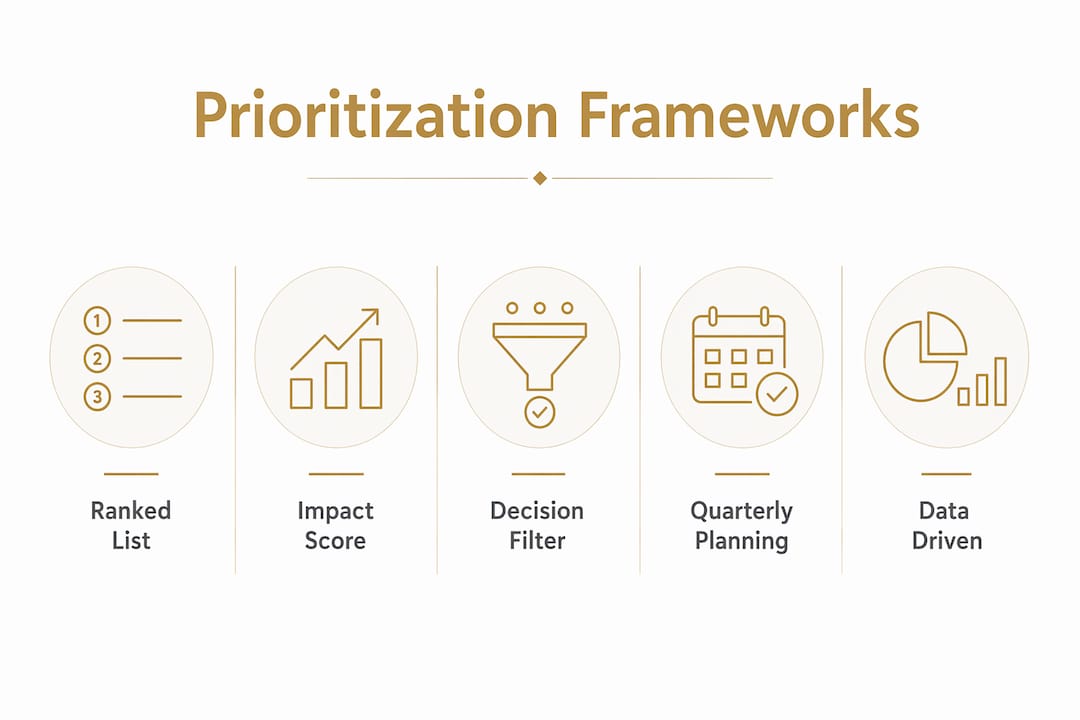
The ranked priority list
The simplest and most durable framework is a ranked list of 3–5 priorities per quarter. Deliberate Directions’ research confirms that consistently saying no to distractions trains teams to think strategically and directs resources to the strongest work. The compounding effect builds over time. Teams that complete focused priorities quarter after quarter develop execution competence that becomes a competitive advantage.
Impact versus feasibility scoring
Rate each candidate initiative on two dimensions: expected value impact (scored 1–10) and current feasibility given your resources (scored 1–10). Multiply the scores. The highest numbers earn the top spots on your quarterly list. This removes politics and personal preference from the selection process.
The founder decision filter
Before committing to any initiative, run it through three questions. First, does this directly address a constraint that is limiting growth right now? Second, do we have the resources to execute it well within 90 days? Third, what do we stop doing to make room for it? The third question is the most important. If you cannot name what you are stopping, you are adding, not prioritizing.
The table below maps common prioritization tools to their best use cases:
| Framework | Best used for | Time horizon |
|---|---|---|
| Ranked priority list | Quarterly planning and team alignment | 90 days |
| Impact vs. feasibility scoring | Evaluating competing initiatives | Pre-planning |
| Founder decision filter | Individual initiative approval | Ongoing |
| Value stick analysis | Growth strategy and investment decisions | Annual |
Embedding a prioritization culture requires more than a quarterly planning session. It requires leaders to model the behavior publicly. When you decline a good idea in a team meeting and explain why, you teach your organization how to think. That lesson compounds. You can explore founder decision frameworks that Commerce Catalyst has documented for consumer brand leaders navigating exactly this challenge.
Prioritization skills become faster and more effective over time, turning what once felt like agonizing trade-offs into clear strategic choices. The goal is not to eliminate difficulty. It is to build the organizational muscle that makes difficulty manageable.
Key takeaways
Prioritization drives business growth because it concentrates resources, accelerates execution, and compounds strategic discipline into a durable competitive advantage.
| Point | Details |
|---|---|
| The 80/20 rule is operational | Focus 20% of initiatives to capture 80% of transformation value, per BCG research. |
| Limit quarterly priorities | Cap organizational priorities at 3–5 items per quarter to prevent competing goals. |
| Saying no is a skill | Declining good ideas trains teams to think strategically and builds execution capacity. |
| Sequencing determines outcomes | The order in which you pursue priorities shapes how much value each one delivers. |
| Frameworks beat gut feel | Repeatable scoring tools remove politics and produce consistent prioritization decisions. |
The discipline nobody talks about enough
The uncomfortable truth is that prioritization is not a planning exercise. It is a leadership identity question. What you choose to pursue tells your team, your investors, and your market what you actually believe matters. When that list is ten items long, the message is that nothing matters more than anything else.
How Commerce Catalyst helps founders prioritize for profitable growth
Knowing that prioritization matters is not the same as knowing which priorities are right for your business right now. That gap is exactly where Commerce Catalyst works.

Chris Wichert’s DTC Financial Health Assessment gives consumer brand founders a clear picture of where their business is generating and leaking value, so the prioritization decisions you make are grounded in real financial data, not assumptions. The Operator Diagnostic goes deeper, identifying the operational constraints that are quietly limiting your growth and helping you sequence the work that will move the needle fastest. If you are ready to stop guessing and start building a focused growth plan, Commerce Catalyst is the place to start.
FAQ
Why does prioritization matter more than working harder?
Effort applied to the wrong initiatives produces activity, not growth. BCG research shows that roughly 80% of transformation value comes from 20% of initiatives, meaning focused effort consistently outperforms distributed effort.
How many priorities should a business have at one time?
Scaling experts recommend limiting organizational priorities to 3–5 items per quarter. More than that creates competing goals that slow execution and dilute team focus.
What is the prioritization blindspot in leadership?
The prioritization blindspot occurs when leaders spend time on comfortable or inherited tasks rather than the high-use duties only they can perform, as identified by Psychology Today’s 2026 research.
How does saying no to good ideas help a business grow?
Deliberate Directions’ research confirms that consistently declining distractions trains teams to think strategically and creates a compounding effect where completed initiatives build execution competence over time.
What is the fastest way to start prioritizing more effectively?
List every active initiative your team is currently running, score each one by impact and feasibility, and cut the list to the top five. Then identify what you will stop doing to protect those five. That single exercise produces more clarity than most planning retreats.