Marketing efficiency drives profits by ensuring every dollar you spend on marketing generates the maximum possible return, reducing waste while maintaining or growing revenue. When you tighten the relationship between spend and outcome, net margins expand without requiring top-line growth to do the heavy lifting.
Here is what that looks like in practice:
- Improved lead quality: Targeted campaigns attract buyers who convert faster and spend more, lowering the cost per closed deal.
- Lower customer acquisition cost (CAC): Reducing wasted ad spend on low-intent audiences shrinks CAC, which directly widens gross margin.
- Higher conversion rates: improved messaging and channel mix turn more prospects into paying customers from the same budget.
- Reduced overhead: Marketing automation drives a 14.5% increase in sales productivity and a 12.2% reduction in marketing overhead, according to Nucleus Research.
- Compounding returns: Efficiency gains reinvested into growth campaigns create a flywheel, not a one-time margin bump.
The critical caveat: efficiency alone does not guarantee profit growth. Scale matters too, and the tension between the two is where most brands lose money quietly.
What marketing efficiency actually means
Marketing efficiency is the measure of how much revenue or profit a business generates relative to what it spends on marketing. Think of it as the return side of the marketing investment equation, where the goal is not just to spend less but to extract more value from every dollar deployed.
The core components include:
- Cost improvement: Eliminating spend on channels, campaigns, or audiences that consume budget without producing measurable contribution.
- Targeting precision: Reaching buyers with genuine purchase intent rather than broad audiences that inflate impressions without driving sales.
- Channel mix discipline: Allocating budget toward the channels that deliver the highest total contribution, not just the best-looking ratios.
- Marketing automation: Using tools like email workflows, CRM integrations, and lead scoring to reduce manual overhead while improving follow-up consistency.
- Waste reduction: Cutting creative production redundancy, overlapping agency fees, and underperforming placements that erode the marketing P&L.
Efficiency is not the same as frugality. A brand spending aggressively but with disciplined allocation can be far more efficient than one spending conservatively but spreading budget across too many low-return channels.

How to measure marketing efficiency with key metrics
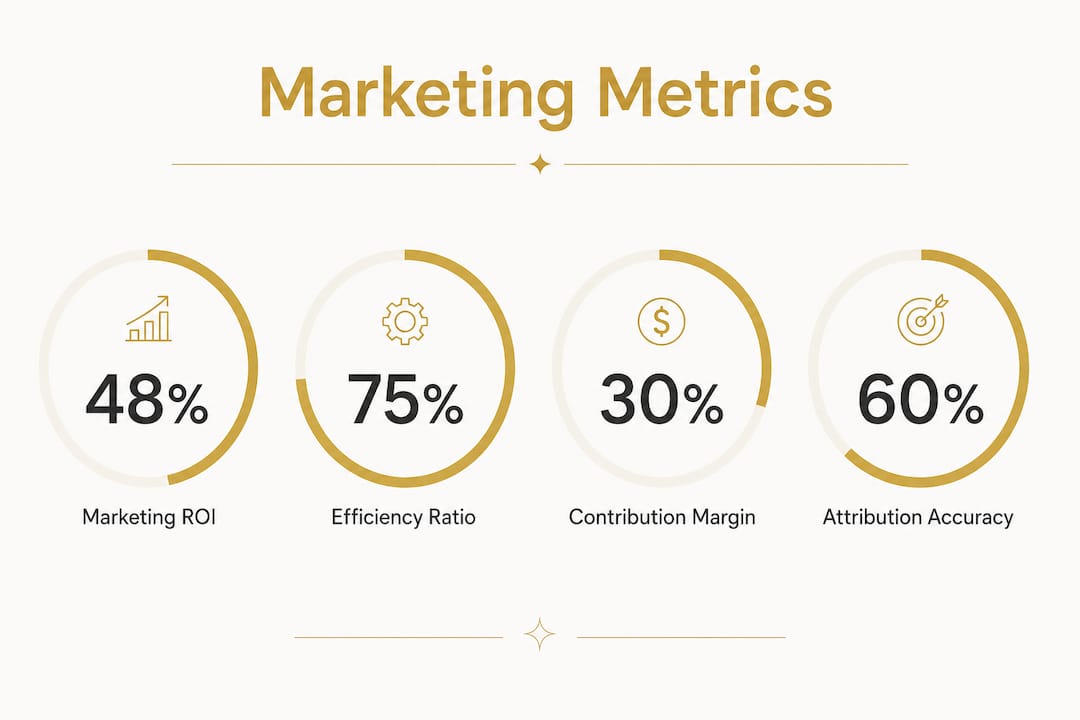
Four metrics form the foundation of any serious marketing efficiency measurement framework.
| Metric | Definition | Business impact |
|---|---|---|
| Marketing ROI | Net profit from marketing divided by marketing spend | Shows whether marketing generates more than it costs |
| Customer Acquisition Cost (CAC) | Total marketing spend divided by new customers acquired | Tracks the cost of growth; rising CAC erodes margin |
| Conversion Rate | Percentage of prospects who complete a desired action | Higher conversion means more revenue from the same spend |
| Marketing Efficiency Ratio (MER) | Total revenue divided by total marketing spend | Provides a blended, portfolio-level view of marketing performance |
The Marketing Efficiency Ratio deserves particular attention. Unlike ROAS, which measures the return on a single paid channel, MER captures the full picture: paid ads, organic traffic, influencer partnerships, and brand campaigns all in one number. Companies that adopt MER have achieved higher marketing ROI than peers relying solely on channel-level metrics. For established businesses, a higher MER typically signals sustainable, profitable marketing.
Pro Tip: Pair MER with contribution margin analysis. A high MER with thin margins can still mean you are losing money. The ratio tells you efficiency; the margin tells you whether that efficiency is actually building profit.
Holistic revenue attribution matters here too. Tracking spend at the campaign level without connecting it to downstream revenue and margin creates blind spots. The brands that measure best tend to use unified dashboards that pull spend, revenue, and CAC into a single view, updated at least weekly.
How marketing efficiency translates into real profit gains
The profit impact of improving marketing efficiency is direct and often underappreciated. When CAC falls while average order value holds steady, contribution margin per customer rises. When conversion rates improve, you generate more revenue without increasing the ad budget. Both outcomes flow straight to the bottom line.
“Marketing isn’t just another cost. It’s the engine that actively generates sales and, more importantly, profit. Cutting spend that looks ‘less efficient’ on a ratio basis might actually reduce your total marketing contribution and hurt your overall profitability.”: The Biscuit Club
The Loaf furniture brand illustrated this during the pandemic. When demand dropped in early 2020, conventional thinking pointed toward cutting marketing spend to protect the spend-to-sales ratio. Instead, Loaf modeled the numbers and found that maintaining spend, including launching a first TV campaign, would generate more total profit by covering fixed costs and preserving market momentum. They were right. Loaf emerged with greater market share and stronger profitability than before. Fixed costs do not shrink when you cut marketing. Revenue does.
This is the efficiency trap many brands fall into: improving ratios while shrinking the total profit pool. The goal is not a clean-looking ROAS. The goal is maximum net contribution after all costs are covered.
Efficiency vs. effectiveness: why the distinction changes your strategy
Marketing efficiency and marketing effectiveness are related but measure fundamentally different things, and conflating them leads to bad budget decisions.
- Marketing effectiveness asks: Did we achieve our marketing objectives? It measures outcomes like brand awareness, market penetration, and long-term revenue growth, regardless of what those outcomes cost.
- Marketing efficiency asks: What did those outcomes cost relative to what we spent? It measures the ratio of output to input.
The practical implications diverge sharply:
- A highly effective campaign that builds brand equity over 18 months may look inefficient on a short-term ROI basis, yet it drives pricing power and customer loyalty that compound for years.
- A highly efficient campaign with a strong ROAS may be generating too little total volume to cover fixed costs, making the business less profitable despite the clean ratio.
- IPA research shows that ROI accounts for only 11% of variations in profit, with the remaining 89% driven by budget scale. Efficiency matters, but scale often matters more.
- Focusing exclusively on efficiency metrics can lead to narrow targeting that misses high-spending consumer segments, reducing total market reach and long-term revenue potential.
The brands that win treat efficiency and effectiveness as complementary levers, not competing priorities.

Proven strategies to improve marketing efficiency
Improving marketing efficiency requires deliberate choices about where you spend, how you measure, and what you cut versus what you scale.
- Reallocate to high-performing channels: Review ROAS and MER by channel regularly. Shift budget toward the placements generating the highest total contribution, not just the best-looking ratios.
- Use marketing automation for lead nurturing: According to the Annuitas Group via Salesforce, companies using automation to nurture prospects see a higher number of qualified leads and larger purchases, leading to increased sales productivity and lower marketing overhead.
- improve conversion, not just acquisition: Improving page load speed, simplifying checkout, and tightening call-to-action copy generates more revenue from existing traffic without increasing spend.
- Increase customer lifetime value (CLTV): Loyalty programs and post-purchase retention campaigns extend the revenue window for each acquired customer, improving MER over time.
- Set a breakeven ROAS threshold: Divide 1 by your gross margin to find the minimum ROAS a campaign must hit to be profitable. Use this as a floor, not a ceiling.
- Broaden your media mix deliberately: IPA data shows that campaigns using a wider range of channels tend to be more effective, and that narrow digital-only mixes often produce diminishing returns.
“Tight budgets and an obsession with efficiency means marketers are always trying to ‘do more with less.’ But this quest for efficiency reduces effectiveness and destroys profits.”: IPA Research, via VideoWeek
The most dangerous pitfall is improving for the ratio while starving the campaigns that generate the most total profit. A campaign with a lower ROAS but higher volume can deliver more contribution simply because it operates at greater scale. Cut it based on the ratio alone, and you shrink your profit pool while your fixed costs stay exactly where they were.
Integrating marketing efficiency into your financial strategy
The brands that extract the most value from marketing efficiency treat it as a capital allocation discipline, not a marketing department metric. This shift changes everything about how budgets get set and defended.
PwC research shows that companies excelling across marketing execution, brand strength, and profitability deliver 79% higher total shareholder returns than peers. That is not a marketing vanity metric. It shows up in the P&L and on the balance sheet.
Here is a framework for embedding efficiency into financial planning:
- Translate marketing metrics into finance language. Convert mROI and brand lift into revenue, margin, and shareholder value terms so CFOs can evaluate marketing with the same rigor as any capital investment.
- Govern the marketing P&L jointly. When finance and marketing co-own the budget, efficiency gains are reinvested into growth rather than extracted as one-time savings.
- Reinvest efficiency gains, do not bank them. PwC’s analysis shows a reinvestment strategy that channels efficiency gains into greater effectiveness can be more than twice as profitable as one focused solely on short-term savings.
- Use AI as a growth driver, not a cost-cutter. When AI automates content adaptation, segmentation, and reporting, the freed capacity should fund creative and brand-building work, not disappear into margin.
- Protect brand investment during downturns. Cutting brand budgets to hit quarterly targets weakens consumer preference over time, requiring heavier promotional spend later to recover lost baseline sales.
Pro Tip: Build a profitability roadmap before you set next year’s marketing budget. Knowing your contribution margin by channel tells you exactly where additional spend generates profit and where it does not.
The brands that treat marketing as a growth engine, governed with financial discipline, consistently outperform those that treat it as a discretionary expense to be trimmed when times get hard.
Tools that help you measure and improve marketing efficiency
The right tools make the difference between guessing at efficiency and managing it with precision.
Analytics and attribution platforms like Google Analytics 4 and Northbeam provide multi-touch attribution that connects ad spend to revenue across channels, giving you a cleaner read on which campaigns are actually driving contribution. Without accurate attribution, MER calculations are unreliable.
Marketing automation platforms such as HubSpot, Klaviyo, and Salesforce Marketing Cloud handle lead nurturing, segmentation, and campaign sequencing at scale. They also centralize performance data, making it far easier to calculate CAC and conversion rates across the full funnel.
Business intelligence tools like Looker and Tableau pull spend, revenue, and margin data into unified dashboards. When your CFO can see marketing contribution alongside gross margin in one view, the conversation about budget allocation becomes grounded in shared facts rather than competing interpretations.
Media mix modeling (MMM) software helps brands understand the long-term contribution of brand-building channels like TV and out-of-home, which tend to be undervalued in last-click attribution models. This is particularly relevant given IPA findings that budget scale drives 89% of profit variation.
The tools matter less than the discipline of using them consistently. Weekly MER reviews, monthly CAC trend analysis, and quarterly channel reallocation decisions create the feedback loop that turns data into better spending choices.
How data analytics and attribution models sharpen marketing efficiency
Attribution is where most brands lose the thread. If you cannot accurately assign revenue to the marketing activity that generated it, every efficiency calculation is built on a shaky foundation.
The core challenge is incrementality: separating the sales your marketing actually caused from the sales that would have happened anyway due to seasonality, brand equity, or competitor activity. A hotel that achieves 80% occupancy during peak season when location demand alone would have driven 70% should attribute only the incremental 10% to its marketing campaigns, not the full 80%. Misattributing baseline demand to marketing inflates apparent ROI and leads to overconfidence in underperforming campaigns.
Multi-touch attribution models, including linear, time-decay, and data-driven variants, distribute credit across the customer journey rather than awarding it entirely to the last click. Data-driven attribution, available in Google Analytics 4, uses machine learning to weight touchpoints based on their actual contribution to conversion, which tends to surface the value of upper-funnel brand activity that last-click models systematically undercount.
Google’s Effectiveness Equation research found that the long-term sales impact of media investment during months 5–24 typically equals that of the first four months. Brands relying on short-window attribution miss half the value their marketing creates, which leads directly to underinvestment in the brand-building activity that drives pricing power and sustainable margin.
The practical implication: run attribution models with at least a 12-month lookback window, layer in media mix modeling for brand channels, and report both short-term and long-term contribution to give leadership a complete picture of marketing’s profit impact.
Key Takeaways
Marketing efficiency drives profits when spend is governed by contribution margin, not just ratios, and when efficiency gains are reinvested into growth rather than extracted as savings.
| Point | Details |
|---|---|
| MER over ROAS | Marketing Efficiency Ratio gives a portfolio-level view; companies adopting it achieve higher marketing ROI than those using channel metrics alone. |
| Scale drives profit | IPA research shows ROI accounts for only 11% of profit variation; budget scale drives the remaining 89%. |
| Automation compounds returns | Marketing automation drives a 14.5% increase in sales productivity and a 12.2% reduction in overhead, per Nucleus Research. |
| Reinvestment beats cost-cutting | PwC analysis shows a reinvestment strategy can be more than twice as profitable as one focused solely on short-term savings. |
| Attribution window matters | Long-term media effects in months 5–24 typically equal the first four months of impact; short attribution windows undercount half of marketing’s value. |
If you are a consumer brand founder trying to connect your marketing spend to actual profit outcomes, Commerce Catalyst’s DTC Financial Health Assessment is built for exactly that. It identifies where your marketing investment is generating contribution and where it is quietly draining it, so you can make allocation decisions with confidence rather than instinct.