Most founders assume accountability is about assigning blame when something goes wrong. That assumption costs them. Why accountability drives founder outcomes has nothing to do with fault-finding and everything to do with how leaders build trust, make faster decisions, and create cultures where truth flows freely. The technical term researchers use is structured accountability, meaning a recurring, public process where founders externalize their plans and progress. This article breaks down what the evidence actually shows, where founders go wrong, and what you can do right now to build accountability into your leadership in a way that compounds results over time.
Table of Contents
- Key takeaways
- Why accountability drives founder outcomes
- What research actually says about accountability
- Psychological safety and authentic leadership
- Practical systems that produce real results
- When accountability backfires
- My take on accountability as a founder
- Take your accountability further with Commerce Catalyst
- FAQ
Key takeaways
| Point | Details |
|---|---|
| Structured accountability is a process | Recurring, public progress-sharing drives better outcomes than occasional blame sessions or informal reviews. |
| Founder characteristics determine fit | Research shows accountability benefits lower-educated founders more; one approach does not work for everyone. |
| Psychological safety is non-negotiable | Accountability without a safe environment for honesty actually reduces experimentation and kills learning. |
| Transparency creates faster decisions | Founders who own consequences honestly improve information flow, which speeds up every decision downstream. |
| Design matters more than intention | Good intentions alone do not create accountability. Intentional systems with auditability sustain it at scale. |
Why accountability drives founder outcomes
Accountability in entrepreneurship gets miscast constantly. Founders either treat it as a polite term for blame culture or they embrace it in name only, posting values on the wall without changing any actual behavior. Neither version works.
True accountability means owning your decisions, your actions, and their outcomes. Not just when things go well. Especially when they do not. When a founder models this consistently, it sets the cultural standard for every person who joins the team. Your team watches what you do far more closely than they listen to what you say.
Here is what genuine accountability looks like in practice:
- Taking ownership of a missed revenue target publicly, then walking the team through what you will do differently
- Being transparent with your team about a strategic pivot and the reasoning behind it, even when the reasoning is uncomfortable
- Holding yourself to deadlines you set, because breaking your own commitments signals to everyone else that commitments are optional
- Asking for feedback on decisions you made, not just decisions you are about to make
Founders with skin in the game build companies where honesty in information flow replaces self-protection. That shift alone changes how fast a company can move and how clearly it can see its own problems.
Accountability is not what you enforce on others. It is what you demonstrate yourself, repeatedly, in the moments when it would be easier to deflect.
This kind of leadership builds credibility with your team in a way that no perk, salary, or mission statement can replicate.
What research actually says about accountability

The strongest evidence on this topic comes from a two-year randomized controlled trial of 361 ventures inside a business accelerator. The findings are more nuanced than most people expect. Structured accountability benefits lower-educated founders more than their highly educated counterparts, and it has a roughly neutral effect on ventures led by founders with advanced education. The implication is significant. A one-size-fits-all accountability program will produce uneven results at best and active resistance at worst.
What made the difference in that study was not the accountability itself but the structure around it. Regular, public expression of plans and progress created accountability as a learning mechanism rather than a performance review. Founders who went through this process consistently were more likely to catch problems early, adjust their strategies, and communicate clearly with stakeholders.
The data table below summarizes the key distinctions between reactive and structured accountability:
| Approach | Timing | Effect on founders | Likely outcome |
|---|---|---|---|
| Reactive (blame-based) | After failures | Defensive, reduced risk-taking | Lower learning, team disengagement |
| Structured (recurring) | Ongoing, public | Ownership-oriented, transparent | Earlier issue detection, better decisions |
| Informal (ad hoc) | Inconsistent | Mixed, often ignored | No reliable performance lift |
After-the-fact blame rituals are not just ineffective. They actively erode trust. The founders who improve are the ones who treat accountability as an ongoing conversation, not a verdict.
Pro Tip: Set a weekly founder check-in where you publicly share your top three commitments from the prior week and your completion rate. This single habit externalizes your own accountability before you ask it of anyone else.
The other critical nuance: accountability effectiveness depends on matching design to founder characteristics. If you are working with a coach, accelerator, or board, push back on any program that treats every founder the same. Your background, experience level, and leadership style should shape how accountability is structured for you.
Psychological safety and authentic leadership
Here is where the research gets even more interesting. Accountability does not operate in isolation. Its effectiveness is directly shaped by the psychological safety conditions in your organization. And psychological safety is directly shaped by you as a founder.
A 2026 study using structural equation modeling confirmed that authentic leadership enhances psychological safety both directly and through stronger leader-member relationships. When founders communicate openly, acknowledge their own uncertainty, and treat team members as partners rather than subordinates, team members feel safer voicing problems before they become crises.
A cross-national study of 84 teams found that psychological safety drives team cooperation and dynamic capabilities, meaning the team’s ability to learn, adapt, and perform under pressure. That is not a soft outcome. That is a core competitive advantage for early-stage companies operating with limited resources.
Here is how to apply this practically as a founder:
- Share your thinking process, not just your decisions. Teams that understand your reasoning are more likely to flag when that reasoning breaks down.
- Respond to bad news with curiosity, not punishment. Your reaction the first time a team member surfaces a problem sets the precedent for every future disclosure.
- Ask questions that invite honest answers. “What am I missing?” works better than “Does anyone have concerns?”
- Acknowledge your own mistakes before you address team mistakes. The sequence matters.
One important cultural caveat: authentic leadership’s effect on psychological safety is less pronounced in collectivistic cultures, where group norms and hierarchy carry more weight. If you are building a culturally diverse team or operating across international markets, your accountability practices need to account for this variation. A professional growth framework that works in one cultural context may need significant adjustment in another.
Pro Tip: After any significant team setback, run a structured debrief using these three questions: What did we expect to happen? What actually happened? What will we do differently? This format builds accountability without assigning personal blame.
Practical systems that produce real results
Accountability does not happen because you want it to. It happens because you design systems that make it the default behavior.
Transparency and auditability in workflows help teams identify issues faster and create the kind of organizational trust that scales with your company. The key insight from medicine applied to business here is that accountability systems built in early, before you need them, produce far better outcomes than ones bolted on after something breaks.
Here is a practical sequence for implementing structured accountability in your startup:
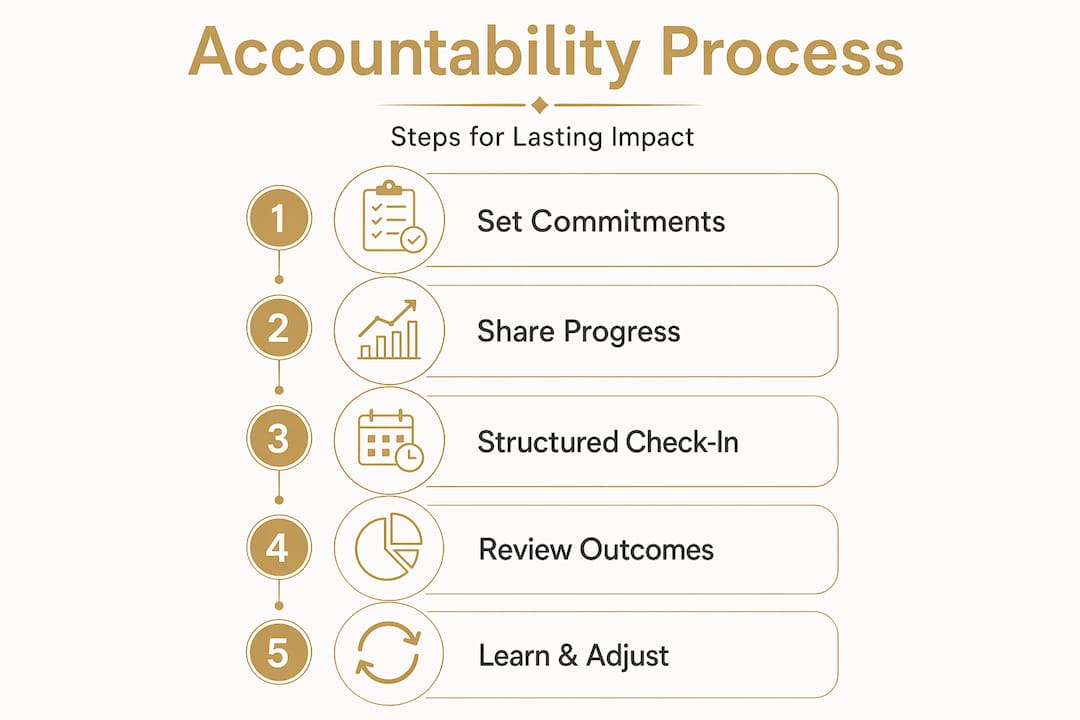
- Externalize commitments. Every significant decision or initiative should be written down with a named owner, a timeline, and the expected outcome. Verbal commitments disappear. Written ones persist.
- Create recurring review cadences. Weekly or biweekly check-ins where founders and team leads share progress against commitments publicly. Keep them short. Thirty minutes is enough.
- Build auditability into your tools. Use project management systems where every decision and status change is logged. This is not micromanagement. It is the ability to reconstruct why decisions were made, which becomes critical during course corrections.
- Separate review from judgment. Progress reviews should feel like learning sessions, not performance hearings. The goal is to surface reality quickly, not to evaluate people.
- Close the loop. When commitments are missed, the conversation should focus on what changed, what was learned, and what the revised commitment is. Not on who is to blame.
Designing workflows with transparency turns accountability from a retrospective blame mechanism into an active learning system. That shift is what builds stronger companies over time. You can also look at how a real DTC turnaround was executed through accountability-based culture shifts to see how these principles play out at the operational level.
Understanding business growth barriers often reveals that accountability gaps are among the most common and most avoidable obstacles founders face.
When accountability backfires
Not every accountability system produces better results. Poorly designed accountability can actively damage your startup, and it is worth knowing the warning signs before you invest in one.
- Blame culture masquerading as accountability. If your reviews consistently end with someone being identified as the problem rather than a system or decision being examined, you have a blame culture. Expect team members to start hiding problems instead of surfacing them.
- Ignoring context and founder readiness. Pushing high-intensity accountability programs onto founders who are already overwhelmed or whose cultural background creates friction with public accountability will produce resistance, not results.
- Accountability without psychological safety reduces experimentation. Teams that fear being called out stop trying things that might not work. In an early-stage startup, that is existential.
- Accountability fatigue. Too many check-ins, too many metrics, and too much review process creates compliance theater. People go through the motions without genuine engagement.
- Asymmetric standards. When founders hold teams to accountability standards they do not apply to themselves, the entire system collapses in credibility.
The fix in every case is the same: return to psychological safety as the foundation, simplify your accountability mechanisms, and model the standard yourself before you enforce it with others.
Take your accountability further with Commerce Catalyst
If this article clarified the importance of accountability in your leadership, the next step is making it structural rather than aspirational. At Commerce Catalyst, Chris Wichert works directly with consumer brand founders to identify the exact gaps between what founders think is happening in their business and what the numbers actually show.

The DTC financial health assessment is a practical starting point. It gives you a clear picture of where your business stands and where accountability gaps are costing you cash flow and decision quality. If you want a more direct conversation, the Founder Hour is designed for exactly that. One focused session, no fluff, built around what your business actually needs. Accountability is not just a mindset. It is a structure you build deliberately.
FAQ
What does structured accountability mean for founders?
Structured accountability is a recurring, public process where founders externalize their plans and report progress consistently. Research from a two-year RCT shows this approach produces better outcomes than informal or reactive accountability practices.
Does accountability work the same way for every founder?
No. A 2026 randomized trial found that structured accountability benefits lower-educated founders significantly more while having a neutral effect on highly educated founders, confirming that design must match founder context.
Why does psychological safety matter for accountability to work?
Without psychological safety, accountability creates fear rather than learning. Research confirms that teams without psychological safety reduce experimentation and hide problems instead of surfacing them early.
How can founders model accountability without damaging team morale?
Founders should own their mistakes publicly, use structured debriefs focused on systems rather than individuals, and apply the same standards to themselves before holding teams accountable. Consistency in this behavior builds credibility over time.
What is the fastest way to improve founder outcomes through accountability?
Start by externalizing your own commitments in writing with clear timelines, then introduce weekly progress reviews that are short and forward-looking. Transparency at the founder level sets the cultural standard faster than any program or policy.