
A clear path to profitability is the single most important signal investors use to judge whether a growing business deserves capital. Known formally as a “path to profitability” or P2P roadmap, it is a documented plan showing exactly how and when a company will cover its costs and generate sustainable returns. 82% of successful Seed and Series A rounds in Q1 2026 included a dedicated P2P section in their pitch decks. That figure tells you everything about where investor priorities sit right now. Understanding why profitability path attracts investors means understanding the financial metrics, management signals, and market forces that make capital efficiency the defining factor in 2026 fundraising.
What key financial metrics define a credible profitability path?
Investors do not take founders at their word. They verify a profitability roadmap through a specific set of quantitative benchmarks that measure capital efficiency and operational health.
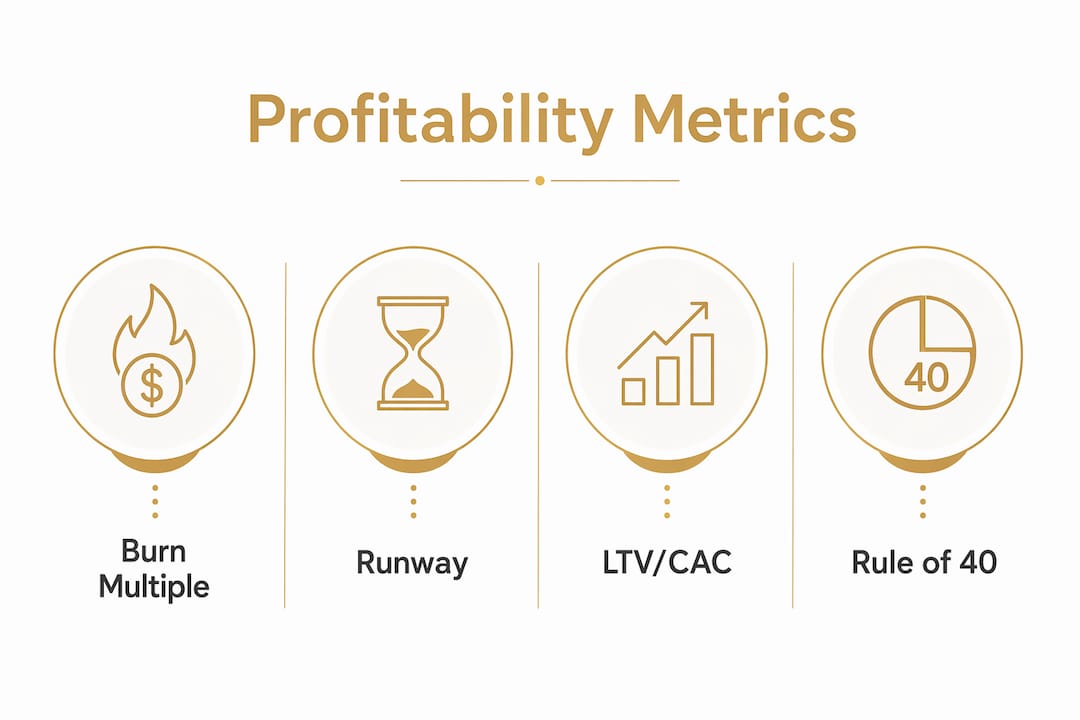
The four metrics that matter most are:
- Burn multiple. This is the ratio of net cash burned to net new revenue added. Institutional investors require a burn multiple below 2x to consider a startup fundable in 2026. A burn multiple above 2x signals that the business is spending far more than it earns in new revenue, which is a red flag for sustainability.
- Runway. Investors expect at least 18 months of operating runway. Anything shorter creates pressure that distorts decision-making and forces founders into desperate fundraising cycles.
- LTV/CAC ratio and payback period. Investors require a customer lifetime value to customer acquisition cost ratio of at least 3:1 and a payback period under 12 months. A 3:1 ratio means the business earns three dollars for every dollar it spends acquiring a customer. That margin creates room for reinvestment and absorbs market shocks.
- Rule of 40. The Rule of 40 combines a company’s revenue growth rate and profit margin. The sum should equal or exceed 40. A business growing at 30% with a 10% profit margin passes. One growing at 60% with a negative 25% margin does not. This metric tells investors whether a company is building real value or just buying growth.
These four benchmarks work together. No single number tells the full story. A strong LTV/CAC ratio with a dangerously short runway still signals risk. Investors look for consistency across all four before committing capital.
Pro Tip: Before your next investor meeting, calculate your burn multiple and Rule of 40 score. If either number falls outside the benchmarks above, fix the underlying unit economics before you pitch. Investors will find the gap anyway.

How does a profitability path signal management quality?
Profitability reflects management quality and capital discipline, which investors interpret as lower risk and stronger future returns. A founder who can grow revenue while controlling costs demonstrates something that no pitch deck narrative can fake: the ability to make hard tradeoffs.
“Profitability is the ultimate test of a business’s viability, signaling correct alignment of operations, pricing, and costs.”: Aswath Damodaran, 2026 Financial Analysis
Investors who favor long-term positions specifically look for this alignment. A business that is profitable, or credibly on its way there, shows that its pricing model works, its cost structure is under control, and its leadership understands the difference between activity and progress.
The concept of being “Default Alive” captures this well. A Default Alive company can reach profitability on its current cash without raising another round. Investors prefer these businesses because they are not permanently dependent on external capital to survive. That independence reduces the investor’s own risk exposure significantly.
The qualitative signals investors read from a strong P2P roadmap include:
- Disciplined spending. No wasteful headcount growth ahead of revenue milestones.
- Margin awareness. Leadership knows gross margin, contribution margin, and net margin by product line.
- Contingency planning. The roadmap includes downside scenarios, not just best-case projections.
- Zero-burn milestones. The plan identifies specific points where the business stops needing external cash.
Companies with strong operating profitability tend to outperform over long periods because of durable competitive advantages and financial strength. Investors who understand this do not just look for current profitability. They look for the management behaviors that produce it.
Why profitability beats growth-at-all-costs for investors
The “growth at any cost” model dominated venture capital from roughly 2010 through 2021. The logic was simple: capture market share fast, worry about margins later. That model collapsed when higher interest rates ended cheap capital and investors stopped rewarding revenue growth divorced from efficiency.
The contrast between the two models is stark:
| Factor | Growth-at-all-costs | Profitability-focused |
|---|---|---|
| Primary metric | Revenue growth rate | Burn multiple and gross margin |
| Capital dependency | Permanent fundraising cycle | Reduces over time |
| Investor risk | High; survival depends on next round | Lower; business can sustain itself |
| Management signal | Execution speed | Capital discipline and judgment |
| Long-term returns | Inconsistent; dilution risk | More predictable; compounding advantage |
In 2026, investors emphasize economic fundamentals, regulatory efficiency, and real profitability over speculative growth narratives. The Kearney FDI Confidence Index confirms this shift. Investors are recalibrating toward businesses that can generate returns without depending on a favorable macro environment.
The practical consequence for founders is clear. Building profitability into the business from day one is no longer optional. Investors who see a company that only plans to become profitable after a future funding round treat that as a structural flaw, not a temporary phase.
Pro Tip: If your current model requires two more funding rounds before reaching breakeven, rebuild your unit economics now. Investors in 2026 will not fund a business whose profitability depends on future capital that has not yet been raised.
How to evaluate a company’s profitability path as an investor
Practical evaluation starts with the pitch deck and the financial model. A credible P2P roadmap contains specific, testable claims. Vague statements about “achieving profitability at scale” are not a plan. They are a placeholder.
Use this evaluation sequence:
- Check the burn multiple first. Pull the last 12 months of cash burn and net new revenue. Divide burn by new revenue. Anything above 2x requires a detailed explanation before you proceed.
- Verify the LTV/CAC ratio with real cohort data. Ask for customer cohort retention curves, not blended averages. Founders often mistake growth for scalability; cohort data reveals whether retention actually supports the LTV assumption.
- Test the runway math. Take current cash divided by monthly net burn. If the result is under 18 months, ask how the company plans to extend it without another raise.
- Apply the Rule of 40. Add the revenue growth rate to the profit margin percentage. A score below 40 in a company claiming operational discipline is a contradiction worth probing.
- Look for scenario planning. A founder who only presents an upside case has not thought seriously about risk. Ask for the base case and the downside case. The quality of those answers tells you more than the numbers do.
The table below shows what separates a credible P2P roadmap from a weak one:
| Element | Credible roadmap | Weak roadmap |
|---|---|---|
| Burn multiple | Below 2x with trend improving | Above 2x with no clear reduction plan |
| LTV/CAC ratio | 3:1 or better, backed by cohort data | Blended estimate without retention data |
| Runway | 18+ months at current burn | Under 12 months, dependent on next raise |
| Profit timeline | Specific date with named milestones | “After we scale” with no defined trigger |
| Downside scenario | Modeled with cost levers identified | Missing or identical to base case |
Qualitative assessment matters alongside the numbers. A founder who can explain exactly which cost line they would cut first in a downturn, and why, demonstrates the kind of judgment that protects investor capital. That conversation is worth more than a polished slide.
You can also use sector-specific benchmarks to contextualize the numbers. A gross margin that looks thin in software might be healthy in food and beverage. Comparing against industry norms prevents misreading a business’s actual position.
Key Takeaways
A clear profitability path attracts investors because it proves capital discipline, reduces survival risk, and signals the management quality that produces durable long-term returns.
| Point | Details |
|---|---|
| Four core metrics | Burn multiple, runway, LTV/CAC ratio, and Rule of 40 together define a credible P2P roadmap. |
| Management signal | Profitability demonstrates capital discipline and operational control, which investors read as lower risk. |
| Market shift | Higher interest rates ended growth-at-all-costs; investors now require profitability from the earliest stages. |
| Evaluation discipline | Verify cohort data, test scenario planning, and check burn trends before committing capital. |
| Default Alive status | Companies that can reach profitability without another raise carry significantly lower investment risk. |
How Commerce Catalyst helps you build a fundable profitability roadmap
Commerce Catalyst works directly with consumer brand founders to translate financial complexity into the kind of clarity investors require. The DTC Financial Health Assessment audits your CAC, gross margins, LTV, and burn multiple against current investor benchmarks, then identifies the specific gaps standing between your business and a fundable P2P roadmap. For founders preparing for a capital raise or a strategic exit, the exit advisory service builds the financial narrative that institutional investors expect to see. Commerce Catalyst’s approach is grounded in founder experience, not theory. Every recommendation connects directly to the metrics that move investor decisions in 2026.
FAQ
What is a path to profitability in a pitch deck?
A path to profitability is a documented plan showing how and when a business will cover its costs and generate sustainable returns without permanent dependence on external capital. 82% of successful Seed and Series A rounds in Q1 2026 included a dedicated P2P section.
What burn multiple do investors require in 2026?
Investors require a burn multiple below 2x and a runway of at least 18 months to consider a startup fundable. A burn multiple above 2x signals the business is spending far more than it earns in new revenue.
What is the Rule of 40 and why do investors use it?
The Rule of 40 adds a company’s revenue growth rate to its profit margin. A combined score of 40 or above signals that the business balances growth and profitability effectively, which investors treat as evidence of operational discipline.
What does Default Alive mean for investors?
A Default Alive company can reach profitability on its current cash without raising another round. Investors prefer these businesses because they carry lower survival risk and are not permanently dependent on favorable fundraising conditions.
Why do investors care more about profitability than revenue growth now?
Higher interest rates ended cheap capital and removed the conditions that made growth-at-all-costs viable. Investors now require businesses to demonstrate real profitability potential from the earliest stages, not just revenue scale.