Your wholesale pricing strategy has to start at true landed cost, not at half your retail price. Calculate the floor first, layer in a target contribution margin in the low to mid-twenties percent range depending on your category, then pick a pricing model, whether keystone, cost-plus, value-based, or tiered, that keeps every discount above that line. The formulas, benchmarks, and governance rules below show you exactly how.
TL;DR:
- Setting wholesale prices based on landed cost and targeted margin guards against selling at a loss, avoiding common mistakes like halving DTC prices.
- Using formulas such as minimum floor, keystone, or cost-plus pricing ensures prices stay above cost and align with industry benchmarks for discounts and margins.
- Implementing a maximum of three discount tiers, with thresholds based on actual order data, helps prevent margin erosion from overly complex or poorly structured volume discounts.
- Accurately calculating and regularly updating fulfillment and cost-to-serve expenses is crucial to maintaining true margin integrity in wholesale pricing.
- Structuring and controlling price lists, enforcing MAP policies, and auditing orders prevent silent margin leaks and unprofitable discount practices.
Table of Contents
- What Is a Wholesale Pricing Strategy, and How Do You Calculate It?
- Which Wholesale Pricing Model Fits Your Brand?
- How Do You Design Volume and Tiered Discounts Without Bleeding Margin?
- Are You Accounting for the Full Cost of Serving a Wholesale Account?
- How Should You Handle MAP, MOQs, and Net Terms?
- How Do You Build a Wholesale Price List That Doesn’t Leak Margin?
- What Are the Most Common Wholesale Pricing Mistakes?
- What Does a Practitioner-Level Wholesale Pricing Fix Actually Look Like?
- Why Founders Keep Underpricing Their Best Wholesale Accounts
- Get a Structured Diagnostic on Your Wholesale Margin
- Where to Read More on Wholesale Pricing
- Sources
What Is a Wholesale Pricing Strategy, and How Do You Calculate It?
Most founders reverse the math. They set a direct-to-consumer price, then cut it in half and call that “wholesale.” QuickBooks’ own wholesale pricing guidance flags this exact habit as the single most common way brands end up selling at a loss to their biggest accounts. A wholesale price built this way ignores what the product actually costs you to make, ship, and fulfill. Fix that by working forward from cost, not backward from retail.
Start with three numbers before you touch a spreadsheet formula:
- Landed cost per unit. Manufacturing cost, inbound freight, duties, and packaging, all divided by units received, not units ordered (accounting for damage and shrink).
- Cost-to-serve per order. Picking, packing, case-pack labor, outbound freight to the account, and any 3PL fees tied to wholesale fulfillment specifically.
- Target contribution margin. The percentage of net wholesale revenue you need left after cost of goods and fulfillment, before overhead. Most consumer brands aim for 15% to 30% here, tighter in categories with heavy competition, looser where you hold pricing power.
Once you have those three, three formulas do almost all the work:
Minimum wholesale floor = Landed cost ÷ (1 − target margin). If your landed cost is $8.00 and your margin target is 25%, your floor is $8.00 ÷ 0.75 = $10.67. Quote anything below that and you are funding the retailer’s business with your own.
Keystone pricing doubles your wholesale price to set retail (wholesale × 2 = MSRP). It is the oldest rule in the industry and still the fastest sanity check, though it assumes a roughly 50% retail markup that not every category supports.
Cost-plus pricing adds a fixed markup percentage on top of landed cost, useful when your category has thin, well-known margin bands and buyers expect a predictable structure.
Pro Tip: *Run your keystone price and your cost-plus price side by side. If they land within a few cents of each other, your model is internally consistent.
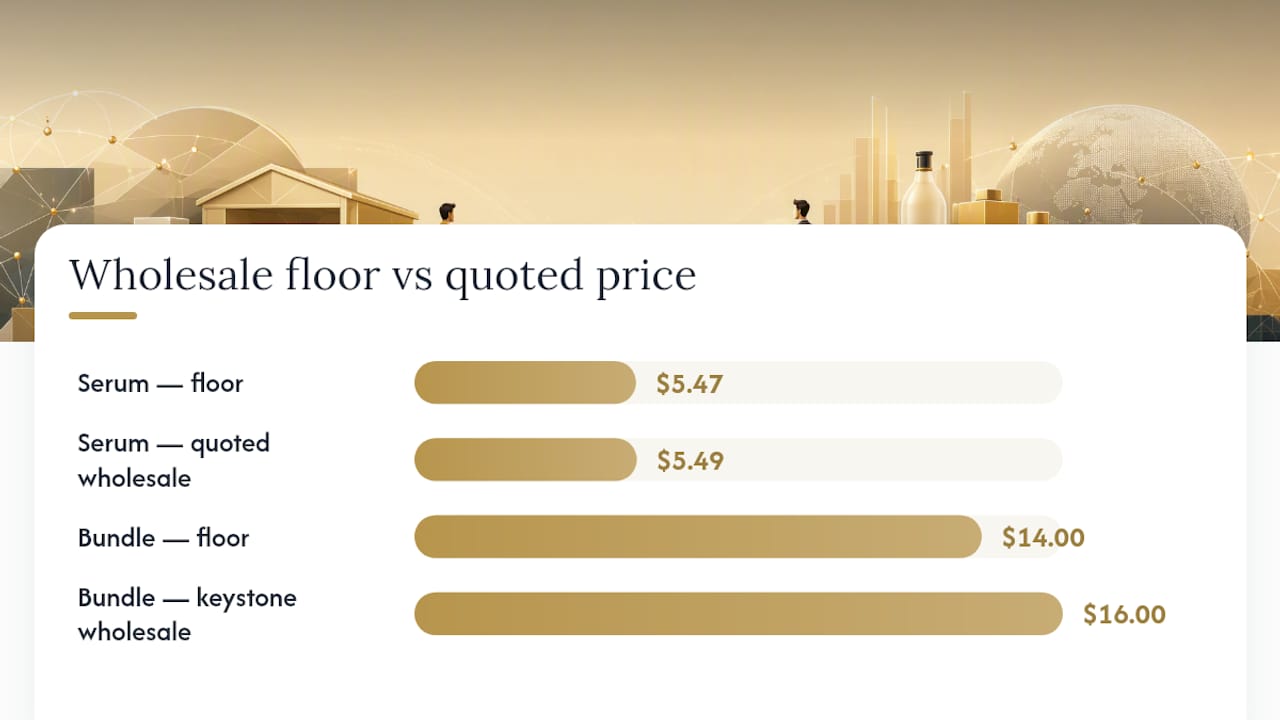
Worked example 1: A $9.50 skincare serum. Landed cost is $4.10. Target margin is 25%. Floor = $4.10 ÷ 0.75 = $5.47. At a 45% wholesale discount off an $9.99 MSRP, wholesale price is $5.49, just above the floor. That is a workable, if thin, margin.

Worked example 2: A $32 supplement bundle. Landed cost including packaging is $9.80. Floor = $9.80 ÷ 0.70 = $14.00. Keystone at $16.00 wholesale sets MSRP at $32.00, comfortably above the floor with room for a volume discount tier later.

Common wholesale discounts run 40% to 50% off MSRP for independent retailers, 50% to 60% for chains and big-box accounts, and 55% to 65% for distributors, according to Saucery’s wholesale pricing benchmarks. Check your floor against those bands before you quote a number to any buyer.
Which Wholesale Pricing Model Fits Your Brand?
Once your floor is set, the model you choose determines how much of your margin actually survives contact with real buyers. Each one solves a different problem.
- Keystone pricing works when your category has an established retail markup convention (beauty, apparel, home goods) and buyers expect the 2x relationship without negotiation. It is simple to explain and simple for reps to quote, but it can leave money on the table for high-demand SKUs.
- Cost-plus pricing fits commodity-adjacent products where buyers compare your markup against category norms. It is transparent and defensible in negotiations, but it ties your price to your cost structure rather than to what the product is actually worth to the buyer.
- Value-based pricing anchors the wholesale price to the retailer’s expected sell-through velocity, margin dollars per linear foot, or brand halo effect, not just your cost. It protects margin best when you have real demand data or a defensible brand story, but it requires more sophisticated sales conversations and doesn’t scale well with junior reps.
- Tiered/volume pricing rewards larger orders with lower per-unit costs, which nudges buyers toward bigger commitments and smooths your own production planning.
Most established consumer brands land on a hybrid: a value-based or keystone anchor price that reflects what the market will bear, layered with tiered discounts that reward volume without collapsing your baseline margin. The anchor protects your floor. The tiers give reps a lever to close bigger deals without a discretionary discount every time a buyer pushes back.
How Do You Design Volume and Tiered Discounts Without Bleeding Margin?
Tiered discounts are the fastest way to grow average order size, and also the fastest way to quietly erase your margin if you build them wrong. The structure matters as much as the numbers.
- Choose retroactive or incremental, deliberately. Retroactive (cliff) pricing applies the lower rate to the entire order once a buyer crosses a threshold, which drives bigger one-time orders but can wipe out margin on the units below the threshold. Incremental pricing applies the discount only to units above each break point, protecting your baseline margin throughout, as Salesforce’s volume pricing guidance lays out. Default to incremental; reserve cliff pricing for closeout inventory or a specific strategic account push.
- Set thresholds from your own order history, not a guess. Pull your last twelve months of wholesale orders and find where natural clusters sit. Set each tier’s jump point slightly above the current clustering, per The Pricing Assistant’s bulk pricing analysis, so the discount genuinely pulls buyers up rather than just rewarding orders they were already placing.
- Cap it at two or three tiers. A four-or five-rung ladder confuses reps, slows quoting, and multiplies the number of places margin can leak. MyRevify’s tier governance research found that a simplified, few-tier structure with documented qualification rules recovers meaningful margin that complex grids quietly lose.
Pro Tip: Before you publish a new tier, run the math on a real order at the bottom of that bracket. If the discounted price doesn’t clear your margin floor once cost-to-serve is included, the tier is broken, no matter how good it looks on paper.
Every tier needs a guardrail check: does the discounted price still clear your contribution margin floor after cost-to-serve? Does the lower per-unit cost at scale (smaller pick fees, fuller pallets, less packaging waste per unit) actually offset part of the discount? If a tier only pencils out on the theoretical wholesale price and ignores the fulfillment reality behind it, it will lose money the moment a real order hits it.
Are You Accounting for the Full Cost of Serving a Wholesale Account?
Landed cost gets the headline attention, but cost-to-serve is where most wholesale margin quietly disappears. Landed cost includes manufacturing, inbound freight, duties, and packaging, allocated per unit received rather than per unit ordered. Miss that distinction and shrink or damaged inventory alone can push you below your floor without you noticing for months.
Cost-to-serve is the second, less visible layer: case-pack labor, palletizing, outbound freight to the account, returns processing, and any per-order fees your fulfillment partner charges. A few line items to build into every wholesale price:
- Pick and pack labor per unit, not per order, since case sizes vary by account.
- Outbound freight, quoted per destination zone rather than a flat national average.
- Return and chargeback allowance, especially for accounts with strict compliance requirements.
- Any minimum handling fee your 3PL charges below a certain order size.
Reviewing 3PL cost benchmarks against your own fulfillment invoices at least quarterly catches drift before it compounds. Keep a live cost sheet, not a quarterly spreadsheet you update from memory. Freight rates and packaging costs move often enough that a static cost basis from six months ago will systematically understate your true floor, and every wholesale quote built on it inherits that error.
How Should You Handle MAP, MOQs, and Net Terms?
Wholesale pricing doesn’t exist in isolation from the rest of your channel strategy. Three policies determine whether your wholesale program strengthens your direct-to-consumer business or quietly cannibalizes it.
- Set MAP close to your DTC price to maintain channel harmony. Minimum advertised price policy keeps retailers from advertising your product so far below your own site that shoppers buy elsewhere and you lose the margin entirely, a pattern detailed in Reddog’s wholesale pricing protection guidance. Enforcement needs teeth: a documented MAP policy with clear consequences, monitored monthly, not a clause buried in a wholesale agreement nobody reads twice.
- Base MOQ and MOV on your case-pack economics, not a round number. If your case pack is 12 units and your per-order fulfillment cost only pencils out above 3 cases, your minimum order quantity should reflect that math, not an arbitrary “24 units” pulled from a competitor’s terms sheet. Retailers building out wholesale accounts, as shown on pages like Darius Cordell’s wholesale terms, typically expect clear case-pack and minimum-order detail up front.
- Price in the cost of net terms. Net 30 or net 60 terms are effectively short-term financing you extend to the buyer. If you’re paying for inventory 60 days before you collect on it, that carrying cost belongs in your margin math, not treated as free. For price increases, give accounts 60 to 90 days’ notice, a cadence Shopify’s wholesale pricing guidance recommends to avoid disrupting a retailer’s own buying and reset cycles.
How Do You Build a Wholesale Price List That Doesn’t Leak Margin?
A price list only protects your margin if it’s actually followed, which means the document itself needs structure, not just numbers.
Every wholesale price list needs these fields at minimum: SKU and product name, case pack size, wholesale unit price by tier, MOQ, MAP (where applicable), payment terms, and an effective date. Distribute it as both a clean PDF for buyer-facing use and a CSV or Excel version your sales team and finance can actually manipulate.
- Version every price list with a clear effective date, and archive the previous version rather than overwriting it.
- Distribute updates to reps and key accounts simultaneously, never let one rep quote last quarter’s pricing because they missed an email.
- Route every discount exception through a single deal desk process rather than letting reps negotiate ad hoc.
- Set an expiration date on every negotiated exception, so a one-time accommodation doesn’t quietly become a permanent discount.
- Run a monthly transaction review against your published price list to catch drift before it becomes a pattern.
MyRevify’s research on tier governance found that centralized exception approval, paired with expiration dates and monthly monitoring, recovers real annual margin that would otherwise vanish one small concession at a time.
What Are the Most Common Wholesale Pricing Mistakes?
Five mistakes account for most of the wholesale margin damage Commerce Catalyst sees in founder conversations: setting DTC price first and halving it, ignoring fulfillment cost entirely, publishing a MAP policy with no enforcement plan, building five or six tiers nobody can quote consistently, and letting small orders slip through without a minimum that covers handling cost.
Run this ten-item audit in under thirty minutes:
- Does your wholesale floor formula start from landed cost, not from a discounted retail price?
- Have you updated landed cost inputs in the last ninety days?
- Does cost-to-serve include outbound freight and pick/pack labor per unit?
- Is your MAP within roughly 5% of your DTC price?
- Do you have a documented MAP enforcement process?
- Do you have three or fewer discount tiers?
- Does your lowest tier clear your margin floor after cost-to-serve?
- Is your MOQ based on case-pack economics rather than a round number?
- Does every price list carry a version date and distribution log?
- Do negotiated exceptions have expiration dates?
Pro Tip: If you answered “no” to three or more of these, don’t rebuild your entire pricing structure this week. Fix your cost inputs first, then your floor, then your tiers. Sequence matters more than speed.
Three fast wins: recalculate your floor with current landed cost this week, cap any tier structure with more than three levels immediately, and audit your last quarter of orders against your published price list for silent violations. Trimming SKU-level costs, as outlined in cost reduction strategies for product brands, often frees up margin room faster than renegotiating a single wholesale account.
What Does a Practitioner-Level Wholesale Pricing Fix Actually Look Like?
Fixing wholesale pricing at the operational level follows a sequence, and skipping steps is how founders end up rebuilding the same broken structure twice. Commerce Catalyst’s advisory work with consumer brand founders consistently starts in the same place: cost data before pricing logic, pricing logic before tier design.
The priority order that works:
- Fix cost inputs first. No pricing formula survives stale landed cost or missing cost-to-serve data.
- Set margin floors before touching tiers. A floor gives every subsequent discount decision a hard boundary.
- Simplify tier structure. Collapse five-tier grids into two or three before adding any new discount logic.
- Automate cost alerts. A live cost feed that flags when freight or materials shift beyond a threshold prevents floors from drifting silently, an approach The Pricing Assistant’s bulk pricing research recommends once manual updates start slipping.
- Renegotiate key accounts last. Only after floors and tiers are solid should you reopen legacy account terms.
Diagnostic engagements built around this sequence typically produce a price floor model tied to real cost data, a tier validation against actual order history, and a benchmark comparison of your fulfillment costs against category norms. Founders scaling past $5 million in revenue tend to have outgrown spreadsheet-based pricing well before they notice it, which is usually the moment the margin leaks start showing up in cash flow instead of in a report.
Why Founders Keep Underpricing Their Best Wholesale Accounts
The wholesale pricing mistakes that do the most damage rarely look like mistakes in the moment. None of these decisions feel reckless individually. Compounded over a year, they are often the difference between a wholesale channel that funds growth and one that quietly drains it.
The instinct to prioritize the top-line order size over the margin line is understandable, and it is also the single most reversible mistake in this article. Run the ten-item audit this month. If it surfaces systemic issues rather than isolated fixes, that’s usually the signal a structured diagnostic makes more sense than another spreadsheet rebuild.
Get a Structured Diagnostic on Your Wholesale Margin
Everything above gives you the formulas and governance rules to fix wholesale pricing yourself. If the audit above turned up more than a couple of red flags, or your cost data is scattered across three spreadsheets nobody fully trusts, Commerce Catalyst’s DTC Financial Health Assessment is built specifically to find where wholesale margin is leaking and hand you a prioritized fix list, not another framework.

The assessment typically runs two to four weeks and produces a clear picture of your landed cost accuracy, tier structure integrity, and cost-to-serve gaps, benchmarked against what similar consumer brands are actually paying their fulfillment partners. You walk away with a prioritized action list instead of a diagnosis with no next step. For founders who need ongoing enforcement rather than a one-time review, a Fractional COO engagement extends that same rigor into monthly governance. Start with the assessment and see exactly where your wholesale numbers stand.
Where to Read More on Wholesale Pricing
- QuickBooks’ wholesale pricing formulas walk through the calculation approach this article builds on, with additional worked examples by category.
- Shopify’s guide to wholesale and retail pricing covers review cadence and price-increase communication in more depth.
- Salesforce’s volume pricing overview explains retroactive versus incremental tier mechanics for teams managing more complex account structures.
- MyRevify’s tier governance research details the exception-control practices referenced in the governance and audit sections above.
Sources
- How to calculate wholesale price: Formulas + examples: QuickBooks
- Shopify: product pricing for wholesale and retail
- Volume pricing guidance: Salesforce