A layered, risk-based returns program combining clear policy, identity linkage, and targeted verification stops most return fraud while preserving customer experience. Start this week with three moves: enforce proof-of-purchase on every refund, add threshold rules that flag high-frequency returners, and require photo evidence on high-risk categories.
- Enforce proof-of-purchase before issuing any refund
- Set simple threshold rules (refund count, dollar amount, timing near policy deadlines)
- Require photo evidence for flagged, high-value, or condition-disputed returns
Expect a meaningful drop in losses within a quarter. Watch your false-positive rate closely. If legitimate customers start getting flagged, you’ve overcorrected.
Key Takeaways
Returns fraud prevention works best as a layered system combining clear policy, identity linkage, targeted verification, and ownership assigned to one accountable team.
| Point | Details |
|---|---|
| Start with three controls | Enforce proof-of-purchase, add threshold rules, and require photo evidence for high-risk returns. |
| Refund abuse differs from chargebacks | It bypasses card networks entirely, so ownership must extend beyond payments and risk teams. |
| Verify in person when possible | Item inspection at drop-off cuts fraud by at least 85% versus mail-in returns. |
| Track four core metrics | Monitor refund rate by cohort, repeat refunder rate, false positive rate, and recovery rate. |
| Get a structured diagnostic | Commerce Catalyst’s Financial Health Assessment identifies where refund losses are cutting into margin. |
Table of Contents
- What Is Returns Fraud Prevention, and How Does It Differ From Chargeback Fraud?
- What Does Returns Fraud Actually Cost Retailers?
- What Are the Most Common Types of Return Fraud?
- What Red Flags Signal Return Abuse or Organized Fraud?
- How Do You Detect Return Fraud Before It Scales?
- What Controls Prevent Return Abuse Without Hurting the Customer Experience?
- What Vendor Tools Help Detect and Prevent Return Fraud?
- How Should You Operationalize a Returns Fraud Program?
- Which Metrics Actually Measure Program Success?
- Why Does AI-Driven Return Risk Intelligence Matter?
- How Do You Recover Losses After Confirmed Return Fraud?
- Where Merchants Get Returns Fraud Prevention Wrong
- How Commerce Catalyst Helps You Close the Returns Fraud Gap
- Sources
What Is Returns Fraud Prevention, and How Does It Differ From Chargeback Fraud?
Returns fraud prevention means stopping customers from exploiting refund policies through wardrobing, empty-box claims, false non-delivery reports, and similar tactics. Refund abuse bypasses card networks entirely, unlike chargeback fraud, which involves a bank-initiated dispute. That distinction determines who owns the problem: chargebacks sit with payments and risk teams, while return abuse often hides inside normal customer service workflows where no one is watching for patterns.
What Does Returns Fraud Actually Cost Retailers?
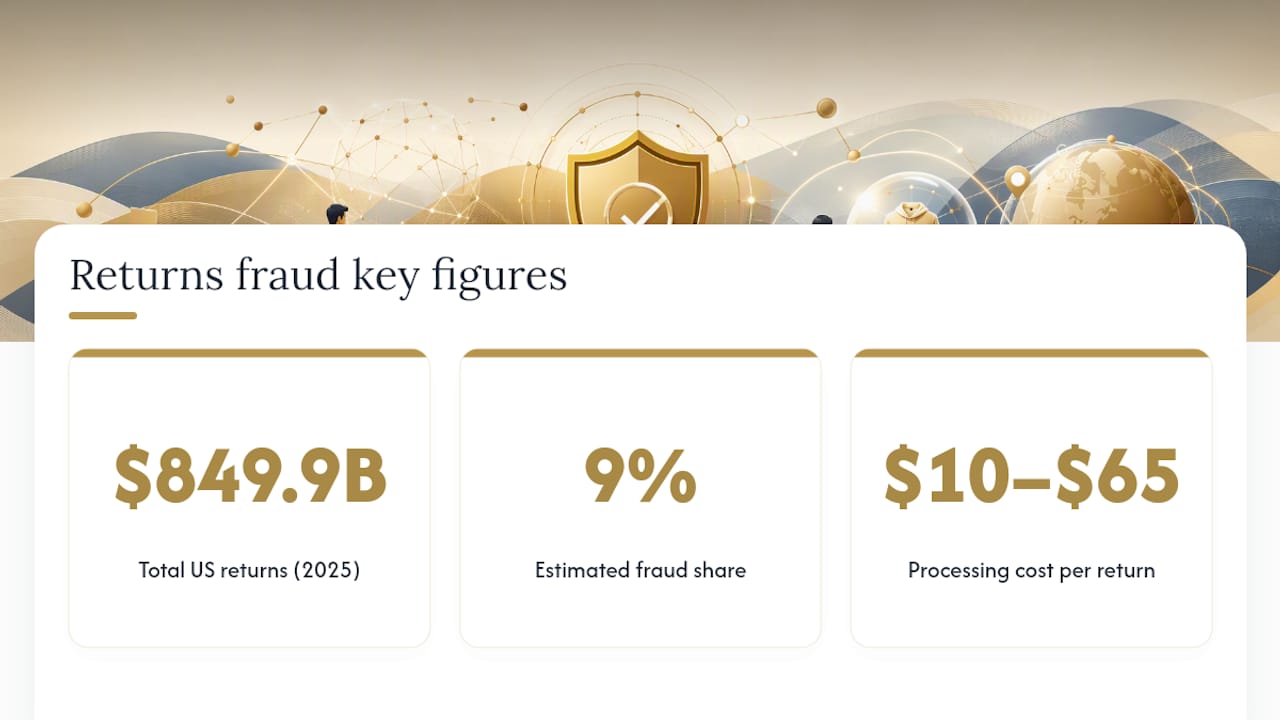
US retail returns approached $849.9 billion in 2025, and industry estimates put roughly 9% of those returns as fraudulent. Beyond the refunded amount, retailers absorb lost inventory, restocking fees, and diminished resale value on returned goods. Processing a single return typically costs between $10 and $65, depending on the product and shipping distance. Add staff hours spent investigating disputes and the wasted acquisition spend on customers who never intended to keep what they bought.
What Are the Most Common Types of Return Fraud?
Fraud patterns vary by channel and intent, but a handful of behaviors account for most losses:
- Wardrobing: a customer wears an item once, then returns it as unused, common with formalwear and shoes.
- Empty-box returns: the box arrives back with packing material but no product inside.
- False non-delivery (INR): a buyer claims a package never arrived while tracking shows delivery.
- Receipt fraud: forged or altered receipts inflate the claimed purchase price.
- Price-switching: a cheaper item’s barcode gets swapped onto a pricier product before return.
- Bracketing: ordering multiple sizes or colors with the intent to return most of them.
- Counterfeit or decoy returns: a fake replaces the genuine product in the returned package.
- Employee-assisted returns: staff process fraudulent refunds for accomplices or themselves.
Mail-in channels amplify empty-box, INR, and counterfeit schemes since no one inspects the item at the point of return.
What Red Flags Signal Return Abuse or Organized Fraud?
Certain patterns show up before losses spiral. Customer-level warning signs include repeat refunders, refund activity concentrated among a small group of accounts, and claims filed right at the edge of your return window. Technical signals matter just as much: shared device fingerprints, VPN or proxy use, recycled email patterns, and multiple accounts pointing to one shipping address or payment method.

Operationally, watch for refunds that don’t match an original sale, a rising share of “no reason given” codes, and returns accepted at full value despite visible damage. Falling resale recovery rates and claims that arrive without any prior customer service contact are two of the clearest early indicators something is off.
That single filter surfaces most serial abusers before they scale up.*
How Do You Detect Return Fraud Before It Scales?
Threshold rules catch obvious cases fast: more than three returns in 30 days, refunds exceeding a set dollar ceiling, or claims filed within 24 hours of a policy deadline. But thresholds alone miss subtler abuse, which is why anomaly detection matters. Comparing each customer against a cohort baseline, rather than a fixed number, catches behavior that looks normal in isolation but abnormal in context.
- Link identity signals across systems: device fingerprints, payment methods, and shipping addresses.
- Route low-risk returns to auto-approval to keep good customers moving.
- Send flagged cases to manual review with a clear evidence checklist attached.
- Require photo or video documentation before issuing refunds on high-risk claims.
Academic research on multi-signal detection frameworks that combine transaction data, behavioral history, and natural language analysis of return reason text found a 76% embellishment rate in customer-written return explanations, a strong argument for looking at what customers actually write, not just what boxes they check.
What Controls Prevent Return Abuse Without Hurting the Customer Experience?
Getting this balance wrong in either direction costs you money, either through fraud losses or through legitimate customers who abandon your brand over friction. A tiered system solves both problems at once.
- Design the policy clearly. Set explicit return windows, condition standards, and proof-of-purchase requirements. Add restocking fees where local law permits.
- Route by risk tier. Trusted, low-risk customers get instant refunds. Flagged accounts go through additional verification before money moves.
- Verify at the point of contact. In-person drop-off with item inspection reduces fraud by at least 85% compared with mail-in returns, since someone actually looks at the product.
- Delay refunds on flagged items until inspection confirms the claim matches the return.
- Apply progressive restrictions to repeat abusers, tightening return privileges or requiring manager approval, which only works if you’ve already linked their identity across accounts.
- Train staff with an inspection checklist so counter employees and customer service reps can spot inconsistencies without turning every interaction into an interrogation.
Pro Tip: Give your customer service team a one-page decision tree for “return looks off” scenarios. Most fraud gets waved through because reps don’t want to escalate a judgment call.
What Vendor Tools Help Detect and Prevent Return Fraud?
Four vendor categories cover most of the returns fraud prevention landscape: AI-driven network risk intelligence, payment-level fraud engines, returns management platforms, and in-person verification services. Riskified and similar network-signal providers pool anonymized data across merchants to flag serial abusers no single retailer could see alone. Stripe Radar applies machine learning at the payment layer, useful when refund abuse overlaps with payment fraud. Stord and comparable fulfillment-side platforms add auditing at the warehouse level, catching empty-box and item-substitution schemes before they become chargebacks.
- Match vendor choice to your channel mix: high mail-in volume needs stronger identity linkage and NLP-based reason-code analysis.
- Store-heavy retailers benefit more from in-person verification tools than from network AI alone.
- Weigh implementation complexity against your team’s technical bandwidth before committing.
How Should You Operationalize a Returns Fraud Program?
Assign a single owner who bridges fraud, customer service, finance, and operations, since return fraud prevention fails when it’s nobody’s explicit job. Build a review queue with clear escalation rules and defined progressive enforcement steps for repeat offenders.
- Require a reason code on every single return, no exceptions.
- Run monthly cohort reports comparing refund rates across customer segments.
- Reconcile refunds against original sales weekly, not quarterly.
- Small teams can start with a shared spreadsheet and three threshold rules; larger merchants need dedicated ownership structures and tool integrations.
Which Metrics Actually Measure Program Success?
Four numbers matter most: refund rate by cohort, repeat refunder rate, false positive rate, and recovery rate on flagged goods. Track time-to-refund and your win rate on chargeback representments as secondary indicators of program health.
- Segment refund rate by customer cohort to spot which acquisition channels attract abusers.
- Monitor false positive rate weekly. A spike means you’re punishing good customers.
- Roll out new rules to a test segment first, then measure impact before going company-wide.
Why Does AI-Driven Return Risk Intelligence Matter?
Single-merchant data has a blind spot: a serial abuser who spreads activity across ten retailers looks clean at each one individually. Return Risk Intelligence solves this by analyzing anonymized transaction patterns across merchants, surfacing repeat offenders that no single company’s data could reveal. Combine this network layer with your own anomaly detection and a human review step, since AI flags candidates but rarely should issue the final decision alone.
- Network signals catch cross-merchant serial abusers.
- In-house rules catch behavior specific to your customer base and product mix.
- Human review resolves ambiguous cases the models can’t confidently score.
Pro Tip: Ask any vendor pitching network intelligence how often their model retrains and on what cadence they validate precision against confirmed fraud outcomes, not just flagged volume.
How Do You Recover Losses After Confirmed Return Fraud?
Once you’ve confirmed fraud, three recovery paths open up: chargeback representment, direct collections, and legal referral for organized cases. Chargeback representment applies when the fraudulent return connects to a disputed charge; document the item’s condition, the return timeline, and any photo evidence, then submit through your payment processor’s dispute portal within their filing window.

For confirmed wardrobing or empty-box schemes without a card dispute, direct collections rarely recover much. The better move is closing the loop operationally: flag the account, restrict future purchases to prepaid-only or final-sale terms, and add the identity markers (device, address, payment method) to your internal watchlist so the same person can’t simply create a new account.
Organized fraud, coordinated bracketing rings, counterfeit substitution networks, or employee-assisted schemes, warrants a different response. Loop in legal counsel early. Document everything: timestamps, communication logs, photo evidence, and financial impact. Many jurisdictions treat coordinated retail fraud above certain dollar thresholds as a criminal matter, and a documented case gives law enforcement something to act on.
Compliance matters here too. Any customer restriction policy needs to apply consistently across your customer base to avoid discrimination claims, and refund denial decisions should be defensible with clear evidence, not just an algorithm’s risk score. Keep a written record of why each contested case was denied. If a customer disputes the decision later, whether through a regulator complaint or a public review, you’ll want the paper trail ready. Recovery isn’t just about getting money back; it’s about building a defensible process for the next hundred cases.
Where Merchants Get Returns Fraud Prevention Wrong
At Commerce Catalyst, our diagnostics prioritize finding the quick wins first: the threshold rule you’re missing, the reason code nobody’s tracking, the cohort where refund rates have quietly doubled. Governance comes second, once you know where the leaks actually are. If you suspect returns are eating into margin but can’t quantify it, that’s usually the first sign you need a structured look at the numbers, not another policy memo.
How Commerce Catalyst Helps You Close the Returns Fraud Gap
Fixing a leaky returns process usually isn’t a technology problem first, it’s a visibility problem. Commerce Catalyst’s DTC Financial Health Assessment pinpoints exactly where refund losses are eating into your margin, cohort by cohort, before you spend a dollar on new tools.

For brands that need faster results, the 90-Day Profit Sprint turns those findings into concrete operational fixes: reconciliation processes, ownership assignments, and threshold rules that actually get implemented instead of sitting in a slide deck. If your returns problem is part of a broader operational gap, no clear owner, no cross-functional process, a Fractional COO engagement puts an operator in the seat to run it. Book a diagnostic conversation and find out what your refund losses are actually costing you this quarter.
Sources
- Return Risk Intelligence story | Mastercard
- Refund Abuse: How to Spot and Stop It | Stripe
- The Hidden Threat in your Returns: How to Spot, Stop, and Prevent Return Fraud: Happy Returns
- Behavioral Pattern Analysis for Return Fraud Detection in High-Volume E-Commerce: A Multi-Signal Approach | International Journal of Artificial Intelligence, Data Science, and Machine Learning
- Beancount
- Return Abuse: 7 Warning Signs You Have a Problem | Wyllo