An investor data room is a secure, organized virtual workspace where startups host financials, contracts, and corporate records for investor and acquirer review. The move here is simple: build a lightweight, investor-ready room before you start outreach, not after a term sheet lands and someone asks for diligence materials in 48 hours.
Two things separate a real data room from a folder of PDFs you email around. First, an audit trail that timestamps every view, download, and question. Second, an NDA gate that captures consent before anyone sees a single file. At Commerce Catalyst, we’ve watched founders lose weeks of momentum scrambling to assemble documents mid-raise, when the fix costs a weekend upfront.
What you need before your first investor call:
- A folder structure organized by category, not by whenever you happened to create the file
- Signed NDAs collected automatically at login
- An index spreadsheet that tells reviewers what’s inside before they click
Key Takeaways
An investor-ready data room requires a numbered folder structure, NDA-gated security controls, and a maintenance cadence that keeps documents current between raises.
| Point | Details |
|---|---|
| Build before you need it | Maintain a standing room updated monthly so inbound investor interest never catches you unprepared. |
| Sequence documents by priority | Upload the pitch deck, cap table, and financials first; contracts and IP documentation follow. |
| Configure security defaults | Set NDA-at-login, watermarking, and view-only access before granting any investor entry. |
| Budget realistically | Expect $180 to $5,000+ monthly depending on tier, with free starter options for early-stage rounds. |
| Stagger access and track engagement | Invite lead investors first, then use audit log activity to spot who’s genuinely close to a decision. |
Table of Contents
- What Is an Investor Data Room and When Do You Need One?
- What Documents Should You Upload First?
- How Do You Structure the Folder Hierarchy?
- What Security Controls Should You Configure?
- Which Platform Features Actually Matter?
- How Do You Run the Room During Diligence?
- What Founders Get Wrong About Data Rooms
- Sources
What Is an Investor Data Room and When Do You Need One?
A data room is a permissioned digital environment built specifically for confidential document exchange during fundraising, M&A, or audits. It is not Google Drive with a folder named “Investors.” Dropbox and Drive move files. A dedicated virtual data room controls who sees what, tracks every interaction, and produces the kind of audit log a lawyer or acquirer will actually ask for.
When do you actually need one? Two scenarios trigger it:
- **A standing room, kept current from your seed round onward, so you’re never caught flat-footed by inbound interest
- An ad-hoc room, spun up fast for a specific raise, acquisition talk, or audit
Standing rooms win. Founders who keep documents current on a rolling basis close rounds faster than those rebuilding everything from scratch every time a term sheet conversation starts.
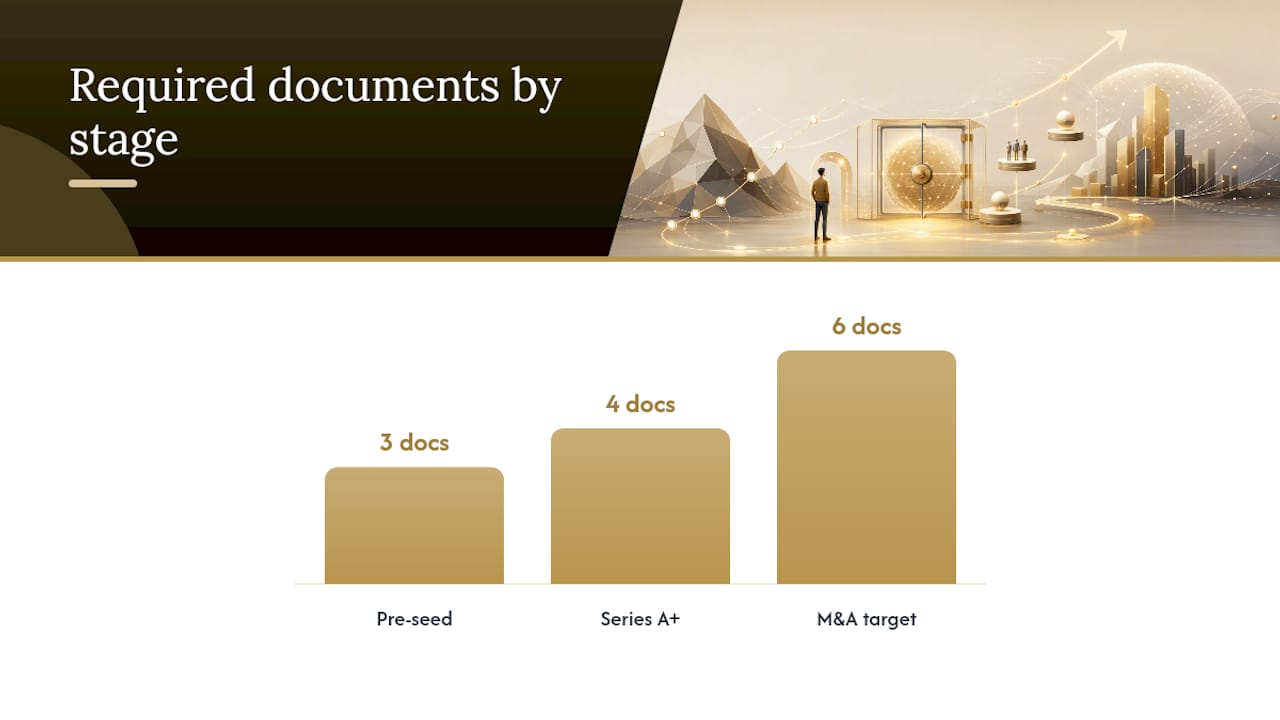
Depth should scale with your stage. Pre-seed founders need a deck, a cap table, and basic incorporation documents. Series A and beyond, expect requests for audited financials, customer contracts, IP assignments, and employment agreements. An M&A target needs all of that plus litigation history and insurance schedules.
What Documents Should You Upload First?
Investors don’t read your data room cover to cover. They scan for red flags and green lights in a specific order, so upload in that order too.
Here’s the priority sequence that gets you investor-ready fastest:
- Pitch deck and one-page executive summary. This is the front door. Keep it current with the version you’re actively pitching, not last quarter’s deck.
- Cap table. Fully diluted, showing option pool, SAFEs, convertible notes, and any side letters. Investors check this within minutes of getting access.
- Trailing 12-month P&L and balance sheet. Even rough numbers beat no numbers. If you don’t have clean statements, a founder financial dashboard built around your real unit economics buys you credibility while your books catch up.
- Key customer contracts and revenue concentration summary. Investors want to know if 60% of revenue sits with two accounts.
- Core IP documentation. Patents, trademarks, and, critically, invention assignment agreements from every founder and early engineer.
Stage changes what comes next. A pre-seed founder can stop roughly there and add employment agreements and a basic org chart. A Series A company or an M&A target needs to go further: audited or reviewed financials, full contract repository, litigation disclosures, insurance policies, and regulatory filings.
Three practical habits save you real time. Keep one master version of every file. Nothing kills investor confidence faster than three different cap tables with three different numbers floating around a room. Write a two-paragraph executive summary for each top-level folder so reviewers know what’s inside before opening a single document, which a master index approach consistently speeds up. And build the index spreadsheet before you upload anything, not after.

Pro Tip: Build your document checklist against the investor stage you’re actually targeting, not the stage you hope to be at next year. A Series A investor doesn’t care about your five-year hiring plan; they care whether your current contracts survive their lawyer’s redline.
How Do You Structure the Folder Hierarchy?
Numbered top-level folders beat alphabetical or thematic naming because they mirror the order investors actually review material. A standard structure covers eight categories most reviewers expect to see, based on common due diligence conventions.
Here’s a copyable structure you can paste into any platform today:
| Folder Number | Category | Example Subfolders/Files |
|---|---|---|
| : | Corporate & Governance | Articles of incorporation, cap table, board minutes, stock ledger |
| : | Financials | P&L, balance sheet, tax returns, financial projections |
| : | Intellectual Property | Patents, trademarks, IP assignment agreements |
| 04 | Contracts | Customer agreements, vendor contracts, leases |
| : | Human Resources | Employment agreements, org chart, equity grants |
| : | Product & Technology | Architecture overview, security docs, tech roadmap |
| : | Commercial & Sales | Sales pipeline, pricing sheets, key partnership terms |
| : | Compliance & Insurance | Insurance policies, regulatory filings, licenses |
Within each folder, keep naming consistent: date first, then document type, then version number. “2026.:.15_CapTable_v3” beats “cap table FINAL final2.”
Numeric indexing does more than look tidy. It gives every document a permanent address you can reference in Q&A responses (“see Folder 04, Customer Agreement #7”) without anyone hunting through nested subfolders. Pair it with an index spreadsheet listing every file, its folder location, and last-updated date, and you’ve cut reviewer friction dramatically before a single question gets asked.
What Security Controls Should You Configure?
Security settings are not a checkbox you configure once and forget. They’re the difference between controlled disclosure and a leaked cap table sitting in a competitor’s inbox.
Configure these defaults before you send a single invite:
- NDA at login. Require a timestamped, signed NDA acceptance before anyone views a document, not after they’ve already skimmed your deck.
- Watermarking on every page. Dynamic watermarks showing viewer name, email, and timestamp discourage casual screenshotting far more than a generic “confidential” stamp.
- View-only as the default permission, with download access granted folder by folder as trust builds through the process.
- Group-based permissions, so a lead investor’s full diligence team sees more than a passive syndicate member checking in once.
Competitively sensitive material, your customer list, unit economics by SKU, supplier pricing, deserves the tightest lockdown. If a strategic investor or potential acquirer also competes with you in some adjacent way, set up a clean-team arrangement: a neutral third party or specific individuals get access to sensitive commercial data, while the rest of their team sees a redacted version.
Redaction itself has moved fast. AI redaction tools now automatically flag and mask sensitive fields like Social Security numbers or specific contract pricing across hundreds of pages in minutes. But automated redaction should get a human review pass before anything goes live. AI catches patterns; it misses context, like the one paragraph in a contract that reveals a customer’s identity without ever naming them directly.

For your most sensitive folder, usually cap table detail or IP assignments, disable downloads entirely. Force everyone to view inside the platform where every scroll gets logged.
Pro Tip: Set your NDA gate to trigger a notification to your own inbox the moment someone signs. That’s often your first real signal an investor is moving from casual interest to serious evaluation.
Which Platform Features Actually Matter?
Vendor demos love to show off flashy dashboards. Ignore most of that and focus on features that reduce your actual workload and risk exposure.
Prioritize these when evaluating platforms:
- A functional Q&A module that routes questions to the right internal owner automatically
- Audit logs detailed enough to show document-level view history, not just room-level login counts
- OCR and automatic indexing so uploaded scans become searchable text immediately
- Bulk upload with AI-assisted classification, sorting files into folders as you drag them in
- Integrations with your CRM or fundraising tracker, so investor activity data doesn’t live in a silo
By 2026, AI and automation have become core infrastructure in leading platforms, powering automated classification, contract data extraction, and engagement analytics. That’s a real efficiency gain, but it raises governance questions you should ask directly in every demo: Where does uploaded data live? Does the vendor train models on your documents? What’s the retention policy after you close or abandon the room? Many investors and acquirers now require written confirmation before diligence material touches any AI training pipeline.
On cost, 2026 pricing splits into three rough bands: basic plans run $180 to $500 per month, mid-tier platforms $500 to $1,200, and enterprise setups $1,200 to $5,000 or more, often scaled by storage, seat count, or per-project fees. Early-stage founders don’t need enterprise tools. Some providers, AngelList among them, offer free starter tiers with limited rooms and storage that cover most pre-seed and seed needs without a monthly bill.
How Do You Run the Room During Diligence?
Opening the floodgates to every interested investor on day one is a mistake. Stagger access instead, and let engagement data tell you who’s serious.
Run diligence in this sequence:
- Invite your lead investor’s full team first, giving them broader folder access than passive participants get.
- Grant secondary and syndicate investors a tiered view, typically financials and corporate governance, with commercially sensitive folders locked until they show real commitment.
- Route every question through a single Q&A workflow, assigning internal owners (you, your CFO, outside counsel) and requiring a legal approval step before sensitive answers go out.
- Set a response SLA of 48 to 72 business hours and hold your team to it. Slow answers read as disorganization, even when the underlying business is solid.
- Check engagement analytics weekly. An investor who’s opened your cap table folder six times and spent twenty minutes in your customer contracts is telling you something a polite email never would.
Audit logs and Q&A histories aren’t just operational tools during the raise. They often become the legal record of what was disclosed, and many teams archive that full history for one to seven years depending on their regulatory exposure.
Pro Tip: Treat a sudden spike in one investor’s document views as your cue to reach out proactively, not wait for them to email you. It usually means they’re building an internal memo, and a quick check-in call at that moment closes rounds faster.
How Long Does It Take to Prepare and Maintain a Room?
Most founders can go from an empty platform to a fully populated, investor-ready room in about four weeks, assuming the folder structure and document inventory get planned before anyone touches the software itself. Templates cut that timeline further.
A realistic four-week arc looks like: week one for planning and inventory, week two for gathering and formatting documents, week three for upload and permission setup, week four for quality control and a dry-run walkthrough with a trusted advisor.
Maintenance matters more than most founders assume. Update financials monthly, refresh the cap table whenever it changes, and run a full pre-raise audit at least once per quarter.
Before sending your first invite, confirm:
- Every file opens correctly and shows the current version
- NDA and permission settings match your intended tiers
- The index spreadsheet matches what’s actually uploaded
A 30-Day Sprint for Resource-Limited Founders
Commerce Catalyst works with consumer brand founders who don’t have a finance team to delegate this to, so sequencing matters more than perfection. Start with the financial artifacts investors scrutinize hardest: your P&L, cash flow, and unit economics, then build out corporate and IP folders once the financial story is defensible.
Our investor readiness framework and the signs your business is investment-ready checklist both point to the same conclusion.
The founders who close fastest aren’t the ones with the fanciest data room design. They’re the ones whose financial story holds up the moment a reviewer starts asking follow-up questions.
Prioritize financials, then cap table clarity, then contracts, in that order, for your first 30 days.
What Founders Get Wrong About Data Rooms
Most founders treat the data room as a formality, something to slap together the week a term sheet shows up. That’s backward. The room itself is a signal. A disorganized, half-populated room tells an investor your operations are probably just as scattered, whether or not that’s actually true.
The conventional advice, “just use Google Drive until you need something fancier,” undersells the real cost. It’s not about looking polished. It’s about the audit trail and permission structure that let you control disclosure precisely, and about the speed a standing room gives you when an inbound offer arrives on a Tuesday and closes by Friday.
What should you prioritize first? Not the folder aesthetics. The financial story. Cap table clarity and clean trailing financials do more to accelerate a raise than a perfectly organized IP folder ever will. Get the numbers defensible, then build the structure around them.
This article is general information, not a substitute for advice from a qualified financial advisor. Consult a qualified financial professional about your own circumstances before acting on anything here.
Sources
- How to Create a Data Room: Structure and Security - LegalClarity
- Data Room Structure: How to Organize for Due Diligence | Tadda
- AngelList investor management / data room (product page)
- Virtual Data Room Trends 2026: AI, Automation, and the Future of Deal Management - TechBullion