You are ready when your home market is profitable, inbound demand exists in a specific target country, and you have 18 to 24 months of runway to absorb a slow first year. If those three hold, the next move is a small, measurable pilot, not a full-scale launch. If any one is missing, the honest answer is to fix that gap before you spend a dollar abroad.
TL;DR:
- A profitable home market, inbound demand from the target country, and 18-24 months of runway are essential before starting an international pilot.
- Entry modes range from exporting and EOR to acquisitions, with staged pilots typically costing tens of thousands and taking up to a year to show traction.
- Critical internal functions like finance, operations, legal, and people must be fully prepared with clear owners before launching, and none can be based on intentions alone.
- A single-market, short-term pilot with specific metrics and local adaptation beats multi-market or scaled launches for reliable signal collection.
- Funding and timelines must be carefully calibrated to avoid underinvestment, with early signals usually visible within 3-12 months depending on the chosen entry mode.
Table of Contents
- What Are the Real Signals of International Expansion Readiness?
- Which Entry Mode Fits Your Speed, Budget, and Risk Tolerance?
- Are Your Finance, Operations, People, and Legal Functions Ready?
- How Much Should You Budget and How Long Will It Take?
- How Do You Choose a Market and Design a Pilot?
- How Does a Diagnostic Turn Gaps Into a Funded Plan?
- What Do Founders Get Wrong About Sequencing?
- Ready to Close Your Readiness Gaps?
- Sources
- FAQ
What Are the Real Signals of International Expansion Readiness?
Most founders overrate market size and underrate one thing: whether the market is already knocking. Inbound market pull beats desk research every time, and it takes ten minutes to check your own signals against this list.
Green lights:
- Two or more years of profitability, or at least stable unit economics in your home market
- A repeatable go-to-market motion you did not have to reinvent for each new customer
- The ability to name your first realistic customer in the target market, by name or by persona
- Financial runway sufficient to cover at least a year or more without dependence on immediate success in the new market
- Unsolicited inbound interest, whether from customers, distributors, or partners
Red flags:
- Operations that stop functioning the moment the founder looks away
- Less than 12 months of runway
- A product that needs a fundamental rebuild before it fits the new market
Score yourself: four or five green lights with no red flags means proceed to pilot design. Two or fewer, or any red flag present, means fix that constraint first.
Which Entry Mode Fits Your Speed, Budget, and Risk Tolerance?
Entry mode is a trade-off between how fast you want revenue, how much control you need, and how much capital you are willing to risk before you know the market works. The academic framework on international expansion breaks this into a handful of structural choices, and each one answers a different question.
- Exporting: fastest and cheapest entry, best for testing demand with an existing product and no local headcount.
- Employer of Record (EOR): lets you hire local talent without forming an entity, best when you need boots on the ground fast.
- Local partnership or distributor: trades margin for market knowledge, best when regulatory or cultural friction is high.
- Joint venture: shares risk and local access, best for capital-intensive or regulated categories.
- Acquisition: buys speed and an existing customer base, best when time-to-market matters more than cost control.
- Greenfield subsidiary: full control, highest cost, best once demand is already proven.
A staged approach tends to outperform jumping straight to an entity: export or EOR pilots often run in the low tens of thousands of dollars in year one, while subsidiaries and acquisitions routinely require six or seven figures and 12 to 24 months before first meaningful revenue. Regulatory friction and product complexity are what push you from exporting toward a partner or entity. A simple physical product with no import restrictions can often ship directly; a regulated category like food, health, or financial products almost always needs a local partner or entity from day one.
Are Your Finance, Operations, People, and Legal Functions Ready?
Before signing a lease, a distributor contract, or an EOR agreement, run this internal check. Each function has a specific failure mode if skipped.
- Finance. Do you have contingency runway beyond your base case, and does your financial model already separate international revenue and costs from domestic? Are you set up for foreign payment rails and the tax registrations the target market requires?
- Operations. Can you deliver and support a customer in the new market without rebuilding your core systems, or does fulfillment collapse the moment an order comes from outside your usual territory?
- People. Who on your leadership team actually has the bandwidth to run this, and do you have a hiring plan or EOR strategy for local language and time zone coverage?
- Legal and compliance. Is your IP protected in the target country, do your contracts account for import/export rules and data residency, and does someone specific own each permit?
Pro Tip: Assign a single named owner to each of these four functions before the pilot starts. “The team will handle it” is how international pilots quietly stall in month three.
Do not sign a contract or hire a local employee until you can answer all four with specifics, not intentions.
How Much Should You Budget and How Long Will It Take?
Underfunding the pilot is the single most common way founders misread early results. Lightweight EOR or export pilots usually require a modest budget for the first year, while entity-led entries need significantly larger budgets including legal setup, local hires, and compliance costs.
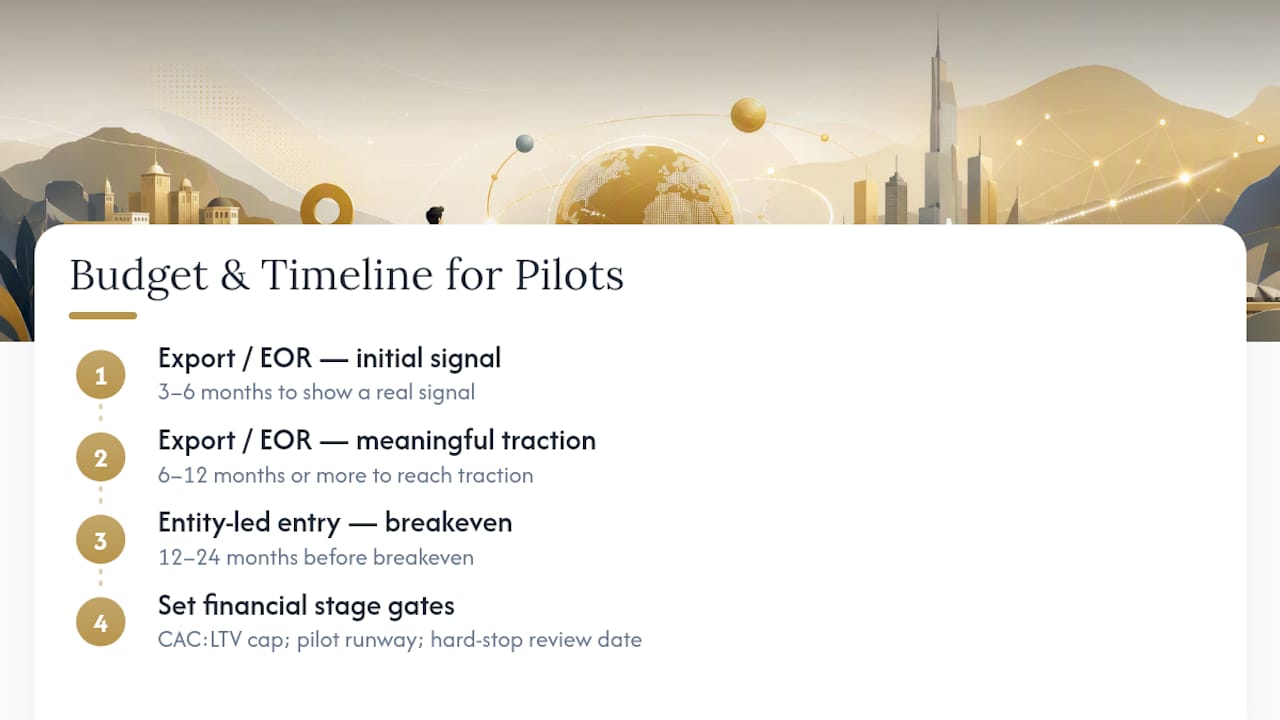
Timelines follow a similar split. EOR and export pilots usually take 3 to 6 months to show a real signal, and 6 to 12 months or more to reach meaningful traction. Entity-led entries stretch to 12 to 24 months before breakeven, which is exactly why they should follow validation, not precede it.
Set financial stage gates before you start, not after: a target CAC-to-LTV ratio you will not exceed, a fixed number of months you will burn runway on the pilot, and a hard stop date to review results honestly. Absent those gates, sunk cost does the deciding for you.
How Do You Choose a Market and Design a Pilot?
Skip the temptation to enter three markets at once. Staged, single-market pilots with clear metrics beat parallel launches almost every time, because you can only really read one signal clearly at a time.
- Score candidate markets on demand pull, regulatory friction, cultural distance, reachable market size, and competitive saturation. Weight demand pull heaviest.
- Design a minimum pilot, not a scaled launch: a limited SKU set, local payment methods, one or two local hires through an EOR, and messaging and support hours adapted to that market rather than translated from your home one. Pricing, product range, and service design need local adaptation, not just a translated storefront, and a localization specialist can shorten that curve considerably.
- Track three decisive metrics: CAC versus LTV in that specific market, repeat purchase rate or trial-to-paid conversion, and whether you can point to real reference customers, not just early sales.
If those three metrics hold after 90 days, you have grounds to scale the mode you chose. If they do not, change the mode or the market before you spend more.
How Does a Diagnostic Turn Gaps Into a Funded Plan?
A checklist tells you where the gaps are. It does not tell you which one to fix first, or fund it. That is the actual job of a structured diagnostic.
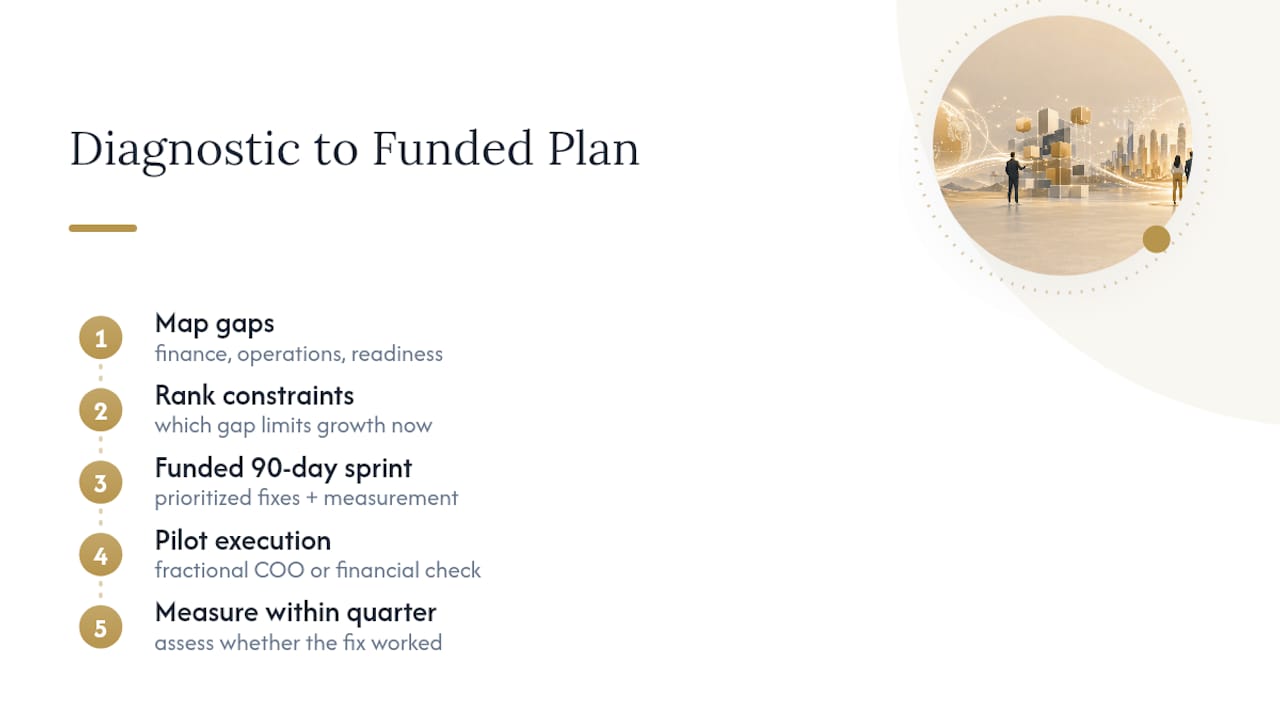
A DTC Operator Diagnostic or Founder Advisory engagement starts by mapping your finance, operations, and readiness gaps against the categories above, then ranks them by which one is actually constraining growth right now. The output is not a report to file away: it is a prioritized list of fixes, often structured as a funded 90-day sprint with a measurement framework attached, so you know within a quarter whether the fix worked.
Founders running an actual pilot commonly bring in fractional COO support or a financial health assessment during execution, since the pilot period is exactly when home operations are most likely to slip while attention shifts abroad. Treat the decision frameworks as a way to keep both fronts visible at once.
What Do Founders Get Wrong About Sequencing?
The founders who succeed abroad almost always pick markets that give a fast economic answer over ones that sound impressive in a board deck. A country generating unsolicited inquiries beats a “strategic” market chosen because a competitor is there.
Ready to Close Your Readiness Gaps?
This service is built for exactly the moment this article describes: the gap between knowing you have a readiness problem and knowing which one to fix first. Where a generic consulting engagement hands you a slide deck, The hands-on approach comes from practical experience, which means the fixes are prioritized by what actually moves cash flow, not by what looks thorough.
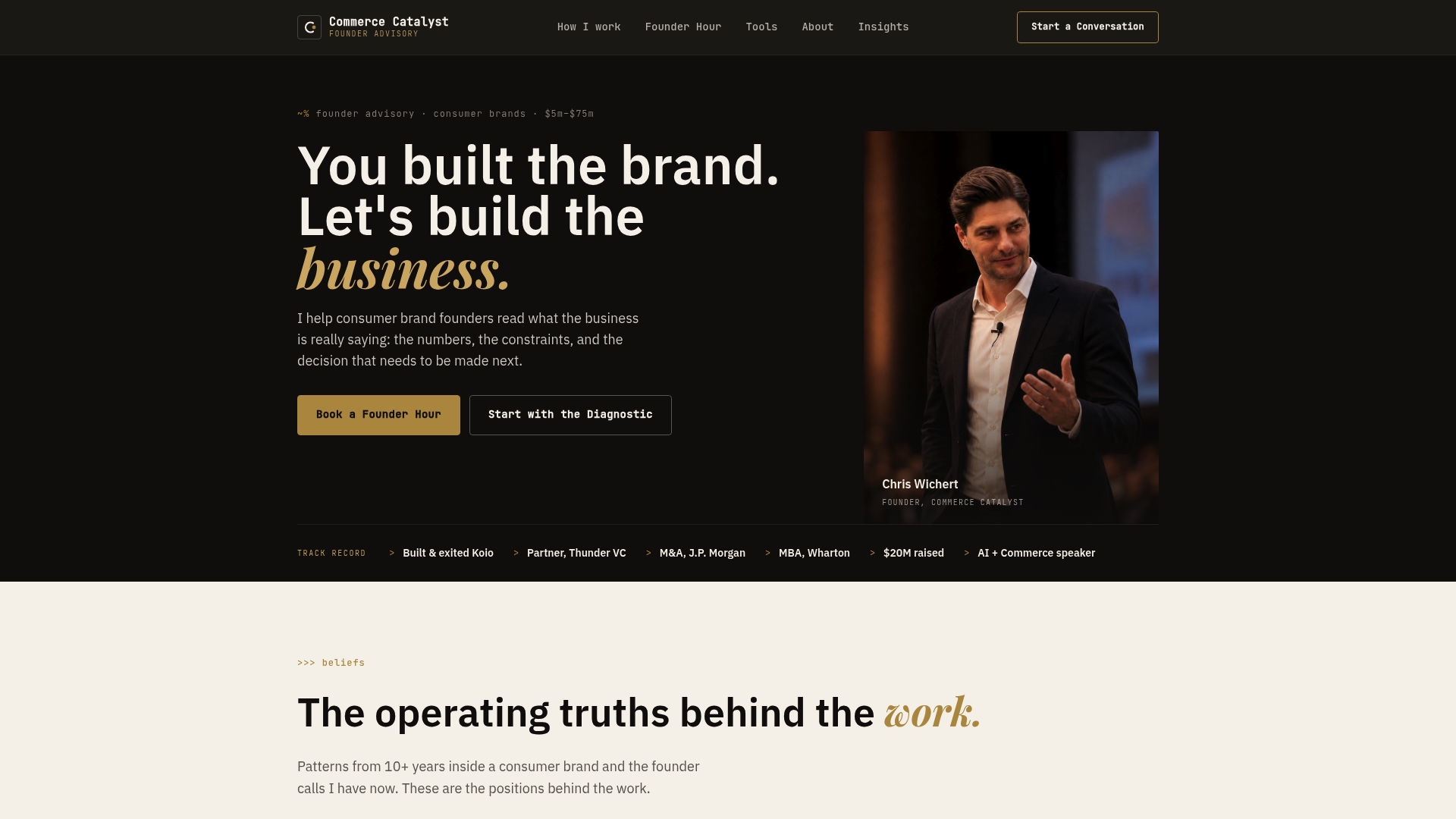
If you need a fast gut check on a single question, like whether you can name your first realistic customer abroad, book a Founder Hour for $500 for a focused hour of advisory. If the gap is bigger, structural, or touches your whole operating model, start with the DTC Operator Diagnostic for $197 to get a prioritized list of what to fix before you spend a dollar on a pilot.
Sources
- Chapter 8: International Expansion and Global Market Opportunity Assessment – International Business
- Global market entry strategies: a guide for expansion: Stripe
- 5 Signs Your Business Is Ready to Expand Internationally: and 3 Signs It Isn’t: Expandys
FAQ
What Does “International Expansion” Mean?
International expansion means extending your business, whether sales, operations, or both, into a market outside your home country through an entry mode like exporting, an EOR, a local partner, or a subsidiary. The right mode depends on product complexity and regulatory environment, not on ambition alone.
What Are the Stages of International Market Entry?
Most frameworks describe a staged path: market scoring and selection, a lightweight pilot through export or EOR, validation against metrics like CAC versus LTV, then conversion to a local entity once demand is proven. Staged commitment models consistently outperform jumping straight to a full entity.
Why Would a Company Want to Expand Internationally?
Companies expand internationally to access new revenue when domestic growth slows, to follow genuine inbound demand from a specific market, or to diversify risk away from a single economy. The strongest reason is evidence, not ambition: unsolicited inquiries or partner outreach from a target country outperform market size alone as a predictor of success.
How Do I Know if My Company Is Actually Ready?
Check three things: home-market profitability or stable unit economics, 18 to 24 months of runway, and the ability to name a real first customer in the target market. Companies missing these factors face a meaningfully higher failure rate once they commit capital abroad.
How Can Commerce Catalyst Help Me Prepare?
Commerce Catalyst’s DTC Operator Diagnostic identifies which readiness gap is actually constraining your expansion, then prioritizes fixes into a funded plan. For a narrower question, like validating a first-customer hypothesis, a Founder Hour session offers a focused, faster path to an answer.