Pricing for sustainable profit is the practice of setting prices that cover all costs, reflect customer value, and generate consistent margins over time. Sustainability drives 25% of global e-commerce purchases, and brands that price without a clear framework leave real money on the table. The industry term for this discipline is strategic pricing, and it goes well beyond marking up your cost of goods. This guide gives you the exact tools, methods, and troubleshooting tactics to price products for sustainable profit without guessing.
What do you need to price products for sustainable profit?
Every sound pricing decision starts with complete cost visibility. Without it, you are setting prices based on instinct rather than data, and instinct rarely protects your margin.
The four cost inputs you cannot skip
The four non-negotiable inputs are cost of goods sold (COGS), shipping and fulfillment, payment processing fees, and customer acquisition cost (CAC). Miss any one of them and your price will look profitable on paper while bleeding cash in practice. Pricing calculators can reverse-engineer a minimum price that hits your target contribution margin after all variable costs are included. That reverse-engineering step is what separates founders who scale profitably from those who grow into a cash crisis.

Market research is the second pillar. You need to know what your customer segment will pay before you set a number. Price elasticity, the degree to which demand changes when price changes, tells you how much room you have to move. Brands selling eco-friendly products often underestimate their customers’ willingness to pay a premium when the value is clearly communicated.
| Input | What to measure | Why it matters |
|---|---|---|
| COGS | Raw materials, labor, packaging | Sets your absolute price floor |
| Fulfillment costs | Shipping, warehousing, returns | Often underestimated; erodes margin fast |
| Processing fees | Payment gateway, platform fees | Typically 2–4% of revenue |
| Customer acquisition cost | Paid ads, referral, influencer spend | Must be recovered within first purchase or LTV |
| Contribution margin target | Revenue minus all variable costs | Defines whether a product is worth selling |
Pro Tip: Build a simple spreadsheet that calculates contribution margin per SKU before you launch any product. If the math does not work at a price your market will accept, fix the cost structure first.
What step-by-step strategies can you apply to price products for sustainable profit?
Pricing maturity progresses from cost-plus to competitive to value-based as businesses gather data and evolve. Most founders start at cost-plus and never move past it. That is a profit ceiling you do not have to accept.
A sequenced pricing methodology
-
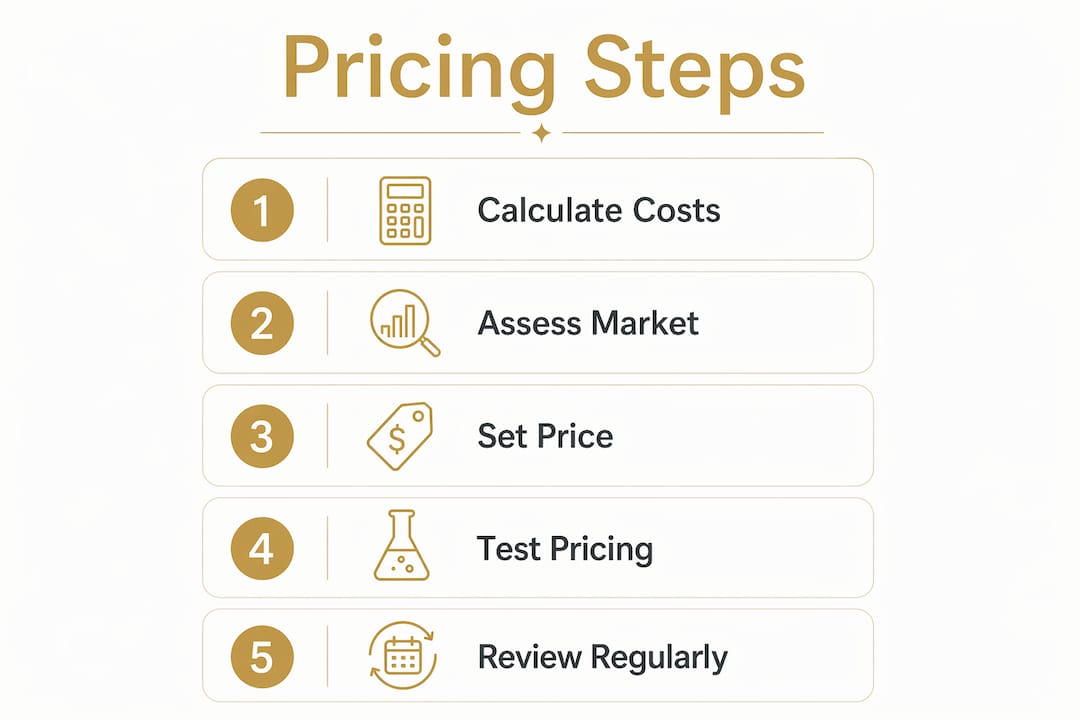
Calculate your total landed cost. Add COGS, shipping, processing fees, and a proportional share of CAC. This is your true cost per unit, not just what you paid the manufacturer.
-
Apply a cost-plus floor. A typical wholesale markup doubles total cost, while retail pricing often runs four times total cost to absorb discounts and returns. Use these as your minimum, not your target.
-
Run a competitive scan. Find three to five comparable products in your category. Note their price points, positioning, and any sustainability claims. Your price needs to make sense relative to this range, but it does not need to match it.
-
Shift to value-based pricing. Identify the specific outcomes your product delivers: lower carbon footprint, longer product life, reduced chemical exposure. Quantify those benefits wherever possible. Value-based pricing can offset 15–20% cost increases for sustainable brands when the value story is clear.
-
Layer in tiered pricing. Offer a base version, a standard version, and a premium version. Tiered pricing structures and ethical transparency convert cost burdens into competitive advantages. Customers self-select into the tier that matches their budget and values.
-
Test price sensitivity. Run A/B price tests on your website or use survey tools to present different price points to customer segments. Watch conversion rate and average order value, not just revenue.
-
Communicate impact explicitly. State the environmental or social benefit on the product page, the packaging, and in post-purchase emails. Customers who understand the impact accept the price more readily.
Pro Tip: When raising prices, lead with the impact story before announcing the number. Customers who already believe in your mission absorb price increases far better than customers who only know your brand from a discount.
The sequenced approach above is not a one-time exercise. Revisit it every quarter as your costs shift and your customer data grows.
How can you improve profit margins while maintaining sustainable product pricing?
A 1% improvement in realized price can surpass months of efficiency efforts. On a business running a 30% margin, a 5% price increase flows almost entirely to the bottom line if churn stays low. That is the use point most founders ignore while obsessing over supplier negotiations.
Margin improvement tactics that actually move the needle
Mix improvement, targeting higher-margin customers and SKUs, improves profitability faster than cost-cutting. The practical version of this is simple: rank every SKU by contribution margin, not revenue. The products at the top of that list deserve more marketing spend. The products at the bottom deserve a hard conversation about whether they belong in your catalog.
Discounting discipline is the second lever. Unplanned discounts are one of the fastest ways to destroy the margin you built into your price. Profit leaks cost 5–20% of revenue, with ad hoc discounts, returns, support costs, and infrastructure spend creep as the primary sources. A discount governance policy, meaning a written rule about who can approve a discount and at what level, stops this erosion before it starts.
Here are the core margin improvement tactics for sustainable product brands:
- Rank SKUs by contribution margin monthly and cut or reprice the bottom 20%
- Set a minimum order quantity for wholesale accounts to protect per-unit economics
- Audit return rates by product and by channel; high return rates signal a pricing or expectation mismatch
- Review subscription or bundle pricing quarterly to confirm the discount offered still leaves an acceptable margin
- Track cost-to-serve by customer segment, not just by product
Pro Tip: Before raising prices broadly, test a 5–10% increase on your lowest-velocity SKUs first. If conversion holds, roll the increase across the catalog. If it drops, you have data to work with instead of a revenue problem.
Profitability improvement is not a single decision. It is a system of regular reviews, clear rules, and data-driven adjustments that compound over time.
What are common challenges in pricing sustainable products and how do you troubleshoot them?
Sustainable products often face consumer trade-offs due to higher prices, requiring clear communication of value and impact for acceptance. That is the central tension: your costs are higher, your customer is price-sensitive, and your competitor may not share your values or your cost structure.
Cost-to-serve analysis often reveals unprofitable high-revenue accounts. A customer who orders frequently but in small quantities, demands custom packaging, and calls support twice a month may generate less margin than a customer who orders once a quarter at full price. Introducing minimum order sizes or service fees for high-touch accounts protects your margin without raising prices across the board.
| Challenge | Root cause | Solution |
|---|---|---|
| Customer price resistance | Value story is unclear | Add specific impact data to product pages and packaging |
| Margin erosion from discounts | No discount governance policy | Set written approval rules; track discount rate by channel |
| Cost increases from suppliers | Input cost volatility | Build cost review triggers into supplier contracts |
| Unprofitable SKUs in catalog | Poor contribution margin tracking | Monthly SKU-level margin review; cut or reprice bottom performers |
| High-revenue but low-margin accounts | No cost-to-serve visibility | Segment customers by profitability; apply service fees or minimums |
When costs rise and you cannot absorb them, the answer is rarely to hold your price and shrink your margin. The better path is to diagnose unprofitable revenue streams first, then decide whether a price increase, a product reformulation, or a customer segment exit is the right move.
Monitoring price elasticity on an ongoing basis gives you the data to make that call with confidence. Run a small price test before committing to a catalog-wide change. The cost of a two-week test is far lower than the cost of a mispriced product line.
Key takeaways
Pricing products for sustainable profit requires complete cost visibility, value-based positioning, and ongoing margin discipline applied consistently across your entire product portfolio.
| Point | Details |
|---|---|
| Start with full cost visibility | Include COGS, fulfillment, processing fees, and CAC before setting any price. |
| Progress beyond cost-plus | Move from cost-plus to value-based pricing as you gather customer and market data. |
| Use tiered pricing for sustainability | Tiered structures let customers self-select and help justify eco-friendly premiums. |
| Treat discounting as a risk | Unplanned discounts are a primary source of profit leaks; govern them with written rules. |
| Review margins by SKU and segment | Monthly contribution margin reviews reveal where to cut, reprice, or double down. |
Pricing is a leadership decision, not a finance task
Most founders treat pricing as something the finance team handles once a year. That framing costs them more than any supplier negotiation ever saves.
The harder truth is that most sustainable brands underprice because they are afraid of the conversation. They assume their customers will not pay more. They have not tested that assumption. They have not built the impact story that makes the price feel obvious. Transparency is not just an ethical position. It is a pricing tool. When a customer understands exactly what their purchase does, the price becomes a reflection of their values, not a barrier to a transaction.
Pricing review should be a standing agenda item in your leadership meetings, not a reaction to a bad quarter. Build a profitability roadmap that includes pricing checkpoints, and treat every price change as a hypothesis to test rather than a policy to defend.
How Commerce Catalyst approaches sustainable pricing and profitability
Pricing decisions get complicated fast when you are managing multiple SKUs, wholesale and retail channels, and rising input costs at the same time.

Commerce Catalyst works directly with consumer brand founders to translate the financial complexity of sustainable product businesses into clear, prioritized decisions. The DTC Financial Health Assessment identifies exactly where your pricing is leaving money behind, which segments are eroding your margin, and what to fix first. Chris Wichert brings the perspective of a founder who has lived these trade-offs, not a consultant reading from a framework. If your pricing feels like a guess rather than a system, that assessment is the right starting point.
FAQ
What is sustainable profit in product pricing?
Sustainable profit means generating consistent margins over time by pricing products to cover all costs and deliver ongoing value. It requires tracking contribution margin per SKU, not just total revenue.
How do I calculate a minimum price for a sustainable product?
Add COGS, shipping, processing fees, and customer acquisition cost, then divide by one minus your target contribution margin percentage. Pricing calculators can automate this calculation once you input all variable costs.
Why do sustainable products face more pricing challenges?
Sustainable products typically carry higher input costs due to ethical sourcing, certifications, and eco-friendly materials. Consumer trade-offs are common at higher price points, which is why clear impact communication is a pricing requirement, not a marketing option.
What is value-based pricing and when should I use it?
Value-based pricing sets the price based on the outcome the customer receives rather than the cost to produce the product. Use it once you have enough customer data to quantify the specific benefits your product delivers.
How often should I review my pricing?
Review pricing at minimum quarterly, and immediately when input costs shift by more than 5%. Pricing as an ongoing discipline outperforms ad hoc adjustments and compounds profit growth over time.