Most founders treat brand positioning as a creative exercise. A logo refresh, a sharper tagline, a more polished Instagram feed. But when you’re trying to attract serious capital, that framing will cost you. Investors don’t fund aesthetics. They fund compounding assets. Learning how to position brand for strategic investment means understanding that your brand is a financial instrument, one that builds or destroys enterprise value depending on how you manage it. This article walks you through the full arc: from building the financial case for brand investment to preparing the evidence package your CFO will need to defend in a data room.
Table of Contents
- Key Takeaways
- How to position brand for strategic investment: the financial case
- Research and segmentation before you pitch
- Execution: aligning brand claims with financial metrics
- Communicating brand investment readiness to investors
- Common pitfalls founders make before seeking investment
- My take: the uncomfortable truth about brand and money
- How Commerce Catalyst helps you get investment-ready
- FAQ
Key Takeaways
| Point | Details |
|---|---|
| Brand is a financial asset | Treat brand investment like capital: it compounds when funded and erodes when neglected. |
| Underinvestment is expensive to fix | Cutting brand spend today creates recovery costs that far exceed the original savings. |
| Measurement drives investor confidence | Triangulating brand impact across multiple data sources builds credibility with finance and investors. |
| Positioning must map to metrics | Every brand claim you make needs a sourceable KPI behind it to survive investor scrutiny. |
| CFO alignment is non-negotiable | Marketing and finance must speak the same language before you walk into any diligence conversation. |
How to position brand for strategic investment: the financial case
Most brand conversations start with marketing. The right ones start with the balance sheet.
Brand behaves like capital: it compounds when you invest in it consistently and depreciates when you cut it. BCG’s research makes the asymmetry stark. Cutting $1 of brand investment today can require $1.92 in future spending just to recover the lost market share. That’s not a marketing problem. That’s a capital allocation problem.
“You’re not asking investors to fund marketing spend. You’re asking them to fund compounding intangible brand capital that prevents value erosion and drives long-term growth.”
This framing changes everything about how you pitch. When investors see brand spend as a line item to cut during a downturn, your brand is positioned as overhead. When they see it as capital with measurable depreciation risk, it becomes a moat worth protecting.
The practical implication for founders: brand budgets as floors, not ceilings. Underinvestment shows little immediate pain but causes demand collapse and a recovery that costs far more than the original savings. Investors who understand this dynamic reward brands that demonstrate spending discipline through cycles, not just during good times.
Pro Tip: Before your next board conversation about marketing budgets, reframe every brand spend line as an intangible asset with a documented depreciation risk. You’ll immediately change the quality of the conversation.
Research and segmentation before you pitch
You cannot build an investor-grade brand narrative on assumptions. The positioning work that actually attracts capital starts with data on your customers, your category, and your competition.

Customer research isn’t just about understanding who buys from you. It’s about quantifying why they stay, what they’d pay a premium for, and where the friction is. These insights feed directly into claims you can defend. When an investor asks, “Why do customers choose you over alternatives?” the answer cannot be “because we’re different.” It needs to be “our repeat purchase rate is X% above category average, and our exit survey data shows pricing tolerance at Y% above our nearest competitor.”
Strategic positioning improves profitability by defining a unique place in the market and reducing competitive ambiguity. That clarity directly supports pricing power, which is one of the first things sophisticated investors probe.
When mapping your competitive position, look for the following:
- White space: Where are competitors weakest in the customer journey?
- Pricing use: Where does your brand command a premium and why?
- Retention differentiators: What keeps your customers from switching?
- Narrative gaps: What story is no one else in your category telling with credibility?
Here’s a simple framework for stress-testing your positioning before you take it to investors:
| Positioning Element | Weak Version | Investor-Ready Version |
|---|---|---|
| Target customer | “Health-conscious millennials” | “Women 28-40, repeat buyers, $85 AOV, 68% LTV retention at 12 months” |
| Unique value | “Better ingredients, better results” | “Third-party efficacy studies + 4.8-star NPS across 10K reviews” |
| Market opportunity | “Huge and growing” | “$4.2B category, 14% CAGR, top-3 brand holds 22% share” |
| Competitive moat | “Brand loyalty” | “Subscription rate 3x category average, churn 40% below benchmarks” |
Pro Tip: Use your food and beverage benchmarks data or category-specific data to anchor your positioning claims. Investors don’t take your word for it. They want to know how you compare.
Execution: aligning brand claims with financial metrics
This is where most brands fall apart in diligence. The positioning sounds great in the deck. Then an investor asks for the data behind a claim and nothing materializes.
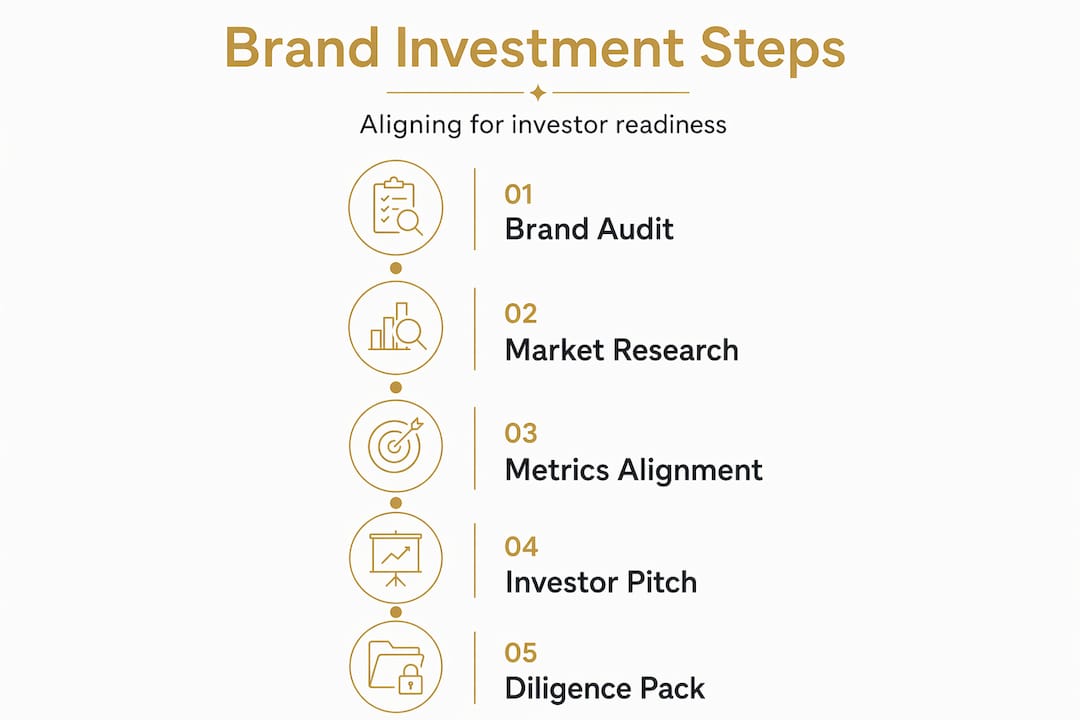
Building investment-ready branding means your creative work and your financial reporting are speaking the same language before you ever enter a funding conversation. Here’s how to get there:
-
Map every brand claim to a KPI. If your positioning says “the most trusted brand in our category,” you need brand consideration data, third-party review scores, or repeat purchase rates that justify the claim. Every brand claim should map to a clear, sourceable metric with documentation prepared in advance.
-
Triangulate your measurement. 70% of high-maturity marketers measure brand impact across three or more methodologies, combining marketing mix modeling, brand lift studies, and customer cohort analysis. Using a single data source gives investors an easy target to question.
-
Align marketing and finance before diligence starts. Your CFO needs to understand the brand story well enough to defend it independently. CFOs act as the primary interlocutor during institutional diligence, which means the finance team must be able to reconcile your brand claims to source data on demand.
-
Sequence your investments deliberately. Align your positioning scope to the investment thesis timeline. Show near-term proof through quick wins like promotional elasticity data or recent retention improvements, while framing the longer-term brand equity build as the compounding value story.
| Brand Metric | What It Signals to Investors | Data Source |
|---|---|---|
| Repeat purchase rate | Customer loyalty and LTV trajectory | CRM / subscription data |
| Price elasticity | Pricing power and margin protection | A/B test history |
| Brand consideration | Category presence and unaided recall | Survey or third-party research |
| NPS / review scores | Customer satisfaction and word-of-mouth | Review platforms, surveys |
| Churn rate | Brand stickiness vs. category norm | Cohort analysis |
Pro Tip: Build a one-page brand metrics summary that mirrors the format your CFO uses for financial reporting. When brand data lives in the same cadence and format as P&L data, it signals organizational maturity. Investors notice.
Communicating brand investment readiness to investors
Getting your internal data aligned is only half the job. You also need to communicate it in a way investors trust.
Investment branding requires clear narratives addressing value creation, business model clarity, and transparency. That doesn’t mean writing longer decks. It means constructing a brand story where every claim is anchored in evidence and every number is traceable back to a source.
The most effective investor-facing brand narratives follow a consistent structure:
- The market reality: Where the category is heading and why that creates an opening for your brand specifically.
- Your unique position: What you own in the customer’s mind that competitors cannot easily replicate.
- The proof: Retention data, pricing history, brand recall studies, and third-party validation that supports each claim.
- The investment thesis: How brand equity translates into enterprise value, specifically through margin protection, reduced acquisition costs, and pricing power over time.
“In diligence, CFOs reconcile outward brand claims to source on demand. Financial defensibility isn’t a nice-to-have. It’s the price of admission.”
Prepare a dedicated brand diligence pack that includes your measurement methodology, data sources, benchmarks against category norms, and a clear narrative explaining what you invest in brand building and why. This pack signals to investors that you treat brand as a managed asset, not a creative output.
Common pitfalls founders make before seeking investment
Most brand positioning errors in fundraising contexts aren’t creative failures. They’re financial failures dressed up as creative ones. Watch for these:
- Freezing brand investment before a raise. Founders often cut brand spend to tighten margins before pitching. But brand cuts show little immediate pain and cause demand collapse later. Investors looking at trailing brand metrics will see the trendline.
- Vague claims with no proof. “Premium quality” and “market-leading customer experience” without data are red flags, not selling points.
- Marketing and finance working in silos. If your CFO can’t explain your brand positioning to an investor, your narrative will fracture under pressure.
- No floor on brand spend. Brand investment in tight budgets must never drop to zero. Maintaining a minimum spend threshold protects demand continuity and signals discipline to investors.
How Commerce Catalyst helps you get investment-ready
If you recognize your brand in the gaps described above, you’re not alone. Most DTC founders have strong brand instincts but haven’t yet built the financial infrastructure to translate those instincts into investor-grade evidence.
Commerce Catalyst works directly with consumer brand founders to close that gap. The DTC Financial Health Assessment evaluates how well your brand positioning aligns with your financial performance and identifies the proof points investors will demand. For founders preparing for a capital raise or exit, the DTC Exit Advisor service builds the full narrative: brand equity, financial defensibility, and investor communications. The DTC Operator Diagnostic is the right starting point if you need to identify exactly where your brand and financial story are misaligned before you take it to market.
FAQ
What does it mean to position a brand for strategic investment?
It means aligning your brand’s story, metrics, and positioning with the financial evidence investors require to assess long-term value. Your brand becomes an asset class, not just a marketing function.
Why do investors care about brand positioning?
Brand positioning directly affects pricing power, customer retention, and competitive moats. Investors use it to assess the durability of your margins and the defensibility of your market share.
How do you measure brand equity for investors?
Use a combination of repeat purchase rates, price elasticity data, brand consideration scores, and NPS. Triangulating across multiple methodologies builds credibility because no single data source is sufficient on its own.
What is the biggest mistake founders make when seeking brand investment?
Cutting brand spend before a raise to improve short-term margins. This creates a trendline that sophisticated investors will spot and penalize in their valuation assumptions.
How should brand claims be documented for investor diligence?
Each claim should map to a specific, sourceable metric with documentation ready in advance. Your CFO should be able to trace every brand positioning statement back to primary data independently.