
An unprofitable revenue stream is any revenue source that destroys value once you account for all direct costs, overhead, and cost-to-serve. Most founders focus on top-line growth and miss the profit leaks hiding inside it. The process to diagnose unprofitable revenue streams requires segmented financial data, proper overhead allocation, and margin analysis at the customer, product, and channel level. Tools like segmented P&L reports, contribution margin calculations, and cost-to-serve models are the standard methods for this kind of revenue stream analysis. Skipping this work is expensive. 22% of small-agency clients are unprofitable once overhead is fully allocated, yet only 8% of owners could identify which ones before running a formal analysis.
How to diagnose unprofitable revenue streams: the data you need first
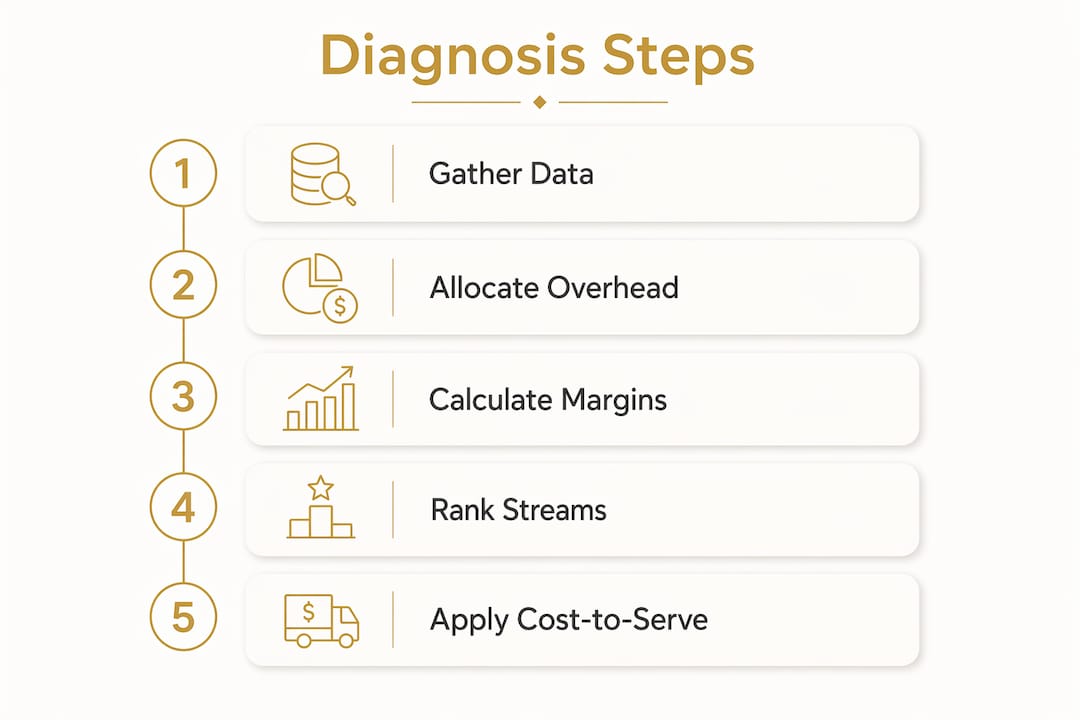
The right diagnosis starts with the right inputs. Without segmented financial data, you are guessing. The foundation is a trailing 12-month profit and loss statement broken out by customer, product line, and sales channel. One blended P&L hides everything. A segmented P&L audit using trailing 12-month data is the industry standard for identifying profit leaks by product, channel, and customer cohort.
Overhead allocation is the step most founders skip. Small businesses typically allocate overhead at 25–40% of revenue when calculating true profit contribution per segment. That range matters because applying a flat rate to every segment distorts the picture. A high-volume, low-touch product line carries very different overhead than a custom, high-service client relationship.
| Diagnostic requirement | What it tells you |
|---|---|
| Trailing 12-month segmented P&L | Baseline profit or loss by customer, product, channel |
| Overhead allocation (25–40% of revenue) | True cost burden per segment |
| Contribution margin II (CM II) | Net profit contribution after all costs |
| Cost-to-serve calculation | Hidden service, logistics, and support costs |
| Revenue waterfall analysis | Where discounts, rebates, and credits erode net revenue |
Software tools like QuickBooks, Xero, and NetSuite can generate segmented reports when set up correctly. Time-tracking tools like Harvest or Toggl add labor cost data by client or project. For consumer brands, pairing your accounting platform with a spreadsheet model built around CM II gives you the clearest picture fastest.
How to analyze your data to find loss-making clients, products, and channels
Start by ranking every revenue stream side by side: revenue on one axis, CM II on the other. The most revealing output of a profitability analysis is this side-by-side ranking, because top-line revenue concentration misleads founders into protecting the wrong relationships. Your largest customer by revenue is often not your most profitable one.

Next, apply your cost-to-serve to each segment. Calculating cost-to-serve means including order processing, logistics, returns, and customer support costs. Without it, a product or client can look profitable at the gross margin line while actively destroying value below it. This is the most common blind spot in a standard financial health check.
The revenue waterfall is the second major analysis. For mid-market companies, the revenue waterfall gap is typically 8–15% of revenue. That gap represents discounts, rebates, credit notes, and other deductions that reduce net revenue before you even reach cost of goods. A product priced at $100 that carries $12 in waterfall deductions is really a $88 product. That changes the margin math significantly.
Sample margin analysis by segment
| Segment | Gross revenue | Gross margin % | CM II % | Verdict |
|---|---|---|---|---|
| Product A (high volume) | $420,000 | 52% | 31% | Profitable |
| Product B (custom orders) | $180,000 | 48% | 9% | Marginal |
| Client X (enterprise) | $310,000 | 44% | 4% | Loss-making |
| Channel: Wholesale | $250,000 | 38% | 11% | Marginal |
| Channel: DTC | $390,000 | 61% | 38% | Profitable |
Product-customer cross-analysis reveals SKU-level losses that aggregate numbers hide. Running this cross-analysis is the step that separates a surface-level review from a real profitability audit.
Watch for these red flags during your analysis:
- Clients with constant scope creep, slow payments, or excessive revision requests. These behaviors signal unprofitable customers and rarely improve without intervention.
- Long-tenure clients who receive legacy pricing that no longer reflects your cost structure.
- Products with high return rates or complex fulfillment that inflate cost-to-serve.
- Channels with heavy discounting or promotional spend that erodes net revenue.
- Revenue streams that require disproportionate founder or leadership time to maintain.
Pro Tip: When you find a borderline segment, separate its direct costs from shared costs before making a decision. Shared costs do not disappear if you drop the segment. Only direct costs do. That distinction determines whether cutting the stream actually improves your bottom line.
What are common mistakes in diagnosing unprofitable revenue streams?
The most frequent error is stopping the analysis at gross margin. Gross margin looks healthy for many products and clients that are quietly destroying value at the CM II level. Calculating contribution margin II by including hidden operating expenses is the step that exposes true value destroyers. Founders who skip it make decisions based on incomplete data.
The second mistake is ignoring the revenue waterfall. Pricing leaks through discounts, rebates, and credit notes are invisible in a standard P&L. They only appear when you build a waterfall from gross price down to net revenue. Skipping this step means you are evaluating margins on a revenue figure that does not reflect what you actually collect.
A third common error is relying on gut feel rather than data. Founders risk vanity revenue by focusing on top-line numbers without analyzing profitability. The client who feels important because of their revenue size may be consuming resources that your most profitable clients need. Emotional attachment to a revenue stream is not a financial argument for keeping it.
Other pitfalls to avoid:
- Confusing revenue volume with profit contribution when prioritizing segments.
- Using a single overhead rate across all segments instead of activity-based allocation.
- Failing to account for founder or senior staff time in cost-to-serve calculations.
- Treating shared costs as a reason to retain an unprofitable segment.
Pro Tip: Before dropping any revenue stream, run a 6–12 month test. Discontinue the segment and track whether the associated costs actually disappear. If shared costs remain regardless, the financial case for cutting that stream weakens considerably.
These founder financial blind spots are well-documented and correctable once you know where to look.
What strategic actions should you take after identifying unprofitable streams?
Finding the loss is only half the work. The other half is deciding what to do about it. The right action depends on why the stream is unprofitable and whether that cause is fixable.
Here is a proven sequence for acting on your findings:
- Raise prices on underpriced segments. If the cost structure is sound but pricing is too low, a price increase is the fastest fix. Calculate the minimum price needed to reach a target CM II and test it with your next renewal or order cycle.
- Reduce scope or renegotiate terms. High-maintenance clients who generate low CM II often consume more than they pay for. Renegotiating service scope, response times, or contract terms can restore profitability without losing the relationship.
- Transition out clients or products that destroy value. Pruning the bottom 20% of clients or products frees resources and improves overall profitability. This is not failure. It is capital reallocation.
- Shift product mix toward high-margin channels. If your DTC channel runs at 38% CM II and your wholesale channel runs at 11%, the math argues for shifting marketing and inventory investment toward DTC. Use your profitability roadmap to sequence that shift without disrupting cash flow.
- Cross-sell profitable products to existing customers. Clients who buy your most profitable SKUs are worth more than clients who buy only your lowest-margin ones. Use your cross-analysis data to identify upsell opportunities within your current base.
- Set a review cycle. Profitability analysis is not a one-time event. Schedule a quarterly review of CM II by segment. Markets shift, costs change, and a profitable stream today can become a loss-maker within two quarters.
Agencies that release their largest unprofitable client almost always grow faster in the following year. The short-term revenue dip is real. The long-term capacity gain is larger. Understanding how to choose between growth and profitability is the mindset shift that makes this decision easier to execute.
Key Takeaways
Diagnosing unprofitable revenue streams requires segmented P&L data, full overhead allocation, and contribution margin II analysis at the customer, product, and channel level.
| Point | Details |
|---|---|
| Start with segmented data | A trailing 12-month P&L by customer, product, and channel is the non-negotiable starting point. |
| Calculate CM II, not just gross margin | Contribution margin II includes overhead and indirect costs, revealing true profit or loss per segment. |
| Map the revenue waterfall | Discounts and rebates create an 8–15% gap in mid-market revenue that distorts margin calculations. |
| Separate direct from shared costs | Only direct costs disappear when you drop a segment; shared costs do not justify keeping a loss-maker. |
| Act on findings with a clear sequence | Raise prices, renegotiate, prune, or shift mix based on CM II data, then review quarterly. |
The revenue conversation most founders avoid
The operational shift required here is equally important. Profitability analysis only works if your team tracks time, costs, and service delivery honestly. That requires a culture where financial transparency is normal, not threatening. Building that culture takes longer than building the spreadsheet model.
Pruning is not shrinking. It is choosing where your business grows next.
What a formal profitability audit looks like with Commerce Catalyst

Commerce Catalyst works directly with consumer brand founders who know their revenue is growing but cannot explain why profit is not following. The DTC Financial Health Assessment runs a structured profitability audit across your customer, product, and channel segments using the same CM II and cost-to-serve framework described here. Chris Wichert brings the perspective of a brand founder who has run this analysis on his own business, not just a consultant who has read about it. If your P&L is telling one story and your bank account is telling another, a formal diagnostic is the fastest way to find out why. You can also use the DTC Operator Diagnostic as a starting point to identify where the biggest gaps are before committing to a full audit.
FAQ
What is an unprofitable revenue stream?
An unprofitable revenue stream is any customer, product, or channel that generates negative profit contribution once all direct costs, overhead, and cost-to-serve are fully allocated. It may show positive gross margin while still destroying value at the net level.
How do I calculate true profitability by segment?
Calculate contribution margin II by subtracting variable costs, allocated overhead (typically 25–40% of revenue), and cost-to-serve from gross revenue for each segment. This gives you a net profit contribution figure that reflects actual economic value.
What is the revenue waterfall and why does it matter?
The revenue waterfall is the gap between your gross price and the net revenue you actually collect after discounts, rebates, and credit notes. For mid-market companies, this gap is typically 8–15% of revenue and directly reduces the margin available to cover costs.
How often should I review revenue stream profitability?
A quarterly review of CM II by segment is the standard for consumer brands managing multiple products or channels. Annual reviews miss seasonal shifts and cost changes that can turn a profitable stream into a loss-maker within a single quarter.
Should I always drop unprofitable clients or products?
Not immediately. First, separate direct costs from shared costs to confirm that dropping the segment actually improves your bottom line. Then run a 6–12 month test before making a permanent decision, especially if shared infrastructure costs would remain regardless.